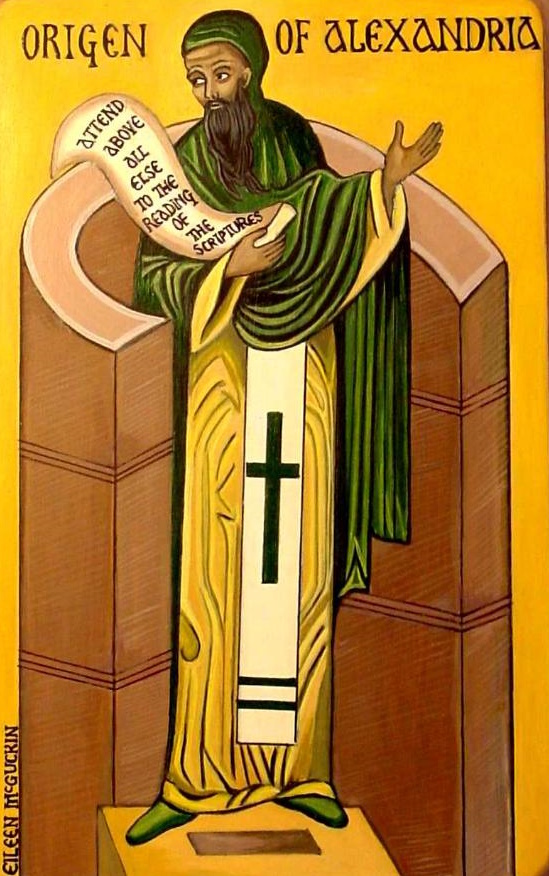
Origen of Alexandria, (c. 184 – c. 254) was Head of the famed Catechetical School in Alexandria at age 18 and arguably the most brilliant theologian of the early Christian church. His book, First Principles (Περὶ Ἀρχῶν; Peri Archon), was the first systematic exposition of Christian theology. He was probably the most able and successful defender of the faith against the heresy of Gnosticism in the third century. A Saint and Church Father without question. The following excerpts come from Origen’s book, On Prayer (Περί Ευχής; Peri Euches), written in about AD 240. Note that these excerpts primarily address active prayer.
When to Pray
Without ceasing:
“… keep that saying of Paul’s in accordance with the exhortations of Jesus, “Pray without ceasing.”
Now, since the performance of actions enjoined by virtue or by the commandments is also a constituent part of prayer, he prays without ceasing who combines prayer with right actions, and becoming actions with prayer. For the saying “pray without ceasing” can only be accepted by us as a possibility if we may speak of the whole life of a saint as one great continuous prayer.”
Specific Times for Prayer
Four set times a day – 3rd Hour, 6th Hour, 9th Hour plus Prayer at Night (about midnight):
“Of such prayer what is usually termed prayer is indeed a part, and ought to be performed at least three times each day, as is plain from the account of Daniel who, in spite of the grave danger that impended, prayed three times daily.”
Indeed we shall not rightly speak even the season of night without such prayer as David refers to when he says ‘at midnight I arose to make acknowledgment to you for your righteous judgments’ and as Paul exemplifies when, as it is said in the Acts of the Apostles, along with Silas he offers prayer and praise to God ‘about midnight’ in Phillipi so that the prisoners also heard them.”
Moods of Prayer
Its Four Moods:
“In the first Epistle to Timothy the Apostle has employed four terms corresponding to four things in close relation to the subject of devotion and prayer… He says, ‘I exhort therefore first of all that requests, prayers, intercessions, thanksgivings be made on behalf of all men,’ and so on.”
Personal Prayer
Place, Preparation, and Posture
“But to secure the performance of one’s prayers in peace without distraction, the rule is for every man to make choice, if possible, of what I may term the most solemn spot in his house before he prays, considering in addition to his general examination of it, whether any violation of law or right has not been done in the place in which he is praying, so as to have made not only himself but also the place of his personal prayer of such a nature that the regard of God has fled from it.
A few words may now be added in reference to the direction in which one ought to look in prayer. Of the four directions, the North, South, East, and West, who would not at once admit that the East clearly indicates the duty of praying with the face turned towards it with the symbolic suggestion that the soul is looking upon the dawn of the true light?
Accordingly it seems to me that one who is about to enter upon prayer ought first to have paused awhile and prepared himself to engage in prayer throughout more earnestly and intently, to have cast aside every distraction and confusion of thought, to have bethought him to the best of his ability of the greatness of Him whom he is approaching and of the impiety of approaching Him frivolously and carelessly and, as it were, in contempt, and to have put away everything alien. He ought thus to enter upon prayer with his soul, as it were, extended before his hands, and his mind intent on God before his eyes, and his intellect raised from earth and set toward the Lord of All before his body stands. Let him put away all resentment against any real or imagined injurer in proportion to his desire for God not to bear resentment against himself in turn for his injuries and sins against many of his neighbors or any wrong deeds whatsoever upon his conscience. Of all the innumerable dispositions of the body that, accompanied by outstretching of the hands and upraising of the eyes, standing is preferred—inasmuch as one thereby wears in the body also the image of the devotional characteristics that become the soul.”
Topics of Prayer
Glory to God, Thanksgiving, Confession, Supplication, Glory to God
“I have still to treat the topics of prayer, and therewith I purpose to bring this treatise to an end. Four topics which I have found scattered throughout the Scriptures appear to me to deserve mention, and according to these everyone should organize their prayer. The topics are as follows: In the beginning and opening of prayer, glory is to be ascribed according to one’s ability to God, through Christ who is to be glorified with Him, and in the Holy Spirit who is to be proclaimed with Him. Thereafter, one should put thanksgivings: common thanksgivings—into which he introduces benefits conferred upon men in general—and thanksgivings for things which he has personally received from God. After thanksgiving it appears to me that one ought to become a powerful accuser of one’s own sins before God and ask first for healing with a view to being released from the habit which brings on sin, and secondly for forgiveness for past actions. After confession it appears to me that one ought to append as a fourth element the asking for the great and heavenly things, both personal and general, on behalf of one’s nearest and dearest. And last of all, one should bring prayer to an end ascribing glory to God through Jesus Christ in the Holy Spirit.“
 First Thoughts