Archive for category Theology
Universal Spiritual Virtues and Personal Moral Values
Posted by Dallas Wolf in New Nuggets, Theology on August 9, 2026
I approach this topic based on my own personal experience. I did not become a sold-out Christian believer until late in life, at age 60. Before that, I was exposed to the Ten Commandments and other biblical laws and accepted them as valid rules of basic human behavior, more or less. In contrast, collimating (aligning, for you land-lubbers) my personal moral compass was accomplished early in my life (between ages 8-18) by two mentors who both served in the military at the dawn of the 20th century; both essentially 19th century Victorian-era men. Both did their work thoroughly on my willing mind and soul, rarely resorting to any reference to Divine authority. It is from this background that I approach the topic.
I believe that love, duty, and honor are three great personal moral values, with a fourth value, integrity, serving to bind them together into a single character. Without these personal moral values, I believe the universal spiritual virtues (Theological Virtues1 and Cardinal Virtues2) must remain remote ideals. With these moral values, spiritual virtues can become a way of being.
Love, Duty, Honor, and Integrity
Love, duty, honor, and integrity are not merely ethical behaviors. They are transformative values that shape the soul and align a person with a higher order of reality. Together they can form a complete path of spiritual development.
Love
As well as an essential moral value, Love is the foundational universal virtue.
Love, whether as a virtue (αγάπη) or value, is not primarily an emotion but a perception of reality. It is the recognition that life is interconnected and that separation is, in some sense, an illusion. Love allows a person to move beyond self-interest and participate in something greater than themselves.
At its highest level, love is self-giving. It seeks the good, beauty, and flourishing of others without demanding possession or reward.
- Question it answers: Who or what is worthy of my devotion?
- True expression: Compassion, sacrifice, communion.
- False expression: Attachment, possessiveness, sappy sentimentality.
Duty
Duty is love made active.
Duty represents the willingness to fulfill one’s responsibilities regardless of mood, convenience, or personal gain. The personal understanding of duty is not blind obedience but faithfulness to one’s rightful obligations in family, community (including country), vocation, and spiritual life.
Duty teaches discipline and steadiness. It prevents love from remaining merely an ideal or feeling.
- Question it answers: What am I called to do?
- True expression: Service, stewardship, faithfulness.
- False expression: Mechanical obedience, resentment, rigidity.
Honor
Honor is devotion to truth and nobility.
Honor means living according to principles that transcend personal advantage. It is the refusal to betray what one knows to be right, even when doing so would be easier or more profitable. Honor can be expressed by the concept of Noblesse Oblige.
In many warrior, knightly, and initiatory traditions, honor is the virtue that protects the soul from corruption. It ensures that strength serves truth rather than ego or worldly power.
- Question it answers: What must I never betray?
- True expression: Courage, fidelity, nobility of character.
- False Expression: Pride, concern for reputation, vanity.
Integrity
Integrity is wholeness.
The word itself points to being undivided and complete. As a moral value, integrity is the alignment of thought, belief, speech, and action. It is the value that unifies the others.
A person with integrity does not merely speak of love, acknowledge duty, or admire honor. Their life expresses these principles consistently.
Integrity is often considered the mark of spiritual maturity because it reflects an inner harmony rather than external compliance.
- Question it answers: Am I living as one whole person?
- True Expression: Authenticity, coherence, spiritual wholeness.
- False Expression: Self-righteousness or the appearance of consistency.
The Four Values as a Composite Whole
Together the four moral values can be understood as four stages or dimensions of character:
- Love gives the heart (nous) its direction.
- Duty gives the will its discipline.
- Honor gives the conscience its strength.
- Integrity unites the entire person into a coherent whole.
Love provides purpose. Duty provides action. Honor provides principle. Integrity provides unity.
A person who embodies all four moral values becomes increasingly whole: someone whose heart seeks the good, whose actions serve it, whose principles protect it, and whose entire life reflects it. In many mystical traditions, this state of wholeness can result in a spiritual progression from Purification (Catharsis), to Illumination (Theoria), and, finally, to Union (Theosis) with the Divine.
- 1 Corinthians 13:13; “Faith (πίστις), Hope (ελπίς – expectation), and Love (αγάπη)”. ↩︎
- Plato, Cicero, Ambrose, Augustine, et al.; “Prudence, Justice, Fortitude, and Temperance“. ↩︎
The Earliest Account of the Eucharist, (i.e., Lord’s Supper/Communion)
Posted by Dallas Wolf in Ancient Christian Manuscripts, Ekklesia and church, First Thoughts, New Nuggets, Theology on May 31, 2026
The earliest written reference to the Eucharist (Lord’s Supper/Communion) is 1 Corinthians 11:23–26, written by St. Paul around A.D. 55.
Paul’s description in 1 Corinthians 11 is the earliest written witness to Christians “eating the bread and drinking the cup of the Lord.” He explicitly links this practice to Jesus’ actions at the Last Supper and treats it as an already-established ritual in the Corinthian church.
This predates the earliest Gospel by at least a decade and is the oldest surviving Christian text describing the rite. However, scholars do not believe that the gospel writers used Paul as a source for their unique Eucharist accounts, which indicates that practice of the rite was widespread in the Eastern Mediterranean in the first century.
Paul also says he is passing on a tradition he himself received, implying the Eucharist was practiced orally even earlier than his letter.
The earliest known manuscript source for 1 Corinthians is Papyrus 46 (𝔓46) — one of the famous Chester Beatty Papyri — and it is one of the oldest surviving New Testament manuscripts of any kind.
Most scholars date 𝔓46 to around 175–225 A.D., though a minority have argued for an even earlier date. Even using the conservative date, 𝔓46 is roughly 150 years earlier than the great parchment codices (Vaticanus, Sinaiticus).
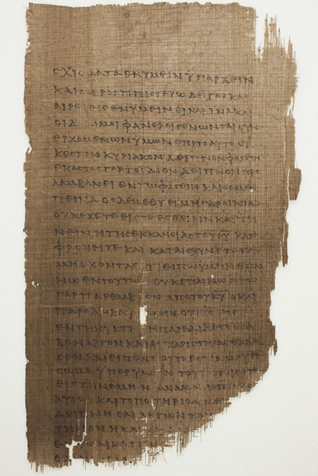
Beatty Papyrus 𝔓46, the earliest extant manuscript containing 1 Cor 11:18-25 (175–225 A.D.)
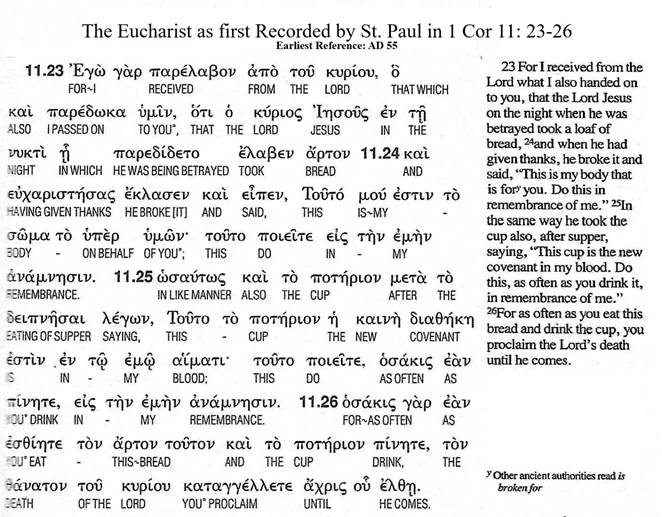
Detailed Illustration of the earliest account of the Eucharist (Greek and English)
The Logos and Kenosis doctrines as the keys to unlocking the mysteries of Creation, Incarnation, Redemption, and Inspiration
Posted by Dallas Wolf in First Thoughts, New Nuggets, The Logos Doctrine (series), Theology on May 13, 2026
Logos – Greek: λόγος – 1. Communication whereby the mind finds expression, – word – of utterance, chiefly oral. 2. Computation, reckoning. Reason for or cause of something, reason, ground, motive. 3. Independent personified expression of God, the Logos (BDAG). John 1:1-14.
Kenosis – Greek: κενόω – to empty. A divestiture of position or prestige: of Christ, who gave up the appearance of his divinity and took on the form of a slave, εαυτόν εκένωσεν [eaftón ekénosen] (BDAG). Phil. 2:5-11.
Excerpts below from John B. Heard, Alexandrian and Carthaginian Theology Contrasted. T. & T. Clark, Edinburgh. 1893. pp. 266-274:
But it occurs to us that the Kenosis doctrine, which relieves much of the mystery on the subject of the human and Divine in Christ, may also throw light on the subject of inspiration… It was assumed (as all Deists must do) that the nature of the Infinite must be incommunicable to the finite. Between Creator and creature there is much more than disparity, there is a gulf fixed which no theory can bridge over. The Incarnation, in a word, from the Deistic point of view, becomes an unthinkable mystery- it goes farther back still, since, in fact, creation itself must be unthinkable; for how can the Creator, if Infinite, pass out of Himself into the finite and conditioned? Hence, we have to fall back on such senseless phrases as that He made the worlds out of nothing, and creation at last becomes a bald affirmation of a fact for which reason by itself can offer no explanation which is not merely verbal. The early Gnostics felt this difficulty, and so they set to work to invent a Demiurge, a Bathos, a Pleroma, and other hypotheses which as hypotheses have gone the way of all brain cobwebs. The orthodox East clung, however, to the conception of the Logos either as ἐνδιάθετος, as before creation, or προφορικός, as going forth in creation. It was this Logos doctrine which carried the East safely through all the labyrinths of thought, as well on the subject of creation as of redemption. Thanks to the preface to St. John’s Gospel, that most precious jewel of God’s word, the arcanum of arcana, all was explicated, and the bald dualism of God and matter bridged over, or rather absorbed in that higher Monism in which the Eternal is ever proceeding forth through the Logos and entering into time relations, and so delighting in the habitable parts of the earth.
The Kenosis, then, which is the key to the Incarnation, is also the key to our conception of God in creation. The Eternal Father is ever communicating, in condescending love through the Son, some of His perfections to those lower orders of being whom we call His creatures. It is His nature and property so to create in condescension or self-emptying, much in the same way as it is the nature and property of the sun to shed his effulgent beams out into space. Kenosis, then, as much in creation as in redemption, at once suggests the key to what we go on to describe as the self-effacement of the Divine in a human consciousness. God spoke by the prophets so the Creed affirms; but we are nowhere asked to define the mystery, or to go into psychological puzzles as to the meeting point of human and God consciousness; nor does the Divine imply a temporary suspension of ordinary self-consciousness. We find in Christ the human was so absorbed by the Divine, that on one occasion when the disciples said, ” Master, eat,” His reply, was ” My meat is to do my Father’s will, and to finish His work.” In His case we must assume perfect simplicity and entire transparency of character. Hence, that He should forget hunger and thirst in the absorbing spirit of His work, is what much lower minds than the Christ attain to every day. But the Kenosis goes farther than this; it implies that He emptied Himself of His glory, and took a servant form. If this had been only in His Incarnation, and for three short years, then it would seem a unique, perhaps incredible mystery. But the Logos has been ever so emptying Himself. It is self-abasement, exinanition of the full glory of Godhead, when He paints the lily, and fits an insect’s eye to the tiny operations of the insect world. Hence it is that, to mere Deism with its design and argument, it seems perplexing to find perfection from the least to the greatest of God’s works. The notion of condescension in the Most High, that He ” humbleth Himself to behold the things which are done in heaven and earth,” seems strange to Deism, to whom humility seems only the shadow of the cross; and that is ” foolishness,” as we know, to the mere natural man. On these grounds we see that unless we set out with this key-word Kenosis, we shall never unravel the mysteries either of creation, redemption, or of that mode of communicating the mind of God to men which we define as inspiration. But this one master-key opens all these three locks. It is the same Logos who is the link in creation between the finite and Infinite, whose goings forth in redemption are that He has become one flesh with us that we may become one spirit with Him, and who is also the source of the old prophetic fire, the one fountain of light and love in inspiration.
The mistake in theology has been the same as in science, by isolating a single truth, and then to try and wrestle with it as with Proteus, and to wring its meaning out in single-handed fight. The sciences will not thus be won by direct assault. Their flank must be turned. In laying a subject aside and in thinking of some other thing, a side light will sometimes enter the mind, and one theory thus open the door to another. So Newton found it, as he passed from one theory of physics, where his calculations had failed him, to another theory of optics; and, after exploring the one domain, he was able to re-enter the other as conqueror, and to hold his ground there. It is the same in theology. Inspiration and the Incarnation throw light on each other; and now that we have got hold of the Incarnation by the right aspect, in the phrase of the Kenosis, it will be strange if we cannot use the same conception to lead us on to the right meaning of inspiration. In the Kenosis of Christ’s person we hold that the wisdom and goodness of God dwelt in Him bodily. In no mere Apollinarian sense (though Apollinarianism is not such a heresy as it seems) the wisdom and goodness of the Logos dwelt in the man Christ Jesus, and were to Him His Pneuma. When we speak of a human pneuma we are using words with no meaning; we are like the disciples on the Mount, not knowing what we say. The Pneuma itself is the Divine inherent in the human; it is itself a prophecy of the Incarnation – the ground and sufficient cause of the Incarnation becoming credible and intelligible, and not a mere mystery jarring to all our sense of truth. In our Lord Jesus the Christ, a Messianic element was the plenary indwelling of the Holy Ghost, not given to Him by measure as to other sons of men. But this does not imply either omniscience or omnipotence. These are attributes of pure Deity, which must be, and were, laid aside when He emptied Himself of His glory; and if equal to the Father as touching His Godhead, He became inferior to the Father as touching His manhood. Under false reverence to shrink from this frank confession of the Kenosis, is to fail to grasp the true meaning of the Incarnation. This is why, as observed already, the popular orthodox view is still Eutychian, and explains the outcry of some hyper-orthodox champions of the old school at the measured and well-weighed words of Mr. Gore in the Lux Mundi on the subject. That they were an offence at all, is an index of the depth of popular ignorance of the true Catholic doctrine of the Incarnation. Till the Kenosis is understood, the Incarnation must remain an unassimilated dogma.
It is the same with inspiration. It also stands apart among unassimilated faith formulas until we see that the Divine can only enter the human by some act of condescension. Accommodation is the old phrase. Men say that God accommodates His teaching to the imperfect faculties and immature judgments of men. At a low stage of culture He meets them with animal sacrifices and rites and ceremonies which to us seem burdensome. As the ages advance, He lightens the burden of ritual-teaching, becomes more oral and less ocular, and at last the prophet and scribe supersede the priest altogether. Even Judaism had reached the Rabbinic stage before Christ’s coming. And how strange a decline it was when Christ’s religion sank back again into the beggarly elements, and the commemoration of His death in the Eucharist feast was lowered again into a repetition of the type after the antitype, and described as the sacrifice of the Mass! We must go on to see in inspiration these advancing stages through accommodation, or else we shall never understand the Bible as a book human and Divine. To throw all the books into pie, so to speak, and read them in a lump, finding the Trinity in Gen. xix. and the doctrine of the Mass in Malachi, this is that kind of uncritical use of the Bible which we need not waste time in exposing. It is too out of date to find excuse for it in the uncritical use of the Old Testament by the Fathers of the early Church. Inspiration, in a word, is the unfolding purpose of God for the education of the race through a chosen people, that people themselves only learning the mind of God through an elect race of prophets and teachers. Thus, within the election there is an election, and the prophets themselves had to search what and what manner of time the Spirit of God which was in them did signify. They had to grope, in a word, after the meaning of their own sayings. They uttered dark sayings of old, because God-consciousness always enters in at first to dim self-consciousness, and a man inspired must be for that very reason in a sense beside himself, though always ” sober for your sake.” Inspiration was always much more than mere mantic phrenzy, we admit, though it often seemed to approach the dangerous limits between sanity and insanity.
High views of inspiration are generally assumed by devout people to indicate high views of God and His glory. In reverence for His word written our views cannot be too high, just as our reverence for the person of the Lord Jesus. Only in both cases we are to avoid the Eutychian extreme, much more common among the orthodox than the Nestorian. Two natures exist in one person; but the natures are, since the Incarnation, so fused and intermingled that He is no longer twain but one Christ; this is orthodox theology with regard to our Lord Jesus, who objects to the expression the indwelling of the Eternal Word in the man Christ. For the same reason we should be content to speak of the book as ” containing ” the word of God. By that expression we mean that in that library which we call the canon, every book has its place and purpose: each is part of a whole; and if, to us, some part seems insignificant, it is because we fail to see organic unity. It is as with our body, in which some members seem more honourable than others, but all are tempered together and bear reference to the whole. Such is inspiration. As to the literature of the canon, there are certain rights of criticism which have their place, but they are quite subordinate to and apart from the spiritual use of the Bible as a book of devotion. On that point Canon Driver has taken his stand on strong ground. He is within his rights as a Canon of Christ Church and Hebrew Professor to discuss and to deal with the Palestinian as much as with the Alexandrian Jew’s revision of the canon. He may show grounds, if there are any, why the most negative German critic may be in truer touch with the spirit of the old book than the Masoretic or any other Hebrew school of the older criticism. But he must not forget, as the negative school too often do, that the onus of proof lies with those who advance novelties. Presumption is always in favour of the occupying holder, since possession is nine points of the law. Some of our younger critics, in the first flush of excitement, forget that it is easier to assert than to prove. Negation becomes thus quite as dogmatic and far more offensive than the old traditionalism, which maintains that a position must be true because it is long established. There is, we admit, an immense presumption in its favour, since the general shut up in a garrison with ten thousand men may expect to hold his ground till another with twenty thousand men comes against him.
But, like Canon Driver, we draw our line at the literature of the Bible. Libros Canonicos ad leones is a modern version of the Christianos ad leones. Let the young lions of criticism work their will on the letter of the record, and we fearlessly say that what remains after negation has done its worst is that ” word of the Lord which liveth and abideth for ever.” To us, for instance, this new phrase, the Hexateuch, is as unimportant as the old phrase Pentateuch: it seems like pulling down one house of cards to set up another. If the orthodox had not been so ill-advised as to fall into Bibliolatry, this kind of attack would have never been made. It was the same when the old orthodox school were Creationists, and evolution seemed to set aside the hand of God and the necessity for a first cause. But as soon as the defence ceased the attack died down; and so it will be with much of this itching ear for the last novelty of negative criticism. As soon as it ceases to alarm by our taking higher ground of inspiration than the old school did, so soon will it sink into the contempt it deserves. The archives of Israel are historical documents, and therefore must go to the school of history there to be tested in the usual way. To fear the result is to show very little faith. If the New Testament canon has come out of the fires of criticism, what have we to fear for the Old? We shall no doubt have to give up something, especially the uncritical order and ground on which Jerome arranged the Vulgate, borrowing partly from the Hebrew and partly from the Greek arrangement of the books, putting them out of their true order, which was mainly chronological, and so giving fictitious importance to some semi- canonical books, such as Daniel and Koheleth, which were probably of later date than their eponymic authors, and among the Antilegomena.
All this will soon be over, and then inspiration will be seen to be a growing truth; and that as Jesus increased in body, soul, and spirit, so there is harmonious orderly growth of the letter and spirit of the Bible. In all the books there is a theopneustic element, the test of which is that it is profitable for doctrine, for reproof, for correction, for instruction in righteousness. The Didaché, in a word, is elenchus, or evidence internal of its truth; this leads on to Paideia, or education, and that established state which he fitly describes as ἐπανόρθωσις, or maturity in the faith.
Reformation Theology: The Continuing Struggle with Poor Dogma
Posted by Dallas Wolf in First Thoughts, Theology on April 27, 2026
I write this post using only direct quotes from two theologians, one American and one English. They both wrote in the late 19th century. Their concerns were similar. Their points of view were similar. Alexander V.G. Allen was a professor of Theology at Harvard. John B. Heard was a British clergyman and graduate/lecturer at Caius College, Cambridge, England. These were not theological lightweights.
I chose to address this topic with nothing but quotes from 130 years ago to highlight the fact that precious little has changed in the theological standoff festering openly in the Western Latin Christian Church since the Protestant Reformation of 1517. Both sides seem content to continue to die, generation after generation, seemingly oblivious (or more probably, willfully ignorant) of their error.
“Are we prepared to discard dogma, and to return to primitive doctrine? Are we prepared to allow that theology, ever since the fourth century, took a wrong turn, and, in the West especially, has since gone from bad to worse, until dogmatism wrought its own overthrow at the revolt of Luther? Then, in a fit of short-sighted panic, the Reformers became more scholastic than the Schoolmen, and so it has come down to our day, in which the extreme peril of the situation is at last opening thoughtful men’s eyes to see where the real danger lies.”1
“To Augustine, the Church, as the keeper and witness to Holy Writ, was the final authority; but the Reformers, in breaking with the Church, and so far parting company with the one Church Father whom they cared even to quote, had to set up some ultimate authority. This to them was the Bible… It was not so much the first as the second generation of the Reformers who set up a theory of inspiration as a new court of final appeal with which to combat Church authority.”2
“[Protestant Reformer John] Calvin’s theology is drawn, or professes to be drawn, exclusively from Scripture. The Bible, as he defined and understood it, is the cornerstone of his system. He had no respect for Luther’s view of Scripture as the mirror of the religious experience of humanity, nor for Zwingle’s view of a “word of God” in the soul by which man judges the value of the written word. He denied the position of the Latin church, that the Bible was given and attested by the authority of the hierarchy, or the continuous existence of the episcopate. According to Calvin, God reveals Himself to man through the book by the power of the Holy Spirit. Man was incapable of knowing himself or knowing God, except by this revelation. Revelation, as given in the book, is a communication from God to man, supernaturally imparted, apart from the action of the consciousness or reason; Calvin speaks at times of the human writer as an amanuensis only of the Spirit. He does not, therefore, presume to criticise the canon or its formation; the Bible is received as one whole, as it has come down through the ages. There is no other revelation except that which God made to the Jewish people through the Old Testament, and to the Christian world through the New.”3
“…those who broke away from the bondage of an infallible [Latin] Church only did so to set up the second bondage to an infallible Book, taken literally to teach all that men need to know of their origin in the past and of their destiny in the future.”4
“We have then to show that, besides Augustinianism proper, there is the popular Protestantism of a book religion which calls for careful restatement.”5
- Heard, John B. Alexandrian and Carthaginian Theology Contrasted. T. & T. Clark, Edinburgh, 1893. pp. 252, 253. ↩︎
- ibid., p. 261 ↩︎
- Allen, Alexander V. G. The Continuity of Christian Thought: A Study of Modern Theology in the Light of its History. Riverside Press, Cambridge, Mass., 1884. pp. 298, 299. ↩︎
- Heard, p. 260 ↩︎
- Heard, p. 262 ↩︎
Western Latin Theology; My “Doxa”
Posted by Dallas Wolf in First Thoughts, Theology on April 25, 2026
Western Latin Theology – My Doxa (i.e., private opinion)
The prevailing Western Latin Theology of Augustine, Anselm, and Aquinas (A3), and doubled-down by Calvin, is largely:
- Un-revealed (i.e., natural theology)
- Un-helpful
- Un-fortunate
It seems to me that Western Christians “become communicants in the divine nature“1 through divinization (theosis) in spite of their official institutional theology; not because of it.
A more supportive, complementary theology is to be found in the ancient Christian East, not in the modern Latin West.
- Hart, David Bentley, The New Testament, A Translation, 2nd Ed. Yale University Press, New London, 2023. 2 Peter 1:4, p. 473. ↩︎
What Does the ‘Ecclesía’ of ‘The Way’ (AKA New Testament Church) Look Like?
Posted by Dallas Wolf in Ekklesia and church, First Thoughts, Theology, Women in Early Christianity on April 8, 2026
Words
A Word of Wisdom from my brilliant college roommate, dear friend, and Christian brother (and lawyer), John Holt:
“Words Matter. The World We Make With Words is always before us in both law and theology because words create worlds. Words matter because they have also created the theological world of every faith.”
Examples:
“The Way”, ἡ Ὁδός , (hē Hodós), was an early term used to describe the Christian movement, emphasizing the teachings, death, and resurrection of Jesus as the path to transformation and salvation, and experience of God. Members of The Way formed assemblies or congregations called “ecclesía”.
“Ecclesía”, Ἐκκλησία (Ekklēsía) used exclusively for Christian assemblies or congregations of believers. In the first century, the ecclesía was primarily a gathering of early Christians who met in private homes or public spaces, functioning as a community rather than a formal institution. These assemblies were characterized by their adaptability to local cultures and their focus on communal worship, fellowship and service, and the mission of spreading the teachings of Jesus. Ecclesía was never used to refer to a physical building, and certainly not to any temporal hierarchical institution (read: Church).[1]
“Words are thus the records of things, and a change of a single term is a kind of signal to sceneshifters that we have closed one act and entered another in the five-act drama of Church history. During the whole of Act I., as we may call it, the keynote is always διδαχή [teaching]; it is a doctrine, and those who preach or teach it are followers of the “way” [ἡ ὁδός], witnesses of the “word” [λόγοσ], or stewards of the “mystery” [μυστήριο]. Such is the apostolic keynote …
But a change came over the Church, which explains all her later “afterthoughts” in theology, as soon as the note διδαχή was dropped, and δόξα [private opinion] at first, and finally hardening into δόγμα [dogma], took the place of διδαχή. It is dogmatic theology, in all its forms, early and later, which we identify with that departure from the faith which the apostle (1 Tim. iv. 1) distinctly refers to as an apostacy.
Faith [πίστις] in the New Testament church [ecclesía] meant trust or affiance in the living God. It did not mean, “the faith” of the later dogmatic Church. If πίστις retains its primitive simplicity of meaning as trust or affiance in the living God, and the term διδαχή the equivalent phrase for those teachings which make up the body of revealed truth, then we have what we need: “faith” in a person, and “teaching” concerning his work.”
“This fusing of morality and religion into one, is indeed that return to primitive New Testament Christianity which the age asks for, but does not see its way to.”[2]
The goal of the discussion below is to help the reader see what the age asks for: the return to primitive New Testament Christianity.
In the light of these circumstances, the total absence of any temporal institutional dogma in the following discussion is wholly intentional.
Ecclesía Structure
The earliest Christian communities were charismatically structured, not institutionally structured.
- Charisma Was the Organizing Principle of the New Testament Ecclesía
- The earliest ecclesías were held together by charismatic authority, meaning:
- Leadership emerged from spiritual gifting, not appointment.
- Apostles, prophets, and teachers were recognized because the Spirit was believed to speak through them.
- Communities were small, fluid, and dependent on Spirit‑empowered individuals.
- The early church didn’t have offices — it had gifts.
- The earliest ecclesías were held together by charismatic authority, meaning:
- Apostles and Prophets Were Central — Not Peripheral
- Apostles as foundational witnesses
- Prophets as Spirit‑filled interpreters
- Evangelists as itinerant emissaries
- In the New Testament Ecclesía:
- Charismatic gifts were common and expected.
- Leadership was fluid and Spirit‑driven.
- Prophecy, tongues, healing, and visions were normal parts of worship.
- Authority was personal and experiential.
- Beginning in the 2nd century, Charisma began to decline as Institutional Authority rose
- As charismatic eyewitnesses died, ecclesías needed stability.
- Bishops and presbyters emerged to provide continuity.
- Written texts (eventually the NT canon) replaced charismatic speech as the norm of authority.
- Prophets and itinerant charismatics became viewed as destabilizing.
Apostles and Prophets built the Ecclesía; Bishops and Presbyters later managed it into the Church.
The Bible
We must understand that in the first century ecclesía, there was no Bible, as we know it. They had the Septuagint (Greek translation of Hebrew Scriptures), but there was then no settled canon of Scripture of the Hebrew Old Testament; and the New Testament would not be assembled and closed for another 250 years. Jesus himself quoted from some of the books which became part of the Hebrew canon, so we can assume that he considered them authoritative “Scripture”. Jesus’ followers considered his (Jesus’) own teachings to be authoritative. Near the end of the first century, Christians were citing Jesus’ words and calling them “Scripture” (e.g., 1 Tim 5:18). The book of 2 Peter includes Paul’s own contemporary letters among the “Scriptures” (2 Pet 3:16). Scripture was mainly oral (from Apostles. Prophets, and Teachers) in the “New Testament” ecclesía.
The Word of God was a Person, Jesus Christ, the Son, the Logos (λόγος). The Christ of history was the Eternal Logos, the light of all humanity. The later developed New Testament Bible canon contains the word of God and became the principal book of modern Christian devotion.
However, we should be reminded that in the ecclesía divine revelation was considered continuous and experiential. The idea that divine revelation would end at some point (e.g., with the closure of the Christian Canon in 367 AD, or at the end of the Apostolic era), would not have occurred to the ecclesía.
Creed
Examples from the New Testament Ecclesía:
From 1 Cor 15:
Christ died for our sins in accordance with the scriptures, and that he was buried, and that he was raised on the third day in accordance with the scriptures, and that he appeared to Cephas, then to the twelve. Then he appeared to more than five hundred brothers and sisters at one time. But in fact Christ has been raised from the dead, the first fruits of those who have died. For since death came through a human being, the resurrection of the dead has also come through a human being; for as all die in Adam, so all will be made alive in Christ. But each in his own order: Christ the first fruits, then at his coming those who belong to Christ. Then comes the end, when he hands over the kingdom to God the Father, after he has destroyed every ruler and every authority and power. For he must reign until he has put all his enemies under his feet. The last enemy to be destroyed is death. For “God has put all things in subjection under his feet.” But when it says, “All things are put in subjection,” it is plain that this does not include the one who put all things in subjection under him. When all things are subjected to him, then the Son himself will also be subjected to the one who put all things in subjection under him, so that God may be all in all.[3]
From Phil 2:
Though he was in the form of God, did not regard equality with God as something to be exploited, but emptied [ἐκένωσεν] himself, taking the form of a slave, being born in human likeness. And being found in human form, he humbled himself and became obedient to the point of death— even death on a cross. Therefore God also highly exalted him and gave him the name that is above every name, so that at the name of Jesus every knee should bend, in heaven and on earth and under the earth, and every tongue should confess that Jesus Christ is Lord, to the glory of God the Father.[4]
The current universal Nicene Creed would not be formulated until 325/381 AD.
Ministries within the New Testament Ecclesía
| Ephesians 4:11 |
| Apostle |
| Prophet |
| Evangelist |
| Pastor |
| Teacher |
Charismatic Gifts of the Holy Spirit within the New Testament Ecclesía
| Romans 12:6-8 | 1 Corinthians 12:1-14 |
| Prophecy | Word of Wisdom |
| Ministry | Word of Knowledge |
| Teaching | Discernment of Spirits |
| Exhortation | Speaking in Tongues |
| Giving | Interpretation of Tongues |
| Leadership | Prophecy |
| Mercy | Faith |
| Working of Miracles | |
| Gifts of Healing |
Women in the New Testament Ecclesía
In an interview, Christian theologian and philosopher David Bentley Hart stressed that Paul’s letters—setting aside later pseudo‑Pauline additions—have a “remarkable egalitarianism” that is “almost historically inconceivable” for the time.
“There is no longer Jew or Greek, there is no longer slave or free, there is no longer male or female; for all of you are one in Christ Jesus.” Gal 3:28
Powerful Women in the New Testament Ecclesía
| Woman | Reference | Comment |
| Phoebe | Romans 16:1-2 | “a deacon [minister] of the ecclesía” |
| Priscilla (or Prisca) | Rom 16:3-5, 1 Cor 16:19 | Founded at least two house ecclesías with Aquila |
| Junia | Rom 16:7 | Named as “prominent among the apostles” |
| Nympha | Col 4:15 | Started ecclesía in her house |
| Lydia | Acts 16:14, 15, 40 | Started ecclesía in her house |
| Apphia | Philem 2 | Started ecclesía in her house |
| Mary, Mother of Jesus | Acts 1:14 | Present at first meetings of the ecclesía |
| Euodia, Syntyche | Phil 4:2-3 | Co-workers: “for they have struggled beside me in the work of the gospel” |
| Four daughters of Philip | Acts 21:8/9 | Prophetesses |
Worship Patterns of the New Testament Ecclesía
The Christian ecclesía usually met in private homes for worship and instruction (Acts 2:46; 16:40; 18:7; Philem. 1:2). It appears that, in commemoration of the resurrection, the congregation assembled on the “Lord’s Day,” Sunday, the first day of the week (Acts 20:7See Eucharist, below; 1 Cor. 16:2). Writing to the ecclesía in Corinth, Paul describes two types of Christian gathering. One is the Lord’s Supper (Eucharist)(1 Cor. 10:16-17; 11:20-29) or ceremonial community meal. Paul goes on to describe a second type of charismatic gathering, the prophetic assembly, which includes both singing and thanksgiving in unknown languages, with interpretation, and prophecy (14:1-33). These were likely two aspects of the same gathering.
The order of worship in the Didache[5] [ca. 100 AD] allows Jewish forms for “grace” before and after meals. The leader’s prayer does not refer to the body and blood of Jesus; instead, the emphasis is on the gathering of the ecclesía body (see 1 Cor. 10:17). It is noteworthy that the prayer and thanksgiving are interlaced with doxologies; the event is a praise-celebration of the congregation of God’s people. The role of prophets is significant; the Didache calls them the ecclesía’s “high priests,” and gives instructions on how to welcome prophets and discern true from false teaching. The document does not specify what sort of ecclesía official is to preside over the Eucharist.
Worship patterns varied widely by location. Paul’s Gentile ecclesías were not as structured as those of the Jewish Christian ecclesías who came from a background of Synagogue/Temple worship (e.g., as described in the Didache). Diversity was the hallmark of New Testament Christianity.
Sacraments (Mysteries)
Jesus himself instituted the Lord’s Supper (Eucharist) as part of his last Passover celebration with his disciples (Matt. 26:26-29; Mark 14:22-25; Luke 22:14-22.) His words on that occasion (“This is my body . . . ,” “this is my blood . . . ,” “do this in remembrance of me”) suggest a close identification between the elements of bread and wine and the continuing presence of Jesus with his Ecclesía.
Two other sacramental actions established by Jesus were Baptism and Foot Washing. The Gospel of John records that Jesus washed the feet of his disciples on the night of his arrest, as a symbol of the loving servanthood they were to show toward one another (John 13:1-15). However, the rite is not specifically mentioned elsewhere in the New Testament.
Regarding Baptism, Jesus himself had been baptized by John the Baptizer as a sign of his role as the Messiah or Son of God (Mark 1:9-11). The Didache tells us: “But with regard to baptism, baptize as follows. Having said all these things in advance, baptize in the name of the Father, and of the Son, and of the Holy Spirit, in [cold] running water.”
Prayer
“pray without ceasing” 1 Thess 5:17 (this is the foundational direction of hesychasm)
“But whenever you pray, go into your room and shut the door and pray to your Father who is in secret; and your Father who sees in secret will reward you [openly].” Matt 6:6
The Didache specifically quotes the text of the Lord’s Prayer (akin to Matt 6) and directs us to “Pray like this three times a day”.
Giving
Early Christian communities practiced notable acts of mutual aid and pooled collections, and giving was encouraged and commended by Paul. But Paul did not prescribe a universal rule that all goods and money be held in common. Early Christian fellowship and service was fundamental and sometimes expressed in radical generosity, but giving was practical, voluntary, and contextual rather than a uniform economic communalism.
Fasting
Again, from the Didache: “And do not keep your fasts with the hypocrites [i.e., Jews]. For they fast on Monday and Thursday; but you should fast on Wednesday and Friday”.
I quoted Rev. John B. Heard at the beginning of this post when he said, “This fusing of morality and religion into one, is indeed that return to primitive New Testament Christianity which the age asks for, but does not see its way to.” I hope we have clearly pointed out “The Way”.
[1] Theodore Beza, a Presbyterian follower of reformer John Calvin, was the first person to translate Greek “Ekklesía” with the modern English word “Church” in his 1556 translation of the New Testament canon. To equate the first century Ecclesía with the 16th century context of “Church” may be the most mis-leading Bible translation ever made in English. Worse yet, the translators of the 1611 King James Bible copied Beza’s mistranslation; and so it goes with most subsequent English translations. With translation alternatives of “assembly” or “congregation” readily available and historically used, I hardly think the mistranslation was innocent. Words matter.
[2] Heard, John B. Alexandrian and Carthaginian Theology Contrasted. T. & T. Clark, Edinburgh, 1893. (pp. 229-230)
[3] 1 Cor 15, Harper Bibles. NRSV–New Testament.
[4] Ibid., Phil: 2.
[5] The Apostolic Fathers. “Didache: The Teaching of the Twelve Apostles” (Bilingual English-Greek Edition). Translated and edited by Bart D. Ehrman. Vol. 1 of two volumes. Harvard University Press. 2003. The Didache was likely written in the first century by Jewish Christians living in the Egyptian, Palestinian, or Syrian region.
Note: All comments in brackets [] mine.
The Holy Spirit as the Feminine Emanation of God
Posted by Dallas Wolf in Ancient Christian Manuscripts, Ekklesia and church, First Thoughts, The Logos Doctrine (series), Theology, Women in Early Christianity on April 2, 2026
In Greco-Roman Christianity, probably because of 2nd century proto-orthodox battles against Gnosticism, the biblical images of God as female were soon suppressed within the doctrine of God. God as Wisdom, Chokmah in Hebrew, or Sophia in Greek, both feminine forms, was translated by Christianity into the Logos concept of Philo, which is masculine and was defined as the Son of God. The theology of God’s mediating presence as female, was de-emphasized. This suppression of the divine feminine went on to include Shekinah, a feminine noun in Hebrew, which uniquely conveys the immanent, relational aspect of the Divine. God’s Spirit Ruach, a feminine noun in Hebrew, took on a neuter form when translated into Greek as Pneuma. The Vulgate translated Ruach into Latin as masculine, Spiritus. God’s Spirit, Ruach, which at the beginning of creation brings forth abundant life in the waters, and makes the womb of Mary fruitful, is now made male.
In spite of the reality of the comforting, compassionate, caring, consoling, healing aspects of divine activity, the dominant patriarchal tradition has prevailed, resulting in seeing the female as the passive recipient of God’s creation; and the female is expressed in nature, church, soul, and finally as Mary, the prototype of redeemed humanity.
Because God as Father has become an over literalized metaphor, the symbol of God as female is eclipsed. The problem lies not in the fact that male metaphors are used for Trinitarian God, but that they are used exclusively and literally. Because images of God as female have been suppressed in official Church formulations and teaching, they came to be embodied in the substitute human figure of Mary, the only exemplar left to reveal the unfailing female love of God.
It is well attested that revelation is experiential. With that proviso, I can tell you that I experience the Holy Spirit (whether as Chokmah, Sophia, Shekinah, Ruach, or Pneuma) as a distinctly feminine presence.
To me, it is much like the meaning of the Greek word dóxa (δόξα); its definition as “personal opinion” in Greek philosophy morphing into “Glory” as it passed into the Septuagint. So too the Holy Spirit; She is my dóxa, in both respects.
This dóxa also serves to restore a proper biblical balance to existing Christian male-only metaphors for the Trinitarian Godhead.
J.B. Heard: The Basis for the Ultimate Reunion of Christendom
Posted by Dallas Wolf in Ekklesia and church, First Thoughts, Theology on March 28, 2026
Rev. John Bickford Heard (28 Oct 1828 – 29 Feb 1908) was born in Dublin, Ireland. He was a British clergyman and graduate/lecturer at Caius College, Cambridge (M.A. 1864). His series of lectures at the Cambridge Hulsean Lectures of 1892-93 served as the basis of his book, Alexandrian and Carthaginian Theology Contrasted, published by T. & T. Clark, Edinburgh, in 1893. Excerpt below is from this work (p. 294):
“If the keynote of religion be God’s general fatherhood, and the keynote of morality be man’s general brotherhood, why may not an accommodation be made on these terms, and an accommodation which will prove the basis for the ultimate reunion of Christendom, on the simple basis of love and loyalty to one Master?”
Never Fully Trust a Translation
Posted by Dallas Wolf in Ancient Christian Manuscripts, Ekklesia and church, Theology on March 28, 2026
Never fully trust a translation of Scripture, regardless of the skill and/or good intention of the translator. “… ἐφ᾽ ᾧ…”.
Fully Understanding Scripture
Posted by Dallas Wolf in Ekklesia and church, Hermeneutics, New Nuggets, Theology on March 28, 2026
For their lack of understanding of Greek, the Romans never fully understood the New Testament; for their lack of understanding of Hebrew, the Greeks never fully understood the Old Testament; for our lack of understanding of both, we fully understand neither.

