Posts Tagged NT manuscripts
Bart Ehrman: Short Intro to the NT Canon
Posted by Dallas Wolf in Ancient Christian Manuscripts, Ekklesia and church, First Thoughts, New Nuggets, Theology on March 23, 2026

Bart D. Ehrman (born October 5, 1955) is an American New Testament scholar whose research focuses on the textual criticism of the New Testament, the historical Jesus, and the origins and development of early Christianity. He is the James A. Gray Distinguished Professor of Religious Studies at the University of North Carolina at Chapel Hill. He is the author or editor of more than 30 books, including six New York Times bestsellers, and has created nine lecture series with The Great Courses. Misquoting Jesus: The Story Behind Who Changed the Bible and Why, HarperCollins, 2005, is his most popular New York Times bestseller mass-market book on Christian textual criticism.
The following is excerpted from: A Brief Introduction to the New Testament, © Bart Ehrman, Oxford University Press, 2004.
Note: With reference to the Bible, the term canon denotes the collection of books that are accepted as authoritative by a religious body. [p. 3]
Jesus and his followers were themselves Jews who were conversant with the ancient writings that were eventually canonized into the Hebrew Scriptures.
Thus Christianity had its beginning in the proclamation of a Jewish teacher, who ascribed to the authority of documents. Moreover, we know that Jesus’ followers considered his own teachings to be authoritative. Near the end of the first century, Christians were citing Jesus’ words and were calling them “Scripture” (e.g., 1 Tim 5:18). It is striking that in some early Christian circles the correct interpretation of Jesus’ teachings was thought to be the key to eternal life (e.g., see John 6:68 and Gosp. Thom. 1). Furthermore, some of Jesus’ followers, such as the apostle Paul, understood themselves to be authoritative spokespersons for the truth. Other Christians granted them this claim. The book of 2 Peter, for example, includes Paul’s letters among the “Scriptures” (2 Peter 3:16).
Thus by the beginning of the second century some Christians were ascribing authority to the words of Jesus and the writings of the apostles. There were nonetheless heated debates which apostles were true to Jesus’ own teachings, and a number of writings that claimed to be written by apostles were thought by some Christians to be forgeries.
It appears then that our New Testament emerged out of the conflicts among Christian groups, and that the dominance of the position that eventually “won out” was what led to the development of the Christian canon as we have it. It is no accident that Gospels that were deemed “heretical” (i.e., false) – for instance, the Gospel of Peter or the Gospel of Philip – did not make it into the New Testament. This is not to say, however, that the canon of Scripture was firmly set by the end of the second century. Indeed, it is a striking fact of history that even though the four Gospels were widely considered authoritative by proto-orthodox Christians then – along with Acts, most of the Pauline epistles, and several of the longer general epistles – the collection of our twenty-seven books was not finalized until much later. For throughout the second, third, and fourth centuries proto-orthodox Christians continued to debate the acceptability of some of the other books. The arguments centered around (a) whether the books in question were ancient (some Christians wanted to include The Shepherd of Hermas, for example; others insisted that it was penned after the age of the apostles); (b) whether they were written by the apostles (some wanted to include Hebrews on the grounds that Paul wrote it; others insisted that he did not); and (c) whether they were widely accepted among the proto-orthodox congregations as containing correct Christian teaching (many Christians, for example, disputed the doctrine of the end times found in the book of Revelation).
Contrary to what one might expect, it was not until the year 367 c.e., almost two and a half centuries after the last New Testament book was written, that any Christian of record named our current twenty-seven books as the authoritative canon of Scripture. The author of this list was Athanasius, the powerful bishop of Alexandria, Egypt. Some scholars believe that this pronouncement on his part, and his accompanying proscription of heretical books, led monks of a nearby monastery to hide the Gnostic writings discovered 1,600 years later by a bedouin near Nag Hammadi, Egypt. [p.7]
We have seen that the New Testament did not emerge as a single collection of twenty-seven books immediately, but that different groups of early Christians had different collections of sacred books. In some ways, however, the problem of the New Testament canon is even more complicated than that. For not only did different Christian communities have different books – they had different versions of the same books.
This is because of the way books were transmitted in an age before internet access, desktop publishing, word processors, photocopiers, and printing presses. Books in the ancient world could not be mass produced. They were copied by hand, one page, one sentence, one word, one letter at a time. There was no other way to do it. Since the books were copied by hand, there was always the possibility that scribes would make mistakes and intentional changes in a book – any and every time it was copied. Moreover, when a new copy was itself copied, the mistakes and changes that the earlier scribe (copyist) made would have been reproduced, while the new scribe would introduce some mistakes and changes of his own. When that copy was then copied, more changes would be introduced. And so it went. [p.8]
Most of these differences are altogether minor and unimportant (misspelled words, changes of word order, the accidental omission of a line, etc.). But some of them are of immense importance. Were the last twelve verses of Mark’s Gospel original, or were they added later (they are not found in any of our oldest and best copies)? Was the story of the woman taken in adultery originally part of John’s Gospel (it does not start to appear regularly in copies until the Middle Ages)? Was the famous account of Jesus “sweating blood” originally found in Luke (some of our oldest and best copies omit it)? [p.9]
Unfortunately, we do not have the originals of any of the books of the New Testament, or the first copies, or the copies of the first copies. What we have are copies made much later – in most cases hundreds of years later. [p. 8]
Codex Sinaiticus
Posted by Dallas Wolf in Ancient Christian Manuscripts, First Thoughts, Patristic Pearls, Theology on September 16, 2025
One of the four Great Uncials. The great uncial codices or four great uncials are the only remaining parchment uncial codices that contain (or originally contained) the entire text of the Bible (Old and New Testament) in Greek. They are the Codex Vaticanus in the Vatican Library, the Codex Sinaiticus and the Codex Alexandrinus in the British Library, and the Codex Ephraemi Rescriptus in the Bibliothèque Nationale de France in Paris. Uncial is a broad rounded majuscule script (written entirely in capital letters without regular gaps between words) commonly used from the 4th to 8th centuries AD by Latin and Greek scribes. Codex Sinaiticus is considered a Alexandrian text-type manuscript.

Let the same mind be in you that was in Christ Jesus, who, though he was in the form of God, did not regard equality with God as something to be exploited, but emptied himself, taking the form of a slave, being born in human likeness. And being found in human form, he humbled himself and became obedient to the point of death— even death on a cross. Therefore God also highly exalted him and gave him the name that is above every name, so that at the name of Jesus every knee should bend, in heaven and on earth and under the earth, and every tongue should confess that Jesus Christ is Lord, to the glory of God the Father. Philippians 2:5-11 (NRSV)
Codex Sinaiticus ca. AD 350
British Library, London
𝔓⁴⁶ – The Earliest Existing Manuscript of Paul’s Letters
Posted by Dallas Wolf in Ancient Christian Manuscripts, First Thoughts, Patristic Pearls, Theology on September 16, 2025
Known as Beatty Papyrus 46, designated by the siglum 𝔓⁴⁶, is an early uncial Greek New Testament codex written on papyrus. P 46 is dated to around AD 175–225. It contains portions of most of the Pauline epistles, including Romans (last eight chapters), Hebrews, 1&2 Corinthians, Ephesians, Galatians, Philippians, Colossians, and 1 Thessalonians. P 46 is considered a Alexandrian text-type manuscript by textual criticism scholars.
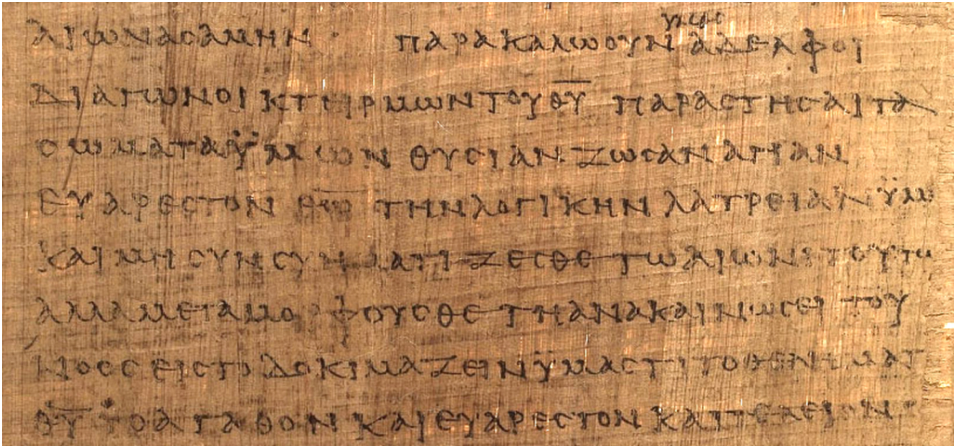
I appeal to you therefore, brothers, by the mercies of God, to present your bodies as a living sacrifice, holy and acceptable to God, which is your spiritual worship. Do not be conformed to this world, but be transformed by the renewal of your mind, that by testing you may discern what is the will of God, what is good and acceptable and perfect. Romans 12:1-2 (ESV)
Beatty Papyrus P46 ca. AD 200
University of Michigan, Ann Arbor
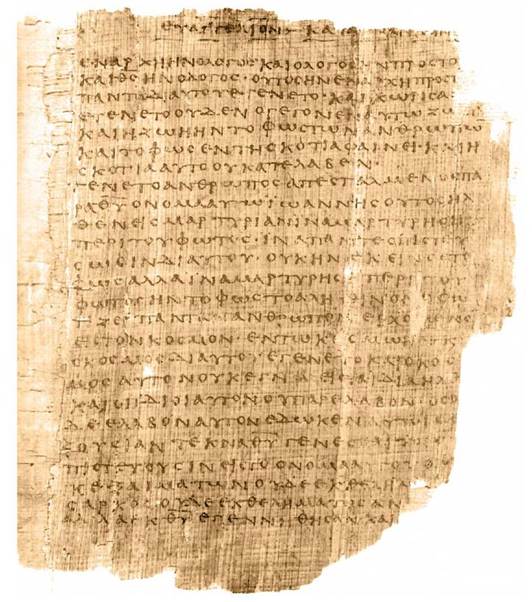
𝔓66 – The Earliest Known NT Manuscript Containing John 1. “In the beginning was the Word…”
Posted by Dallas Wolf in Ancient Christian Manuscripts, First Thoughts, Patristic Pearls, The Logos Doctrine (series) on September 15, 2025
Dated c. AD 150-250 (most likely around AD 200), Papyrus 66, designated by the siglum 𝔓66, is an early uncial Greek New Testament codex written on papyrus. It contains text from the Gospel of Luke 3:18-24:53, and John 1:1-15:8. P66 is considered a Alexandrian text-type manuscript by textual criticism scholars. Part of the Bodmer Papyri, Bodmer Library, Cologny, Switzerland.
 First Thoughts