Posts Tagged Thecla
Thecla: A Visual Example of Early Christian Equality and Later Inequality of Women
Posted by Dallas Wolf in Ekklesia and church, Women in Early Christianity on March 24, 2025
Desecration

“In 1906 a small cave was discovered cut into the rock on the northern slope of Bülbül Dag, high above the ruins of ancient Ephesus, just off the mid-Aegean coast of Turkey. To the right of the entrance and beneath layers of plaster, Karl Herold of the Austrian Archaeological Institute uncovered two sixth-century images of Saint Theoklia [sic, Thecla] and Saint Paul. They both have the same height and are therefore iconographically of equal importance.
They both have their right hands raised in teaching gesture and are therefore iconographically of equal authority. But while the eyes and upraised hand of Paul are untouched, some later person scratched out the eyes and erased the upraised hand of Theoklia. If the eyes of both images had been disfigured, it would be simply another example of iconoclastic antagonism since that was believed to negate the spiritual power of an icon without having to destroy it completely. But here only Theoklia’s eyes and her authoritative hand are destroyed. Original imagery and defaced imagery represent a fundamental clash of theology. An earlier image in which Theoklia and Paul were equally authoritative apostolic figures has been replaced by one in which the male is apostolic and authoritative and the female is blinded and silenced. And even the cave-room’s present name, St. Paul’s Grotto, continues that elimination of female-male equality once depicted on its walls.
We take that original assertion of equality and later counter-assertion of inequality as encapsulating visually the central claim of this book in terms of Christianity itself. The authentic and historical Paul, author of the seven New Testament letters he actually wrote, held that within Christian communities, it made no difference whether one entered as a Christian Jew or a Christian pagan, as a Christian man or a Christian woman, as a Christian freeborn or a Christian slave. All were absolutely equal with each other. But in 1 Timothy, a letter attributed to Paul by later Christians but not actually written by him, women are told to be silent in church and pregnant at home (2:8-15). And a later follower of Paul inserted in 1 Corinthians that it is shameful for women to speak in church but correct to ask their husbands for explanations at home (14:33-36).
Those pseudo-Pauline, post-Pauline, and anti-Pauline obliterations of female authority are the verbal and canonical equivalent of that visual and iconographic obliteration of Theoklia’s eyes and hand in that hillside cave. But both defacements also bear witness to what was there before the attack.”
Quote excerpted from: In Search of Paul: How Jesus’s Apostle Opposed Rome’s Empire with God’s Kingdom by John Dominic Crossan and Johnathan L. Reed, 2004, HarperCollins, NY, NY. pp. xxii-xiii
____________________________________________________________________________________
Restoration
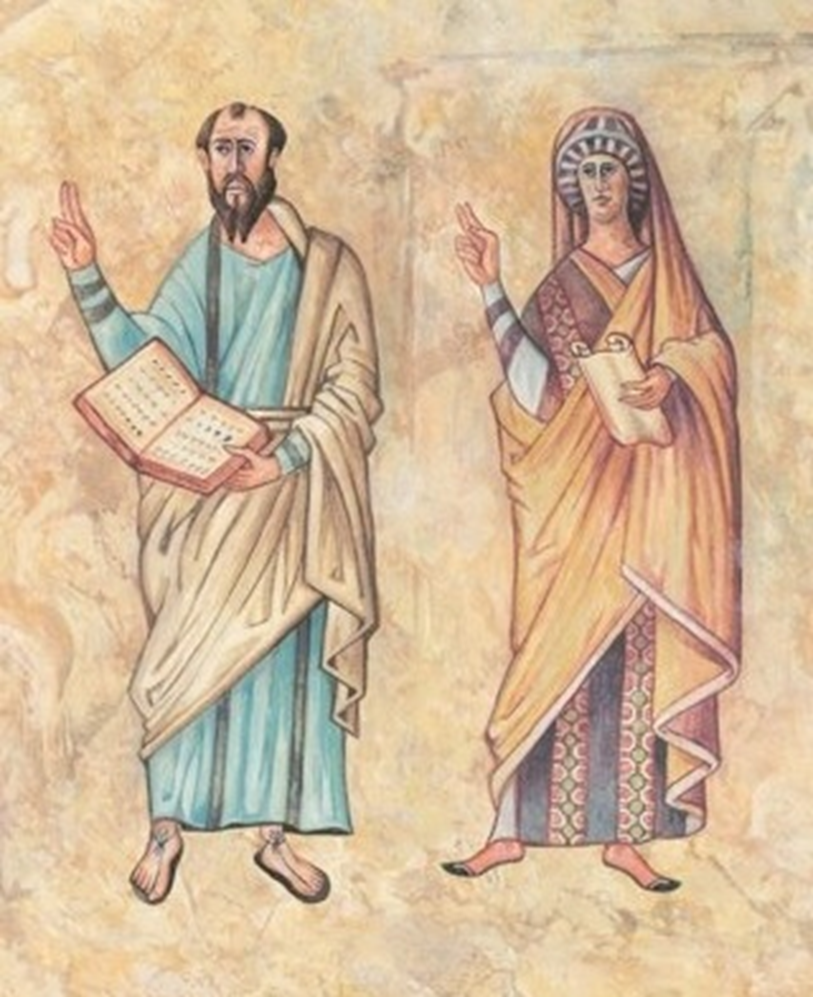
An artist’s creative restoration of that frescoed point-counterpoint from the Cave or Grotto of St. Paul at Ephesus.
Paul is just as the church’s post-Pauline tradition has always placed him. Theoclia is of equal height, but now with open eyes intact and upraised hand untouched as she was depicted in the sixth century.
 First Thoughts