Archive for April, 2023
St. Basil the Great: “On the Holy Spirit”
Posted by Dallas Wolf in Ekklesia and church, First Thoughts, Monasticism, Patristic Pearls, The Cappadocians, The Holy Trinity, Theology on April 6, 2023
St. Basil of Caesarea, also called Saint Basil the Great (330 – January 379), was a bishop of Caesarea Mazaca in Cappadocia (modern-day Turkey). He was an influential theologian who supported the Nicene Creed and opposed the heresies of the early Christian church. Together with Pachomius, he is remembered as a father of communal (coenobitic) monasticism in Eastern Christianity. Basil, together with his brother Gregory of Nyssa and his friend Gregory of Nazianzus, are collectively referred to as the Cappadocian Fathers.

“Just as when a sunbeam falls on bright and transparent bodies, they themselves become brilliant too, and shed forth a fresh brightness from themselves, so souls wherein the Spirit dwells, illuminated by the Spirit, themselves become spiritual, and send forth their grace to others. Hence comes foreknowledge of the future, understanding of mysteries, apprehension of what is hidden, distribution of good gifts, the heavenly citizenship, a place in the chorus of angels, joy without end, abiding in God, the being made like to God, and, highest of all, the being made God. Such, then, to instance a few out of many, are the conceptions concerning the Holy Spirit, which we have been taught to hold concerning His greatness, His dignity, and His operations, by the oracles of the Spirit themselves.”
~ from: On the Holy Spirit (De Spiritu Sancto), Chap. 9
St. Gregory of Nazianzus: “… the confession of the Father and the Son and the Holy Ghost.”
Posted by Dallas Wolf in Ekklesia and church, First Thoughts, Patristic Pearls, The Cappadocians, The Holy Trinity, Theology on April 6, 2023
St. Gregory of Nazianzus (c. 329 – 25 January 390), also known as Gregory the Theologian or Gregory Nazianzen, was a 4th-century Archbishop of Constantinople, theologian, and one of the Cappadocian Fathers (along with Basil the Great and Gregory of Nyssa). He is widely considered the most accomplished rhetorical stylist of the patristic age. Gregory made a significant impact on the shape of Trinitarian theology among both Greek and Latin-speaking theologians, and he is remembered as the “Trinitarian Theologian”.

“Besides all this and before all, keep I pray you the good deposit, by which I live and work, and which I desire to have as the companion of my departure; with which I endure all that is so distressful, and despise all delights; the confession of the Father and the Son and the Holy Ghost. This I commit unto you today; with this I will baptize you and make you grow. This I give you to share, and to defend all your life, the One Godhead and Power, found in the Three in Unity, and comprising the Three separately, not unequal, in substances or natures, neither increased nor diminished by superiorities or inferiorities; in every respect equal, in every respect the same; just as the beauty and the greatness of the heavens is one; the infinite conjunction of Three Infinite Ones, Each God when considered in Himself; as the Father so the Son, as the Son so the Holy Ghost; the Three One God when contemplated together; Each God because Consubstantial; One God because of the Monarchia. No sooner do I conceive of the One than I am illumined by the Splendour of the Three; no sooner do I distinguish Them than I am carried back to the One. When I think of any One of the Three I think of Him as the Whole, and my eyes are filled, and the greater part of what I am thinking of escapes me. I cannot grasp the greatness of That One so as to attribute a greater greatness to the Rest. When I contemplate the Three together, I see but one torch, and cannot divide or measure out the Undivided Light.”
~ from The Orations and Letters of Saint Gregory Nazianzus . Oration 40, XLI.
St. Maximus the Confessor: “…and having entered the dark cloud”
Posted by Dallas Wolf in Contemplative Prayer (series), First Thoughts, Patristic Pearls on April 4, 2023
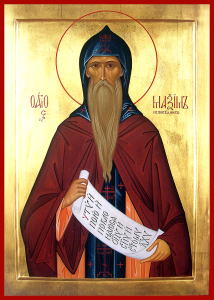
St. Maximus the Confessor (c. 580 – 662) was a 7th century Christian monk, theologian, and scholar who many contemporary scholars consider to be the greatest theologian of the Patristic era. Two of his most famous works are “Ambigua” – An exploration of difficult passages in the work of Pseudo-Dionysius and Gregory of Nazianzus, focusing on Christological issues, and “Questions to Thalassius” or “Ad Thalassium” – a lengthy exposition on various Scriptural texts. The following quote comes from Maximus’ “Two Hundred Chapters on Theology”, probably written after both Ambigua and Ad Thalassium, in about AD 633.
“The great Moses, having pitched his tent outside the camp, that is, having established his will and intellect outside visible realities, begins to worship God; and having entered the dark cloud [γνόφον], the formless and immaterial place of knowledge, he remains there, performing the holiest rites.
The dark cloud [γνόφος] is the formless, immaterial, and incorporeal condition containing the paradigmatic knowledge of beings; he who has come to be inside it, just like another Moses, understands invisible realities in a mortal nature; having depicted the beauty of the divine virtues in himself through this state, like a painting accurately rendering the representation of the archetypal beauty, he descends, offering himself to those willing to imitate virtue, and in this shows both love of humanity and freedom from envy of the grace of which he had partaken.”
~ from: Two Hundred Chapters on Theology, 1.84, 1.85.
 First Thoughts