Posts Tagged eastern orthodox tradition
The Earliest Account of the Eucharist, (i.e., Lord’s Supper/Communion)
Posted by Dallas Wolf in Ancient Christian Manuscripts, Ekklesia and church, First Thoughts, New Nuggets, Theology on May 31, 2026
The earliest written reference to the Eucharist (Lord’s Supper/Communion) is 1 Corinthians 11:23–26, written by St. Paul around A.D. 55.
Paul’s description in 1 Corinthians 11 is the earliest written witness to Christians “eating the bread and drinking the cup of the Lord.” He explicitly links this practice to Jesus’ actions at the Last Supper and treats it as an already-established ritual in the Corinthian church.
This predates the earliest Gospel by at least a decade and is the oldest surviving Christian text describing the rite. However, scholars do not believe that the gospel writers used Paul as a source for their unique Eucharist accounts, which indicates that practice of the rite was widespread in the Eastern Mediterranean in the first century.
Paul also says he is passing on a tradition he himself received, implying the Eucharist was practiced orally even earlier than his letter.
The earliest known manuscript source for 1 Corinthians is Papyrus 46 (𝔓46) — one of the famous Chester Beatty Papyri — and it is one of the oldest surviving New Testament manuscripts of any kind.
Most scholars date 𝔓46 to around 175–225 A.D., though a minority have argued for an even earlier date. Even using the conservative date, 𝔓46 is roughly 150 years earlier than the great parchment codices (Vaticanus, Sinaiticus).
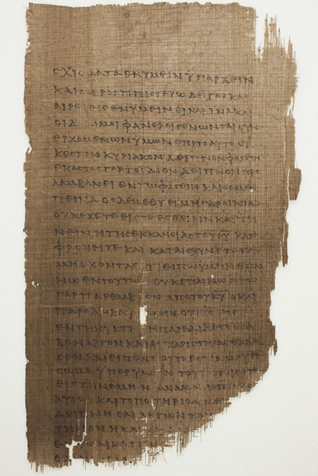
Beatty Papyrus 𝔓46, the earliest extant manuscript containing 1 Cor 11:18-25 (175–225 A.D.)
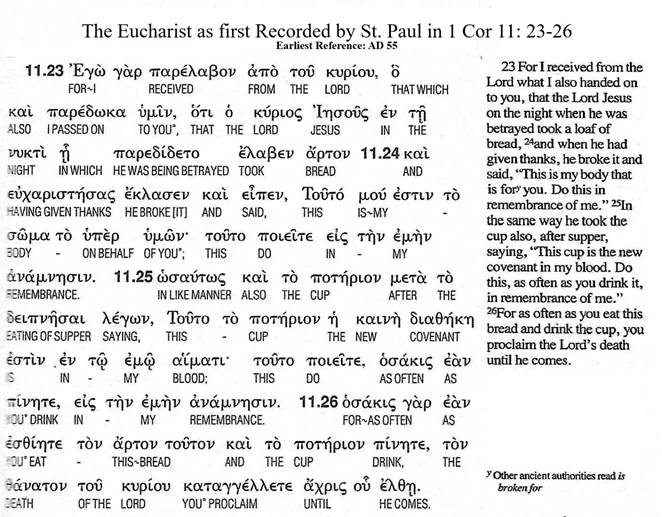
Detailed Illustration of the earliest account of the Eucharist (Greek and English)
The Logos and Kenosis doctrines as the keys to unlocking the mysteries of Creation, Incarnation, Redemption, and Inspiration
Posted by Dallas Wolf in First Thoughts, New Nuggets, The Logos Doctrine (series), Theology on May 13, 2026
Logos – Greek: λόγος – 1. Communication whereby the mind finds expression, – word – of utterance, chiefly oral. 2. Computation, reckoning. Reason for or cause of something, reason, ground, motive. 3. Independent personified expression of God, the Logos (BDAG). John 1:1-14.
Kenosis – Greek: κενόω – to empty. A divestiture of position or prestige: of Christ, who gave up the appearance of his divinity and took on the form of a slave, εαυτόν εκένωσεν [eaftón ekénosen] (BDAG). Phil. 2:5-11.
Excerpts below from John B. Heard, Alexandrian and Carthaginian Theology Contrasted. T. & T. Clark, Edinburgh. 1893. pp. 266-274:
But it occurs to us that the Kenosis doctrine, which relieves much of the mystery on the subject of the human and Divine in Christ, may also throw light on the subject of inspiration… It was assumed (as all Deists must do) that the nature of the Infinite must be incommunicable to the finite. Between Creator and creature there is much more than disparity, there is a gulf fixed which no theory can bridge over. The Incarnation, in a word, from the Deistic point of view, becomes an unthinkable mystery- it goes farther back still, since, in fact, creation itself must be unthinkable; for how can the Creator, if Infinite, pass out of Himself into the finite and conditioned? Hence, we have to fall back on such senseless phrases as that He made the worlds out of nothing, and creation at last becomes a bald affirmation of a fact for which reason by itself can offer no explanation which is not merely verbal. The early Gnostics felt this difficulty, and so they set to work to invent a Demiurge, a Bathos, a Pleroma, and other hypotheses which as hypotheses have gone the way of all brain cobwebs. The orthodox East clung, however, to the conception of the Logos either as ἐνδιάθετος, as before creation, or προφορικός, as going forth in creation. It was this Logos doctrine which carried the East safely through all the labyrinths of thought, as well on the subject of creation as of redemption. Thanks to the preface to St. John’s Gospel, that most precious jewel of God’s word, the arcanum of arcana, all was explicated, and the bald dualism of God and matter bridged over, or rather absorbed in that higher Monism in which the Eternal is ever proceeding forth through the Logos and entering into time relations, and so delighting in the habitable parts of the earth.
The Kenosis, then, which is the key to the Incarnation, is also the key to our conception of God in creation. The Eternal Father is ever communicating, in condescending love through the Son, some of His perfections to those lower orders of being whom we call His creatures. It is His nature and property so to create in condescension or self-emptying, much in the same way as it is the nature and property of the sun to shed his effulgent beams out into space. Kenosis, then, as much in creation as in redemption, at once suggests the key to what we go on to describe as the self-effacement of the Divine in a human consciousness. God spoke by the prophets so the Creed affirms; but we are nowhere asked to define the mystery, or to go into psychological puzzles as to the meeting point of human and God consciousness; nor does the Divine imply a temporary suspension of ordinary self-consciousness. We find in Christ the human was so absorbed by the Divine, that on one occasion when the disciples said, ” Master, eat,” His reply, was ” My meat is to do my Father’s will, and to finish His work.” In His case we must assume perfect simplicity and entire transparency of character. Hence, that He should forget hunger and thirst in the absorbing spirit of His work, is what much lower minds than the Christ attain to every day. But the Kenosis goes farther than this; it implies that He emptied Himself of His glory, and took a servant form. If this had been only in His Incarnation, and for three short years, then it would seem a unique, perhaps incredible mystery. But the Logos has been ever so emptying Himself. It is self-abasement, exinanition of the full glory of Godhead, when He paints the lily, and fits an insect’s eye to the tiny operations of the insect world. Hence it is that, to mere Deism with its design and argument, it seems perplexing to find perfection from the least to the greatest of God’s works. The notion of condescension in the Most High, that He ” humbleth Himself to behold the things which are done in heaven and earth,” seems strange to Deism, to whom humility seems only the shadow of the cross; and that is ” foolishness,” as we know, to the mere natural man. On these grounds we see that unless we set out with this key-word Kenosis, we shall never unravel the mysteries either of creation, redemption, or of that mode of communicating the mind of God to men which we define as inspiration. But this one master-key opens all these three locks. It is the same Logos who is the link in creation between the finite and Infinite, whose goings forth in redemption are that He has become one flesh with us that we may become one spirit with Him, and who is also the source of the old prophetic fire, the one fountain of light and love in inspiration.
The mistake in theology has been the same as in science, by isolating a single truth, and then to try and wrestle with it as with Proteus, and to wring its meaning out in single-handed fight. The sciences will not thus be won by direct assault. Their flank must be turned. In laying a subject aside and in thinking of some other thing, a side light will sometimes enter the mind, and one theory thus open the door to another. So Newton found it, as he passed from one theory of physics, where his calculations had failed him, to another theory of optics; and, after exploring the one domain, he was able to re-enter the other as conqueror, and to hold his ground there. It is the same in theology. Inspiration and the Incarnation throw light on each other; and now that we have got hold of the Incarnation by the right aspect, in the phrase of the Kenosis, it will be strange if we cannot use the same conception to lead us on to the right meaning of inspiration. In the Kenosis of Christ’s person we hold that the wisdom and goodness of God dwelt in Him bodily. In no mere Apollinarian sense (though Apollinarianism is not such a heresy as it seems) the wisdom and goodness of the Logos dwelt in the man Christ Jesus, and were to Him His Pneuma. When we speak of a human pneuma we are using words with no meaning; we are like the disciples on the Mount, not knowing what we say. The Pneuma itself is the Divine inherent in the human; it is itself a prophecy of the Incarnation – the ground and sufficient cause of the Incarnation becoming credible and intelligible, and not a mere mystery jarring to all our sense of truth. In our Lord Jesus the Christ, a Messianic element was the plenary indwelling of the Holy Ghost, not given to Him by measure as to other sons of men. But this does not imply either omniscience or omnipotence. These are attributes of pure Deity, which must be, and were, laid aside when He emptied Himself of His glory; and if equal to the Father as touching His Godhead, He became inferior to the Father as touching His manhood. Under false reverence to shrink from this frank confession of the Kenosis, is to fail to grasp the true meaning of the Incarnation. This is why, as observed already, the popular orthodox view is still Eutychian, and explains the outcry of some hyper-orthodox champions of the old school at the measured and well-weighed words of Mr. Gore in the Lux Mundi on the subject. That they were an offence at all, is an index of the depth of popular ignorance of the true Catholic doctrine of the Incarnation. Till the Kenosis is understood, the Incarnation must remain an unassimilated dogma.
It is the same with inspiration. It also stands apart among unassimilated faith formulas until we see that the Divine can only enter the human by some act of condescension. Accommodation is the old phrase. Men say that God accommodates His teaching to the imperfect faculties and immature judgments of men. At a low stage of culture He meets them with animal sacrifices and rites and ceremonies which to us seem burdensome. As the ages advance, He lightens the burden of ritual-teaching, becomes more oral and less ocular, and at last the prophet and scribe supersede the priest altogether. Even Judaism had reached the Rabbinic stage before Christ’s coming. And how strange a decline it was when Christ’s religion sank back again into the beggarly elements, and the commemoration of His death in the Eucharist feast was lowered again into a repetition of the type after the antitype, and described as the sacrifice of the Mass! We must go on to see in inspiration these advancing stages through accommodation, or else we shall never understand the Bible as a book human and Divine. To throw all the books into pie, so to speak, and read them in a lump, finding the Trinity in Gen. xix. and the doctrine of the Mass in Malachi, this is that kind of uncritical use of the Bible which we need not waste time in exposing. It is too out of date to find excuse for it in the uncritical use of the Old Testament by the Fathers of the early Church. Inspiration, in a word, is the unfolding purpose of God for the education of the race through a chosen people, that people themselves only learning the mind of God through an elect race of prophets and teachers. Thus, within the election there is an election, and the prophets themselves had to search what and what manner of time the Spirit of God which was in them did signify. They had to grope, in a word, after the meaning of their own sayings. They uttered dark sayings of old, because God-consciousness always enters in at first to dim self-consciousness, and a man inspired must be for that very reason in a sense beside himself, though always ” sober for your sake.” Inspiration was always much more than mere mantic phrenzy, we admit, though it often seemed to approach the dangerous limits between sanity and insanity.
High views of inspiration are generally assumed by devout people to indicate high views of God and His glory. In reverence for His word written our views cannot be too high, just as our reverence for the person of the Lord Jesus. Only in both cases we are to avoid the Eutychian extreme, much more common among the orthodox than the Nestorian. Two natures exist in one person; but the natures are, since the Incarnation, so fused and intermingled that He is no longer twain but one Christ; this is orthodox theology with regard to our Lord Jesus, who objects to the expression the indwelling of the Eternal Word in the man Christ. For the same reason we should be content to speak of the book as ” containing ” the word of God. By that expression we mean that in that library which we call the canon, every book has its place and purpose: each is part of a whole; and if, to us, some part seems insignificant, it is because we fail to see organic unity. It is as with our body, in which some members seem more honourable than others, but all are tempered together and bear reference to the whole. Such is inspiration. As to the literature of the canon, there are certain rights of criticism which have their place, but they are quite subordinate to and apart from the spiritual use of the Bible as a book of devotion. On that point Canon Driver has taken his stand on strong ground. He is within his rights as a Canon of Christ Church and Hebrew Professor to discuss and to deal with the Palestinian as much as with the Alexandrian Jew’s revision of the canon. He may show grounds, if there are any, why the most negative German critic may be in truer touch with the spirit of the old book than the Masoretic or any other Hebrew school of the older criticism. But he must not forget, as the negative school too often do, that the onus of proof lies with those who advance novelties. Presumption is always in favour of the occupying holder, since possession is nine points of the law. Some of our younger critics, in the first flush of excitement, forget that it is easier to assert than to prove. Negation becomes thus quite as dogmatic and far more offensive than the old traditionalism, which maintains that a position must be true because it is long established. There is, we admit, an immense presumption in its favour, since the general shut up in a garrison with ten thousand men may expect to hold his ground till another with twenty thousand men comes against him.
But, like Canon Driver, we draw our line at the literature of the Bible. Libros Canonicos ad leones is a modern version of the Christianos ad leones. Let the young lions of criticism work their will on the letter of the record, and we fearlessly say that what remains after negation has done its worst is that ” word of the Lord which liveth and abideth for ever.” To us, for instance, this new phrase, the Hexateuch, is as unimportant as the old phrase Pentateuch: it seems like pulling down one house of cards to set up another. If the orthodox had not been so ill-advised as to fall into Bibliolatry, this kind of attack would have never been made. It was the same when the old orthodox school were Creationists, and evolution seemed to set aside the hand of God and the necessity for a first cause. But as soon as the defence ceased the attack died down; and so it will be with much of this itching ear for the last novelty of negative criticism. As soon as it ceases to alarm by our taking higher ground of inspiration than the old school did, so soon will it sink into the contempt it deserves. The archives of Israel are historical documents, and therefore must go to the school of history there to be tested in the usual way. To fear the result is to show very little faith. If the New Testament canon has come out of the fires of criticism, what have we to fear for the Old? We shall no doubt have to give up something, especially the uncritical order and ground on which Jerome arranged the Vulgate, borrowing partly from the Hebrew and partly from the Greek arrangement of the books, putting them out of their true order, which was mainly chronological, and so giving fictitious importance to some semi- canonical books, such as Daniel and Koheleth, which were probably of later date than their eponymic authors, and among the Antilegomena.
All this will soon be over, and then inspiration will be seen to be a growing truth; and that as Jesus increased in body, soul, and spirit, so there is harmonious orderly growth of the letter and spirit of the Bible. In all the books there is a theopneustic element, the test of which is that it is profitable for doctrine, for reproof, for correction, for instruction in righteousness. The Didaché, in a word, is elenchus, or evidence internal of its truth; this leads on to Paideia, or education, and that established state which he fitly describes as ἐπανόρθωσις, or maturity in the faith.
What Does the ‘Ecclesía’ of ‘The Way’ (AKA New Testament Church) Look Like?
Posted by Dallas Wolf in Ekklesia and church, First Thoughts, Theology, Women in Early Christianity on April 8, 2026
Words
A Word of Wisdom from my brilliant college roommate, dear friend, and Christian brother (and lawyer), John Holt:
“Words Matter. The World We Make With Words is always before us in both law and theology because words create worlds. Words matter because they have also created the theological world of every faith.”
Examples:
“The Way”, ἡ Ὁδός , (hē Hodós), was an early term used to describe the Christian movement, emphasizing the teachings, death, and resurrection of Jesus as the path to transformation and salvation, and experience of God. Members of The Way formed assemblies or congregations called “ecclesía”.
“Ecclesía”, Ἐκκλησία (Ekklēsía) used exclusively for Christian assemblies or congregations of believers. In the first century, the ecclesía was primarily a gathering of early Christians who met in private homes or public spaces, functioning as a community rather than a formal institution. These assemblies were characterized by their adaptability to local cultures and their focus on communal worship, fellowship and service, and the mission of spreading the teachings of Jesus. Ecclesía was never used to refer to a physical building, and certainly not to any temporal hierarchical institution (read: Church).[1]
“Words are thus the records of things, and a change of a single term is a kind of signal to sceneshifters that we have closed one act and entered another in the five-act drama of Church history. During the whole of Act I., as we may call it, the keynote is always διδαχή [teaching]; it is a doctrine, and those who preach or teach it are followers of the “way” [ἡ ὁδός], witnesses of the “word” [λόγοσ], or stewards of the “mystery” [μυστήριο]. Such is the apostolic keynote …
But a change came over the Church, which explains all her later “afterthoughts” in theology, as soon as the note διδαχή was dropped, and δόξα [private opinion] at first, and finally hardening into δόγμα [dogma], took the place of διδαχή. It is dogmatic theology, in all its forms, early and later, which we identify with that departure from the faith which the apostle (1 Tim. iv. 1) distinctly refers to as an apostacy.
Faith [πίστις] in the New Testament church [ecclesía] meant trust or affiance in the living God. It did not mean, “the faith” of the later dogmatic Church. If πίστις retains its primitive simplicity of meaning as trust or affiance in the living God, and the term διδαχή the equivalent phrase for those teachings which make up the body of revealed truth, then we have what we need: “faith” in a person, and “teaching” concerning his work.”
“This fusing of morality and religion into one, is indeed that return to primitive New Testament Christianity which the age asks for, but does not see its way to.”[2]
The goal of the discussion below is to help the reader see what the age asks for: the return to primitive New Testament Christianity.
In the light of these circumstances, the total absence of any temporal institutional dogma in the following discussion is wholly intentional.
Ecclesía Structure
The earliest Christian communities were charismatically structured, not institutionally structured.
- Charisma Was the Organizing Principle of the New Testament Ecclesía
- The earliest ecclesías were held together by charismatic authority, meaning:
- Leadership emerged from spiritual gifting, not appointment.
- Apostles, prophets, and teachers were recognized because the Spirit was believed to speak through them.
- Communities were small, fluid, and dependent on Spirit‑empowered individuals.
- The early church didn’t have offices — it had gifts.
- The earliest ecclesías were held together by charismatic authority, meaning:
- Apostles and Prophets Were Central — Not Peripheral
- Apostles as foundational witnesses
- Prophets as Spirit‑filled interpreters
- Evangelists as itinerant emissaries
- In the New Testament Ecclesía:
- Charismatic gifts were common and expected.
- Leadership was fluid and Spirit‑driven.
- Prophecy, tongues, healing, and visions were normal parts of worship.
- Authority was personal and experiential.
- Beginning in the 2nd century, Charisma began to decline as Institutional Authority rose
- As charismatic eyewitnesses died, ecclesías needed stability.
- Bishops and presbyters emerged to provide continuity.
- Written texts (eventually the NT canon) replaced charismatic speech as the norm of authority.
- Prophets and itinerant charismatics became viewed as destabilizing.
Apostles and Prophets built the Ecclesía; Bishops and Presbyters later managed it into the Church.
The Bible
We must understand that in the first century ecclesía, there was no Bible, as we know it. They had the Septuagint (Greek translation of Hebrew Scriptures), but there was then no settled canon of Scripture of the Hebrew Old Testament; and the New Testament would not be assembled and closed for another 250 years. Jesus himself quoted from some of the books which became part of the Hebrew canon, so we can assume that he considered them authoritative “Scripture”. Jesus’ followers considered his (Jesus’) own teachings to be authoritative. Near the end of the first century, Christians were citing Jesus’ words and calling them “Scripture” (e.g., 1 Tim 5:18). The book of 2 Peter includes Paul’s own contemporary letters among the “Scriptures” (2 Pet 3:16). Scripture was mainly oral (from Apostles. Prophets, and Teachers) in the “New Testament” ecclesía.
The Word of God was a Person, Jesus Christ, the Son, the Logos (λόγος). The Christ of history was the Eternal Logos, the light of all humanity. The later developed New Testament Bible canon contains the word of God and became the principal book of modern Christian devotion.
However, we should be reminded that in the ecclesía divine revelation was considered continuous and experiential. The idea that divine revelation would end at some point (e.g., with the closure of the Christian Canon in 367 AD, or at the end of the Apostolic era), would not have occurred to the ecclesía.
Creed
Examples from the New Testament Ecclesía:
From 1 Cor 15:
Christ died for our sins in accordance with the scriptures, and that he was buried, and that he was raised on the third day in accordance with the scriptures, and that he appeared to Cephas, then to the twelve. Then he appeared to more than five hundred brothers and sisters at one time. But in fact Christ has been raised from the dead, the first fruits of those who have died. For since death came through a human being, the resurrection of the dead has also come through a human being; for as all die in Adam, so all will be made alive in Christ. But each in his own order: Christ the first fruits, then at his coming those who belong to Christ. Then comes the end, when he hands over the kingdom to God the Father, after he has destroyed every ruler and every authority and power. For he must reign until he has put all his enemies under his feet. The last enemy to be destroyed is death. For “God has put all things in subjection under his feet.” But when it says, “All things are put in subjection,” it is plain that this does not include the one who put all things in subjection under him. When all things are subjected to him, then the Son himself will also be subjected to the one who put all things in subjection under him, so that God may be all in all.[3]
From Phil 2:
Though he was in the form of God, did not regard equality with God as something to be exploited, but emptied [ἐκένωσεν] himself, taking the form of a slave, being born in human likeness. And being found in human form, he humbled himself and became obedient to the point of death— even death on a cross. Therefore God also highly exalted him and gave him the name that is above every name, so that at the name of Jesus every knee should bend, in heaven and on earth and under the earth, and every tongue should confess that Jesus Christ is Lord, to the glory of God the Father.[4]
The current universal Nicene Creed would not be formulated until 325/381 AD.
Ministries within the New Testament Ecclesía
| Ephesians 4:11 |
| Apostle |
| Prophet |
| Evangelist |
| Pastor |
| Teacher |
Charismatic Gifts of the Holy Spirit within the New Testament Ecclesía
| Romans 12:6-8 | 1 Corinthians 12:1-14 |
| Prophecy | Word of Wisdom |
| Ministry | Word of Knowledge |
| Teaching | Discernment of Spirits |
| Exhortation | Speaking in Tongues |
| Giving | Interpretation of Tongues |
| Leadership | Prophecy |
| Mercy | Faith |
| Working of Miracles | |
| Gifts of Healing |
Women in the New Testament Ecclesía
In an interview, Christian theologian and philosopher David Bentley Hart stressed that Paul’s letters—setting aside later pseudo‑Pauline additions—have a “remarkable egalitarianism” that is “almost historically inconceivable” for the time.
“There is no longer Jew or Greek, there is no longer slave or free, there is no longer male or female; for all of you are one in Christ Jesus.” Gal 3:28
Powerful Women in the New Testament Ecclesía
| Woman | Reference | Comment |
| Phoebe | Romans 16:1-2 | “a deacon [minister] of the ecclesía” |
| Priscilla (or Prisca) | Rom 16:3-5, 1 Cor 16:19 | Founded at least two house ecclesías with Aquila |
| Junia | Rom 16:7 | Named as “prominent among the apostles” |
| Nympha | Col 4:15 | Started ecclesía in her house |
| Lydia | Acts 16:14, 15, 40 | Started ecclesía in her house |
| Apphia | Philem 2 | Started ecclesía in her house |
| Mary, Mother of Jesus | Acts 1:14 | Present at first meetings of the ecclesía |
| Euodia, Syntyche | Phil 4:2-3 | Co-workers: “for they have struggled beside me in the work of the gospel” |
| Four daughters of Philip | Acts 21:8/9 | Prophetesses |
Worship Patterns of the New Testament Ecclesía
The Christian ecclesía usually met in private homes for worship and instruction (Acts 2:46; 16:40; 18:7; Philem. 1:2). It appears that, in commemoration of the resurrection, the congregation assembled on the “Lord’s Day,” Sunday, the first day of the week (Acts 20:7See Eucharist, below; 1 Cor. 16:2). Writing to the ecclesía in Corinth, Paul describes two types of Christian gathering. One is the Lord’s Supper (Eucharist)(1 Cor. 10:16-17; 11:20-29) or ceremonial community meal. Paul goes on to describe a second type of charismatic gathering, the prophetic assembly, which includes both singing and thanksgiving in unknown languages, with interpretation, and prophecy (14:1-33). These were likely two aspects of the same gathering.
The order of worship in the Didache[5] [ca. 100 AD] allows Jewish forms for “grace” before and after meals. The leader’s prayer does not refer to the body and blood of Jesus; instead, the emphasis is on the gathering of the ecclesía body (see 1 Cor. 10:17). It is noteworthy that the prayer and thanksgiving are interlaced with doxologies; the event is a praise-celebration of the congregation of God’s people. The role of prophets is significant; the Didache calls them the ecclesía’s “high priests,” and gives instructions on how to welcome prophets and discern true from false teaching. The document does not specify what sort of ecclesía official is to preside over the Eucharist.
Worship patterns varied widely by location. Paul’s Gentile ecclesías were not as structured as those of the Jewish Christian ecclesías who came from a background of Synagogue/Temple worship (e.g., as described in the Didache). Diversity was the hallmark of New Testament Christianity.
Sacraments (Mysteries)
Jesus himself instituted the Lord’s Supper (Eucharist) as part of his last Passover celebration with his disciples (Matt. 26:26-29; Mark 14:22-25; Luke 22:14-22.) His words on that occasion (“This is my body . . . ,” “this is my blood . . . ,” “do this in remembrance of me”) suggest a close identification between the elements of bread and wine and the continuing presence of Jesus with his Ecclesía.
Two other sacramental actions established by Jesus were Baptism and Foot Washing. The Gospel of John records that Jesus washed the feet of his disciples on the night of his arrest, as a symbol of the loving servanthood they were to show toward one another (John 13:1-15). However, the rite is not specifically mentioned elsewhere in the New Testament.
Regarding Baptism, Jesus himself had been baptized by John the Baptizer as a sign of his role as the Messiah or Son of God (Mark 1:9-11). The Didache tells us: “But with regard to baptism, baptize as follows. Having said all these things in advance, baptize in the name of the Father, and of the Son, and of the Holy Spirit, in [cold] running water.”
Prayer
“pray without ceasing” 1 Thess 5:17 (this is the foundational direction of hesychasm)
“But whenever you pray, go into your room and shut the door and pray to your Father who is in secret; and your Father who sees in secret will reward you [openly].” Matt 6:6
The Didache specifically quotes the text of the Lord’s Prayer (akin to Matt 6) and directs us to “Pray like this three times a day”.
Giving
Early Christian communities practiced notable acts of mutual aid and pooled collections, and giving was encouraged and commended by Paul. But Paul did not prescribe a universal rule that all goods and money be held in common. Early Christian fellowship and service was fundamental and sometimes expressed in radical generosity, but giving was practical, voluntary, and contextual rather than a uniform economic communalism.
Fasting
Again, from the Didache: “And do not keep your fasts with the hypocrites [i.e., Jews]. For they fast on Monday and Thursday; but you should fast on Wednesday and Friday”.
I quoted Rev. John B. Heard at the beginning of this post when he said, “This fusing of morality and religion into one, is indeed that return to primitive New Testament Christianity which the age asks for, but does not see its way to.” I hope we have clearly pointed out “The Way”.
[1] Theodore Beza, a Presbyterian follower of reformer John Calvin, was the first person to translate Greek “Ekklesía” with the modern English word “Church” in his 1556 translation of the New Testament canon. To equate the first century Ecclesía with the 16th century context of “Church” may be the most mis-leading Bible translation ever made in English. Worse yet, the translators of the 1611 King James Bible copied Beza’s mistranslation; and so it goes with most subsequent English translations. With translation alternatives of “assembly” or “congregation” readily available and historically used, I hardly think the mistranslation was innocent. Words matter.
[2] Heard, John B. Alexandrian and Carthaginian Theology Contrasted. T. & T. Clark, Edinburgh, 1893. (pp. 229-230)
[3] 1 Cor 15, Harper Bibles. NRSV–New Testament.
[4] Ibid., Phil: 2.
[5] The Apostolic Fathers. “Didache: The Teaching of the Twelve Apostles” (Bilingual English-Greek Edition). Translated and edited by Bart D. Ehrman. Vol. 1 of two volumes. Harvard University Press. 2003. The Didache was likely written in the first century by Jewish Christians living in the Egyptian, Palestinian, or Syrian region.
Note: All comments in brackets [] mine.
How did the meaning of the Greek word δόξα (dóxa) shift from “private opinion” to “glory”?
Posted by Dallas Wolf in Ancient Christian Manuscripts, First Thoughts, Patristic Pearls on April 1, 2026
The Greek word dóxa shifted from “opinion” to “glory” through a historical semantic expansion driven largely by the Greek translation of the Hebrew Bible. In classical Greek it meant “what seems,” “appearance,” or “belief,” but in Jewish and early Christian Greek it came to express the radiant, weighty presence of God.
Here’s how that transformation happened:
1. The Original Meaning: “What Seems / Opinion”
In early and classical Greek, δόξα comes from the verb δοκεῖν (“to seem, to appear, to think”). It referred to: personal opinion, common belief, reputation (good or bad). Philosophers like Plato used dóxa to contrast mere belief with true knowledge (epistēmē).
2. The Septuagint Shift: Translating Hebrew kavod
The decisive change occurred between the 3rd and 1st centuries BCE, when Jewish scholars translated the Hebrew Bible into Greek (the Septuagint).
Hebrew כָּבוֹד (kavod) means: “weight,” “substance,” and metaphorically “glory,” “honor,” “radiance,” especially of God.”
The translators chose δόξα as the Greek equivalent.
This was a semantic leap: kavod had no connection to “opinion.” But dóxa was the closest Greek term that could express public esteem or reputation, which overlaps with “glory.” As a result, dóxa absorbed the theological weight of kavod.
3. Early Christian Usage: “Glory” Becomes Primary
Because the Septuagint was the Old Testament Bible of the early Church, the new meaning spread rapidly. In the New Testament and Christian liturgy: dóxa overwhelmingly means glory, especially divine glory. It becomes associated with: radiance, majesty, honor, praise.
This usage became so dominant that the older sense (“opinion”) nearly disappeared from religious Greek.
Philological sources note that dóxa came to mean “glory” especially in Hellenistic and Christian Greek, while still retaining its older philosophical sense in some contexts.
Bart Ehrman: “Textual Criticism 101”
Posted by Dallas Wolf in Ancient Christian Manuscripts, New Nuggets on March 12, 2026

Bart D. Ehrman (born October 5, 1955) is an American New Testament scholar whose research focuses on the textual criticism of the New Testament, the historical Jesus, and the origins and development of early Christianity. He is the James A. Gray Distinguished Professor of Religious Studies at the University of North Carolina at Chapel Hill. He is the author or editor of more than 30 books, including six New York Times bestsellers, and has created nine lecture series with The Great Courses. Misquoting Jesus: The Story Behind Who Changed the Bible and Why, HarperCollins, 2005, is his most popular New York Times bestseller mass-market book on Christian textual criticism.
The following excerpt is from his The New Testament – A Historical Introduction to the Early Christian Writings, 3rd Edition, Oxford University Press, 2004. Pp. 485-488.
Criteria for Establishing the Original Text of the New Testament
There is a subdiscipline within New Testament scholarship called “textual criticism,” which seeks to establish the original text of the New Testament based on the surviving manuscript evidence. It is a complex task but one that can be extremely intriguing – something like reading a detective story in which a few clues have to be pieced together in order to decide “whodunit.” When there are different forms of the text, that is, when a verse is worded in different ways in the surviving manuscripts, the question has to be asked, which manuscripts represent the text of the autograph and which ones represent changes of the text? Inevitably, a choice has to be made between one form of wording and another, and the choice can sometimes make a significant difference in how a document is interpreted. Since it is better to make an intelligent choice based on evidence than simply to guess, critics have developed certain principles for deciding which form of a text is more likely to be original.
- The Number of Witnesses That Support a Reading. In addition to the approximately 5,400 Greek manuscripts of the New Testament, we have tens of thousands of New Testament manuscripts in other languages into which it was eventually translated (especially Latin but also Syriac, Coptic, Armenian, and others). Moreover, there are dozens of ancient Christian authors from different times and places who quoted the New Testament. By collecting their quotations, we can reconstruct what their own manuscripts probably looked like.
Given the abundance of evidence, one might suppose that a fairly obvious criterion for deciding which reading is original is to count the witnesses in support of each (different) reading and to accept the one that is most abundantly attested. Suppose, for example, that for a given verse there were 500 witnesses that have one form of wording and only six that have a variant form. All other things being equal, one might suspect that the six represent a mistake.
The problem, however, is that all other things are rarely equal. If the six witnesses, for example, all derive from the third and fourth centuries, whereas the 500 are all later, from the fifth to the fifteenth centuries, then the six may preserve an earlier form of the text that came to be changed to the satisfaction of later scribes. Thus, simply counting the witnesses that support a certain form of the text is generally recognized as a rather unreliable method for reconstructing the original text. - The Age of the Witnesses. The form of the text that is supported by the oldest witness is more likely to be original than a different form found only in later manuscripts, even if these are more numerous. Most scholars recognize that this principle is better than simply counting the manuscripts, but it too can be problematic. For example, it is possible for a sixth-century manuscript to preserve an older form of the text than, say, a fourth-century one. This would happen if the sixth-century manuscript had been produced from a copy that was made in the second century, whereas the fourth-century manuscript derived from one made in the third.
- The Quality of the Witnesses. In a court of law, the testimony of some witnesses carries more weight than that of others. If there are two witnesses with contradictory testimony, and one is known to be a habitual liar, drunkard, and thief, whereas the other is an upstanding member of the community, most juries will have little difficulty deciding whom to believe. A similar situation occurs with manuscripts. Some are obviously full of errors, for instance, when their scribe was routinely inattentive or inept, and others appear to be on the whole trustworthy. The best manuscripts are those that do not regularly preserve forms of the text that are obviously in error.
- The Geographical Spread of the Witnesses. An even more useful criterion involves the geographical distribution of the different forms of the text, especially among the earliest manuscripts. Suppose our manuscripts support two different forms of a passage, one found only among manuscripts produced in a specific geographical area (say, southern Italy), the other found in witnesses spread throughout the Mediterranean (say, Northern Africa, Alexandria, Syria, Asia Minor, Gaul, and Spain). In this case, the former is more likely to be a local variation reproduced by scribes of the region, whereas the other is more likely to be older since it was more widely known.
The foregoing criteria often have a cumulative effect in helping scholars decide what the original text was. If one form of reading, for example, is found in geographically diverse witnesses that are early and of generally high quality, then there is a good chance that it is original. This judgment has to be borne out, however, by two other factors. - The Difficulty of the Reading. Scholars have found this criterion to be extraordinarily useful. We have seen that scribes sometimes eliminated possible contradictions and discrepancies, harmonized stories, and changed doctrinally questionable statements. Therefore, when we have two forms of a text, one that would have been troubling to scribes – for example, one that is possibly contradictory to another passage or grammatically inelegant or theologically problematic – and one that would not have been as troubling, it is the former form of the text, the one that is more “difficult,” that is more likely to be original. That is, since scribes were far more likely to have corrected problems than to have created them, the comparatively smooth, consistent, harmonious, and orthodox readings are more likely, on balance, to have been created by scribes. Our earliest manuscripts, interestingly enough, are the ones that tend to preserve the more difficult readings.
- Conformity with the Author’s Own Language, Style, and Theology. With the preceding criterion we were interested in determining which form of a passage could be most easily attributed to scribes who copied the text. With our sixth and final criterion we are interested in seeing which form of a passage would be easiest to ascribe to the author who originally produced the text in light of its vocabulary, writing style, and theology. If two forms of a passage are preserved among the New Testament manuscripts and one of them contains words, grammatical constructions, and theological ideas that never occur in the author’s writings elsewhere (or that conflict with his other writings), then that form of the text is less likely to be original than the other.
All of these criteria need to be applied to any particular passage in order to decide which reading among the manuscripts is likely to be original. In many instances, the arguments coalesce, so that the earliest and best manuscripts also support the reading that is most difficult and that conforms most closely with the author’s own language and style. When this happens, we can be relatively certain that we have uncovered the earliest available form of the text.
Codex Sinaiticus: “God is love”
Posted by Dallas Wolf in Ancient Christian Manuscripts, First Thoughts, Theology on March 9, 2026

Modern Greek: Ὁ θεὸς ἀγάπη ἐστίν
English: God is love (from 1 John 4:8)
Codex Sinaiticus ca. AD 350
British Museum, London
The “God is love” graphic, above, is copied from the Codex Sinaiticus. Codex Sinaiticus is a manuscript of the Christian Bible written in the middle of the fourth century and contains the earliest complete copy of the Christian New Testament. The name ‘Codex Sinaiticus’ literally means ‘the Sinai Book’. The hand-written text is in Greek. The New Testament appears in the original vernacular language (koine) and the Old Testament in the version known as the Septuagint (LXX, ca. 130 B.C.), that was adopted by early Greek-speaking Christians. Codex Sinaiticus is one of only four great codices that have survived to the present day. They are written in a certain uncial (broad single-stroke letters using simple round forms) style of calligraphy using only majuscule (capital) letters, written in scriptio continua (meaning without regular gaps or spaces between words). Words do not necessarily end on the same line on which they start. All four of these manuscripts were made at great expense in material and labor, written on parchment or velum (animal skins) by professional scribes. All four of the Great Codices are Alexandrian text-type manuscripts.
‘Codex’ means ‘book’. By the time Codex Sinaiticus was written, works of literature were increasingly written on sheets that were folded and bound together in the form that we still use today. This book format was steadily replacing the roll format which was more widespread just a century before. These rolls were made of animal skin (like most of the Dead Sea Scrolls) or the papyrus plant (commonly used for Greek and Latin literature). Using the papyrus codex was a distinctive feature of early Christian culture. The pages of Codex Sinaiticus, however, are made of animal skin parchment. This marks it out as standing at an important transition in book history. Before it we see many examples of Greek and Latin texts on papyrus roll or papyrus codex, but almost no traces of parchment codices. After it, the parchment codex becomes the norm.
In Christian scribal practice, nomina sacra is the abbreviation of frequently used divine names or titles, especially in Greek manuscripts of the Bible. A nomen sacrum consists of two or more letters from the original word spanned by an overline; in the case of the Sinaiticus graphic, above, the theta and sigma are the first and last letters in the Greek word Theos, or God.
David Bentley Hart: “Traditio Deformis – The long history of defective Christian scriptural exegesis occasioned by problematic translations”
Posted by Dallas Wolf in Ancient Christian Manuscripts, New Nuggets, Theology on March 8, 2026

David Bentley Hart (born 1965) is an American Orthodox Christian philosophical theologian, cultural commentator and polemicist. Here, in one short essay published in “First Things” in May 2015, Prof. Hart addresses, “The long history of defective Christian scriptural exegesis occasioned by problematic translations”.
The long history of defective Christian scriptural exegesis occasioned by problematic translations is a luxuriant one, and its riches are too numerous and exquisitely various adequately to classify. But I think one can arrange most of them along a single continuum in four broad divisions: some misreadings are caused by a translator’s error, others by merely questionable renderings of certain words, others by the unfamiliarity of the original author’s (historically specific) idiom, and still others by the “untranslatable” remoteness of the author’s own (culturally specific) theological concerns. And each kind comes with its own special perils and consequences.
But let me illustrate. Take, for example, Augustine’s magisterial reading of the Letter to the Romans, as unfolded in reams of his writings, and ever thereafter by his theological heirs: perhaps the most sublime “strong misreading” in the history of Christian thought, and one that comprises specimens of all four classes of misprision. Of the first, for instance: the notoriously misleading Latin rendering of Romans 5:12 that deceived Augustine into imagining Paul believed all human beings to have, in some mysterious manner, sinned “in” Adam, which obliged Augustine to think of original sin—bondage to death, mental and moral debility, estrangement from God—ever more insistently in terms of an inherited guilt (a concept as logically coherent as that of a square circle), and which prompted him to assert with such sinewy vigor the justly eternal torment of babes who died unbaptized. And of the second: the way, for instance, Augustine’s misunderstanding of Paul’s theology of election was abetted by the simple contingency of a verb as weak as the Greek proorizein (“sketching out beforehand,” “planning,” etc.) being rendered as praedestinare—etymologically defensible, but connotatively impossible. And of the third: Augustine’s frequent failure to appreciate the degree to which, for Paul, the “works” (erga, opera) he contradistinguishes from faith are works of the Mosaic law, “observances” (circumcision, kosher regulations, and so on). And of the fourth—well, the evidences abound: Augustine’s attempt to reverse the first two terms in the order of election laid out in Romans 8:29–30 (“Whom he foreknew he also marked out beforehand”); or his eagerness, when citing Romans 5:18, to quote the protasis (“Just as one man’s offence led to condemnation for all men”), but his reluctance to quote the (strictly isomorphic) apodosis (“so also one man’s righteousness led to justification unto life for all men”); or, of course, his entire reading of Romans 9–11 . . .
Ah—thereby hangs a tale.
Not that Paul’s argument there is difficult to follow. What preoccupies him is the agonizing mystery that the Messiah has come, yet so few of the house of Israel have accepted him, while so many Gentiles—outside the covenant—have. What then of God’s faithfulness to his promises? It is not an abstract question regarding who is “saved” and who “damned”: By the end of chapter 11, the former category proves to be vastly larger than that of the “elect,” or the “called,” while the latter category makes no appearance at all. It is a concrete question concerning Israel and the Church. And ultimately Paul arrives at an answer drawn, ingeniously, from the logic of election in Hebrew Scripture.
Before reaching that point, however, in a completely and explicitly conditional voice, he limns the problem in the starkest chiaroscuro. We know, he says, that divine election is God’s work alone, not earned but given; it is not by their merit that Gentile believers have been chosen. “Jacob have I loved, but Esau have I hated” (9:13)—here quoting Malachi, for whom Jacob is the type of Israel and Esau the type of Edom. For his own ends, God hardened Pharaoh’s heart. He has mercy on whom he will, hardens whom he will (9:15–18). If you think this unjust, who are you, O man, to reproach God who made you? May not the potter cast his clay for purposes both high and low, as he chooses (9:19–21)? And, so, what if (ei de, quod si) God should show his power by preparing vessels of wrath, solely for destruction, to provide an instructive counterpoint to the riches of the glory he lavishes on vessels prepared for mercy, whom he has called from among the Jews and the Gentiles alike (9:22–24)? Perhaps that is simply how it is: The elect alone are to be saved, and the rest left reprobate, as a display of divine might; God’s faithfulness is his own affair.
Well, so far, so Augustinian. But so also, again, purely conditional: “What if . . . ?” Rather than offering a solution to the quandary that torments him, Paul is simply restating it in its bleakest possible form, at the very brink of despair. But then, instead of stopping here, he continues to question God’s justice after all, and spends the next two chapters unambiguously rejecting this provisional answer altogether, in order to reach a completely different—and far more glorious—conclusion.
Throughout the book of Genesis, the pattern of God’s election is persistently, even perversely antinomian: Ever and again the elder to whom the birthright properly belongs is supplanted by the younger, whom God has chosen in defiance of all natural “justice.” This is practically the running motif uniting the whole text, from Cain and Abel to Manasseh and Ephraim. But—this is crucial—it is a pattern not of exclusion and inclusion, but of a delay and divagation that immensely widens the scope of election, taking in the brother “justly” left out in such a way as to redound to the good of the brother “unjustly” pretermitted. This is clearest in the stories of Jacob and of Joseph, and it is why Esau and Jacob provide so apt a typology for Paul’s argument. For Esau is not finally rejected; the brothers are reconciled, to the increase of both precisely because of their temporary estrangement. And Jacob says to Esau (not the reverse), “Seeing your face is like seeing God’s.”
And so Paul proceeds. In the case of Israel and the Church, election has become even more literally “antinomian”: Christ is the end of the law so that all may attain righteousness, leaving no difference between Jew and Gentile; thus God blesses everyone (10:11–12). As for the believing “remnant” of Israel (11:5), they are elected not as the number of the “saved,” but as the earnest through which all of Israel will be saved (11:26), the part that makes the totality holy (11:16). And, again, the providential ellipticality of election’s course vastly widens its embrace: For now, part of Israel is hardened, but only until the “full entirety” (pleroma) of the Gentiles enter in; they have not been allowed to stumble only to fall, however, and if their failure now enriches the world, how much more so will their own “full entirety” (pleroma); temporarily rejected for “the world’s reconciliation,” they will undergo a restoration that will be a “resurrection from the dead” (11:11–12, 15).
This, then, is the radiant answer dispelling the shadows of Paul’s grim “what if,” the clarion negative: There is no final “illustrative” division between vessels of wrath and of mercy; God has bound everyone in disobedience so as to show mercy to everyone (11:32); all are vessels of wrath so that all may be made vessels of mercy.
Not that one can ever, apparently, be explicit enough. One classic Augustinian construal of Romans 11, particularly in the Reformed tradition, is to claim that Paul’s seemingly extravagant language—“all,” “full entirety,” “the world,” and so on—really still means just that all peoples are saved only in the “exemplary” or “representative” form of the elect. This is, of course, absurd. Paul is clear that it is those not called forth, those allowed to stumble, who will still never be allowed to fall. Such a reading would simply leave Paul in the darkness where he began, reduce his glorious discovery to a dreary tautology, convert his magnificent vision of the vast reach of divine love into a ludicrous cartoon of its squalid narrowness. Yet, on the whole, the Augustinian tradition on these texts has been so broad and mighty that it has, for millions of Christians, effectively evacuated Paul’s argument of all its real content. It ultimately made possible those spasms of theological and moral nihilism that prompted John Calvin to claim (in book 3 of The Institutes) that God predestined even the Fall, and (in his commentary on 1 John) that love belongs not to God’s essence, but only to how the elect experience him. Sic transit gloria Evangelii. I have to say that, as an Orthodox scholar, I have made many efforts over the years to defend Augustine against what I take to be defective and purely polemical Eastern interpretations of his thought, in the realms of metaphysics, Trinitarian theology, and the soul’s knowledge of God (often to the annoyance of some of my fellow Orthodox). But regarding that part of his intellectual patrimony that has had the widest effect—his understanding of sin, grace, and election—not only do I share the Eastern distaste for (or, frankly, horror at) his conclusions; I am even something of an extremist in that respect. In the whole long, rich history of Christian misreadings of Scripture, none I think has ever been more consequential, more invincibly perennial, or more disastrous.
“Christianity is in a pretty poor mess…” ~ Fr. Richard Rohr
Posted by Dallas Wolf in Ekklesia and church on October 6, 2025
Christianity continues decades of decline in the U.S., and the “Church” continues to splinter apart worldwide. Along with Fr. Richard, I think that qualifies as a “pretty poor mess”.
Some background for consideration:
The Christian Nicene Creed[1], the official Statement of Christian Beliefs, states:
[I believe] in one holy, catholic apostolic Church
This was indeed a reality until AD 451. It’s become a wistful faerie tale since then (I submit 1054 and 1517 as additional evidence).
The original language of the New Testament and Nicene Creed is Greek: catholic in Greek is καθολικὴν (katholikén), meaning universal (not “Roman Catholic”!); church in New Testament Greek is ἐκκλησία ((ekklēsía) and translates as “assembly” or “gathering.” In the New Testament context, ἐκκλησία referred to the assembly of Christ believers, not the worldly institution that we know as “Church”. Church is an invention developed by generations of post-apostolic institutional male clerics. It’s actually helpful, I think, that in English we use the word Church, because New Testament Ekklesía and institutional Church are clearly not the same thing.
Many “Churches” claim to embody the New Testament Ekklesía, but in fact often operate with only one or two of the five ministries present in the apostolic Ekklesías (Eph. 4:11 refers). And “worship leader” is not one of them.
The facts speak for themselves:
- There are more than 45,000 different Christian denominations in the world today. That’s up from 33,000 in 2007.[2]
- In 2023, 62% of the U.S. adults self-identified as Christians. That’s down from 78% in 2007. Estimates for 2025 are as low as 57%.
- In 2023, approximately 33% of adults attended church at least once a month. That’s down from 2007, when it was 57%.
- The percentage of U.S. adult “nones”, those having no religious affiliation, has risen from 16% in 2007 to 29% in 2023[3].
New and returning Christians are often encouraged to “Find a Bible-believing Church” and all will be well. “Bible-believing” now has such a plethora of divergent definitions and applications that, today, the term is virtually meaningless. In most cases, it simply implies, “Be like us”! Not helpful, I submit.
I will offer a word of knowledge for the Sunday crowds triumphantly proclaiming belief in “one holy, catholic apostolic Church”. Consider the following simple working definition of insanity:
“Continuing to do what you have been doing and expecting a different outcome.”
[1] Excerpt from the Christian Niceno-Constantinopolitan Creed of AD 325/381
[2] Gina A. Zurlo, ed. World Christian Database (Leiden/Boston: Brill, 2025)
[3] Pew Research Center, Religious Landscape Study, 2023-24.
The Greek East – …sunk…in a sleep of traditionalism… and ethno-phyletism
Posted by Dallas Wolf in Ekklesia and church on May 2, 2025
This is the bad news:
Hyper-Traditionalism
“It is probable enough that this widespread ascendancy of Augustinianism would not have maintained itself so long but for the utter decay of the Greek Church, under that debasing servility of the Church to palace intrigue, which is known as Byzantinism. It has been truly said that, just as the rise of scholasticism in the West was an attempt of the Latins to Hellenize, and so let a breath of philosophic thought pass over the stagnant morass of dead dogmatism; so, on the other hand, Greek theology in the age of its decline showed a tendency to Latinise, and to fall away from the high intuitional view of spiritual realities, by mixing its gold with the clay of legal conceptions. The result of this falling away of Greek theology into Byzantinism, by the adoption of a magical external type of ceremonial religion, has been that Reformers have ceased to look any longer for new light from the East, and have steadily set their faces to the far West. We have ceased to think of the church of the future as a revised orthodox Church… This is only what we may expect as long as the East continues sunk, as at present, in a sleep of traditionalism.”
J.B. Heard, 1893.
Ethno-phyletism
The above entry was written in 1893 and is as true today as it was then. Coincidentally, 21 years before Heard wrote this, the Council of Constantinople of 1872 dealt with the growing problem within Orthodoxy of phyletism, specifically ethno-phyletism, which comes from the Greek: “Ethno-Phyle-Tismos“, and can be accurately translated as “national tribalism”.
Phyletism relates to the problem of separating the unity of the one Orthodox Church into any number of competitive national, linguistic, racial or ethnic Churches. The problem arises both in the countries where Orthodoxy is the dominant religion (e.g. Romania, Russia, Bulgaria, Greece), but also in countries where Orthodoxy is represented by different countries that have immigrants (diaspora) there (e.g. UK, France, Canada, US). The term ethno-phyletism promotes the idea that a local autocephalous (self-governing) church should not be based on a local criterion, but on a national, ethnic, racial, or linguistic one. The 1872 Council condemned “phyletist nationalism” as a modern ecclesial heresy: the church was not to be confused with the destiny of a single nation or a single race.
In the United States, most Eastern Orthodox parishes as well as jurisdictions are ethnocentric, that is, focused on serving an ethnic community that has immigrated from overseas (e.g., the Greeks, Russians, Romanians, Finns, Serbs, Arabs, etc.).
In June 2008, Metropolitan Jonah of the Orthodox Church in America (OCA) delivered a talk on “Episcopacy, Primacy, and the Mother Churches: A Monastic Perspective” at the Conference of the Fellowship of St. Alban and St. Sergius at St. Vladimir’s Theological Seminary.
He said:
“The problem is not so much the multiple overlapping jurisdictions, each ministering to diverse elements of the population. This could be adapted as a means of dealing with the legitimate diversity of ministries within a local or national Church. The problem is that there is no common expression of unity that supersedes ethnic, linguistic and cultural divisions: there is no synod of bishops responsible for all the churches in America, and no primacy or point of accountability in the Orthodox world with the authority to correct such a situation.”
Metropolitan Jonah was forced to resign in 2012.
In 1872, the problem was Bulgaria. In 2019, the problem was Ukraine. In 2025, the problem is the US, UK, France, and others.
Same problems, 150+ years later; the Church’s behavior is virtually identical to most any established worldly institution.
The good news is: It’s temporary!
Yes, it’s temporary. All the problems discussed are typical of worldly cultural institutions. They will pass away in time.
I know the orthodox church has had challenges building a suitable institutional infrastructure since the mid-fourth century; it’s had challenges being partnered with powerful worldly empire; it had internal struggles with Western Patriarchal obsession with hierarchical administrative control; it dealt with numerous violent Muslim crises; and resisted Western cultural and political pressures… the list could go on and on.
And yes, myopic focus on tradition and insular, triumphalist ethno-phyletism needs to be dealt with.
But, the Orthodox church is still the church of Justin, Clement, Origen, Athanasius, and the Cappadocians; it is the source, repository and guardian of inspired universal Logos theology, applicable to all of mankind as The Way to union with God. And remember, church, “evangelism” is not a Protestant word or idea; they just borrowed it (from you!). εὐαγγέλιον (euaggelion), The Good News. You remember, right? Goes right along with κήρυγμα (kerygma), the apostolic proclamation; accompanied by signs and wonders (σημεῖα καὶ τέρατα). All of this is part of the Orthodox Tradition. It’s right there, hidden under your pillow!
Wake up, church!
J.B. Heard: Theology Proper
Posted by Dallas Wolf in Ekklesia and church, First Thoughts, The Logos Doctrine (series), Theology on April 27, 2025
Rev. John Bickford Heard (28 Oct 1828 – 29 Feb 1908) was born in Dublin, Ireland. He was a British clergyman and graduate/lecturer at Caius College, Cambridge (M.A. 1864). His series of lectures at the Cambridge Hulsean Lectures of 1892-93 served as the basis of his book, Alexandrian and Carthaginian Theology Contrasted, published by T. & T. Clark, Edinburgh, in 1893. Excerpts below are from this work:
“Nor need we be at a loss for a definition of theology, since the Master has himself deigned to define it. At the crowning stage of His ministry, in summing up all He had been given to teach, He sums it up: “And this is life eternal: that they might know Thee the only true God, and Jesus Christ whom Thou hast sent.” [John 17:3]
Theology, rightly considered, is the knowledge of God in His relation to us, the cardinal point of which lies in the truth which the old Greek poet [Acts 17:28] had glanced at. “For we are also His offspring” – this is the true keynote; and theology, setting out from this kinship between us and God, we at once soar, as on wings of a spiritual intuition, across the abyss between creature and Creator.”
Op. cit. pp. 31, 32. Brackets [ ] mine.

