Archive for category Hesychasm – Jesus Prayer
St. Gregory Palamas: “Deification is an enhypostatic and direct illumination…”
Posted by Dallas Wolf in Hesychasm - Jesus Prayer, Monasticism, Patristic Pearls on May 11, 2015
St. Gregory Palamas (Greek: Γρηγόριος Παλαμάς; 1296–1359) – was a monk of Mount Athos in Greece and later the archbishop of Thessaloniki, known as a preeminent theologian of Hesychasm. The teachings embodied in his writings defending Hesychasm against the attack of Barlaam are sometimes referred to as Palamism, and his followers as Palamites.
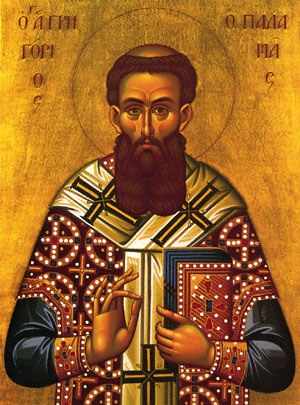
“But when you hear of the vision of God face-to-face, recall the testimony of Maximus: ‘Deification is an enhypostatic and direct illumination which has no beginning, but appears in those worthy as something exceeding their comprehension. It is indeed a mystical union with God, beyond intellect and reason, in the age when creatures will no longer know corruption. Thanks to this union, the saints, observing the light of the hidden and more-than-ineffable glory, become themselves able to receive the blessed purity, in company with the celestial powers”
~ St. Gregory Palamas, The Triads, III.i.28
St. Gregory of Nyssa: Moses and “Luminous Darkness”… “seeing that consists in not seeing”.
Posted by Dallas Wolf in Hesychasm - Jesus Prayer, Monasticism, Patristic Pearls, Theology on March 15, 2015
St. Gregory of Nyssa (c. 335 – c. 395), is one of the three Great Cappadocian Fathers along with his older brother, St. Basil the Great, and friend, St. Gregory of Nazianzus. I especially love Gregory Nyssen for his deep spirituality and mysticism. He was a highly original and sophisticated thinker who remains controversial among both liberal and conservative theologians to this day. In his treatise The Life of Moses, St. Gregory tells us that a person’s encounter of the mystery of God corresponds to the three theophanies of Moses, involving successive entry into light, cloud, and darkness.
According to St. Gregory Nyssen, the first stage in our quest to encounter God is Moses’ vision of God as the light of the burning bush; illuminating the darkness of our sin and ignorance. The second stage involves a journey from light into partial darkness where Moses encounters God as the ‘cloud’; the intermingling of light and darkness, revealing the distance between the Creator and the created realm. The third and final stage entails Moses entering the darkness of Sinai where God is; and our realization upon encountering and even being united with God that He is utterly incomprehensible in his essence.
In this treatment, I think, St. Gregory of Nyssa clearly identifies both cataphatic and apophatic theology, bridges the two and holds the tension between them, drawing the best from both.

“What does it mean that Moses entered the darkness and then saw God in it? What is now recounted seems somehow to be contradictory to the first theophany, for then the divine was beheld in light but now He is seen in darkness. Let us not think that this is at variance with the sequence of things we have contemplated spiritually. Scripture teaches by this that religious knowledge comes at first to those who receive it as light. Therefore what is perceived to be contrary to religion is darkness; an escape from darkness comes about when one participates in the light. But as the mind progresses and, through an ever greater and more perfect diligence, comes to apprehend reality, as it approaches more nearly to contemplation, it sees more clearly that God cannot be contemplated. For leaving behind everything that is observed, not only what sense comprehends but also what the intelligence thinks it sees, it keeps on penetrating deeper until by the intelligence’s yearning for understanding it gains access to the invisible and the incomprehensible and there it sees God. This is the true knowledge of what is sought; this is the seeing that consists in not seeing, because that which is sought transcends all knowledge, being separated on all sides by incomprehensibility as by a kind of darkness. Therefore, John the sublime who penetrated into the luminous darkness [λαµπρός γνόφος – lamprós gnóphos], says “no one has ever seen God,” thus asserting that knowledge of the divine essence is unattainable not only by humans but also by every intelligent creature. When, therefore, Moses grew in knowledge, he declared that he had seen God in the darkness, that is, that he had then come to know that what is divine is beyond all knowledge and comprehension, for the text says,’Moses approached the dark cloud where God was‘.”
~ from: The Life of Moses
Maximos the Confessor: “How is unceasing prayer possible?”
Posted by Dallas Wolf in Hesychasm - Jesus Prayer, Patristic Pearls, Theology on February 28, 2015

“How is unceasing prayer possible? When we are singing the Psalms, when we are reading the Scriptures, when we are serving our neighbor, even then it is easy enough for the mind to wander off after irrelevant thoughts and images.
Yet the Scriptures do not require impossibilities. St. Paul himself sang the Psalms, read the Scriptures, offered his own apostolic service, and nonetheless prayed uninterruptedly.
Unceasing prayer means to have the mind always turned to God with great love, holding alive our hope in Him, having confidence in Him whatever we are doing and whatever happens to us.
That is the attitude that the Apostle had when he wrote: ‘Who shall separate us from the love of Christ?”…
Thanks to this attitude of mind, Paul prayed without ceasing. In all that he did and in all that happened to him, he kept alive his hope in God.”
– St. Maximos…
View original post 5 more words
St. Diadochos of Photiki: “Early Mention of the ‘Jesus Prayer’, c. AD 450”
Posted by Dallas Wolf in Hesychasm - Jesus Prayer, Patristic Pearls on January 11, 2015
St. Diadochos of Photiki (c. AD 400 – c. 486). One of the earliest written references to the “Jesus Prayer”; “the remembrance of the glorious and holy name of the Lord Jesus…“
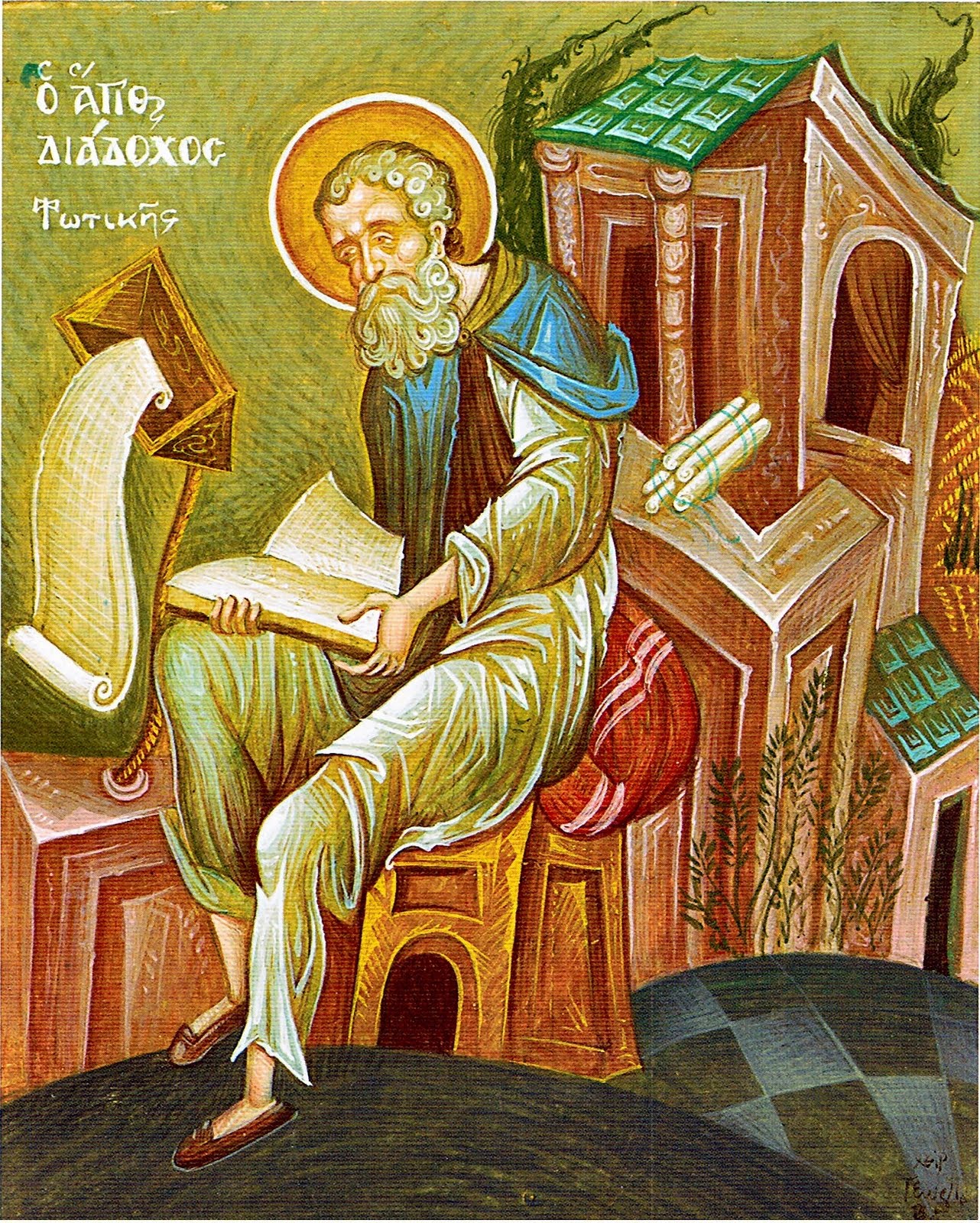
“When our intellect begins to perceive the grace of the Holy Spirit, then Satan, too, importunes the soul with a sense of deceptive sweetness in the quiet times of the night, when we fall into a light kind of sleep. If the intellect at that time cleaves fervently to the remembrance of the glorious and holy name of the Lord Jesus and uses it as a weapon against Satan’s deception, he gives up this trick and for the future will attack the soul directly and personally. As a result the intellect clearly discerns the deception of the evil one and advances even further in the art of discrimination.”
~ from: “On Spiritual Knowledge and Discrimination. One Hundred Texts“, No. 31. From Philokalia, Vol. 1.
Metropolitan Kallistos (Ware): “Inner Meaning of The Jesus Prayer”
Posted by Dallas Wolf in Hesychasm - Jesus Prayer, New Nuggets on January 2, 2015
 “There is a story told from 18th century France of an old man who used to go for a long time each day into Church. His friends asked him: “What are you doing all the time in Church?” “I’m praying”, he said. And they answered: “You must have a great many things to ask God, if you take such a long time praying?” With indignation he responded: “I’m not asking God for anything!” “Well”, they said, “what are you doing all that time in Church?”
And he replied: “I just sit and look at God and God sits and looks at me”.
That is one of the best definitions that I know of prayer. And it sums up the Jesus Prayer in particular; it is a way of sitting and looking at God!
Let us now consider a little the inner meaning of the Jesus Prayer. In the Sermon of the Mount Christ says: “When you pray do not use vain repetitions”. Don’t heap up empty phrases as the heathen do thinking that they will be heard because of their many words. Does then the Jesus Prayer come under Christ’s rebuke? Certainly it is a repetition, but it is not a vain repetition if it is said with faith and with love. Within the Jesus Prayer every word has weight, every word has meaning. It is not verbosity, but the Jesus Prayer is on the contrary, a precise and eloquent confession of faith.
Let us explore then a little of the meaning of the Jesus Prayer. In that very attractive 19th century Russian text; attractive, but also in some ways misleading: The Tales of a Pilgrim. It is said, that the Jesus Prayer contains the whole of the Gospel; all embracing. In what way? First, the Jesus Prayer contains the two poles, the two moments of Christian experience. And these two moments are: adoration and penitence, or glory and forgiveness. There is in the Jesus Prayer a circular movement, a double movement of assent and return. First we ascend to God in adoration “Lord Jesus Christ, Son of God” and then we return to ourselves in penitence “have Mercy on me the sinner”.
Now, the gulf, the abyss between the divine glory and our human brokenness is bridged in the Jesus Prayer by two words “Jesus” and “Mercy”. In this connection we need to recall the literal meaning of the name Jesus. It means: Salvation! As the angel says before the birth of Christ (Matt 1:21): “You shall call his name Jesus, for he shall save his people from their sin”.
First of all then, the gulf between glory and sin is bridged by Jesus, who is salvation. Then the other bridge building word in the Jesus Prayer is the word “Mercy”, Eleos in Greek. What does the word “Mercy” mean to you? For me it means love in action, love poured out to heal, to reconcile, to renew. Sometime people say to me that the Jesus Prayer is a rather gloomy prayer. I don’t experience it in that way. I see it as a prayer full of light and hope, because it speaks of Salvation and of Mercy.” ~ From a lecture delivered in 1997
Stăniloae: “The latter [apophatic knowledge] is superior to the former [cataphatic knowledge] because it completes it.”
Posted by Dallas Wolf in Hesychasm - Jesus Prayer, New Nuggets, Theology on December 7, 2014
Dumitru Stăniloae (1903 – 1993) was an Orthodox priest and renowned as an Orthodox theologian, academic, and professor. In addition to commentary on the works of the Church Fathers Maximus the Confessor, Gregory Palamas, and Athanasias, his 1978 masterpiece “The Dogmatic Orthodox Theology” established him as one of the foremost Christian theologians of the later half of the twentieth century.
 “According to patristic tradition, there is a rational or cataphatic knowledge of God, and an apophatic or ineffable knowledge. The latter is superior to the former because it completes it. God is not known in his essence, however, through either of these. We know God through cataphatic knowledge only as creating and sustaining cause of the world, while through apophatic knowledge we gain a kind of direct experience of his mystical presence which surpasses the simple knowledge of him as cause who is invested with certain attributes similar to those of the world. This latter knowledge is termed apophatic because the mystical presence of God experienced through it transcends the possibility of being defined in words. This knowledge is more adequate to God than is cataphatic knowledge.” Dogmatic Orthodox Theology, I-95
Saint Maximus the Confessor: “Flee from self-love”, philautía (φιλαυτία)
Posted by Dallas Wolf in Hesychasm - Jesus Prayer, Patristic Pearls on November 28, 2014
“Flee from self-love, the mother of malice, which is an irrational love for the body. For from it are born the three chief sinful passions: gluttony, avarice, and vainglory, which take their causes from bodily needs, and from them all the tribe of the passions is born. This why we must always oppose self-love and fight against it. Whoever rejects self-love will easily conquer all the other passions with the help of God: anger, despondency, rancor, and the others. But whoever is retained by self-love will even unwillingly be conquered by the above-named passions.”
– Saint Maximus the Confessor
St. Gregory of Nyssa – “… only wonder grasps anything”
Posted by Dallas Wolf in Hesychasm - Jesus Prayer, Monasticism, Patristic Pearls on August 5, 2014
St. Gregory of Nyssa (c. AD 335 – 395) – Along with his older brother, Basil of Caesarea, and their friend, Gregory of Nazianzus, Nyssen was one the three great Cappadocian Fathers of the 4th century. He was also younger brother of St. Macrina the Younger; virgin, mystic, monasatic, wonder worker, and philosopher of God.
“Concepts create idols; only wonder grasps anything; People kill one another over idols. Wonder makes us fall to our knees.”
~ from: The Life of Moses
Maximus: “The scriptural Word knows of two kinds of knowledge of divine things.”
Posted by Dallas Wolf in Hesychasm - Jesus Prayer, Patristic Pearls, Theology on July 3, 2014
Maximus the Confessor (c. 580 – 662) was a 7th century Christian monk, theologian, and scholar who many contemporary scholars consider to be the greatest theologian of the Patristic era. Two of his most famous works are “Ambigua” – An exploration of difficult passages in the work of Pseudo-Dionysius and Gregory of Nazianzus, focusing on Christological issues, and “Questions to Thalassius” or “Ad Thalassium” – a lengthy exposition on various Scriptural texts. This quote is from the latter work. It affirms the primacy of experience in an authentic spiritual life.
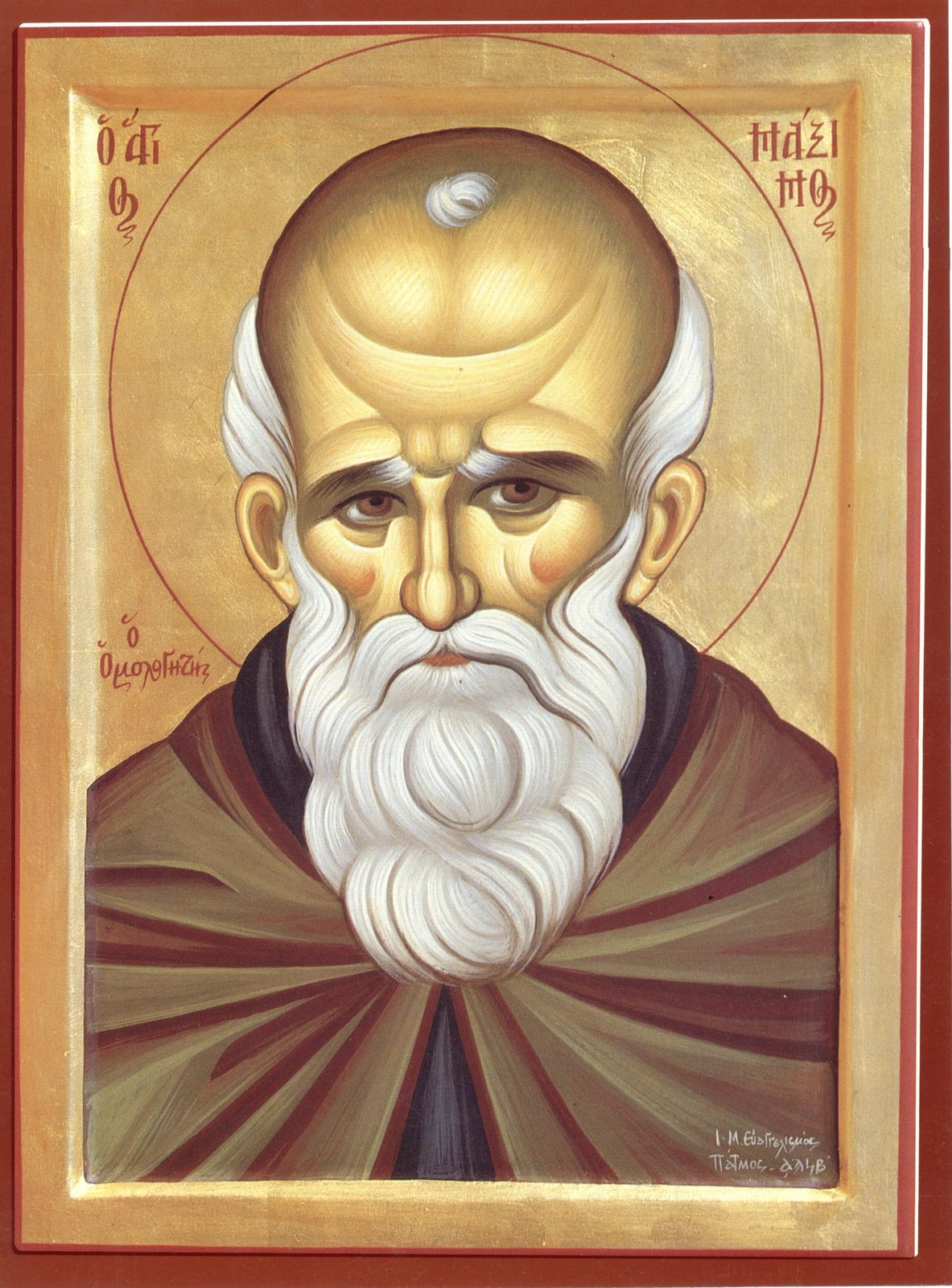
Maximus the Confessor (c. 580 – 662)
“The scriptural Word knows of two kinds of knowledge of divine things. On the one hand, there is relative knowledge, rooted only in reason and ideas, and lacking in the kind of experiential perception of what one knows through active engagement; such relative knowledge is what we use to order our affairs in our present life. On the other hand, there is that truly authentic knowledge, gained only by actual experience, apart from reason and ideas, which provides a total perception of the known object through a participation by grace. By this latter knowledge, we attain, in the future state, the supernatural deification that remains unceasingly in effect.” ~ Ad Thalassium 60
St. Symeon the New Theologian: “…by what other means can he ever obtain salvation? By no means!”
Posted by Dallas Wolf in Hesychasm - Jesus Prayer, Monasticism, Patristic Pearls on June 22, 2014
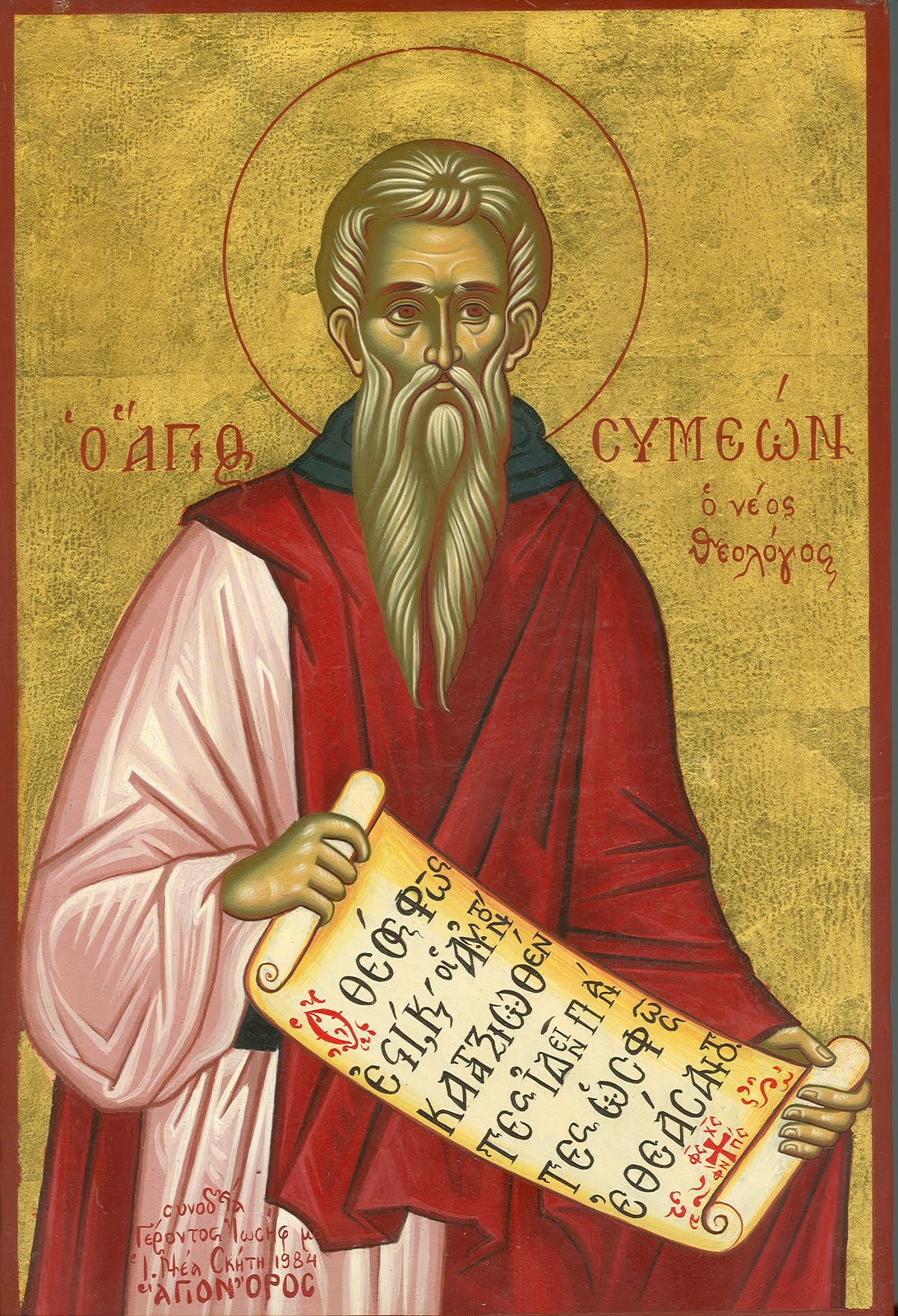
St. Symeon the New Theologian (949-1022) was absolutely insistent that every believer must receive a second baptism, the Baptism of the Holy Spirit. It is not to be confused with ritual Orthodox Chrismation.
“… ‘John Baptized with water, but you shall be baptized with the Holy Spirit’. If one is ignorant of the Baptism wherewith he was baptized as a child and does not even realize that he was baptized, but only accepts it by faith and then wipes it away with thousands upon thousands of sins, and if he denies the second Baptism – I mean, that which is through the Spirit, given from above by the loving-kindness of God to those who seek it by penitence – by what other means can he ever obtain salvation? By no means!”
~ from: The Discourses. XXXII
 First Thoughts