Archive for category New Nuggets
Good Science and Good Religion cannot be in Conflict.
Posted by Dallas Wolf in First Thoughts, New Nuggets on October 22, 2017
I do not believe that there is any real conflict between good science and good religion. There can’t be. If both science and religion genuinely seek truth and God is truth, they both seek the same thing. They are two sides of the same coin. The problem arises when either science or religion becomes entrenched and dogmatic in a theory or idea. This is where the conflict arises: Bad science and/or bad religion. The classic case is the Roman Catholic Church against Copernicus and Galileo and the heliocentric solar system. “You say the sun doesn’t revolve around the earth? Heresy, I say!”, said Pope. That was pretty stupid. But, to be fair, both sides have been guilty of arbitrarily turning speculation and theory into hard fact without total understanding or certainty.
In our contemporary world, it seems to me that science is often times doing better theology than the theologians. This is especially true in the field of Physics, including astro-physics, radio astronomy, and small particle physics. Let’s look at three examples:
Example 1: The Big Bang and the Voice of God
The Big Bang model is the prevailing cosmological theory of the origin of the universe. It postulates that the universe began as a very small, very dense, and extremely hot “ball” anywhere from the size of an atom to that of an orange. When this dense extremely hot “ball of fire” exploded it produced a “Big Bang” expanding outward in all directions, expanding into what our universe is today.
But, from where did this Big Bang come from? Theology had already provided an answer. In the beginning when God created all things he simply spoke—and it came forth from the word of his mouth! “And GOD SAID, Let there be light: and there was light” (Gen 1:3). The writer of Hebrews informs us that “The worlds were framed by the word of God, so that things which are seen were not made of things which do appear” (Heb. 11:3). In other words . . . God SPOKE, and BANG, it was!
But, back to science. Bell Labs built a giant antenna in Holmdel, New Jersey, in 1960. It was part of a very early satellite transmission system. Two employees of Bell Labs had their eye on the antenna. Arno Penzias, a German-born radio astronomer, joined Bell Labs in 1958. He knew the Holmdel antenna would also make a great radio telescope and was dying to use it to observe the universe. Another radio astronomer, Robert Wilson, came to Bell Labs in 1962 with the same idea.
When they began to use the Holmdel antenna as a telescope they found there was a background “noise” (like static in a radio). This annoyance was a uniform signal in the microwave range, seeming to come from all directions. Everyone assumed it came from the telescope itself, which was not unusual. Penzias and Wilson had to get rid of it to make the observations they planned. They checked everything to rule out the source of the excess radiation. It wasn’t urban interference. It wasn’t radiation from our galaxy or extraterrestrial radio sources. It wasn’t even the pigeons living in the big, horn-shaped antenna. Penzias and Wilson had to conclude it was not the antenna and it was not random noise causing the radiation.
Penzias and Wilson began looking for theoretical explanations. Around the same time, Robert Dicke at nearby Princeton University had been pursuing theories about the Big Bang. He had elaborated on existing theory to suggest that if there had been a Big Bang, the residue of the explosion should by now take the form of a low-level background radiation throughout the universe. Dicke was looking for evidence of this theory when Penzias and Wilson got in touch with his lab.
They didn’t realize it, but with their discovery of background cosmic microwave radiation in 1965. . . Penzias and Wilson were perhaps listening to the echoes of the creational voice of God! They won the Nobel Prize in Physics in 1978 for their discovery.
Example 2. Empty Space or a Relational Universe.
The second example also comes from Physics. Science believes that only about 5% of the universe is made up of “normal” matter. But, the remaining 95% of the universe is not empty. Scientists speculate that the balance of the universe is made up of what they describe as “dark energy” (~68%) and “dark matter” (~27%). They aren’t sure exactly what either of these are, but they know they exist because of the measurable effects of the relationships between them and “normal” matter.
Scientists are finding that the energy is in the space between the particles of the atom and between the planets and the stars. They are discovering that reality is absolutely relational at all levels.
This is exactly what Christian mystics have been telling religion and the rest of the world for two thousand years. “God is love, and he who abides in love abides in God, and God in him.” (1 John 4:16)
Example 3. More “Dimensions” Than We Thought
The last example comes to us from small particle physics. The “M theory” of small particle physics indicates (mathematically) that in addition to our classic four dimensions of spacetime (three dimensions in space: up/down, left/right, and forward/backward, and one dimension of time: later/earlier) there may be as many as seven additional dimensions we virtually know nothing about; for a total of 11 dimensions in theoretical spacetime.
Perhaps one or more of those seven additional dimensions of spacetime might be “spiritual” dimensions. Or perhaps all eleven dimensions may be evidence of the Divine Triune perichoresis, or circle-dance, which manifests in our spacetime yet also transcends it into the other dimensions that we just don’t have the “eyes” to see.
Regardless of the propensity of both science and religion to claim false certainties, I firmly believe that scientists and theologians alike are climbing different sides of the same mountain.
Met. Kallistos (Ware): “On the Jesus Prayer”
Posted by Dallas Wolf in Hesychasm - Jesus Prayer, New Nuggets on October 21, 2017
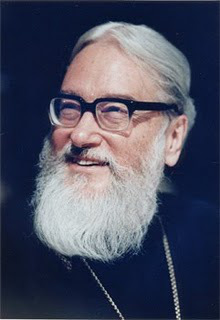
Metropolitan Kallistos (Ware) of Diokleia – (b. 1934) is a titular metropolitan of the Orthodox Ecumenical Patriarchate in Great Britain. From 1966-2001, he was Spalding Lecturer of Eastern Orthodox Studies at Oxford University, and has authored numerous books and articles pertaining to the Orthodox faith.
“There is a Trinitarian dimension to the most dearly-loved of single-phrase Orthodox prayers, the Jesus Prayer, an ‘arrow prayer’ used both at work and during times of quiet. In its most common form this runs: Lord Jesus Christ, Son of God, have mercy on me a sinner. This is, in outward form, a prayer to the second person of the Trinity, the Lord Jesus Christ. But the other two persons are also present, although they are not named. For, by speaking of Jesus as ‘Son of God’, we point towards his Father; and the Spirit is also embraced in our prayer, since ‘no one can say “Lord Jesus”, except in the Holy Spirit’ (1 Cor. 12:3). The Jesus Prayer is not only Christ-centered but Trinitarian.
Let us now consider what it has to tell us about the Incarnation of Jesus Christ, and about our healing by and in him.
There are in the Jesus Prayer two ‘poles’ or extreme points. ‘Lord … Son of God’: the Prayer speaks first about God’s glory, acclaiming Jesus as the Lord of all creation and the eternal Son. Then at its conclusion the Prayer turns to our condition as sinners- sinful by virtue of the fall, sinful through our personal acts of wrongdoing: ‘. . . on me a sinner’. (In its literal meaning the Greek text is yet more emphatic, saying ‘on me the sinner’, as if I were the only one.)
So the Prayer begins with adoration and ends with penitence. Who or what is to reconcile these two extremes of divine glory and human sinfulness? There are three words in the Prayer which give the answer. The first is ‘Jesus’, the personal name conferred on Christ after his human birth from the Virgin Mary. This has the sense of Saviour: as the angel said to Christ’s foster-father St Joseph: ‘You shall call his name Jesus, for he shall save his people from their sins’ (Matt. 1:21).
The second word is the title ‘Christ’, the Greek equivalent of the Hebrew ‘Messiah’, meaning the Anointed One – anointed, that is, by the Holy Spirit of God. For the Jewish people of the Old Covenant, the Messiah was the coming deliverer, the future king, who in the power of the Spirit would set them free from their enemies.
The third word is ‘mercy’, a term that signifies love in action, love working to bring about forgiveness, liberation and wholeness. To have mercy is to acquit the other of the guilt which by his own efforts he cannot wipe away 1 to release him from the debts he himself cannot pay, to make him whole from the sickness for which he cannot unaided find any cure. The term ‘mercy’ means furthermore that all this is conferred as a free gift: the one who asks for mercy has no claims upon the other, no rights to which he can appeal.
The Jesus Prayer, then, indicates both man’s problem and God’s solution. Jesus is the Saviour, the anointed king, the one who has mercy. But the Prayer also tells us something more about the person of Jesus himself. He is addressed as ‘Lord’ and ‘Son of God’: here the Prayer speaks of his Godhead, of his transcendence and eternity. But he is addressed equally as ‘Jesus’, that is, by the personal name which his mother and his foster-father gave him after his human birth in Bethlehem. So the Prayer speaks also of his manhood, of the genuine reality of his birth as a human being.
The Jesus Prayer is thus an affirmation of faith in Jesus Christ as alike truly divine and fully human. He is the Theanthropos or ‘God-man’, who saves us from our sins precisely because he is God and man at once. Man could not come to God, so God has to come to man – by making himself human. In his outgoing or ‘ecstatic’ love, God unites himself to his creation in the closest of all possible unions, by himself becoming that which he has created. God, as man, fulfils the mediatorial task which man rejected at the fall. Jesus our Saviour bridges the abyss between God and man because he is both at once. As we say in one of the Orthodox hymns for Christmas Eve, ‘Heaven and earth are united today, for Christ is born. Today has God come down to earth, and man gone up to heaven’.” ~Met. Kallistos (Ware), from The Orthodox Way, p.48, 90-92.
The Orthodox Prayer Rope
Posted by Dallas Wolf in Hesychasm - Jesus Prayer, New Nuggets on October 20, 2017
The prayer rope (Greek: κομποσκοίνι, “komboskini”; Russian: чётки, “chotki”) is part of the habit of Eastern Orthodox monks and nuns and is employed by monastics and by others, clergy and laity alike, to count the number of times one has prayed the Jesus Prayer or, occasionally, other prayers. The prayer rope is traditionally made out of wool, symbolizing the flock of Christ. The traditional color of the rope is black (symbolizing mourning for one’s sins), with either black or colored beads. The beads (if they are colored) are traditionally red, symbolizing the blood of Christ and the blood of the martyrs. Prayer ropes are tied in a loop, terminating in a cross. The original prayer rope had 33 knots to symbolize the age of Jesus Christ when he died. Prayer ropes may come in different lengths in addition to the 33 knot standard to include 50 knot, 100 knot, and even 300 knot lengths.

Though prayer ropes are often tied by monastics, lay persons are permitted to tie them also. In proper practice, the person tying a prayer rope should be of true faith and pious life and should be praying the Jesus Prayer the whole time.
Origins
The invention of the prayer rope is attributed to Saint Pachomius in the fourth century as an aid for illiterate monks to accomplish a consistent number of prayers and prostrations in their cells. Previously, monks would count their prayers by casting pebbles into a bowl, but this was cumbersome, and could not be easily carried about when outside the cell. The use of the rope made it possible to pray the Jesus Prayer unceasingly, whether inside the cell or out, in accordance with Saint Paul’s injunction to “Pray without ceasing” (I Thessalonians 5:17).
The Seven-Cross Knot
It is said that the method of tying the prayer rope had its origins from the Father of Orthodox Monasticism, Saint Anthony the Great. He started by tying a leather rope with a simple knot for every time he prayed Kyrie Eleison (“Lord have Mercy”), but the Devil would come and untie the knots to throw off his count. He then devised a way—inspired by a vision he had of the Theotokos—of tying the knots so that the knots themselves would constantly make the sign of the cross. This is why prayer ropes today are still tied using knots that each contain seven little crosses being tied over and over. The Devil could not untie it because the Devil is vanquished by the Sign of the Cross.
Using the Prayer Rope
When praying, the user normally holds the prayer rope in the left hand, leaving the right hand free to make the Sign of the Cross. When not in use, the prayer rope is traditionally wrapped around the left wrist so that it continues to remind one to pray without ceasing. If this is impractical, it may be placed in the (left) pocket, but should not be hung around the neck or suspended from the belt. The reason for this is humility: one should not be ostentatious or conspicuous in displaying the prayer rope for others to see.
Leonard: “Worship in the Early Church”
Posted by Dallas Wolf in Ekklesia and church, New Nuggets on October 20, 2017
Richard C. Leonard – holds a Ph.D. in Biblical Studies from Boston University (1972) and has taught at the college and graduate level. Below, Dr. Leonard discusses Christian worship in the first two centuries of the church with information from primary sources of the time.
 Worship in the New Testament Church
The New Testament church was a minority movement within a hostile religious environment. The earliest followers of Jesus could not conduct public Christian worship of the type we are accustomed to in the Western world. For this reason, the New Testament does not offer detailed instructions for the order and leadership of worship. However, from its pages we are able to glean some indication of what worship looked like in the church’s earliest days.
The Christian assembly usually met in private homes for worship and instruction (Acts 2:46; 16:40; 18:7; Philem. 1:2). It appears that, in commemoration of the resurrection, the congregation assembled on the “Lord’s Day,” the first day of the week (Acts 20:7; 1 Cor. 16:2). Writing to the church in Corinth, Paul describes two types of Christian gathering. One is the Lord’s Supper (1 Cor. 10:16-17; 11:20-29) or ceremonial community meal, over which Jesus had presided on the night of his arrest and which he had asked his followers to continue. Paul goes on to describe a second type of gathering, the prophetic assembly, which includes both singing and thanksgiving in unknown languages, with interpretation, and prophecy (14:1-33). Perhaps these were two aspects of the same gathering.
Elsewhere the New Testament suggests that Christian worship incorporated singing of hymns and psalms (Eph. 5:19), prayer (1 Cor. 11:4-5), vocal thanksgiving (Eph. 5:20; Heb. 13:15), and instruction (1 Cor. 14:26; Col. 3:16). The Gospel of Luke and the Revelation to John preserve hymns that may have been used in the worship of the early church. The New Testament does not specify who is to officiate in worship, or to administer the Lord’s Supper, although prophets clearly had a role in corporate worship (1 Cor. 14:23-33). Paul’s words indicate that unbelievers occasionally attended the prophetic assembly (1 Cor. 14:22-25), although it would not have been appropriate for them to take part in the Lord’s Supper.
Jesus himself instituted the Lord’s Supper as part of his last Passover celebration with his disciples (Matt. 26:26-29; Mark 14:22-25; Luke 22:14-22.) His words on that occasion (“This is my body . . . ,” “this is my blood . . . ,” “do this in remembrance of me”) suggest a close identification between the elements of bread and wine and the continuing presence of Jesus with his church. Though it is clear that the risen Christ was recognized by his followers “in the breaking of bread” (Luke 24:13-35), the New Testament does not define this relationship as precisely as later theologians might have wished. As the ceremony passed into the practice of the church, it appears that the aspect of blessing and thanksgiving became predominant in a celebration of the oneness of Christ with his followers (1 Cor. 10:16-17). Indeed, the Greek word for giving thanks (eucharisteo) associated with Jesus’ institution of the Lord’s Supper has given us one of the ceremony’s historic names, Eucharist.
Two other sacramental actions established by Jesus were baptism and foot washing. The Gospel of John records that Jesus washed the feet of his disciples on the night of his arrest, as a symbol of the loving servanthood they were to show toward one another (John 13:1-15). However, the rite is not specifically mentioned elsewhere in the New Testament.
Regarding baptism, Jesus himself had been baptized by John the Baptizer as a sign of his role as the Messiah or Son of God (Mark 1:9-11). As practiced by Jesus’ followers after his resurrection, baptism is an act through which a person repents, or turns away from the existing cultural and religious establishment to identify with the new order God has initiated in the resurrection of Jesus (Acts 2:38-39). Such repentance involves acknowledging Jesus as Lord and Messiah (Acts 2:36). Paul gives baptism further theological significance as an act through which one dies to sin and shares in Christ’s resurrection (Rom. 6:3-9). But its basic function as a ceremony is to initiate the new convert into the Christian faith. Jesus had commanded its use for this very purpose, as part of “making disciples” of people from all ethnic groups (Matt. 28:19-20). Since baptism was a rite of initiation, it was not practiced in the setting of a service of worship. Although the symbolism of baptism is best preserved when the new convert is completely immersed in water, the New Testament records several occasions of baptism where that method would have been impractical (such as the 3,000 baptized on the day of Pentecost in Jerusalem, which has no river), and perhaps water was simply poured over the convert’s head.
For more extended discussion of worship in the New Testament, see The Biblical Foundations of Christian Worship, Volume I of The Complete Library of Christian Worship.
The Didache or Teaching of the Twelve Apostles
The Didache (pronounced “dee-dah-khay’”) or “Teaching” is a manual of church order and Christian living from the late first or early second century. The Greek title is “Teaching of the Lord through the Twelve Apostles.” The Didache was apparently compiled from earlier sources, including material now included in the Gospels. It was rediscovered in 1875. Its importance for Christian worship lies in the fact that it contains the earliest description of the Eucharist outside the New Testament.
The document recommends praying the Lord’s Prayer three times daily. It describes how Christians come together on the Lord’s Day “to break bread and give thanks,” first confessing their sins and being reconciled with their neighbors for a pure sacrifice to the Lord. Only baptized Christians are to partake.
The service of the Eucharist begins with thanksgiving over the cup and the loaf. In offering the cup, the leader gives thanks for “the holy vine of David,” apparently a reference to the Messianic community (Psa. 80:8). A doxology, or expression of praise to God, follows: “To you be glory forever.” Then the leader gives thanks over the broken bread, thanking God “for the life and knowledge you have revealed through Jesus, your child [servant],” concluding with a doxology. Then follows a prayer comparing the bread to the gathering of the church into the kingdom, again ending with a doxology. The community meal, which comes next, is not described.
After the meal, the leader again offers thanksgivings for the Lord’s holy name dwelling within his people, and for God’s creative activity and his provision of food and drink for all people. He then prays that the Lord would deliver the church from evil, perfect it in love, and gather it into his kingdom. Each of these acts concludes with a doxology. The service concludes with responses ending with Maranatha! Amen, and extemporaneous thanksgivings by the church prophets, who are to be allowed to give thanks (eucharist) in their own way, following no particular text.
The order of worship in the Didache follows Jewish forms for “grace” before and after meals. The leader’s prayer does not refer to the body and blood of Jesus; instead, the emphasis is on the gathering of the church body (see 1 Cor. 10:17). It is noteworthy that the prayer and thanksgiving are interlaced with doxologies; the event is a praise-celebration of the congregation of God’s people. The role of prophets is significant; the Didache calls them the church’s “high priests,” and gives instructions on how to welcome prophets and discern true from false. The document does not specify what sort of church official is to preside at the Eucharist.
The Letter of Pliny the Younger
Pliny the Younger (Gaius Plinius Caecelius Secundus, circa 61-113) was a Roman administrator whom the Emperor Trajan had sent to Bithynia, in Asia Minor, to reform the region’s finances and court system. Around AD 112 he wrote to Trajan reporting how he had dealt with Christians in his jurisdiction, and requesting the Emperor’s further advice. The Christian movement had become strong in the region, for the pagan temples were virtually deserted. But the fact that Christians worshiped in secret gatherings had aroused public suspicion. They were being accused of killing infants, eating human flesh, and having incestuous relations, and were considered atheists because they refused to honor the pagan gods.
Pliny was not sure whether Christians should be condemned for specific crimes, or simply because they professed to be followers of Christ. His first tactic was to ask the accused if they were Christians, and then if they persisted in their Christian confession he had them executed because of their obstinacy. But he changed his policy after large numbers of people began to be accused. When a person was charged with being Christian, Pliny gave them the chance to worship pagan divinities and make offerings to their images, including that of the Emperor, and to curse Christ. Using this procedure, Pliny found many people who admitted to having once been Christians but claimed to have renounced the faith. From them he learned what little he knew about Christian worship.
According to these people, “on an appointed day they had been accustomed to meet before daybreak, and to recite a hymn antiphonally to Christ, as to a god.” Then they would take an oath (Latin sacramentum) “to abstain from theft, robbery, adultery, and breach of faith.” After this ceremony they left, but reassembled later on to eat together.
Although Pliny’s knowledge of Christian worship was gained second-hand from people who had abandoned the faith, the general outline is consistent with our other sources and supplements them. We find the Christian community assembling early on the Lord’s day, and then gathering to share a meal. One may assume the meal included the Lord’s Supper, but Pliny reported he was unable to get much more information about the ceremony even after torturing two deaconesses. The word sacramentum referred to an oath taken by Roman soldiers, and its use to describe an act of Christian worship reminds us that worship is basically a pledge of loyalty to the God of the covenant. Finally, Pliny’s account is the only one of our sources that specifically mentions hymns as part of Christian worship. However, since worship in both Old and New Testaments emphasizes “psalms and hymns and spiritual songs,” we must assume that some kind of singing or chanting — in this case an antiphonal or responsive hymn — was a standard component of worship during the earliest Christian centuries.
The First Apology of Justin Martyr
Justin was a seeker after truth who, after a long flirtation with various pagan philosophies, finally embraced the Christian faith. He composed his First Apology in Rome about AD 155. This document is addressed to the Roman Emperor Antoninus Pius (reign AD 137-161), defending the Christian faith against attacks on legal and moral grounds. Justin was later put to death for his faith (about AD 165), and is therefore known to history as Justin Martyr.
In his First Apology, Justin describes both a post-baptismal Eucharist and a Sunday assembly. The first event follows the baptism, or “washing,” of one who has become convinced and confessed Christ. The new Christian is then led to the assembly of “brethren.” Only those who accept the Christian faith and have “received the washing” for forgiveness of sins and for rebirth, and who live by Christ’s principles, are allowed to partake of the Eucharist.
The Eucharist begins with common prayers for the assembly: for themselves, for the new convert, and for others. Then the worshipers greet one another with a kiss. (We should probably understand that men and women were in separate parts of the congregation, so that this greeting was not “coeducational.”) Bread, wine and water are then brought to the president, who offers the eucharistic prayer. The prayer begins by ascribing glory to the Father in the name of the Son and Spirit, and continues with thanksgiving that worshipers have been judged worthy to receive the bread and wine. At the end, the congregation says the Amen.
Deacons then give to those present a portion of the bread, wine and water that have been “eucharistized” (offered thanks over). Justin’s account adds, “For we do not receive these things as common bread or common drink; but as Jesus Christ our Savior being incarnate by God’s word took flesh and blood for our salvation, so also we have been taught that the food consecrated by the word of prayer which comes from him, from which our flesh and blood are nourished by transformation, is the flesh and blood of the incarnate Jesus.” Justin then repeats Jesus’ words in delivering the bread and cup at the Last Supper. At the conclusion of the service, the Eucharist is also taken to those members of the Christian community who were absent. Justin goes on to mention the ongoing common life of the Christian community, in which “those who have more come to the aid of those who lack,” and God is blessed for his gifts.
The other event Justin describes is the Sunday assembly “in one place.” He explains that the community gathers on Sunday, or the first day, both because it was the first day of creation and because on it Jesus rose from the dead.
The service begins with readings from the “memoirs of the apostles” (the Gospels) or writings of the prophets, as long as time allows. Then the president teaches from the Scriptures. The speaker was probably seated while the people stood, as was the custom in ancient times (see Matt. 5:1). Prayers and the celebration of the Eucharist follow, as described above. At the end, those who have prospered voluntarily bring their gifts to the president, who will distribute them to those in need.
The worship Justin describes reveals a further development of Christian liturgy beyond the ceremony described in the Didache. There is a formal offertory for the elements of bread and wine, which are now associated with the body and blood of Christ. They do not here signify the gathering of the church, although the corporate solidarity of the community is evident in the setting for the Eucharist. The Sunday assembly combines the service of the Word, or reading and teaching from Scripture, with the Eucharist or service of the Lord’s table; this was to become the historic sequence of Christian worship. There is a greater role and responsibility for the president and deacons, while the prophets of the Didache are not mentioned. The description of the post-baptismal Eucharist makes it clear that the unbaptized were not present for the Eucharist. If during the Sunday gathering they were present for the readings and the president’s discourse, they would have been dismissed before the prayers.
The Apostolic Tradition of Hippolytus
Around AD 200 Hippolytus, a Roman clergyman, composed a manual of church order and worship known as the Apostolic Tradition. In this document, Hippolytus describes a Eucharist in two settings: one following the consecration of a bishop, and one following baptism and confirmation.
The Eucharist at the consecration of a bishop begins with the greeting or kiss of peace. Deacons then bring the elements to the bishop, who with other presbyters (elders) lays his hands on them. Introductory responses, still used in many liturgies, are then spoken:
The Lord be with you.
And with your spirit.
Lift up your hearts.
We have them with the Lord.
Let us give thanks unto the Lord.
It is fitting and right.
The eucharistic prayer is longer than in the previous examples. It begins with thanksgiving for the coming of Jesus, the incarnate Word. It proceeds through the narrative of Christ’s sufferings through which he abolished death, to the words of Jesus’ institution of the Lord’s Supper and the anamnesis (recollection) of Christ’s death and resurrection. The prayer concludes with the invocation of the Holy Spirit upon the assembly, and a doxology.
Hippolytus then indicates that if oil is offered as a gift, it is then blessed, symbolic of the anointing of kings, priests and prophets. A doxology concludes the ceremony. If cheese and olives are offered, they are similarly blessed as symbolic of charity and of the free flow from the tree of life, with a concluding doxology.
In Hippolytus’ second example, the Eucharist after baptism and confirmation, the ceremony begins with the offering by the deacons of bread, wine, milk, honey and water. During the prayer that follows, which Hippolytus does not quote, the bread is to be eucharistized into the “flesh of Christ” and the cup of wine into his blood. The mixed milk and honey, symbolic of the promised land and the nourishment of Christ, is blessed, and also the water, symbolic of cleansing. The bread, and cups of water, milk and wine are then distributed by the presbyters. The cups are served to each worshiper three times, with the following dialogue:
In God the Father Almighty. Amen.
And in the Lord Jesus Christ. Amen.
And in the Holy Spirit in the Holy Church. Amen.
In the Apostolic Tradition of Hippolytus, we note that the elements of the Eucharist are viewed as the representation of the flesh and blood of Christ, having taken on this property through the eucharistic prayer. There is now an invocation of the Holy Spirit (epiklesis), but it is upon the people rather than upon the elements of the Eucharist as in later practice. The church hierarchy shows a greater differentiation; the president is now a consecrated bishop, elevated above other presbyters. There is more elaborate use of symbolism suitable to the different occasions on which the Eucharist is celebrated, but the service of the Word is not mentioned in these examples.
Concluding Observations
Already by the second century, Christian worship had developed beyond what is described in the New Testament. There is a tendency to invent new symbolism not directly present in Scripture. In some cases it is hard to establish a clear linkage between early Christian liturgies and the practice of the New Testament church.
On one important point, however, the second-century sources agree with the witness of the New Testament: Christian worship centered in the celebration of the Lord’s Supper or Eucharist, accompanied by the proclamation of the Word of God. In the case of the second-century church, the Word took the form of the reading and interpretation of Scripture, while in the New Testament period the Word came partly through the activity of prophets. In this twofold structure we see the kernel of the historic fourfold sequence of Christian worship: Entrance, Service of the Word, Service of the Lord’s Table, and Dismissal.
The church was moving from Hebraic culture into Graeco-Roman culture and was undergoing a philosophical transition. The emphasis was shifting from being the people of God to explaining issues of Christian theology. This begins to appear in the writings of the early “fathers” of the church and in early doctrinal disputes, and is reflected in the development of the liturgy. There is a growing tendency to define the way in which the bread and wine are identified with the body and blood of Christ, although the New Testament sources do not.
Understanding early Christian worship is an important aspect of the renewal of Christian worship today. In our efforts to restore Christian worship based on primitive models, however, we must always evaluate what we do in the light of worship as described in Scripture.
The “Ekklesía” of Jesus and Paul is not the “Church” of men.
Posted by Dallas Wolf in Ekklesia and church, First Thoughts, New Nuggets on October 19, 2017
Most English bible translators have interpreted the Greek word “ekklesía” as “church”, but “ekklesía” has nothing to do with the word “church”! Every word study and reference available agree that the word “church” does not come from the original Koine Greek word “ekklesía”, but comes from a different, late Greek word, which has a totally different meaning!
“Ekklesía” means an assembly of the “called out”, or “gathered apart”. In Scripture, it refers to a “convocation, assembly, or congregation”. “Ekklesía” clearly refers to people.
However, the word “church”, as you will learn, is defined as a place (physical building and its associated institutional infrastructure), and not as a people. That is the difference. Now, a group of believers, the Ekklesía, may go to a “church” building to worship God, but the “church” building and its supporting infrastructue is not the Ekklesía.
The English word “church” is derived from the Greek word kyrios, meaning ruler or lord. Specifically, it comes into English in the context of, “kyriake oikia”, “Lord’s house”, which by the 4th century was shortened to the adjective “kyriakon”, “of the Lord”, and was used to denote houses of Christian worship. Neither “kyriake oikia” nor “kyriakon” ever appear in the Greek New Testament referring to a congregation of worshippers or as a place of worship. This association did not occur until about AD 300, 270 years after Jesus’ Crucifixion. Regardless, this is the late Greek word that was first translated into Old English as “cirice”. It was then translated into Middle English as “chirche“, from which we get the modern English word “church”.
The Wycliffe Bible (1385), the first Bible printed in vernacular English, was a translation of the Latin Vulgate Bible (Jerome used “Ecclesiam”), and Wycliffe used the Middle English words “chirche”, “chirches”, and “chirchis” some 111 times in the New Testament.
On the other hand, if you look at William Tyndale’s Bible (1526), which was the first English Bible translated directly from Hebrew and Greek texts, he correctly translated “ekklesía” as “congregation”.
The first recorded use of the Modern English word “church” in a Bible was in 1556 by a Presbyterian follower of John Calvin, Theodore Beza. The following year the New Testament of the Geneva Bible (the Bible of the America’s Pilgrims) was published by Beza’s friend, William Wittingham, and he also used the word “church”. And of course, the later King James Bible of 1611 also uses the term “church”.
The word “ekklesía” is used 115 times in the Greek New Testament, and in most English bibles, it is always incorrectly translated as “church” with the exception of three instances (Acts 19:32,39,41) where it is properly translated as “assembly”.
By the Protestant Reformation, after some 1,200 years of institutional cathedrals, clergy, liturgy, ritual, doctrine and dogma, Jesus’s New Testament concept of “ekklesía” had become so obscured that Protestants, long preceded by Roman Catholic and Orthodox churchmen, considered the Greek word “ekklesía” virtually synonymous with “church”! We continue that convenient institutional rationalization and error today.
“Church” is not found in the original Greek New Testament in either word or concept. It is an afterthought and convenient rationalization of post-apostolic institutional men.
Met. Kallistos: “Dare We Hope for the Salvation of All?”
Posted by Dallas Wolf in New Nuggets, Universal Restoration (Apokatastasis) on October 18, 2017
Metropolitan Kallistos (Ware) (born 1934) – is an English-born bishop and theologian of the Eastern Orthodox Church. From 1966 to 2001, Ware was Lecturer of Eastern Orthodox Studies at the University of Oxford. He has authored numerous books and articles pertaining to the Orthodox Christian faith.
“If the strongest argument in favor of universal salvation is the appeal to divine love, and if the strongest argument on the opposite side is the appeal to human freedom, then we are brought back to the dilemma with which we started: how are we to bring into concord the two principles God is love and Human beings are free? For the time being we cannot do more than hold fast with equal firmness to both principles at once, while admitting that the manner of their ultimate harmonization remains a mystery beyond our present comprehension. What St Paul said about the reconciliation of Christianity and Judaism is applicable also to the final reconciliation of the total creation: “O the depth of the riches and wisdom and knowledge of God! How unsearchable are His judgments and how inscrutable His ways!” (Rom 11:33).
When I am waiting at Oxford Station for the train to London, sometimes I walk up to the northernmost stretch of the long platform until I reach a notice: “Passengers must not proceed beyond this point. Penalty: £50.” In discussion of the future hope, we need a similar notice: “Theologians must not proceed beyond this point”—Let my readers devise a suitable penalty. Doubtless, Origen’s mistake was that he tried to say too much. It is a fault that I admire rather than execrate, but it was a mistake nonetheless.
Our belief in human freedom means that we have no right to categorically affirm, “All must be saved.” But our faith in God’s love makes us dare to hope that all will be saved.
Is there anybody there? said the traveler,
Knocking on the moonlit door.
Hell exists as a possibility because free will exists. Yet, trusting in the inexhaustible attractiveness of God’s love, we venture to express the hope—it is no more than a hope—that in the end, like Walter de la Mare’s Traveller, we shall find that there is nobody there. Let us leave the last word, then, with St Silouan of Mount Athos: ‘Love could not bear that… We must pray for all’.”
~ From “Dare We Hope for the Salvation of All? Origen, St Gregory of Nyssa and St Isaac the Syrian”
Hart: “On Universal Salvation”
Posted by Dallas Wolf in New Nuggets, Universal Restoration (Apokatastasis) on October 18, 2017
David Bentley Hart (born 1965) is an American Orthodox Christian philosophical theologian, cultural commentator and polemicist.
 “If God is the good creator of all, he is the savior of all, without fail, who brings to himself all he has made, including all rational wills, and only thus returns to himself in all that goes forth from him. If he is not the savior of all, the Kingdom is only a dream, and creation something considerably worse than a nightmare. But, again, it is not so. God saw that it was good; and, in the ages, so shall we.” ~From the essay, “God, Creation, and Evil“, (pp. 16-17)
Rohr: “The Jesus Hermeneutic”
Posted by Dallas Wolf in Hermeneutics, New Nuggets on October 18, 2017
Fr. Richard Rohr, OFM, is a Franciscan Priest and contemporary Christian mystic. He is a noted teacher, author, and lecturer and founding Director of the Center for Action and Contemplation in Albuquerque, NM.
 “You deserve to know my science for interpreting sacred texts. It is called a “hermeneutic.” Without an honest and declared hermeneutic, we have no consistency or authority in our interpretation of the Bible. My methodology is very simple; I will try to interpret Scripture the way that Jesus did.
Even more than telling us exactly what to see in the Scriptures, Jesus taught us how to see, what to emphasize, and also what could be de-emphasized, or even ignored. Jesus is himself our hermeneutic, and he was in no way a fundamentalist or literalist. He was a man of the Spirit. Just watch him and watch how he does it (which means you must have some knowledge of his Scriptures!).
Jesus consistently ignored or even denied exclusionary, punitive, and triumphalistic texts in his own Jewish Bible in favor of texts that emphasized inclusion, mercy, and justice for the oppressed. He had a deeper and wider eye that knew what passages were creating a highway for God and which passages were merely cultural, self-serving, and legalistic additions. When Christians state that every line in the Bible is of equal importance and inspiration, they are being very unlike Jesus . . . .
Jesus read the inspired text in an inspired way, which is precisely why he was accused of “teaching with authority and not like our scribes” (Matthew 7:29).” ~ From “Yes, And…: Daily Meditations“
Fortuin: “The Christ Hermeneutic”
Posted by Dallas Wolf in Hermeneutics, New Nuggets on October 18, 2017
Robert F. Fortuin is Adjunct Professor of Orthodox Theology at St Katherine College in San Diego, California.
 “It is my contention that Soli Traditio is as misleading as Sola Scriptura for its failure to acknowledge Christ alone as hermeneutic principle; it is in Christ in whom the authority and meaning—of tradition and scripture—is properly situated…
Christ the Interpreter is the principle of tradition as the context of scripture. The practice of tradition by the Eastern Orthodox constitutes a radical shift of perspective—neither placing authority in text nor in tradition. The authoritative hermeneutic is provided by, and is, the enfleshed Son of God, the crucified and risen Christ. The apostolic Christ provides inspiration, meaning, and illumination; only in Christ resides the authority to bring an end to the false dichotomies of ‘scripture vs tradition’, ‘faith vs works’, ‘clergy vs laity’. These dichotomies are theological and spiritual dead-ends, needless disputes which have embroiled the western Christian churches for far too long. The Orthodox do not dismiss the Protestant Reformers’ concerns—Christians from the orient direct our gaze to the risen Christ of ‘the faith that was passed down to the saints once and for all’ (Jude 1:3) and in whom alone resides all meaning and authority.” ~ Excerpts from “Sola Scriptura, Holy Tradition, and the Hermeneutics of Christ“, 2017
Louth: “On Universal Salvation”
Posted by Dallas Wolf in New Nuggets, Universal Restoration (Apokatastasis) on October 15, 2017
Fr. Andrew Louth is Professor of Patristic and Byzantine Studies, University of Durham, England. In the last chapter of his book, Introducing Eastern Orthodox Theology, Dr. Louth writes the following about “Universal Salvation” :
 “Origen hoped for the ‘restoration of all’, apokatastasis panton… His conviction did not simply rest on a philosophical belief that ‘the end is like the beginning’ a principle he affirmed several times in On First Principles… There is a deeper reason for Origen’s conviction of final restoration for all: for him it is inconceivable that Christ is to remain in sorrow for all eternity on account of the failure of any rational creature to respond to his love and benefit from his sacrifice.
Whereas in Western theology, such a conviction rapidly dies out, in Orthodox theology hope in universal salvation, based on a conviction of the boundlessness of God’s love, has never gone away. St. Gregory of Nyssa interprets the words of the apostle Paul’s teaching that God will be ‘all in all’ (1 Cor. 15.28) to mean the ‘complete annihilation of evil.’ St. Maximos the Confessor likewise holds out the hope of the salvation of all. The grounds for this are principally the long-suffering love of God for all creation, and also the conviction that evil is without substance, but is rather a corruption of distortion of what is good. These two motives find striking expression in St Maximos’ contemporary, St. Isaac the Syrian, who asserts that,
‘there exists within the Creator a single love and compassion which is spread out over all creation, a love which is without alteration, timeless and everlasting… No part belonging to any single one of all rational beings will be lost, as far as God is concerned, in the preparation of that supernatural kingdom’
and then adds, quoting Diodore of Tarsus, ‘not even the immense wickedness of the demons can overcome the measure of God’s goodness.’ The pain of hell is the result of love: ‘those who are punished in Gehenna are scourged by the scourge of love… For the sorrow caused in the heart by sin against love is more poignant than any torment.’ Evil and hell cannot be eternal: ‘Sin, Gehenna, and death do not exist at all with God, for they are effects, not substances. Sin is the fruit of free will. There was a time when sin did not exist, and there will be a time when it will not exist.’
This conviction that there is nothing outside God’s loving care finds expression in the prayers of the Orthodox Church. In the service of kneeling at Vespers on the evening of Pentecost, we pray ‘for those who are held fast in hell, granting us great hopes that there will be sent down from you to the departed repose and comfort from the pains which hold them’. This hope, amounting to a conviction, that there is nothing beyond the infinite love of God, that there is no limit to our hope in the power of his love, at least regards as a legitimate hope the universal salvation of all rational creatures, maybe even of the devil himself and his demons. Such a belief has found its defenders among modern Orthodox theologians, such as Olivier Clément, Metropolitan Kallistos Ware and Metropolitan Hilarion Alfeyev. It was also the conviction of one of the greatest Orthodox saints of recent times, St. Silouan of Athos, manifest in a conversation with another Athonite hermit, who declared ‘with evident satisfaction’,
‘God will punish all atheists. They will burn in hell in everlasting fire’.
Obviously upset, the Staretz said,
‘Tell me, supposing you went to paradise, and there looked down and saw somebody burning in hell-fire – would you feel happy?’
‘It can’t be helped. It would be their own fault’, said the hermit.
The Staretz answered with a sorrowful countenance:
‘Love could not bear that’, he said, ‘We must pray for all’.”
 First Thoughts