Posts Tagged eastern orthodox tradition
The Concept of “Person” 8
Posted by Dallas Wolf in Concept of "Person" (series) on July 1, 2014
“It is the “person” that recognizes that it is created in the image of God with the single purpose to attain to His likeness…”
Hierotheos Vlachos then summed up for us all of the church Fathers’ thinking on the concept of “person”: “In the teaching of the holy Fathers, to be in the image is potentially to be in the likeness, and being in the likeness is actually the image. In the same way the man created by God and recreated by the Church through Holy Baptism, is potentially a person. But when, through his personal struggle, and especially by the grace of God, he attains the likeness, then he is actually a person.”
Hierotheos brings the concept of “person” into the context of 21st century society. He tells us that becoming a “person” takes some real work and effort, “The theology of man as a person can play an important part in contemporary society. To be sure, the person par excellence is God, but man too, as created in the image and likeness of God, can become a person… But, in order to reach this point it is necessary to live the asceticism of the person. The Fathers of the Church give great weight to this matter… If we do not look at the ascetic dimension of the human person, then we fail to see the patristic teaching concerning the person, no matter how many patristic references we may use.”
Vlachos concludes his thoughts by speaking about the value the teaching about the “person” can be to society: “The teaching about the human person will solve many problems which are arising every day. Love, freedom, the solution to social problems, anguish and insecurity, the eastern religions, dialogue, [and] psychological phenomena cannot be cured and confronted apart from the patristic teaching about man and about the person.”
Given what we have learned here, it is no surprise that the concept of “person” has been lost to “individual”-obsessed Western culture, including the church. The concept of “person” has been reduced to being equated with “individual”. I think all of us have had the uneasy feeling that the fundamental self-centeredness and worldliness inherent with modern society’s idolatry with “individuality” might somehow fall short of God’s plan for us. Now we can see that indeed it does and, better yet, why.
The “individual” is an instance of human nature; the self-centered, ego driven subsistence of human nature that pits itself and defends its interests against all other individuals. The “person” is not the same; it includes the “individual” and yet transcends it. It is the “person” that recognizes that it is created in the image of God with the single purpose to attain to His likeness in an intimate relationship of agape love for humankind and for all creation, bringing the created world along to union with God; “partaking of the divine nature”.
Lossky: “The man who is governed by his nature… is the least personal.”
Posted by Dallas Wolf in New Nuggets on June 30, 2014
Vladimir Lossky – (1903 – 1958) was one of the most influential Orthodox Christian theologians of the 20th century. He emphasized theosis as the main principle of Orthodox Christianity.

Vladimir Lossky (1903-1958)
“The man who is governed by his nature and acts in the strength of his natural qualities, of his ‘character’, is the least personal. He sets himself up as an individual, proprietor of his own nature, which he pits against the natures of others and regards as his ‘me’, thereby confusing person and nature.” ~ The Mystical Theology of the Eastern Church
Justin: “Whatever things were rightly said among all men, are the property of us Christians”
Posted by Dallas Wolf in Patristic Pearls on June 28, 2014
St. Justin Martyr (c. 100 – 165) taught that all truth came from the Logos, or Word, of God. Therefore, whatever truth was stated by any human being at any time, anywhere, was the result of the influence of the immanent Logos within him/her; and was, therefore, Christian. It was later generations of Christians that claimed for the institutional Christian church a total monopoly on truth as its sole source and repository… as it does to this day.

St. Justin Martyr
“the teachings of Plato are different from those of Christ, … they are not in all respects similar, as neither are those of the others, Stoics, and poets, and historians. For each man spoke well in proportion to the share he had of the spermatic word [spermatikos logos; the Logos inherent in all humans], seeing what was related to it. But they who contradict themselves on the more important points appear not to have possessed the heavenly wisdom, and the knowledge which cannot be spoken against. Whatever things were rightly said among all men, are the property of us Christians… For all the writers were able to see realities darkly through the sowing of the implanted word [spermatikos logos] that was in them. For the seed and imitation imparted according to capacity is one thing, and quite another is the thing itself, of which there is the participation and imitation according to the grace which is from Him.” Second Apology, 13.
Hierotheos: “Christ as physician; Church as hospital”
Posted by Dallas Wolf in Ekklesia and church, New Nuggets on June 28, 2014
Metropolitan Hierotheos (Vlachos) of Nafpaktos, born in Greece in 1945, is one of the greatest living Christian theologians. The influence of fellow theologian, Fr. John Romanides, the study of the patristic texts (particularly those of the neptic hesychast Fathers of the Philokalia), many years of studying St. Gregory Pálamas, association with the monks of the Holy Mountain (Mount Athos in northern Greece), and many years of pastoral experience, all brought him to the realization that Christian theology is a science of the healing of humankind’s fallen nature and damaged nous and that the early Church Fathers can be of immense help to modern society, so disturbed and afflicted as it is by its many internal and existential problems.

Met. Hierotheos (Vlachos) 1945 –
“In the parable of the Good Samaritan the Lord showed us several truths. As soon as the Samaritan saw the man who had fallen among thieves who had wounded him and left him half-dead, he “had compassion on him and went to him and bandaged his wounds, pouring on oil and wine; and he set him on his own animal, brought him to an inn and took care of him” (Luk. 10:33f). Christ treated the wounded man and brought him to the inn, to the Hospital which is the Church. Here Christ is presented as a physician who heals man’s illnesses, and the Church as a Hospital.” ~ Orthodox Psychotherapy, p.27.
The Logos Doctrine 2
Posted by Dallas Wolf in The Logos Doctrine (series) on June 28, 2014
“The Logos is the universal principle of the self-manifestation of God…”
The Logos is the universal principle of the self-manifestation of God to himself, in himself. That means that whenever God appears, either to himself or outside himself, it is the Logos that appears. The Logos is the first “work” or generation of God as Father.
God the Father is often called eternal mind (nous). The Father, being eternal mind, has the Logos within himself. This means that he has the power of self-manifestation within him. A human analogy would be the fact that there is no mental process going on in a human except in silent words. Likewise, the inner spiritual life of God includes the silent Word within him.
The Logos is a spiritual procession that goes out from God the Father to the created world. It’s the way that God the Father manifests himself to the created world. This procession does not produce separation. The Logos of God is not identical to God; it is the self-manifestation of God. It is like the rays from the sun; it is not the sun, yet it cannot be separated from the sun. If you separate the Logos from God, it becomes empty and without content. As St. Justin Martyr (AD 100–165) says, “The Logos is different from God according to number, but not according to concept.” He is God; he is not the God (the Father), but he is one with God in essence.
The Logos is the principle which gives order the created cosmos. The Logos is the dynamic principle, the providentially working power which directs the natural and moral laws of the universe. It is the natural law to which everything is subject, both matter and living beings.
In the Christian Bible, Logos means both word and reason. In the context of the Old Testament, you would best translate Logos (memra in Aramaic) as word. In New Testament (Greek) terms, you would translate Logos in the more personal sense of reason. This is reason not in the sense of rational, logical “reasoning”, but more in the sense of the meaningful structure of reality. The Logos is present in and permeates throughout all creation; it is ubiquitous in the universe and yet also contains it without being bounded by it.
Logos Doctrine 3
Posted by Dallas Wolf in The Logos Doctrine (series) on June 27, 2014
“This revelation is uniquely Christian.”
In terms of humankind, the Logos gives to every human being an intuitive knowledge of the existence of God and a culturally influenced knowledge of moral laws which we feel the obligation to fulfill in freedom. The Logos also gives structure to the mind or nous. The nous is not the Logos but it is the Logos that gives order to the contents of the nous.
Clement of Alexandria (AD 150-215) believed that humankind should live life according to the Logos (cf. Stromata, 3). Faith, in terms of assent and obedience, is the beginning, but it is not enough. Real participation in God requires the addition of knowledge. Clement does not feel that there is any conflict between faith and knowledge, between reason and revelation. Knowledge enters into faith as one of its constituent elements; reason and reflection are the avenues through which the divine revelation comes.
According to Justin Martyr, the spermatikos logos, the germinal or seminal word, is sown as conscience in the hearts of all humans. According to Justin, the use of reason by people, even in those without express faith in Christ, is already Christ the Logos at work in them. “We have been taught,” St. Justin declared, “that Christ is the First-born of God, and we have declared . . . that he is the Word [Logos] of whom every race of men were partaken, and those who lived reasonable are Christians, even though they have been thought atheists.” First Apology, 46.
The Incarnation of the Logos as a human, Jesus of Nazareth, is a unique revelation of Christianity. Jesus is unique in that he represents not only the incarnation of the Logos of God, but also the Christ (anointed one), the Hebrew Messiah. So, now when we use the word Logos in any post-incarnational discussion, we need to also mentally add “Jesus” and “Christ” to “Son” in our composite picture. To the Stoic idea of Logos as a universal, transcendent principle, Christianity added the very personal dimensions of Son of God and Jesus Christ. This revelation is uniquely Christian.
Logos Doctrine 4
Posted by Dallas Wolf in The Logos Doctrine (series) on June 26, 2014
“…according to the Logos Doctrine, Christianity is very inclusive and universal.”
The incarnation of the Logos, the Son, as Jesus the Christ is a once-for-all event. It is not the incarnation of a particular characteristic or set of characteristics of God; it is the very Logos of God, center of divinity, which becomes incarnate. The incarnation initiates a series of events in the economy, or plan of God for the salvation of humankind.
The saving economy of Jesus Christ, the Logos, are is found in his incarnation which deified the fallen nature of humankind; in his ministry which gave us direct knowledge of God; in his death by which he redeemed us from the bondage of sin; and in the resurrection, which defeated death.
Jesus Christ, as Logos, is first of all a teacher in the sense of giving us existential knowledge and power through the Holy Spirit. Justin Martyr said, “the teachings of Plato are not alien to those of Christ, although not in all respects similar. For all the writers of antiquity were able to have a dim vision of the realities by the means of the implanted word [Logos].” 2nd Apology, 13.
So, you see, according to the Logos Doctrine, Christianity is very inclusive and universal; “catholic”, if you will. It is not the exclusive club, tribe, or competing religion than humans have made of it. Ancient Christianity was inclusive of all truth, regardless of source, place, or time. It included all of humankind, without distinction.
When seen from the viewpoint of the Logos Doctrine, the seemingly exclusive claims of John 14:6 become a declaration of inclusive, cosmic, universal truth. The verse reads: “Jesus said to him, ‘I am the way, the truth, and the life. No one comes to the Father except through me’.” In paraphrase, I believe this means: “I am the Logos, the self-manifestation of God the Father. We are the same in essence, but the Father remains hidden from creation. The only possible way that humankind has to understand and know God is through understanding and knowing the Logos.” This is the cosmic Christ. This is the Way; the “finger pointing to the moon”!
St. Symeon the New Theologian: “… first seek to learn and experience these things in fact…”
Posted by Dallas Wolf in Hesychasm - Jesus Prayer, Monasticism, Patristic Pearls on June 21, 2014
St. Symeon the New Theologian (949-1022) excoriates the church clergy for not personally being contemplatives and experiencing the presence of God (theoria) themselves before trying to lead and teach the laity. This criticism is just as valid for the institutional church today as it was for the Byzantine church in AD 1000. Few, if any, of the contemporary institutional clergy practice contemplative Christian prayer.
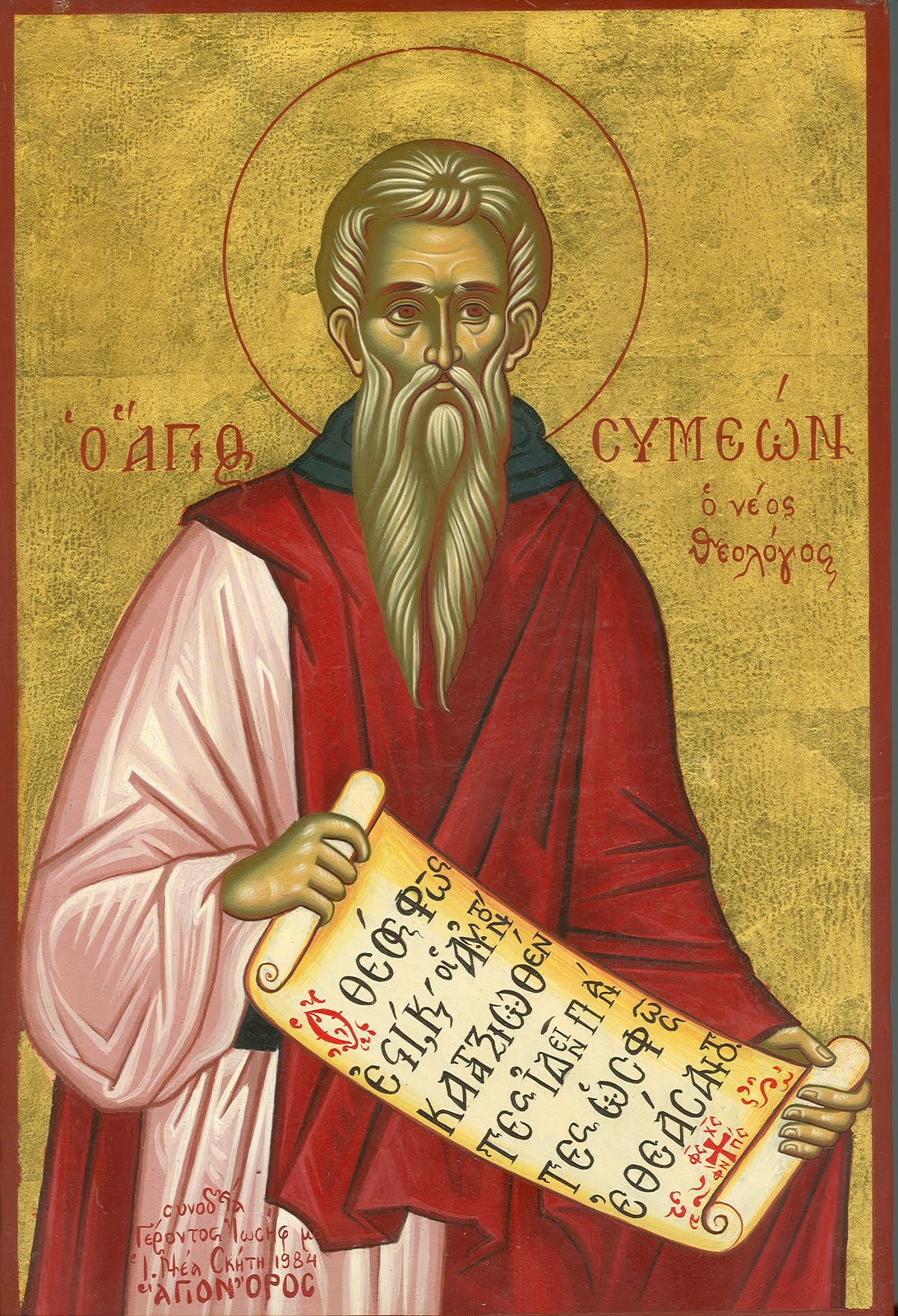
“You priests and monks teach others with vain words and think that you are rulers – but falsely! Ask your elders and high priests, gather yourselves together in the love of God, and first seek to learn and experience these things in fact, and then have the will to see this and by experience become like God. Be anxious not merely to act a play and wear the garment thereof and so to approach apostolic dignities. Otherwise, as you in your imperfection rush to rule over others, before acquiring the knowledge of the mysteries of God, you will hear these words, ‘Woe to those who are wise in their own eyes and shrewd in their own sight! Woe to those who put darkness for light and light for darkness!'”
~ from: Discourses, XXXIII
Nous (νοῦς) – “…the highest faculty in man” 1
Posted by Dallas Wolf in The "Nous" (series) on June 20, 2014
“What’s a “nous”?”
In the last 500 years, since about the time of the Protestant Reformation (16th century) and Enlightenment (17th century), Western culture has been obsessed with the rational, reasoning, logical mind. It has become so dominant in our thinking, that it is now the sole measure of human intelligence. Our fixation with the rational mind is not without foundation. The power of the rational mind has been the engine that gave us the scientific method of inquiry; it brought us the Industrial and Scientific revolutions; the Information Age. It has largely shaped the modern world. So, in modern society, when we speak of “mind” or “intelligence” we mean one thing and one thing only: the rational, reasoning human mind.
For Christians trying to understand the New Testament (originally written in Greek) and other early Christian spiritual writings (also predominantly in Greek), the exclusive association of “mind” and “intelligence” with man’s rational, reasoning faculties is problematic. In Christian spiritual tradition, the rational, reasoning faculty of man is not the only definition of “mind” and “intelligence”. In fact, it is not even considered the highest or most developed definition of “mind” and “intelligence”. That distinction belongs to the “nous”.
What? What’s a “nous”? I’ll bet most Westerners, even mature Christians, have never heard the word “nous”. The word “nous” (pronounced “nooce”) is Greek (νοϋς) and can be found throughout the Greek New Testament (it appears explicitly 22 times in the NT) and in scores of other early Christian (Patristic) writings.
The term “nous” can be thought of as a perceptive or receptive ability to hear God’s voice and to, perhaps, experience Him in His energies. It has often been translated simply as “mind”, as in Paul’s letter to the Romans where he wrote, “And do not be conformed to this world, but be ye transformed by the renewing of your mind [nous], that you may prove what is that good and acceptable and perfect will of God.” (12:2)
More next post.
Nous (νοῦς) – “…the highest faculty in man” 2
Posted by Dallas Wolf in The "Nous" (series) on June 19, 2014
“…the organ of contemplation…, the ‘eye of the heart’…”
The word “nous” has been translated into English as “mind”, “intellect”, and a variety of other meanings as well. The word “mind” was the choice made by Bishop Kallistos Ware (now Metropolitan Kallistos) and others in their translation of the Philokalia (the collection of Christian mystic writings from the 4th to the 15th centuries). But our modern conception of “mind” does not really capture the meaning of “nous”. Some use the word “intellect” as an equivalent. This also misses the nuanced meaning of “nous”. The problem is that we in the modern world only think of “mind” and “intellect” in terms of our rational, reasoning faculties. We can start to get a sense of the real meaning of “nous” from the definition contained in the Philokalia itself. Here, it translates “nous” as “intellect”, but you can see that it is clearly different from our contemporary idea of “intellect”:
“the highest faculty in man, through which – provided it is purified – he knows God or the inner essences or principles … of created things by means of direct apprehension or spiritual perception. Unlike the dianoia or reason…, from which it must be carefully distinguished, the intellect [nous] does not function by formulating abstract concepts and then arguing on this basis to a conclusion reached through deductive reasoning, but it understands divine truth by means of immediate experience, intuition or ‘simple cognition’ (the term used by St Isaac the Syrian). The intellect [nous] dwells in the ‘depths of the soul’; it constitutes the innermost aspect of the heart… The intellect [nous] is the organ of contemplation…, the ‘eye of the heart’ (Makarian Homilies).”
A lot of confusion surrounded the term “nous”, clearly. As a result, many secular philosophers have used it to refer to quite different concepts. “Nous” has been used to refer to anything from personal mental qualities or abilities all the way to qualities ascribed to God or the cosmos.
 First Thoughts