Posts Tagged Heaven and Hell
Macarius the Great: The Pagan Skull
Posted by Dallas Wolf in Heaven and Hell, Universal Restoration (Apokatastasis) on November 25, 2024
Macarius of Egypt (c. 300 – 391) was a Christian monk and Grazer hermit (Greek: βοσκοί, romanized: boskoí) who nourished themselves only with raw plants, often on all fours, and living in a wild manner, “among the beasts. He is also known as Macarius the Elder or Macarius the Great (not to be confused with Macarius of Alexandria).
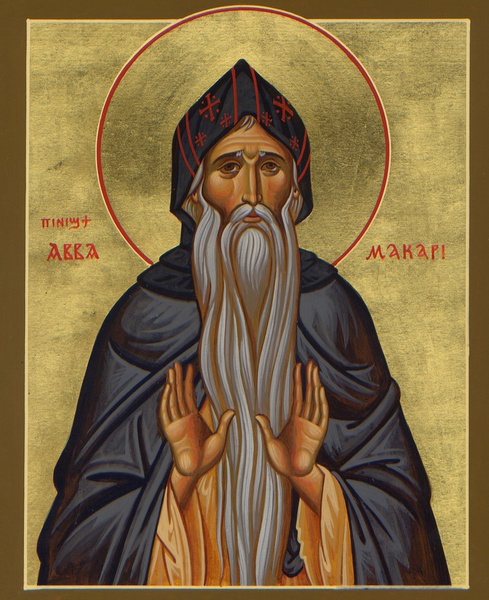
“Abba Macarius said, ‘Walking in the desert one day, I found the skull of a dead man, lying on the ground. As I was moving it with my stick, the skull spoke to me. I said to it, “Who are you?” The skull replied, “I was high priest of the idols and of the pagans who dwelt in this place; but you are Macarius, the Spirit-bearer. Whenever you take pity on those who are in torments, and pray for them, they feel a little respite.” The old man said to him, “What is this alleviation, and what is this torment?” He said to him, “As far as the sky is removed from the earth, so great is the fire beneath us; we are ourselves standing in the midst of the fire, from the feet up to the head. It is not possible to see anyone face to face, but the face of one is fixed to the back of another. Yet when you pray for us, each of us can see the other’s face a little. Such is our respite.” The old man in tears said, “Alas the day when that man was born!” He said to the skull, “Are there punishments which are more painful than this?” The skull said to him, “There is a more grievous punishment down below us.” The old man said, “Who are the people down there?” The skull said to him: “We have received a little mercy since we did not know God, but those who know God and denied Him are down below us.” Then, picking up the skull, the old man buried it.”
(The Sayings of the Desert Fathers, The Alphabetical Collection: Macarius the Great, 38.)
An Orthodox view on Heaven and Hell
Posted by Dallas Wolf in Heaven and Hell, Theology on November 2, 2024
From the The Orthodox Church in America (OCA)
The Kingdom of heaven is already in the midst of those who live the spiritual life. What the spiritual person knows in the Holy Spirit, in Christ and the Church, will come with power and glory for all men to behold at the end of the ages.
The final coming of Christ will be the judgment of all men. His very presence will be the judgment. Now men can live without the love of Christ in their lives. They can exist as if there were no God, no Christ, no Spirit, no Church, no spiritual life. At the end of the ages this will no longer be possible. All men will have to behold the Face of Him who “for us men and our salvation came down from heaven and was incarnate . . . who was crucified under Pontius Pilate, and suffered and was buried . . .” (Nicene Creed). All will have to look at Him whom they have crucified by their sins: Him “who was dead and is alive again” (Rev 1.17–18).
For those who love the Lord, His Presence will be infinite joy, paradise and eternal life. For those who hate the Lord, the same Presence will be infinite torture, hell and eternal death. The reality for both the saved and the damned will be exactly the same when Christ “comes in glory, and all angels with Him,” so that “God may be all in all” (1 Cor 15–28). Those who have God as their “all” within this life will finally have divine fulfillment and life. For those whose “all” is themselves and this world, the “all” of God will be their torture, their punishment and their death. And theirs will be “weeping and gnashing of teeth” (Mt 8.21, et al.).
The Son of Man will send His angels and they will gather out of His kingdom all causes of sin and all evil doers, and throw them into the furnace of fire; there men will weep and gnash their teeth. Then the righteous will shine like the sun in the Kingdom of their Father (Mt 13.41–43).
According to the saints, the “fire” that will consume sinners at the coming of the Kingdom of God is the same “fire” that will shine with splendor in the saints. It is the “fire” of God’s love; the “fire” of God Himself who is Love. “For our God is a consuming fire” (Heb 12.29) who “dwells in unapproachable light” (1 Tim 6.16). For those who love God and who love all creation in Him, the “consuming fire” of God will be radiant bliss and unspeakable delight. For those who do not love God, and who do not love at all, this same “consuming fire” will be the cause of their “weeping” and their “gnashing of teeth.”
Thus it is the Church’s spiritual teaching that God does not punish man by some material fire or physical torment. God simply reveals Himself in the risen Lord Jesus in such a glorious way that no man can fail to behold His glory. It is the presence of God’s splendid glory and love that is the scourge of those who reject its radiant power and light.
. . . those who find themselves in hell will be chastised by the scourge of love. How cruel and bitter this torment of love will be! For those who understand that they have sinned against love, undergo no greater suffering than those produced by the most fearful tortures. The sorrow which takes hold of the heart, which has sinned against love, is more piercing than any other pain. It is not right to say that the sinners in hell are deprived of the love of God . . . But love acts in two ways, as suffering of the reproved, and as joy in the blessed! (Saint Isaac of Syria, Mystic Treatises).
This teaching is found in many spiritual writers and saints: Saint Maximus the Confessor, the novelist Fyodor Dostoevsky. At the end of the ages God’s glorious love is revealed for all to behold in the face of Christ. Man’s eternal destiny—heaven or hell, salvation or damnation—depends solely on his response to this love.
Met. Kallistos Ware: On Hell
Posted by Dallas Wolf in First Thoughts, Heaven and Hell, Universal Restoration (Apokatastasis) on November 2, 2024
Metropolitan Kallistos (Ware) of Diokleia – (1934 – 2022) was a titular metropolitan of the Orthodox Ecumenical Patriarchate in Great Britain. From 1966-2001, he was Spalding Lecturer of Eastern Orthodox Studies at Oxford University, and has authored numerous books and articles pertaining to the Orthodox faith. The following excerpts are taken from Met. Kallistos’ book, The Orthodox Way (1986).

Hell is a point not in space but in the soul. It is the place where God is not. (And yet God is everywhere!) (p. 106)
The Last Judgement is best understood as the moment of truth when everything is brought to light, when all our acts of choice stand revealed to us in their full implications, when we realize with absolute clarity who we are and what has been the deep meaning and aim of our life. And so, following this final clarification, we shall enter – with soul and body reunited – into heaven or hell, into eternal life or eternal death.
Christ is the judge; and yet, from another point of view, it is we who pronounce judgement upon ourselves. If anyone is in hell, it is not because God has imprisoned him there, but because that is where he himself has chosen to be. The lost in hell are self-condemned, self-enslaved; it has been rightly said that the doors of hell are locked on the inside. (p. 181)
How can a God of love accept that even a single one of the creatures whom he has made should remain for ever in hell? There is a mystery here which, from our standpoint in this present life, we cannot hope to fathom. The best we can do is to hold in balance two truths, contrasting but not contradictory. First, God has given free will to man, and so to all eternity it lies within man’s power to reject God. Secondly, love signifies compassion, involvement; and so, if there are any who remain eternally in hell, in some sense God is also there with them. It is written in the Psalms, ‘If I go down to hell, thou art there also’ (139:7); and St. Isaac the Syrian says, ‘It is wrong to imagine that sinners in hell are cut off from the love of God.’ Divine love is everywhere, and rejects no one. But we on our side are free to reject divine love: we cannot, however, do so without inflicting pain upon ourselves, and the more final our rejection the more bitter our suffering. (p.182)
 First Thoughts