Posts Tagged Jesus Ministry
Fr. Richard Rohr, OFM: “Jesus the Prophet”
Posted by Dallas Wolf in Ekklesia and church, New Nuggets, Theology on October 15, 2025
In a homily Father Richard Rohr, OFM, describes the tension between priestly and prophetic tasks—both necessary for healthy religion:

There are two great strains of spiritual teachers in Judaism, and I think, if the truth is told, in all religions. There’s the priestly strain that holds the system together by repeating the tradition. The one we’re less familiar with is the prophetic strain, because that one hasn’t been quite as accepted. Prophets are critical of the very system that the priests maintain.
If we have both, we have a certain kind of wholeness or integrity. If we just have priests, we keep repeating the party line and everything is about loyalty, conformity, and following the rules—and that looks like religion. But if we have the priest and the prophet, we have a system constantly refining itself and correcting itself from within. Those two strains very seldom come together. We see it in Moses, who both gathers Israel, and yet is the most critical of his own people. We see it again in Jesus, who loves his people and his Jewish religion, but is lethally critical of hypocrisy and illusion and deceit (see Matthew 23; Luke 11:37–12:3).
Choctaw elder and Episcopal bishop Steven Charleston considers how Jesus invited others to share in his prophetic vision:
Jesus … saw a vision that became an invitation for people to claim a new identity, to enter into a new sense of community.… Jesus offered the promise of justice, healing, and redemption.… Jesus became the prophetic teacher of a spiritual renewal for the poor and the oppressed…. Jesus was more than just the recipient of a vision or the messenger of a vision. What sets Jesus apart is that he brought the elements of his vision quest together in a way that no one else had ever done….
“This is my body,” he told them. “This is my blood.” For him, the culmination of his vision was not just the messiahship of believing in him as a prophet. Through the Eucharist, Jesus was not just offering people a chance to see his vision, but to become a part of it by becoming a part of him.
Richard honors the role of prophets in religious systems:
The only way evil can succeed is to disguise itself as good. And one of the best disguises for evil is religion. Someone can be racist, be against the poor, hate immigrants, and be totally concerned about making money and being a materialist but still go to church each Sunday and be “justified” in the eyes of religion.
Those are the things that prophets point out, so prophets aren’t nearly as popular as priests. Priests keep repeating the party line, but prophets do both: they put together the best of the conservative with the best of the liberal, to use contemporary language. They honor the tradition, and they also say what’s phony about the tradition. That’s what fully spiritually mature people can do.
Richard Rohr’s Daily Meditation – Monday, October 13, 2025
The Women Disciples of Jesus
Posted by Dallas Wolf in Ekklesia and church, Women in Early Christianity on March 22, 2025
Christianity most often focuses on the twelve male disciples as followers of Jesus. We most often overlook the women who followed Jesus. Luke tells us that there were a large group of women who were also followers of Jesus. In fact, Luke lists the women along with the disciples.
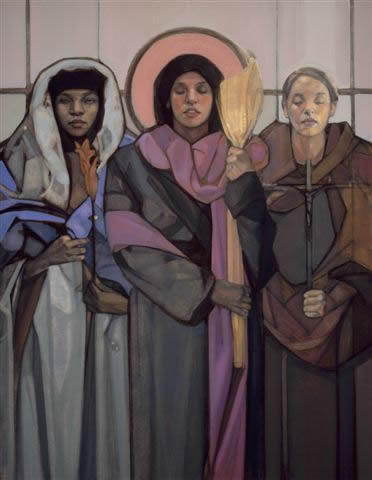
8:1 Soon afterwards he went on through cities and villages, proclaiming and bringing the good news of the kingdom of God. The twelve were with him, 8:2 as well as some women who had been cured of evil spirits and infirmities: Mary, called Magdalene, from whom seven demons had gone out, 8:3 and Joanna, the wife of Herod’s steward Chuza, and Susanna, and many others, who provided for them out of their resources.
Mark tells us that the women at the cross were among those who followed Jesus and provided for him.
15:40 There were also women looking on from a distance; among them were Mary Magdalene, and Mary the mother of James the younger and of Joses, and Salome. 15:41 These used to follow him and provided for him when he was in Galilee; and there were many other women who had come up with him to Jerusalem.
Matthew also tells us of women followers at the cross and later at the tomb (cf. John 19:25).
27:55 Many women were also there, looking on from a distance; they had followed Jesus from Galilee and had provided for him. 27:56 Among them were Mary Magdalene, and Mary the mother of James and Joseph, and the mother of the sons of Zebedee. . .
These women “provided for them out of their resources” (Luke 8:3). “Provided” [Gk: diakoneo] means “to serve, wait on, minister to as deacon,” and it was used in the early Christian community to describe “eucharistic table service and proclamation of the word” (Jane Schaberg, Women’s Bible Commentary, 376).
Mary Magdalene “was a prominent disciple of Jesus who followed him in Galilee and to Jerusalem. She is always listed first in groups of named female disciples” (The Dictionary of Jesus and the Gospels, 884). She is mentioned in all four Gospel accounts of Jesus’ crucifixion. Mary was one of the women Luke named in chapter 8, not only following Jesus, but serving him from her own means. She stood at the cross with the other woman and saw where Jesus was buried. She was the first to see the Risen Christ. She became known as the “apostle to the apostles”.
In all the Gospel accounts women are the first to the tomb Sunday morning, and they are the first to see the risen Christ and commanded to carry the good news to the disciples. In all four accounts different women are named, but one name is constant in all four gospels: Mary Magdalene. She was the first preacher of the good news of the resurrection to the male disciples.
The tradition that Christ appeared first to women was well established by the end of the second century when Celsus, a pagan critic, discounted the gospel and resurrection by saying that an account given by a hysterical woman could not be trusted (cf. Luke 24:11). Origen, an Early Church Father, responded by saying that there was more than one woman who witnessed the risen Christ, and that none of them were hysterical in the Gospels.
It is ironic, with the low status of women in the Greco-Roman world of that day, that Jesus chose to appear to Mary and the other women; and that “the first Christian preachers of the Resurrection were not men, but women!” (The Dictionary of Jesus and the Gospels, 883).
Jesus did not first appear to the “rock” of the church, Peter, or even to the beloved disciple, John. He appeared to Mary and the women who followed him and served him. Mary saw him first, and she received the central tenet of the Christian faith: “He is risen!” She was the first to proclaim the good news, or gospel, of the resurrection. That he appeared to Mary first can only mean that this was by divine appointment and was a deliberate act on His part.
________________________________________________________________________________
Shawna Renee Bound, “Women in the Gospels” in Your Daughters Shall Prophesy: A Biblical Theology of Single Women in Ministry, unpublished thesis, (Copyright © 2002 by Shawna Renee Bound).
Dictionary of Jesus and the Gospels (Downers Grove, IL: InterVarsity Press, 1992).
Gail R. O’Day, “John” in the Women’s Bible Commentary, exp. ed., eds. Carol A. Newsome and Sharon H. Ringe (Louisville: Westminster John Knox Press, 1998).
Jane Schaberg, “Luke” in the Women’s Bible Commentary, exp. ed., eds. Carol A. Newsome and Sharon H. Ringe (Louisville: Westminster John Knox Press, 1998).
 First Thoughts