Archive for November, 2024
Rohr: Power, Prestige, and Possessions; Major Obstacles to the Reign of God
Posted by Dallas Wolf in Ekklesia and church, New Nuggets on November 28, 2024
Fr. Richard Rohr – is a Franciscan priest, Christian mystic, and teacher of Ancient Christian Contemplative Prayer. He is the founding Director of the Center for Action and Contemplation in Albuquerque, NM.

In Jesus’s consistent teaching and in Mary’s great Magnificat, both say that there are three major obstacles to the coming of the reign of God. I call them the three P’s: power, prestige and possessions. Mary refers to them as “the proud,” “the mighty on thrones” and “the rich.” These, she says, God is “routing,” “pulling down” and “sending away empty.” (This great prayer of Mary was considered so subversive by the Argentine government that they banned it from public recitation at protest marches!) We can easily take nine-tenths of Jesus’s teachings and very clearly align it under one of those three categories: Our attachments to power, prestige and possessions are obstacles to God’s coming. Why could we not see that?
—from the book Preparing for Christmas: Daily Meditations for Advent
by Richard Rohr
Origen: On Prayer; ca. AD 240
Posted by Dallas Wolf in First Thoughts on November 26, 2024
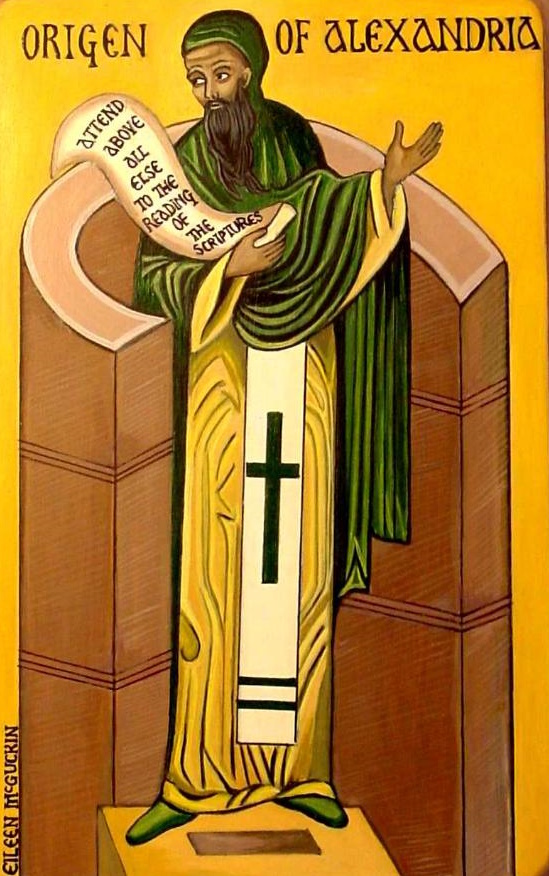
Origen of Alexandria, (c. 184 – c. 254) was Head of the famed Catechetical School in Alexandria at age 18 and arguably the most brilliant theologian of the early Christian church. His book, First Principles (Περὶ Ἀρχῶν; Peri Archon), was the first systematic exposition of Christian theology. He was probably the most able and successful defender of the faith against the heresy of Gnosticism in the third century. A Saint and Church Father without question. The following excerpts come from Origen’s book, On Prayer (Περί Ευχής; Peri Euches), written in about AD 240. Note that these excerpts primarily address active prayer.
When to Pray
Without ceasing:
“… keep that saying of Paul’s in accordance with the exhortations of Jesus, “Pray without ceasing.”
Now, since the performance of actions enjoined by virtue or by the commandments is also a constituent part of prayer, he prays without ceasing who combines prayer with right actions, and becoming actions with prayer. For the saying “pray without ceasing” can only be accepted by us as a possibility if we may speak of the whole life of a saint as one great continuous prayer.”
Specific Times for Prayer
Four set times a day – 3rd Hour, 6th Hour, 9th Hour plus Prayer at Night (about midnight):
“Of such prayer what is usually termed prayer is indeed a part, and ought to be performed at least three times each day, as is plain from the account of Daniel who, in spite of the grave danger that impended, prayed three times daily.”
Indeed we shall not rightly speak even the season of night without such prayer as David refers to when he says ‘at midnight I arose to make acknowledgment to you for your righteous judgments’ and as Paul exemplifies when, as it is said in the Acts of the Apostles, along with Silas he offers prayer and praise to God ‘about midnight’ in Phillipi so that the prisoners also heard them.”
Moods of Prayer
Its Four Moods:
“In the first Epistle to Timothy the Apostle has employed four terms corresponding to four things in close relation to the subject of devotion and prayer… He says, ‘I exhort therefore first of all that requests, prayers, intercessions, thanksgivings be made on behalf of all men,’ and so on.”
Personal Prayer
Place, Preparation, and Posture
“But to secure the performance of one’s prayers in peace without distraction, the rule is for every man to make choice, if possible, of what I may term the most solemn spot in his house before he prays, considering in addition to his general examination of it, whether any violation of law or right has not been done in the place in which he is praying, so as to have made not only himself but also the place of his personal prayer of such a nature that the regard of God has fled from it.
A few words may now be added in reference to the direction in which one ought to look in prayer. Of the four directions, the North, South, East, and West, who would not at once admit that the East clearly indicates the duty of praying with the face turned towards it with the symbolic suggestion that the soul is looking upon the dawn of the true light?
Accordingly it seems to me that one who is about to enter upon prayer ought first to have paused awhile and prepared himself to engage in prayer throughout more earnestly and intently, to have cast aside every distraction and confusion of thought, to have bethought him to the best of his ability of the greatness of Him whom he is approaching and of the impiety of approaching Him frivolously and carelessly and, as it were, in contempt, and to have put away everything alien. He ought thus to enter upon prayer with his soul, as it were, extended before his hands, and his mind intent on God before his eyes, and his intellect raised from earth and set toward the Lord of All before his body stands. Let him put away all resentment against any real or imagined injurer in proportion to his desire for God not to bear resentment against himself in turn for his injuries and sins against many of his neighbors or any wrong deeds whatsoever upon his conscience. Of all the innumerable dispositions of the body that, accompanied by outstretching of the hands and upraising of the eyes, standing is preferred—inasmuch as one thereby wears in the body also the image of the devotional characteristics that become the soul.”
Topics of Prayer
Glory to God, Thanksgiving, Confession, Supplication, Glory to God
“I have still to treat the topics of prayer, and therewith I purpose to bring this treatise to an end. Four topics which I have found scattered throughout the Scriptures appear to me to deserve mention, and according to these everyone should organize their prayer. The topics are as follows: In the beginning and opening of prayer, glory is to be ascribed according to one’s ability to God, through Christ who is to be glorified with Him, and in the Holy Spirit who is to be proclaimed with Him. Thereafter, one should put thanksgivings: common thanksgivings—into which he introduces benefits conferred upon men in general—and thanksgivings for things which he has personally received from God. After thanksgiving it appears to me that one ought to become a powerful accuser of one’s own sins before God and ask first for healing with a view to being released from the habit which brings on sin, and secondly for forgiveness for past actions. After confession it appears to me that one ought to append as a fourth element the asking for the great and heavenly things, both personal and general, on behalf of one’s nearest and dearest. And last of all, one should bring prayer to an end ascribing glory to God through Jesus Christ in the Holy Spirit.“
Macarius the Great: The Pagan Skull
Posted by Dallas Wolf in Heaven and Hell, Universal Restoration (Apokatastasis) on November 25, 2024
Macarius of Egypt (c. 300 – 391) was a Christian monk and Grazer hermit (Greek: βοσκοί, romanized: boskoí) who nourished themselves only with raw plants, often on all fours, and living in a wild manner, “among the beasts. He is also known as Macarius the Elder or Macarius the Great (not to be confused with Macarius of Alexandria).
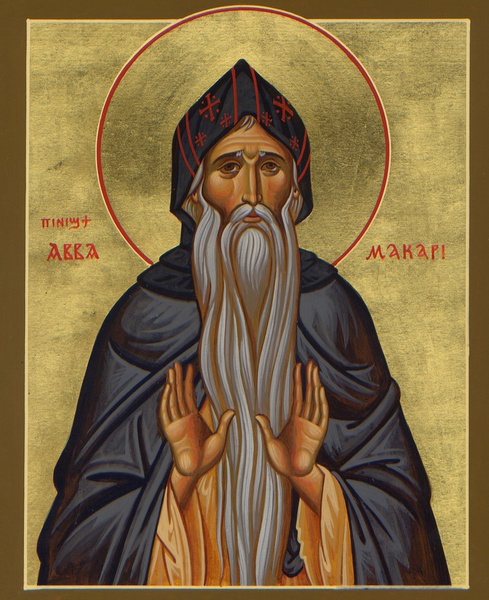
“Abba Macarius said, ‘Walking in the desert one day, I found the skull of a dead man, lying on the ground. As I was moving it with my stick, the skull spoke to me. I said to it, “Who are you?” The skull replied, “I was high priest of the idols and of the pagans who dwelt in this place; but you are Macarius, the Spirit-bearer. Whenever you take pity on those who are in torments, and pray for them, they feel a little respite.” The old man said to him, “What is this alleviation, and what is this torment?” He said to him, “As far as the sky is removed from the earth, so great is the fire beneath us; we are ourselves standing in the midst of the fire, from the feet up to the head. It is not possible to see anyone face to face, but the face of one is fixed to the back of another. Yet when you pray for us, each of us can see the other’s face a little. Such is our respite.” The old man in tears said, “Alas the day when that man was born!” He said to the skull, “Are there punishments which are more painful than this?” The skull said to him, “There is a more grievous punishment down below us.” The old man said, “Who are the people down there?” The skull said to him: “We have received a little mercy since we did not know God, but those who know God and denied Him are down below us.” Then, picking up the skull, the old man buried it.”
(The Sayings of the Desert Fathers, The Alphabetical Collection: Macarius the Great, 38.)
The “Icon Corner”
Posted by Dallas Wolf in Contemplative Prayer (series), Ekklesia and church, First Thoughts, Hesychasm - Jesus Prayer, Monasticism on November 21, 2024

The Book of Acts and the Epistles of the Apostle Paul record that in the early Church, Christians used to meet in the homes of the faithful. This tradition of the House church assembly continues to this day in Eastern Christianity. An Orthodox Christian is expected to pray constantly. Thus the house, just like the Temple (church building), is considered to be a consecrated place. The center of worship in the house is the icon corner (Greek: εικονοστάσι, iconostási).
An icon corner is normally oriented to face east. It is often located in a corner to eliminate worldly distractions and allow prayer to be more concentrated. Here is where the family’s icons were located and displayed. From the earliest days, Light has been an important part of Christian worship. It not only provides a beautiful and calming ambience; it takes on a theological significance with Christ as the Light of the World. Thus, oil lamps and candles frequently illuminate the icons in the icon corner.
In the theology of Orthodox iconography, the prayers and veneration directed to the icons are passed on to the prototype—the person depicted in the image. For, as St. John of Damascus wrote, “we do not worship paint or wood, we do not worship matter; we worship the God who created matter, who became matter (flesh) for our sake“.
The icons in the icon corner also remind us of the declaration in Hebrews 12:1, that “we are surrounded by so great a cloud of witnesses“; so we need never pray alone. We venerate these witnesses through their icons, petition them and join them in prayer and worship of our Triune God.
An Orthodox view on Heaven and Hell
Posted by Dallas Wolf in Heaven and Hell, Theology on November 2, 2024
From the The Orthodox Church in America (OCA)
The Kingdom of heaven is already in the midst of those who live the spiritual life. What the spiritual person knows in the Holy Spirit, in Christ and the Church, will come with power and glory for all men to behold at the end of the ages.
The final coming of Christ will be the judgment of all men. His very presence will be the judgment. Now men can live without the love of Christ in their lives. They can exist as if there were no God, no Christ, no Spirit, no Church, no spiritual life. At the end of the ages this will no longer be possible. All men will have to behold the Face of Him who “for us men and our salvation came down from heaven and was incarnate . . . who was crucified under Pontius Pilate, and suffered and was buried . . .” (Nicene Creed). All will have to look at Him whom they have crucified by their sins: Him “who was dead and is alive again” (Rev 1.17–18).
For those who love the Lord, His Presence will be infinite joy, paradise and eternal life. For those who hate the Lord, the same Presence will be infinite torture, hell and eternal death. The reality for both the saved and the damned will be exactly the same when Christ “comes in glory, and all angels with Him,” so that “God may be all in all” (1 Cor 15–28). Those who have God as their “all” within this life will finally have divine fulfillment and life. For those whose “all” is themselves and this world, the “all” of God will be their torture, their punishment and their death. And theirs will be “weeping and gnashing of teeth” (Mt 8.21, et al.).
The Son of Man will send His angels and they will gather out of His kingdom all causes of sin and all evil doers, and throw them into the furnace of fire; there men will weep and gnash their teeth. Then the righteous will shine like the sun in the Kingdom of their Father (Mt 13.41–43).
According to the saints, the “fire” that will consume sinners at the coming of the Kingdom of God is the same “fire” that will shine with splendor in the saints. It is the “fire” of God’s love; the “fire” of God Himself who is Love. “For our God is a consuming fire” (Heb 12.29) who “dwells in unapproachable light” (1 Tim 6.16). For those who love God and who love all creation in Him, the “consuming fire” of God will be radiant bliss and unspeakable delight. For those who do not love God, and who do not love at all, this same “consuming fire” will be the cause of their “weeping” and their “gnashing of teeth.”
Thus it is the Church’s spiritual teaching that God does not punish man by some material fire or physical torment. God simply reveals Himself in the risen Lord Jesus in such a glorious way that no man can fail to behold His glory. It is the presence of God’s splendid glory and love that is the scourge of those who reject its radiant power and light.
. . . those who find themselves in hell will be chastised by the scourge of love. How cruel and bitter this torment of love will be! For those who understand that they have sinned against love, undergo no greater suffering than those produced by the most fearful tortures. The sorrow which takes hold of the heart, which has sinned against love, is more piercing than any other pain. It is not right to say that the sinners in hell are deprived of the love of God . . . But love acts in two ways, as suffering of the reproved, and as joy in the blessed! (Saint Isaac of Syria, Mystic Treatises).
This teaching is found in many spiritual writers and saints: Saint Maximus the Confessor, the novelist Fyodor Dostoevsky. At the end of the ages God’s glorious love is revealed for all to behold in the face of Christ. Man’s eternal destiny—heaven or hell, salvation or damnation—depends solely on his response to this love.
Met. Kallistos Ware: On Hell
Posted by Dallas Wolf in First Thoughts, Heaven and Hell, Universal Restoration (Apokatastasis) on November 2, 2024
Metropolitan Kallistos (Ware) of Diokleia – (1934 – 2022) was a titular metropolitan of the Orthodox Ecumenical Patriarchate in Great Britain. From 1966-2001, he was Spalding Lecturer of Eastern Orthodox Studies at Oxford University, and has authored numerous books and articles pertaining to the Orthodox faith. The following excerpts are taken from Met. Kallistos’ book, The Orthodox Way (1986).

Hell is a point not in space but in the soul. It is the place where God is not. (And yet God is everywhere!) (p. 106)
The Last Judgement is best understood as the moment of truth when everything is brought to light, when all our acts of choice stand revealed to us in their full implications, when we realize with absolute clarity who we are and what has been the deep meaning and aim of our life. And so, following this final clarification, we shall enter – with soul and body reunited – into heaven or hell, into eternal life or eternal death.
Christ is the judge; and yet, from another point of view, it is we who pronounce judgement upon ourselves. If anyone is in hell, it is not because God has imprisoned him there, but because that is where he himself has chosen to be. The lost in hell are self-condemned, self-enslaved; it has been rightly said that the doors of hell are locked on the inside. (p. 181)
How can a God of love accept that even a single one of the creatures whom he has made should remain for ever in hell? There is a mystery here which, from our standpoint in this present life, we cannot hope to fathom. The best we can do is to hold in balance two truths, contrasting but not contradictory. First, God has given free will to man, and so to all eternity it lies within man’s power to reject God. Secondly, love signifies compassion, involvement; and so, if there are any who remain eternally in hell, in some sense God is also there with them. It is written in the Psalms, ‘If I go down to hell, thou art there also’ (139:7); and St. Isaac the Syrian says, ‘It is wrong to imagine that sinners in hell are cut off from the love of God.’ Divine love is everywhere, and rejects no one. But we on our side are free to reject divine love: we cannot, however, do so without inflicting pain upon ourselves, and the more final our rejection the more bitter our suffering. (p.182)
 First Thoughts