Rohr: “Every time Paul uses the word flesh, just replace it with the word ego…”
Posted by Dallas Wolf in First Thoughts, New Nuggets on November 17, 2017
Fr. Richard Rohr – is a Franciscan priest, Christian mystic, and teacher of Ancient Christian Contemplative Prayer. He is the founding Director of the Center for Action and Contemplation in Albuquerque, NM.
 “The dialectic that we probably struggle with the most is the one Paul creates between flesh and spirit. I don’t think Paul ever intended for people to feel that their bodies are bad; he was not a Platonist. After all, God took on a human body in Jesus! Paul does not use the word “soma”, which literally means “body.” I think what Paul means by “sarx” is the trapped self, the small self, the partial self, or what Thomas Merton called the false self. Basically, spirit is the whole self, the Christ self that we were born into and yet must re-discover. The problem is not between body and spirit; it’s between part and whole. Every time Paul uses the word “flesh” [sarx], just replace it with the word “ego’, and you will be much closer to his point. Your spiritual self is your whole and True Self, which includes your body; it is not your self apart from your body. We are not angels, we are embodied human beings.” ~ From a meditation: “Paul as a Nondual Teacher“, Wednesday, May 17, 2017.
Romanides: “The schism between Eastern and Western Christianity was not between East and West Romans.”
Posted by Dallas Wolf in Ekklesia and church, New Nuggets on November 13, 2017
Father John Romanides (1927 – 2001) – was a prominent 20th century Orthodox Christian theologian, priest, and writer. He was Professor of Dogmatic Theology at the Holy Cross Theological School in Brookline, MA and later Professor of Dogmatic Theology at the University of Thessaloniki, Greece. His books include: The Ecclesiology of St Ignatius of Antioch (1956); Franks, Romans, Feudalism, and Doctrine: An Interplay Between Theology and Society (1982); Ancestral Sin (2002); An Outline of Orthodox Patristic Dogmatics (2004); and The Life in Christ (2010).
Romanides traced the 1054 split between the Eastern and Western Christian churches to a long political, military, and ethnic struggle between the Roman East and the Germanic conquerors of the Roman West. These German tribes started with the Visigoths in AD 410, culminating with Charlemagne and the Franks in AD 800. The Great Schism of 1054 had more to do with a Frankish – Eastern Roman power struggle than it did with religious doctrine. In the West, the church was simply used as a tool in that imperial struggle.
“The schism between Eastern and Western Christianity was not between East and West Romans. In actuality, it was a split between East Romans and the conquerors of the West Romans.”

Fr. John Romanides
“In the background of dialogue and the Ecumenical Movement for the reunion of Christendom lies the generally recognized fact that there is an interplay between theology and society, which may lead to a dogmatic formulation and become the cause of doctrinal differences.
Within the Roman Empire doctrinal conflicts took place usually among Roman citizens in a atmosphere of religious and philosophical pluralism. With the official recognition of Orthodox Christianity, we witness the beginning of the use of doctrinal differences in support of nationalistic movements of separate identity and secession from Roman rule, both political and ecclesiastical. Both Nestorianism and so-called Monophysitism, although initially promoted by Roman nationals, were finally supported by separatist tendencies among such ethnic groups as Syrians, Copts, and Armenians. Indeed, both Persians and Arabs took care to keep Christians separated.
By the eighth century, we meet for the first time the beginning of a split in Christianity which, from the start, took on ethnic names instead of names designating the heresy itself or its leader. Thus in West European sources we find a separation between a Greek East and a Latin West. In Roman sources this same separation constitutes a schism between Franks and Romans.
One detects in both terminologies an ethnic or racial basis for the schism which may be more profound and important for descriptive analysis than the doctrinal claims of either side. Doctrine here may very well be part of a political, military, and ethnic struggle and, therefore, intelligible only when put in proper perspective. The interplay between doctrine and ethnic or racial struggle may be such that the two can be distinguished, but not separated.
The schism between Eastern and Western Christianity was not between East and West Romans. In actuality, it was a split between East Romans and the conquerors of the West Romans.
The Roman Empire was conquered in three stages: 1st by Germanic tribes who became known as Latin Christianity, 2nd by Muslim Arabs, and finally, by Muslim Turks. In contrast to this, the ecclesiastical administration of the Roman Empire disappeared in stages from West European Romania (the Western part of the Roman nation), but has survived up to modern times in the Roman Orthodox Patriarchates of Constantinople, Alexandria, Antioch and Jerusalem.
The reason for this is that the conquerors of the West Romans used the Church to suppress the Roman nation, whereas under Islam the Roman nation survived by means of the Church. In each instance of conquest, the bishops became the ethnarchs of the conquered Romans and administered Roman law on behalf of the emperor in Constantinople. As long as the bishops were Roman, the unity of the Roman Church was preserved, in spite of theological conflicts. The same was true when Romanized Franks became bishops during Merovingian times and shared with Roman bishops church administration.
During the seventh century, however, the seeds of schism appear. The Visigoths in Spain had abandoned their Arian heresy and had become nominally Orthodox. But they preserved their Arian customs of church administration, which became that of the Carolingian Franks, and finally, of the Normans. The Visigoths began subjugating the Spanish Romans by replacing Roman bishops with Goths and by 654, had abolished Roman law.
During this same century, especially after 683, the Franks also had appointed Frankish bishops en masse and had rid their government administration of Roman officials.
Earlier, during the sixth and early seventh century, rebellions of leaders in Francia were joint conspiracies of Franks and Romans. By 673, however, the rebellions had become purely Frankish.” ~From the Introduction to “Franks, Romans, Feudalism, and Doctrine; An Interplay Between Theology and Society“
Met. Hierotheos: “Degrees of Spiritual Perfection”
Posted by Dallas Wolf in First Thoughts on November 11, 2017
Metropolitan Hierotheos (Vlachos) – (1945- ) is the Greek Orthodox Metropolitan of Nafpaktos, an author, and a theologian. He graduated from the Theological School of the University of Thessaloniki and is one of the finest Patristic scholars living. His books include: “Orthodox Psychotherapy: (the Science of the Fathers)“, “The Illness and Cure of the Soul in the Orthodox Tradition“, “The Person in the Orthodox Tradition“, and “A Night in the Desert of the Holy Mountain“.
Below is an excerpt on the Degrees of Spiritual Perfection from Chapter 4 of “Orthodox Spirituality, a brief introduction”, by Met. of Nafpaktos Hierotheos, pp. 40-49. This covers a number of topics central to Orthodox theology including the Fall, “Original” sin, the Church as hospital, the darkening of the nous, the cure of the nous through purification (Katharsis), illumination (Theoria), and union (Theosis), and the Essence and Energies of the Trinitarian Godhead.
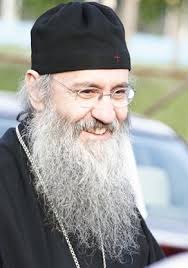
Met. Hierotheos (Vlachos)
“The most important work of the Church is to cure man. Therefore the Orthodox Church is a Hospital, an infirmary of the soul. This does not mean that the Church disregards other domains of pastoral activity, since she aims at the whole of man, consisting of both body and soul. She cares indeed for the physical, economic and social problems as well; yet the main weight of her pastoral service is put on the soul’s therapy, for when man’s soul is cured then many other intractable problems are solved.
Some people accuse the Orthodox Church of not being very much involved in social problems. However, the Church does care about all matters which concern man. This is evident in the content of her prayers during worship services as well as in the work and teaching of the Holy Fathers. But just as a medical Hospital is primarily interested in the treatment of the body – and through this therapy it gets involved with the rest of a person’s problems – so it is in the Orthodox Church. She cures the core of human personality and through this, she heals the whole person. That is why even during times of social upheavals, when all governmental mechanisms are virtually brought to a halt – even peoples’ external freedoms are disrupted – the Church maintains its work: to treat and cure the person.
Healing of man’s personality is in fact his progress toward perfection which is actually identified as “theosis”, for in patristic theology theosis and perfection are synonymous terms. And this therapy is absolutely necessary, because man’s fall, effected in the person of Adam, constitutes the sickness of man’s nature.
In Paradise, before the Fall, Adam was in a state of “theoria” (vision) of God. The study of the book of Genesis reveals that Adam was in communion with God; however it was necessary for him to remain in that state, by virtue of his voluntary struggle, in order for him to become more stabilized and reach perfect communion and union with Him. St. John of Damascus describes this state of primordial “justice” characteristically. Adam was purified and nourished at the same time by the vision of God. His nous* was illumined, and this signifies above all that he was a temple of the Holy Spirit, and was experiencing unceasing remembrance of God.
“Original” sin consists of the darkening of the nous and the loss of communion with God. This, of course, had other repercussions, as well: man was clothed in the fleshly garments of decay and mortality The nous experienced a deep darkness. In other words, man lost the illumination of his nous; it became impure, impassioned and his body bore corruption and mortality. Thus, from the day of our birth, we bear within us corruption and death: a human life is brought into the world bound for death. Hence, because of the fall we experience universal malady. Both soul and body are sick and naturally, since man is the summation of all creation, – the microcosmos within the megacosmos – corruption also befell all of creation.
“My mind is wounded, my body has grown feeble, my spirit is sick, my speech has lost its power, my life is dead; then end is at the door. What shalt thou do, then, miserable soul, when the Judge comes to examine thy deeds?” (Great Canon).
In fact, when we speak of original sin and its consequences, we mean three things: first, the malfunction of the nous, since the nous ceased to work properly; secondly, the identification of the nous with reason (and to a certain extent, deification of reason) and thirdly the nous’ enslavement to the passions, anxiety and the conditions of the environment. And this constitutes man’s real death.
He experiences total disorganization; his inner self is deadened – his nous is overcome by darkness. And just as when the eye of the body is hurt,the whole body is obscure, so also when the eye of the soul – the nous – suffers blindness, the spiritual self as a whole becomes sick. It falls into the deepest darkness. This is what the Lord is referring, when He says: “If therefore the light that is in thee be darkness, how great is that darkness!” (Matt. 6, 23).
In addition to the disruption of the soul’s entire inner workings, original sin resulted also in the disorganization of man outwardly. He now confronts his fellow-men, God, the world and all of creation in a different way. The nous is unable to encounter God; so reason undertakes the effort. Thus idols of God are created leading to pagan religions and even heretical deviations.
Incapable of seeing man as an image of God, the nous encounters him under the influence of the passions. He ambitiously exploits his fellow-man, through his love of pleasure and material gain. He regards him as a vessel or instrument of pleasure; at the same time he idolizes all creation, which is what the Apostle Paul describes in his Epistle to the Romans: “Professing themselves to be wise, they became fools, And changed the glory of the uncorruptible God into an image made like to corruptible man, and to birds, and four-footed beasts, and creeping things” (Rom. 1, 22-23).
Therefore man needs to be cured, that is to be purified, to reach the illumination of the nous – Adam’s state before the Fall – and then attain theosis. This is achieved precisely through Christ’s incarnation and the entire work of the Divine Economy and of the Church. It is within this frame of reference we must see many liturgical texts according to which Christ is characterised a physician and healer of souls and bodies. Moreover, in the same framework various patristics texts should be studied, where it is apparent that the work of Christ is first and foremost a therapeutic one.
After the Fall man needed a cure. This was effected by the Incarnation of Christ and ever since then it has been the work of the Church. She cures and is curing man; she primarily cures his ailing personality – his nous and heart. All the Fathers of the Church exhort men to seek to be cured. Man is cured by the energy of God whose source is uncreated and revealed “in the person of Jesus Christ”. Christ’s energy, from which comes man’s cure, is granted freely, and for this reason is called divine grace. Therefore, whether we say uncreated energy or divine grace makes no difference; we mean the same thing. The Apostle Paul writes: “For by grace are ye saved through faith; and that not of yourselves: it is a gift of God” (Eph. 2, 8).
Living within the Church by grace, man must first cleanse his heart of the passions; attain the illumination of the nous – Adam’s state before the Fall – and then ascend to theosis, which constitutes man’s communion and union with God and is identified with salvation. These are the steps of spiritual perfection – the foundations of Orthodox spirituality.
Yet a few things about the divine grace need to be said before we see the stages of spiritual perfection – the method and way of man’s therapy – for it is closely connected with purification, illumination, and theosis.
In Orthodox spirituality purification, illumination and theosis are not stages of anthropocentric activity, but rather are results of the uncreated energy of God. When the divine grace (energy of God) purifies man from passions, it is call purifying; when it illumines his nous it is called illuminating; and when it deifies man it is called deifying. The same grace and energy of God is given various names according to its effects.
Throughout all patristic tradition the Fathers allude to the three stages of spiritual perfection as the three degrees of one’s cure. St. Dionysios the Areopagite makes mention of purification, illumination and perfection. St. Gregory of Nyssa also makes use of the same distinction. St. Maximos the Confessor refers, as well, to practical philosophy (purification), natural theoria (illumination) and mystical theology (theosis). St. Symeon the New Theologian, in his writings divides certain chapters into practical, gnostic, and theological. In all of Orthodox Tradition these three stages of perfection are frequently mentioned. In this way man is cured and experiences Holy Tradition; he becomes “Tradition” and creates “Tradition”. He is a bearer of Tradition. Distinctive is the subtitle of Philokalia which is the work of St. Nicodemos, of the Holy Mountain and of St. Makarios, Bishop of Corinth. In this work which is a compilation of the writings of the Holy Fathers [from the 4th to the 15th centuries], how man cures his nous by going through the three stages of spiritual life is discussed. And it is known that the Philokalia, which contains the complete method of cure for humans is a fundamental manual of the spiritual life.”
*Nous: The word has various uses in Patristic teaching, It indicates either the soul or the heart or even an energy of the soul. Yet, the nous is mainly the eye of the soul; the purest part of the soul; the highest attention. It is also called noetic energy and it is not identified with reason.
Met. Kallistos: “God in Trinity”
Posted by Dallas Wolf in First Thoughts, New Nuggets, The Holy Trinity, Theology on November 10, 2017
Metropolitan Kallistos (Ware) of Diokleia – (1934 = 2022) was a titular metropolitan of the Orthodox Ecumenical Patriarchate in Great Britain. From 1966-2001, he was Spalding Lecturer of Eastern Orthodox Studies at Oxford University, and has authored numerous books and articles pertaining to the Orthodox faith. The following excerpt is taken from Chapter 11 of Met. Kallistos’ book, The Orthodox Church: An Introduction to Eastern Christianity (1993)

“Our social programme, said the Russian thinker Fedorov, is the dogma of the Trinity. Orthodoxy believes most passionately that the doctrine of the Holy Trinity is not a piece of ‘high theology’ reserved for the professional scholar, but something that has a living, practical importance for every Christian. Man, so the Bible teaches, is made in the image of God, and to Christians God means the Trinity: thus it is only in the light of the dogma of the Trinity that man can understand who he is and what God intends him to be. Our private lives, our personal relations, and all our plans of forming a Christian society depend upon a right theology of the Trinity. ‘Between the Trinity and Hell there lies no other choice (V. Lossky, The Mystical Theology of the Eastern Church, p. 66). As an Anglican writer has put it: ‘In this doctrine is summed up the new way of thinking about God, in the power of which the fishermen. went out to convert the Greco-Roman world. It marks a saving revolution in human thought (D. J. Chitty, ‘The Doctrine of the Holy Trinity told to the Children,’ in Sobornost, series 4, no. 5, 1961, p. 241).
The basic elements in the Orthodox doctrine of God have already been mentioned in the first part of this book, so that here they will only be summarized briefly:
1. God is absolutely transcendent.
‘No single thing of all that is created has or ever will have even the slightest communion with the supreme nature or nearness to it (Gregory Palamas, P.G. 150, 1176c (quoted on p. 77)). This absolute transcendence Orthodoxy safeguards by its emphatic use of the ‘way of negation,’ of ‘apophatic’ theology. Positive or ‘cataphatic’ theology — the ‘way of affirmation’ — must always be balanced and corrected by the employment of negative language. Our positive statements about God — that He is good, wise, just and so on — are true as far as they go, yet they cannot adequately describe the inner nature of the deity. These positive statements, said John of Damascus, reveal ‘not the nature, but the things around the nature.’ ‘That there is a God is clear; but what He is by essence and nature, this is altogether beyond our comprehension and knowledge (On the Orthodox Faith, 1, 4 (P.G. 94, 800B, 797B)).
2. God, although absolutely transcendent, is not cut of from the world which He has made.
God is above and outside His creation, yet He also exists within it. As a much used Orthodox prayer puts it: ‘Thou art everywhere and finest all things.’ Orthodoxy therefore distinguishes between God’s essence and His energies, thus safeguarding both divine transcendence and divine immanence: God’s essence remains unapproachable, but His energies come down to us. God’s energies, which are God Himself, permeate all His creation, and we experience them in the form of deifying grace and divine light. Truly our God is a God who hides Himself, yet He is also a God who acts — the God of history, intervening directly in concrete situations.
3. God is personal, that a to say, Trinitarian.
This God who acts is not only a God of energies, but a personal God. When man participates in the divine energies, he is not overwhelmed by some vague and nameless power, but he is brought face to face with a person. Nor is this all: God is not simply a single person confined within his own being, but a Trinity of three persons, Father, Son, and Holy Spirit, each of whom ‘dwells’ in the other two, by virtue of a perpetual movement of love. God is not only a unity but a union.
4. Our God is an Incarnate God.
God has come down to man, not only through His energies, but in His own person. The Second Person of the Trinity, ‘true God from true God,’ was made man: “The Word became flesh and dwelt among us” (John 1:14). A closer union than this between God and His creation there could not be. God Himself became one of His creatures (For the first and second of these four points, see pp. 72-9; for the third and fourth points, see pp. 28-37).
Those brought up in other traditions have sometimes found it difficult to accept the Orthodox emphasis on apophatic theology and the distinction between essence and energies; but apart from these two matters, Orthodox agree in their doctrine of God with the overwhelming majority of all who call themselves Christians. Monophysites and Lutherans, Nestorians and Roman Catholics, Calvinists, Anglicans, and Orthodox: all alike worship One God in Three Persons and confess Christ as Incarnate Son of God (In the past hundred years, under the influence of ‘Modernism,’ many Protestants have virtually abandoned the doctrines of the Trinity and the Incarnation. Thus when I speak here of Calvinists, Lutherans, and Anglicans, I have in mind those who still respect the classical Protestant formularies of the sixteenth century).
Yet there is one point in the doctrine of God the Trinity over which east and west part company — the filioque. We have already seen how decisive a part this one word played in the unhappy fragmentation of Christendom. But granted that the filioque is important historically, does it really matter from a theological point of view? Many people today — not excluding many Orthodox — find the whole dispute so technical and obscure that they are tempted to dismiss it as utterly trivial. From the viewpoint of traditional Orthodox theology there can be but one rejoinder to this: technical and obscure it undoubtedly is, like most questions of Trinitarian theology; but it is not trivial. Since belief in the Trinity lies at the very heart of the Christian faith, a tiny difference in Trinitarian theology is bound to have repercussions upon every aspect of Christian life and thought. Let us try therefore to understand some of the issues involved in the filioque dispute.
One essence in three persons. God is one and God is three: the Holy Trinity is a mystery of unity in diversity, and of diversity in unity. Father, Son, and Spirit are ‘one in essence’ (homoousios), yet each is distinguished from the other two by personal characteristics. ‘The divine is indivisible in its divisions (Gregory of Nazianzus, Orations, 31, 14). for the persons are ‘united yet not confused, distinct yet not divided’ (John of Damascus, On the Orthodox Faith, 1, 8 (P.G. 94, 809A)); ‘both the distinction and the union alike are paradoxical’ (Gregory of Nazianzus, Orations, 25, 17).
But if each of the persons is distinct, what holds the Holy Trinity together? Here the Orthodox Church, following the Cappadocian Fathers, answers that there is one God because there is one Father. In the language of theology, the Father is the ‘cause’ or ‘source’ of Godhead, He is the principle (arche) of unity among the three; and it is in this sense that Orthodoxy talks of the ‘monarchy’ of the Father. The other two persons trace their origin to the Father and are defined in terms of their relation to Him. The Father is the source of Godhead, born of none and proceeding from none; the Son is born of the Father from all eternity (‘before all ages,’ as the Creed says); the Spirit proceeds from the Father from all eternity.
It is at this point that Roman Catholic theology begins to disagree. According to Roman theology, the Spirit proceeds eternally from the Father and the Son; and this means that the Father ceases to be the unique source of Godhead, since the Son also is a source. Since the principle of unity in the Godhead can no longer be the person of the Father, Rome finds its principle of unity in the substance or essence which all three persons share. In Orthodoxy the principle of God’s unity is personal, in Roman Catholicism it is not.
But what is meant by the term ‘proceed?’ Unless this is properly understood, nothing is understood. The Church believes that Christ underwent two births, the one eternal, the other at a particular point in time: he was born of the Father ‘before all ages,’ and born of the Virgin Mary in the days of Herod, King of Judaea, and of Augustus, Emperor of Rome. In the same way a firm distinction must be drawn between the eternal procession of the Holy Spirit, and the temporal mission, the sending of the Spirit to the world: the one concerns the relations existing from all eternity within the Godhead, the other concerns the relation of God to creation. Thus when the west says that the Spirit proceeds from the Father and the Son, and when Orthodoxy says that He proceeds from the Father alone, both sides are referring not to the outward action of the Trinity towards creation, but to certain eternal relations within the Godhead — relations which existed before ever the world was. But Orthodoxy, while disagreeing with the west over the eternal procession of the Spirit, agrees with the west in saying that, so far as the mission of the Spirit to the world is concerned, He is sent by the Son, and is indeed the ‘Spirit of the Son.’
The Orthodox position is based on John 15:26, where Christ says: ‘When the Comforter has come, whom I will send to you from the Father — the Spirit of truth, who proceeds from the Father — he will bear witness to me.’ Christ sends the Spirit, but the Spirit proceeds from the Father: so the Bible teaches, and so Orthodoxy believes. What Orthodoxy does not teach, and what the Bible never says, is that the Spirit proceeds from the Son.
An eternal procession from Father and Son: such is the western position. An eternal procession of the Spirit from the Father alone, a temporal mission from the Son: such was the position upheld by Saint Photius against the west. But Byzantine writers of the thirteenth and fourteenth centuries — most notably Gregory of Cyprus, Patriarch of Constantinople from 1283 to 1289, and Gregory Palamas — went somewhat further than Photius, in an attempt to bridge the gulf between east and west. They were willing to allow not only a temporal mission, but an eternal manifestation of the Holy Spirit by the Son. While Photius had spoken only of a temporal relation between Son and Spirit, they admitted an eternal relation. Yet on the essential point the two Gregories agreed with Photius: the Spirit is manifested by the Son, but does not proceed from the Son. The Father is the unique origin, source, and cause of Godhead.
Such in outline are the positions taken up by either side; let us now consider the Orthodox objections to the western position. The filioque leads either to ditheism or to semi-Sabellianism (Sabellius, a heretic of the second century, regarded Father, Son, and Spirit not as three distinct persons, but simply as varying ‘modes’ or ‘aspects’ of the deity). If the Son as well as the Father is an arche, a principle or source of Godhead, are there then (the Orthodox asked) two independent sources, two separate principles in the Trinity? Obviously not, since this would be tantamount to belief in two Gods; and so the Reunion Councils of Lyons (1274) and Florence (1438-1439) were most careful to state that the Spirit proceeds from Father and Son ‘as from one principle,’ tanquam ex (or ab) uno principio. From the Orthodox point of view, however, this is equally objectionable: ditheism is avoided, but the persons of Father and Son are merged and confused. The Cappadocians regarded the ‘monarchy’ as the distinctive characteristic of the Father: He alone is a principle or arche within the Trinity. But western theology ascribes the distinctive characteristic of the Father to the Son as well, thus fusing the two persons into one; and what else is this but ‘Sabellius reborn, or rather some semi-Sabellian monster,’ as Saint Photius put it? (P.G. 102, 289B).
Let us look more carefully at this charge of semi-Sabellianism. Orthodox Trinitarian theology has a personal principle of unity, but the west finds its unitary principle in the essence of God. In Latin Scholastic theology, so it seems to Orthodox, the persons are overshadowed by the common nature, and God is thought of not so much in concrete and personal terms, but as an essence in which various relations are distinguished. This way of thinking about God comes to full development in Thomas Aquinas, who went so far as to identify the persons with the relations: personae sunt ipsae relationes (Summa Theologica, 1, question 40, article 2). Orthodox thinkers find this a very meagre idea of personality. The relations, they would say, are not the persons — they are the personal characteristics of Father, Son, and Holy Spirit; and (as Gregory Palamas put it) ‘personal characteristics do not constitute the person, but they characterize the person’ (Quoted in J. Meyendorff, Introduction à 1’étude de Grégoire Palamas, Paris, 1959, p. 294). The relations, while designating the persons, in no way exhaust the mystery of each.
Latin Scholastic theology, emphasizing as it does the essence at the expense of the persons, comes near to turning God into an abstract idea. He becomes a remote and impersonal being, whose existence has to be proved by metaphysical arguments — a God of the philosophers, not the God of Abraham, Isaac, and Jacob. Orthodoxy, on the other hand, has been far less concerned than the Latin west to find philosophical proofs of God’s existence: what is important is not that a man should argue about the deity, but that he should have a direct and living encounter with a concrete and personal God.
Such are some of the reasons why Orthodox regard the filioque as dangerous and heretical. Filioquism confuses the persons, and destroys the proper balance between unity and diversity in the Godhead. The oneness of the deity is emphasized at the expense of His threeness; God is regarded too much in terms of abstract essence and too little in terms of concrete personality.
But this is not all. Many Orthodox feel that, as a result of the filioque, the Holy Spirit in western thought has become subordinated to the Son — if not in theory, then at any rate in practice. The west pays insufficient attention to the work of the Spirit in the world, in the Church, in the daily life of each man.
Orthodox writers also argue that these two consequences of the filioque — subordination of the Holy Spirit, over-emphasis on the unity of God — have helped to bring about a distortion in the Roman Catholic doctrine of the Church. Because the role of the Spirit has been neglected in the west, the Church has come to be regarded too much as an institution of this world, governed in terms of earthly power and jurisdiction. And just as in the western doctrine of God unity was stressed at the expense of diversity, so in the western conception of the Church unity has triumphed over diversity, and the result has been too great a centralization and too great an emphasis on Papal authority.
Such in outline is the Orthodox attitude to the filioque, although not all would state the case in such an uncompromising form. In particular, many of the criticisms given above apply only to a decadent form of Scholasticism, not to Latin theology as a whole.”
Met. Hierotheos: “A night in the desert of the Holy Mountain”
Posted by Dallas Wolf in Hesychasm - Jesus Prayer, New Nuggets on November 5, 2017
Metropolitan Hierotheos (Vlachos) – (1945- ) is the Greek Orthodox Metropolitan of Nafpaktos, an author, and a theologian. He graduated from the Theological School of the University of Thessaloniki and is one of the finest Patristic scholars living. His books include: “Orthodox Psychotherapy: (the Science of the Fathers)“, “The Illness and Cure of the Soul in the Orthodox Tradition“, “The Person in the Orthodox Tradition“, and “A night in the desert of the Holy Mountain“.
Below is an excerpt of a discussion with an Athonite hermit on the Jesus Prayer. From “A night in the desert of the Holy Mountain”, by Met. of Nafpaktos Hierotheos, pp. 57-59
 “- Gerondas, allow me a few questions which arose while you were talking about the stages of the Jesus Prayer. What do you mean by the word heart?
– According to the teaching of the Holy Fathers, the heart is the center of the spiritual world. Among the many opinions of the Fathers on this subject I will mention a distinctive one of St. Epiphanios, Bishop of Konstantia in Cyprus: “For this reason, we need not in any way define or ascertain in what part of man the image of God rather is accomplished, but we need to confess that the image of God does exist in man, so that we will not despise the grace of God and disbelieve in Him. For whatever God says is true, although His word has to a certain extent, escaped our capacity to receive it”. Just as a beam when it falls upon a prism is refracted and shown from all sides, in the same way does the soul also express herself through the whole human being.
When we say the Jesus Prayer, however, we fix our attention on the physical organ, on the heart, so that we are distracted away from the outside world and bring it back into ourselves, into the “deep heart”. In this way the nous – the eye of the soul – returns to its home and is united there with the other powers.
– Allow me a second question. Do all who are enchanted by the enjoyment of God follow the course you have just described to me?
– Yes, most of them do. There are some however who, from the very beginning, seek to unite the nous with the heart by doing breathing exercise. They breath in the word “Lord Jesus Christ” and exhale the words “have mercy on me”. They follow the air as it comes into the nose all the way to the heart, and there they rest a little.
This, of course, is done to allow the nous to be fixed on the prayer, The Holy Fathers have also handed over to us another method, We breath in saying all the words of the Jesus Prayer and we breath out saying them again. This method, however, requires maturity in spiritual development. But using this way of breathing can cause many difficulties, many problems; that is why it should be avoided, if there is no guidance from a spiritual father. It can be used, however, simply to fix the nous on the words of the prayer so that the nous is not distracted. I repeat, this needs a special blessing (permission) of a discerning father.
– You said before, Gerondas, that the aim of the Jesus Prayer is to bring the nous back into the heart, that is the energy into the essence. We can experience this specifically at the third stage [prayer of the heart] of this holy pathway. When, however, you recounted the fifth stage [Christ living in the heart], you referred to a quotation from St. Basil the Great: “he who loves God having avoided all these, departs toward God”. How does the nous come into the heart and depart towards God? Is this perhaps a contradiction?
– No it is not, the holy hermit answered. As the Holy and God-fearing Fathers teach, those who pray are at various stages. There are the beginners as well as the advance; as they are better called to the teaching of the Fathers, the practical and the theoretical ones. For the practical ones, prayer is born of fear of God and a firm hope in Him, whereas to the theoretical ones, prayer is begotten by a divinely intense longing for God and by total purification. The characteristics of the first state – that of the practical ones – is the concentration of the nous within the heart; when the nous prays to God without distraction. The characteristic of the second state of prayer – that of the theoretical ones – is the rapture of the nous by the divine Light, so that it is aware neither of the world nor of itself. This is the ravishment (ecstasy) of the nous, and we say that, at this stage the nous “departs” to God. The god-bearing Fathers who experienced these blessed states describe the divine ravishment; “it is the ravishment of the nous by the divine and infinite light, so that is aware neither of itself nor of any created thing, but only of Him Who through love, has activated such radiance in the nous”. (St. Maximos)”
Markides: “Eastern Orthodox Mysticism and Transpersonal Theory”
Posted by Dallas Wolf in First Thoughts, Hesychasm - Jesus Prayer, New Nuggets on November 5, 2017

Dr. Kyriakos Markides
Kyriacos C. Markides (b. 1942) – Dr. Markides is a professor of sociology at the University of Maine. He has written several books on Christian mysticism including Mountain of Silence (2001), Gifts of the Desert (2005), and Inner River (2012). Dr. Markides is a contributor to Transpersonal Psychology, a sub-field or “school” of psychology that integrates the spiritual and transcendent aspects of the human experience with the framework of modern psychology. Based on the early works of Carl Jung, William James, and Abraham Maslow, it is also possible to define Transpersonal Psychology as a “spiritual psychology”. Dr. Markides is trying to introduce Eastern Orthodox Mysticism into Western secular Psychology, something that is long overdue and desperately needed.
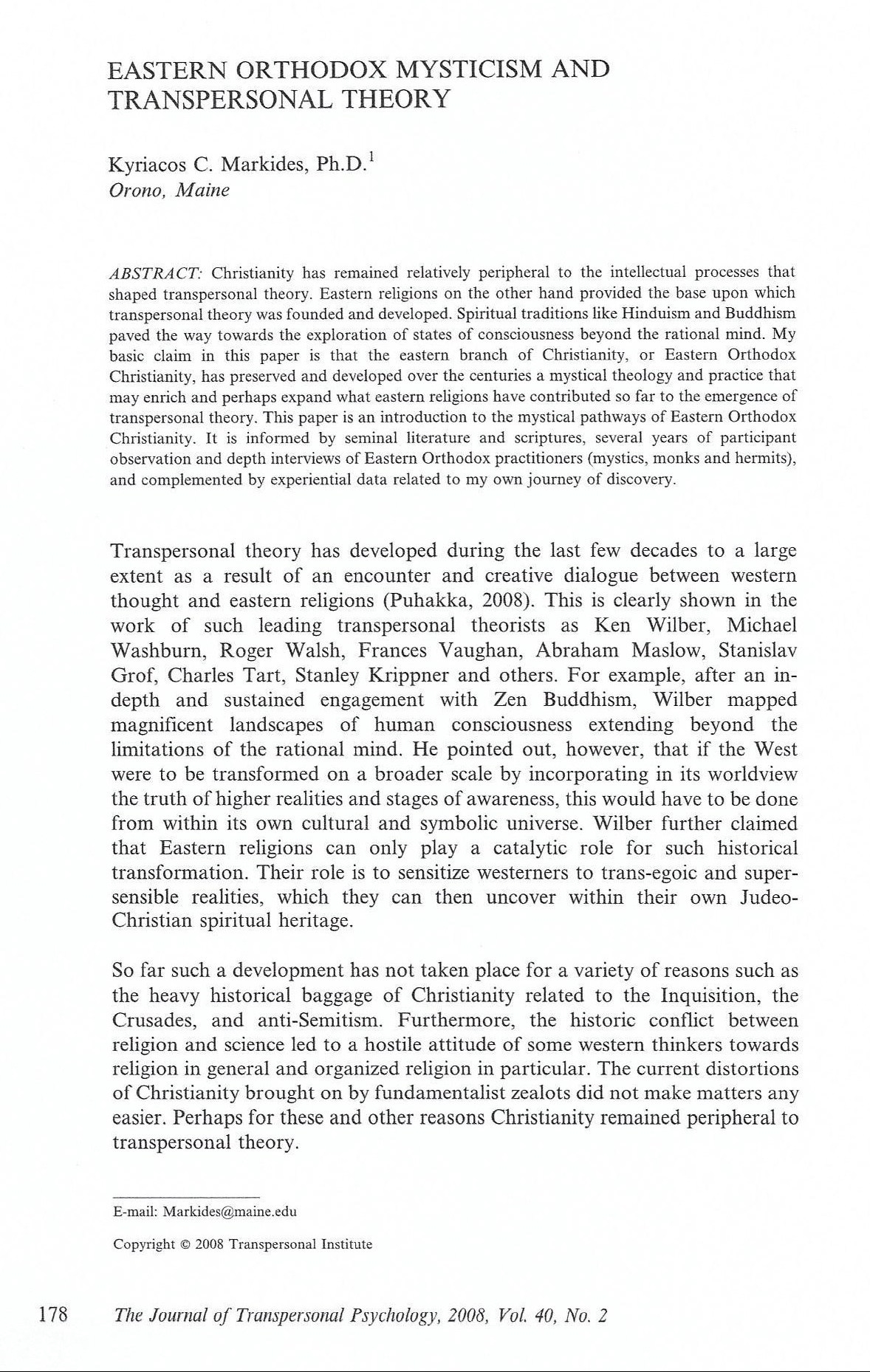
I attach a paper written by Dr. Markides and published in The Journal of Transpersonal Psychology, in 2008 (Vol. 40, No. 2). It is entitled, “Eastern Orthodox Mysticism and Transpersonal Theory”. As a “teaser” to the paper, I include Dr. Markides’ abstract:
ABSTRACT: Christianity has remained relatively peripheral to the intellectual processes that shaped transpersonal theory. Eastern religions on the other hand provided the base upon which transpersonal theory was founded and developed. Spiritual traditions like Hinduism and Buddhism paved the way towards the exploration of states of consciousness beyond the rational mind. My basic claim in this paper is that the eastern branch of Christianity, or Eastern Orthodox Christianity, has preserved and developed over the centuries a mystical theology and practice that may enrich and perhaps expand what eastern religions have contributed so far to the emergence of transpersonal theory. This paper is an introduction to the mystical pathways of Eastern Orthodox Christianity. It is informed by seminal literature and scriptures, several years of participant observation and depth interviews of Eastern Orthodox practitioners (mystics, monks and hermits), and complemented by experiential data related to my own journey of discovery.
Click on the blue hyperlink or the graphic, below, to open Dr. Markides paper:
St. Seraphim of Sarov: “The Acquisition of the Holy Spirit of God”
Posted by Dallas Wolf in Hesychasm - Jesus Prayer, Monasticism, Patristic Pearls on November 2, 2017
St Seraphim of Sarov (1754 – 1833) – is one of the most renowned Orthodox Russian saints. He is generally considered the greatest of the 19th-century startsy (elders). Seraphim extended the monastic teachings of asceticism, contemplation, and theosis to lay Christians. He taught that the purpose of the Christian life was to acquire the Holy Spirit. Perhaps his most popular quotation amongst Orthodox believers is “Acquire a peaceful spirit, and thousands around you will be saved.”
Nikolay Motovilov was a disciple of St Seraphim and wrote down many of his conversations with the starets, including this famous Talk On the Purpose of the Christian Life, that took place in November 1831 in the forest near Sarov. Motovilov’s account is considered one of the spiritual treasures of Russian Orthodoxy.
The Acquisition of the Holy Spirit of God
Click on the graphic or the blue hyperlink below to open the document:

St. Ignaty Brianchaninov: “On Practicing the Jesus Prayer”
Posted by Dallas Wolf in Hesychasm - Jesus Prayer, Patristic Pearls on November 2, 2017
Saint Ignatius (Brianchaninov), (1807–1867) – was a bishop and theologian of the Russian Orthodox Church. His two most important books translated into English are: The Arena: An Offering to Contemporary Monasticism; and On the Prayer of Jesus.

St Ignatius (Brianchaninov)
“The correct practice of the Jesus Prayer proceeds naturally from correct notions about God, about the most holy name of the Lord Jesus, and about man’s relationship to God.
Approach Prayer with Humility
God is an infinitely great and all-perfect being. God is the Creator and Renewer of men, Sovereign Master over men, angels, demons and all created things, both visible and invisible. Such a notion of God teaches us that we ought to stand prayerfully before Him in deepest reverence and in great fear and dread, directing toward Him all our attention, concentrating in our attention all the powers of the reason, heart, and soul, and rejecting distractions and vain imaginings, whereby we diminish alertness and reverence, and violate the correct manner of standing before God, as required by His majesty (John 4:23-24; Matt. 22:37; Mark 12:29-30; Luke 10:27). St. Isaac the Syrian put it marvelously: “When you turn to God in prayer, be in your thoughts as an ant, as a serpent of the earth, like a worm, like a stuttering child. Do not speak to Him something philosophical or high-sounding, but approach Him with a child’s attitude” (Homily 49). Those who have acquired genuine prayer experience an ineffable poverty of the spirit when they stand before the Lord, glorify and praise Him, confess to him, or present to Him their entreaties. They feel as if they had turned to nothing, as if they did not exist. That is natural. For when he who is in prayer experiences the fullness of the divine presence, of Life Itself, of Life abundant and unfathomable, then his own life strikes him as a tiny drop in comparison to the boundless ocean. That is what the righteous and long-suffering Job felt as he attained the height of spiritual perfection. He felt himself to be dust and ashes; he felt that he was melting and vanishing as does snow when struck by the sun’s burning rays (Job 42:6).
The name of our Lord Jesus Christ is a divine name. The power and effect of that name are divine, omnipotent and salvific, and transcend our ability to comprehend it. With faith therefore, with confidence and sincerity, and with great piety and fear ought we to proceed to the doing of the great work which God has entrusted to us: to train ourselves in prayer by using the name of our Lord Jesus Christ. “The incessant invocation of God’s name,” says Barsanuphius the Great, “is a medicine which mortifies not just the passions, but even their influence. Just as the physician puts medications or dressings on a wound that it might be healed, without the patient even knowing the manner of their operation, so also the name of God, when we invoke it, mortifies all passions, though we do not know how that happens” (421st Answer).
Our ordinary condition, the condition of all mankind, is one of fallenness, of spiritual deception, of perdition. Apprehending—and to the degree that we apprehend, experiencing—that condition, let us cry out from it in prayer, let us cry in spiritual humility, let us cry with wails and sighs, let us cry for clemency! Let us turn away from all spiritual gratifications, let us renounce all lofty states of prayer of which we are unworthy and incapable! It is impossible “to sing the Lord’s song in a strange land” (Ps. 136:5), in a heart held captive by passions. Should we hear an invitation to sing, we can know surely that it emanates “from them that have taken us captive” (Ps. 136:3). “By the waters of Babylon” tears alone are possible and necessary (Ps. 136:1).
Rule for Practicing the Jesus Prayer
This is the general rule for practicing the Jesus Prayer, derived from the Sacred Scriptures and the works of the Holy Fathers, and from certain conversations with genuine men of prayer. Of the particular rules, especially for novices, I deem the following worthy of mention.
Be Attentive
St. John of the Ladder counsels that the mind should be locked into the words of the prayer and should be forced back each time it departs from it (Step XXVIII, ch. 17). Such a mechanism of prayer is remarkably helpful and suitable. When the mind, in its own manner, acquires attentiveness, then the heart will join it with its own offering— compunction. The heart will empathize with the mind by means of compunction, and the prayer will be said by the mind and heart together.
Do Not Hurry
The words of the prayer ought to be said without the feast hurry. even lingering, so that the mind can lock itself into each word.
Persevere bring attention Back to the Words when the Mind wanders
St. John of the Ladder consoles and instructs the coenobitic… “God does not expect a pure and undistracted prayer. Despair not should inattention come over you! Be of cheerful spirit and constantly compel your mind to return to itself! For the angels alone are not subject to any distraction” (Step IV, ch. 93). “Being enslaved by passions, let us persevere in praying to the Lord: for all those who have reached the state of passionlessness did so with the help of such indomitable prayer. If, therefore, you tirelessly train your mind never to stray from the words of the prayer, it will be there even at mealtime. A great champion of perfect prayer has said: ‘I had rather speak five words with my understanding … than ten thousand words in an unknown tongue’ (I Cor. 14:19). Such prayer,” that is, the grace-given prayer of the mind in the heart, which shuns imaginings, “is not characteristic of children; wherefore we who are like children, being concerned with the perfection of our prayer,” that is, the attentiveness which is acquired by locking the mind into the words of the prayer, “must pray a great deal. Quantity is the cause of quality. The Lord gives pure prayer to him who, eschewing laziness, prays much and regularly in his own manner, even if it is marred by inattention” (The Ladder, Step XXVI11, ch. 21).
It Takes Time
Novices need more time in order to train themselves in prayer… Asceticism needs both time and gradual progress, so that the ascetic can mature for prayer in every respect. In order that a flower might bloom or the fruit grow on a tree, the tree must first be planted and left to develop; thus also does prayer grow out of the soil of other virtues and nowhere else… Pulled hither and thither by its acquired predilections, impressions, memories and worries, the novice’s mind constantly breaks its salvific chains and strays from the narrow to the wide path. It prefers to wander freely, to stroll in the regions of falsehood in association with the fallen spirits, to stray aimlessly and mindlessly over great expanses, though this be damaging to him and cause him great loss. The passions, those moral infirmities of human nature, are the principal cause of inattentiveness and absentmindedness in prayer. The more they are weakened in a man, the less is he distracted in spirit when praying. The passions are brought under control and mortified little by little by means of obedience, as well as by self-reproach and humility—these are the virtues upon which successful prayer is built. Concentration, which is accessible to man, is granted by God in good time to every struggler in piety and asceticism who by persistence and ardor proves the sincerity of his desire to acquire prayer.
Begin by saying the Prayer Aloud
The Russian hieromonk Dorotheus, a great instructor in spiritual asceticism, who was in this respect very much like St. Isaac the Syrian, counsels those who are learning the Jesus Prayer to recite it aloud at first. The vocal prayer, he says, will of itself turn into the mental.
After much vocal prayer there comes Mental Prayer
“Mental prayer,” he continues, “is the result of much vocal prayer, and mental prayer leads to the prayer of the heart. The Jesus Prayer should not be said in a loud voice but quietly, just audibly enough that you can hear yourself.,’ It is particularly beneficial to practice the Jesus Prayer aloud when assailed by distraction, grief, spiritual despondency and laziness. The vocal Jesus Prayer gradually awakens the soul from the deep moral slumber into which grief and spiritual despair are wont to thrust it. It is also particularly beneficial to practice the Jesus Prayer aloud when attacked by images, appetites of the flesh, and anger; when their influence causes the blood to boil. It should be practiced when peace and tranquility vanish from the heart, and the mind hesitates, becomes weak, and—so to speak—goes into upheaval because of the multitude of unnecessary thoughts and images. The malicious princes of the air, whose presence is hidden to physical sight but who are felt by the soul through their influences upon it, hearing as they mount their attack the name of the Lord Jesus—which they dread—will become undecided and confused, and will take fright and withdraw immediately from the soul. The method of prayer which the hieromonk suggests is very simple and easy. It should be combined with the method of St. John of the Ladder: the Jesus Prayer should be recited loud enough that you can hear yourself, without any hurry, and by locking the mind into the words of the prayer. This last, the hieromonk enjoins upon all who pray by Jesus’ name….
Establish a Daily Rule for Prostrations
The novice who is studying the Jesus Prayer will advance greatly by observing a daily rule comprising a certain number of full prostrations and bows from the waist, depending upon the strength of each individual. These are all to be performed without any hurry, with a repentant feeling in the soul and with the Jesus Prayer on the lips during each prostration…. Twelve prostrations suffice in the beginning. Depending upon one’s strength, ability and circumstances, that number can be constantly increased. But when the number of prostrations increases, one should be careful to preserve the quality of one’s prayer, so that one not be carried away by a preoccupation with the physical into fruitless, and even harmful, quantity. The bows warm up the body and somewhat exhaust it, and this condition facilitates attention and compunction. But let us be watchful, very watchful, lest the state pass into a bodily preoccupation which is foreign to spiritual sentiments and recalls our fallen nature! Quantity, useful as it is when accompanied by the proper frame of mind and the proper objective, can be just as harmful when it leads to a preoccupation with the physical. The latter is recognized by its fruits which also distinguish it from spiritual ardor. The fruits of physical preoccupation are conceit, self-assurance, intellectual arrogance: in a word, pride in its various forms, all of which are easy prey to spiritual deception. The fruits of spiritual ardor are repentance, humility, weeping and tears. The rule of prostrations is best observed before going to sleep: then, after the cares of the day have passed, it can be practiced longer and with greater concentration…. Prostrations stimulate a prayerful state of the mind and mortify the body as well as support and strengthen fervor in prayer.
These suggestions are, I believe, sufficient for the beginner who is eager to acquire the Jesus Prayer. “Prayer,” said the divine St. Meletius the Confessor, “needs no teacher. It requires diligence, effort and personal ardor, and then God will be its teacher.” The Holy Fathers, who have written many works on prayer in order to impart correct notions and faithful guidance to those desiring to practice it, propose and decree that one must engage in it actively in order to gain experiential knowledge, without which verbal instruction, though derived from experience, is dead, opaque, incomprehensible and totally inadequate. Conversely, he who is carefully practicing prayer and who is already advanced in it, should refer often to the writings of the Holy Fathers about prayer in order to check and properly direct himself, remembering that even the great Paul, though possessing the highest of all testimonies for his Gospel—that of the Holy Spirit— nevertheless went to Jerusalem where he communicated to the apostles who had gathered there the Gospel that he preached to the gentiles, “lest by any means,” as he said, “I should run, or had run, in vain ” (Gal. 2:2).”
Translated by Stephen Karganovic from The Alphabet of Orthodox Life, Belgrade, 1974. This appeared in Orthodox Life, vol. 28, no. 5, Sept.-Oct. 1978, pp. 9-14. Reprinted with permission.
Source: http://orthodoxinfo.com/praxis/ignaty_jesus.aspx
Elder Sophrony: “The Jesus Prayer: Method”
Posted by Dallas Wolf in Hesychasm - Jesus Prayer, New Nuggets on November 1, 2017
Archimandrite Sophrony (Sakharov) (1896 – 1993) – also known as Elder Sophrony, was best known as the disciple and biographer of St Silouan the Athonite and compiler of St Silouan’s works, and as the founder of the Patriarchal Stavropegic Monastery of St. John the Baptist in Tolleshunt Knights, Maldon, Essex, England.

Elder Sophrony
“I propose to devote this chapter to setting out as briefly as possible the more important aspects of the Jesus Prayer and the commonsense views regarding this great culture of the heart that I met with on the Holy Mountain.
Year after year monks repeat the prayer with their lips, without trying by any artificial means to join mind and heart. Their attention is concentrated on harmonizing their life with the commandments of Christ. According to ancient tradition mind unites with heart through Divine action when the monk continues in the ascetic feat of obedience and abstinence; when the mind, the heart and the very body of the ‘old man’ to a sufficient degree are freed from the dominion over them of sin; when the body becomes worthy to be ‘the temple of the Holy Ghost’ (cf. Rom. 6. 11-14). However, both early and present day teachers occasionally permit recourse to a technical method of bringing the mind down into the heart. To do this, the monk, having suitably settled his body, pronounces the prayer with his head inclined on his chest, breathing in at the words ‘Lord Jesus Christ, (Son of God)’ and breathing out to the words ‘have mercy upon me (a sinner)’. During inhalation the attention at first follows the movement of the air breathed in as far as the upper part of the heart. In this manner concentration can soon be preserved without wandering, and the mind stands side by side with the heart, or even enters within it. This method eventually enables the mind to see, not the physical heart but that which is happening within it-the feelings that creep in and the mental images that approach from without. With this experience, the monk acquires the ability to feel his heart, and to continue with his attention centered in the heart without further recourse to any psychosomatic technique.
True Prayer Comes Through Faith and Repentance
This procedure can assist the beginner to understand where his inner attention should be stayed during prayer and, as a rule, at all other times, too. Nevertheless, true prayer is not to be achieved thus. True prayer comes exclusively through faith and repentance accepted as the only foundation. The danger of psychotechnics is that not a few attribute too great significance to method qua method. In order to avoid such deformation the beginner should follow another practice which, though considerably slower, is incomparably better and more wholesome to fix the attention on the Name of Christ and on the words of the prayer. When contrition for sin reaches a certain level the mind naturally heeds the heart.
The Complete Formula
The complete formula of the Jesus Prayer runs like this: Lord, Jesus Christ, Son of God, have mercy upon me, a sinner, and it is this set form that is recommended. In the first half of the prayer we profess Christ-God made flesh for our salvation. In the second we affirm our fallen state, our sinfulness, our redemption. The conjunction of dogmatic confession with repentance makes the content of the prayer more comprehensive.
Stages of Development
It is possible to establish a certain sequence in the development of this prayer.
…First, it is a verbal matter: we say the prayer with our lips while trying to concentrate our attention on the Name and the words.
…Next, we no longer move our lips but pronounce the Name of Jesus Christ, and what follows after, in our minds, mentally.
…In the third stage mind and heart combine to act together: the attention of the mind is centered in the heart and the prayer said there.
…Fourthly, the prayer becomes self-propelling. This happens when the prayer is confirmed in the heart and, with no especial effort on our part, continues there, where the mind is concentrated.
…Finally, the prayer, so full of blessing, starts to act like a gentle flame within us, as inspiration from on High, rejoicing the heart with a sensation of divine love and delighting the mind in spiritual contemplation. This last state is sometimes accompanied by a vision of Light.
Go step by step
A gradual ascent into prayer is the most trustworthy. The beginner who would embark on the struggle is usually recommended to start with the first step, verbal prayer, until body, tongue, brain and heart assimilate it. The time that this takes varies. The more earnest the repentance, the shorter the road.
The practice of mental prayer may for a while be associated with the hesychastic method-in other words, it may take the form of rhythmic or a-rhythmic articulation of the prayer as described above, by breathing in during the first half and breathing out during the second part. This can be genuinely helpful if one does not lose sight of the fact that every invocation of the Name of Christ must be inseparably coupled with a consciousness of Christ Himself. The Name must not be detached from the Person of God, lest prayer be reduced to a technical exercise and so contravene the commandment, ‘Thou shalt not take the name of the Lord thy God in vain’ (EX. 20.7; Deut. 5.11).
Attention of Mind gained
When the attention of the mind is fixed in the heart it is possible to control what happens in the heart, and the battle against the passions assumes a rational character. The enemy is recognized and can be driven off by the power of the Name of Christ. With this ascetic feat the heart becomes so highly sensitive, so discerning, that eventually when praying for anyone the heart can tell almost at once the state of the person prayed for. Thus the transition takes place from mental prayer to prayer of the mind and heart, which may be followed by the gift of prayer that proceeds of itself.
Do Not Hurry
We try to stand before God with the whole of our being. Invocation of the Name of God the Saviour, uttered in the fear of God, together with a constant effort to live in accordance with the commandments, little by little leads to a blessed fusion of all our powers. We must never seek to hurry in our ascetic striving. It. is essential to discard any idea of achieving the maximum in the shortest possible time. God does not force us but neither can we compel Him to anything whatsoever. Results obtained by artificial means do not last long and, more importantly, do not unite our spirit with the Spirit of the Living God.
It’s a Long Path
In the atmosphere of the world today prayer requires super human courage. The whole ensemble of natural energies is in opposition. To hold on to prayer without distraction signals victory on every level of existence. The way is long and thorny but there comes a moment when a heavenly ray pierces the dark obscurity, to make an opening through which can be glimpsed the source of the eternal Divine Light. The Jesus Prayer assumes a meta-cosmic dimension. St John the Divine asserts that in the world to come our deification will achieve plenitude since ‘we shall see Him as He is’. ‘And every man that hath this hope in him purifieth himself, even as he is pure … Whosoever abideth in him sinneth not: whosoever sinneth hath not seen him, neither known him’ (cf. 1John 3.2,3,6). In order in Christ’s Name to receive forgiveness of sins and the promise of the Father we must strive to dwell on His Name ‘until we be endued with power from on high’ (cf. Luke24-49).
In advising against being carried away by artificial practices such as transcendental meditation I am but repeating the age-old message of the Church, as expressed by St Paul: ‘Exercise thyself rather unto godliness. For bodily exercise profiteth little: but godliness is profitable unto all things, having promise of the life that now is, and of that which is to come. This is a faithful saying and worthy of all acceptation. For therefore we both labour and suffer reproach, because we trust in the living God, who is the Saviour of all men’ (1Tim. 4.7-10)
It’s Not Like Transcendental Meditation
The way of the fathers requires firm faith and long patience”, whereas our contemporaries want to seize every spiritual gift, including even direct contemplation of the Absolute God, by force and speedily, and will often draw a parallel between prayer in the Name of Jesus and yoga or transcendental meditation and the like. I must stress the danger of such errors-the danger of looking upon prayer as one of the simplest and easiest ‘technical’ means leading to immediate unity with God. It is imperative to draw a very definite line between the Jesus Prayer and every other ascetic theory. He is deluded who endeavors to divest himself mentally of all that is transitory and relative in order to cross some invisible threshold, to realize his eternal origin, his identity with the Source of all that exists; in order to return and merge with Him, the Nameless transpersonal Absolute. Such exercises have enabled many to rise to supra-rational contemplation of being; to experience a certain mystical trepidation; to know the state of silence of the mind, when mind goes beyond the boundaries of time and space. In such-like states man may feel the peacefulness of being withdrawn from the continually changing phenomena of the visible world; may even have a certain experience of eternity. But the God of Truth, the Living God, is not in all this. It is man’s own beauty, created in the image of God, that is contemplated and seen as Divinity, whereas he himself still continues within the confines of his creatureliness. This is a vastly important concern. The tragedy of the matter lies in the fact that man sees a mirage which, in his longing for eternal life, he mistakes for a genuine oasis. This impersonal form of ascetics leads finally to an assertion of divine principle in the very nature of man. Man is then drawn to the idea of self-deification- the cause of the original fall. The man who is blinded by the imaginary majesty of what he contemplates has in fact set his foot on the path to self-destruction. He has discarded the revelation of a Personal God. He finds the principle of the Person-Hypostasis a limiting one, unworthy of the Absolute. He tries to strip himself of like limitations and return to the state which he imagines has belonged to him since before his coming into this world. This movement into the depths of his own being is nothing else but attraction towards the non-being from which we were called by the will of the Creator.
Knowledge of Personal God
The true Creator disclosed Himself to us as a Personal Absolute. The whole of our Christian life is based on knowledge of God, the First and the Last, Whose Name is I AM. Our prayer must always be personal, face to Face. He created us to be joined in His Divine Being, without destroying our personal character. It is this form of immortality that was promised to us by Christ. Like St Paul we would not ‘be unclothed, but clothed upon, that mortality might be swallowed up of life’. For this did God create us and ‘hath given unto us the earnest of the Spirit’ (2 Cor. 5.4,5).
Personal immortality is achieved through victory over the world – a mighty task. The Lord said, ‘Be of good cheer; I have overcome the world’ (John 10. 3 3), and we know that the victory was not an easy one. ‘Beware of false prophets … Enter ye in at the strait gate: for wide is the gate, and broad is the way, that leadeth to destruction, and many there be which go in thereat: Because strait is the gate, and narrow is the way, which leadeth unto life, and few there be that find it’ (Matt. 7.13-115).
Wherein lies destruction? In that people depart from the Living God.
To believe in Christ one must have either the simplicity of little children – ‘Except ye be converted and become as little children, ye shall not enter into the kingdom of heaven’ (Matt. 18.3)-or else, like St Paul, be fools for Christ’s sake. ‘We are fools for Christ’s sake … we are weak … we are despised … we are made as the filth of the world, and are the offscouring of all things unto this day’ (1 Cor. 4. 10, 13). However, ‘other foundation can no man lay than that is laid, which is Jesus Christ’ (1 Cor. 3 .11). ʻWherefore I beseech you, be ye followers of me’ (1 Cor. 4. 16). In the Christian experience cosmic consciousness comes from prayer like Christ’s Gethsemane prayer, not as the result of abstract philosophical cogitations.
When the Very God reveals Himself in a vision of Uncreated Light, man naturally loses every desire to merge into a transpersonal Absolute. Knowledge which is imbued with life (as opposed to abstract knowledge) can in no wise be confined to the intellect: there must be a real union with the act of Being. This is achieved through love: ‘Thou shalt love the Lord thy God with all thy heart … and with all thy mind’ (Matt. 22.37). The commandment bids us love. Therefore love is not something given to us: it must be acquired by an effort made of our own free will. The injunction is addressed first to the heart as the spiritual centre of the individual. Mind is only one of the energies of the human. Love begins in the heart, and the mind is confronted with a new interior event and contemplates Being in the Light of Divine love.
A Difficult Task
There is no ascetic feat more difficult, more painful, than the effort to draw close to God, Who is Love (cf. i John 4.8, 16). Our inner climate varies almost from day to day: now we are troubled because we do not understand what is happening about us; now inspired by a new flash of knowledge. The Name Jesus speaks to us of the extreme manifestation of the Father’s love for us (cf.John 3.16). In proportion as the image of Christ becomes ever more sacred to us, and His word is perceived as creative energy, so a marvelous peace floods the soul while a luminous aura envelops heart and head. Our attention may hold steady. Sometimes we continue thus, as if it were a perfectly normal state to be in, not recognizing that it is a gift from on High. For the most part we only realize this union of mind with heart when it is interrupted.
In the Man Christ Jesus ‘dwelleth all the fullness of the Godhead bodily’ (Col. 2.9). in Him there is not only God but the whole human race. When we pronounce the Name Jesus Christ we place ourselves before the plenitude both of Divine Being and created being. We long to make His life our life; to have Him take His abode in us. In this lies the meaning of deification. But Adam’s natural longing for deification at the very outset took a wrong turning which led to a terrible deviation. His spiritual vision was insufficiently established in Truth.
Our life can become holy in all respects only when true knowledge of its metaphysical basis is coupled with perfect love towards God and our fellow-men. When we firmly believe that we are the creation of God the Primordial Being, it will be obvious that there is no possible deification for us outside the Trinity. If we recognize that in its ontology all human nature is one, then for the sake of the unity of this nature we shall strive to make love for our neighbor part of our being.
Our most dire enemy is pride. Its power is immense. Pride saps our every aspiration, vitiates our every endeavor. Most of us fall prey to its insinuations. The proud man wants to dominate, to impose his own will on others; and so conflict arises between brethren. The pyramid of inequality is contrary to revelation concerning the Holy Trinity in Whom there is no greater, no lesser; where each Person possesses absolute plenitude of Divine Being.
The Kingdom of Christ is founded on the principle that whosoever would be first should be the servant of all (cf. Mark 9.3 5). The man who humbles himself shall be raised up, and vice versa: he who exalts himself shall be brought low. In our struggle for prayer we shall cleanse our minds and hearts from any urge to prevail over our brother. Lust for power is death to the soul. People are lured by the grandeur of power but they forget that ‘that which is highly esteemed among men is an abomination in the sight of God’ (Matt. 16.15). Pride incites us to criticize, even scorn our weaker brethren; but the Lord warned us to ‘take heed that we despise not one of these little ones’ (cf. Matt. i8.io). If we give in to pride all our practice of the Jesus Prayer will be but profanation of His Name. ‘He that saith he abideth in Him ought himself also to walk, even as He walked’ (1John2.6). He who verily loves Christ will devote his whole strength to obeying His word. I stress this because it is our actual method for learning to pray. This, and not any psychosomatic technics, is the right way.
Not a Christian Yoga
I have lingered on the dogmatic justification for the Jesus Prayer largely because in the last decade or so the practice of this prayer has been distorted into a so-called ‘Christian yoga’ and mistaken for ‘transcendental meditation’. Every culture, not only every religious culture, is concerned with ascetic exercises. If a certain similarity either in their practice or their outward manifestations, or even their mystical formulation, can be discerned, that does not at all imply that they are alike fundamentally. Outwardly similar situations can be vastly different in inner content.
When we contemplate Divine wisdom in the beauty of the created world, we are at the same time attracted still more strongly by the imperishable beauty of Divine Being as revealed to us by Christ. The Gospel for us is Divine Self-Revelation. In our yearning to make the Gospel word the substance of our whole being we free ourselves by the power of God from the domination of passions. Jesus is the one and only Savior in the true sense of the word. Christian prayer is effected by the constant invocation of His Name: Lord Jesus Christ, Son of the Living God, have mercy upon us and upon Thy world.
Though prayer in the Name of Jesus in its ultimate realization unites man with Christ fully, the human hypostasis is not obliterated, is not lost in Divine Being like a drop of water in the ocean. ‘I am the light of the world … I am the truth and the life’ (John 8.12; 14.6). For the Christian-Being, Truth, Life are not ‘what’ but ‘who’. Where there is no personal form of being, there is no living form either. Where in general there is no life, neither is there good or evil; light or darkness. ‘Without him was not any thing made that was made. In him was life’ (John 1:3).
When contemplation of Uncreated Light is allied to invocation of the Name of Christ, the significance of this Name as ‘the kingdom of God come with power’ (Mark 9.1) is made particularly clear, and the spirit of man hears the voice of the Father: ‘This is my beloved Son’ (Mark 9.7). Christ in Himself showed us the Father: ‘he that hath seen me hath seen the Father’ (John 14:9). Now we know the Father in the same measure as we have known the Son. ‘I and my Father are one’ (John 10.30). And the Father bears witness to His Son. We therefore pray, 90 Son of God, save us and Thy world.’
To acquire prayer is to acquire eternity. When the body lies dying, the cry ‘Jesus Christ’ becomes the garment of the soul; when the brain no longer functions and other prayers are difficult to remember, in the light of the divine knowledge that proceeds from the Name our spirit will rise into life incorruptible.”
~From His Life is Mine by Archimandrite Sophrony, trans. Rosemary Edmonds, St. Valdimir Seminary Press, pp112-120
St Theophan the Recluse: “On the Jesus Prayer”
Posted by Dallas Wolf in Hesychasm - Jesus Prayer, Patristic Pearls on November 1, 2017
Theophan the Recluse, (1815 – 1894) is a well-known saint in the Russian Orthodox Church.
Below are St Theophan’s thoughts on the Jesus Prayer:

St Theophan the Recluse
“The hands at work, the mind and heart with God
You have read about the Jesus Prayer, have you not? And you know what it is from practical experience. Only with the help of this prayer can the necessary order of the soul be firmly maintained; only through this prayer can we preserve our inner order undisturbed even when distracted by household cares. This prayer alone makes it possible to fulfill the injunction of the Fathers: the hands at work, the mind and heart with God. When this prayer becomes grafted in our heart, then there are no inner interruptions and it continues always in the same, evenly flowing way.
The path to achievement of a systematic interior order is very hard, but it is possible to preserve this (or a similar) state of mind during the various and inevitable duties you have to perform; and what makes it possible is the Jesus Prayer when it is grafted in the heart. How can it be so grafted ? Who knows ? But it does happen. He who strives is increasingly conscious of this engrafting, without knowing how it has been achieved. To strive for this inner order, we must walk always in the presence of God, repeating the Jesus Prayer as frequently as possible. As soon as there is a free moment, begin again at once, and the engrafting will be achieved.
One of the means of renewing the Jesus Prayer and bringing it to life is by reading, but it is best to read mainly about prayer.
The Jesus Prayer, and the warmth which accompanies it
To pray is to stand spiritually before God in our heart in glorification, thanksgiving, supplication, and contrite penitence. Everything must be spiritual. The root of all prayer is devout fear of God; from this comes belief about God and faith in Him, submission of oneself to God, hope in God, and cleaving to Him with the feeling of love, in oblivion of all created things. When prayer is powerful, all these spiritual feelings and movements are present in the heart with corresponding vigor.
How does the Jesus Prayer help us in this?
Through the feeling of warmth which develops in and around the heart as the effect of this Prayer.
The habit of prayer is not formed suddenly, but requires long work and toil.
The Jesus Prayer, and the warmth which accompanies it, helps better than anything else in the formation of the habit of prayer.
Note that these are the means, and not the deed itself.
It is possible for both the Jesus Prayer and the feeling of warmth to be present without real prayer, This does indeed happen, however strange it may seem.
When we pray we must stand in our mind before God, and think of Him alone. Yet various thoughts keep jostling in the mind, and draw it away from God. In order to teach the mind to rest on one thing, the Holy Fathers used short prayers and acquired the habit of reciting them unceasingly. This unceasing repetition of a short prayer kept the mind on the thought of God and dispersed all irrelevant thoughts. They adopted various short prayers, but it is the Jesus Prayer which has become particularly established amongst us and is most generally employed: ‘Lord Jesus Christ, Son of God, have mercy upon me, a sinner!’
So this is what the Jesus Prayer is. It is one among various short prayers, oral like all others. Its purpose is to keep the mind on the single thought of God.
Whoever has formed the habit of this Prayer and uses it properly, really does remember God incessantly.
Since the remembrance of God in a sincerely believing heart is naturally accompanied by a sense of piety, hope, thanksgiving, devotion to God’s will, and by other spiritual feelings, the Jesus Prayer, which produces and preserves this remembrance of God, is called spiritual prayer. It is rightly so called only when it is accompanied by these spiritual feelings. But when not accompanied by them it remains oral like any other prayer of the same type.
This is how one should think of the Jesus Prayer. Now what is the meaning of this warmth which accompanies the practice of the Prayer ?
In order to keep the mind on one thing by the use of a short prayer, it is necessary to preserve attention and so lead it into the heart: for so long as the mind remains in the head, where thoughts jostle one another, it has no time to concentrate on one thing. But when attention descends into the heart, it attracts all the powers of the soul and body into one point there. This concentration of all human life in one place is immediately reflected in the heart by a special sensation that is the beginning of future warmth. This sensation, faint at the beginning, becomes gradually stronger, firmer, deeper. At first only tepid, it grows into warm feeling and concentrates the attention upon itself. And so it comes about that, whereas in the initial stages the attention is kept in the heart by an effort of will, in due course this attention, by its own vigor, gives birth to warmth in the heart. This warmth then holds the attention without special effort. From this, the two go on supporting one another, and must remain inseparable; because dispersion of attention cools the warmth, and diminishing warmth weakens attention.
From this there follows a rule of the spiritual life: if you keep the heart alive towards God, you will always be in remembrance of God. This rule is laid down by St. John of the Ladder.
The question now arises whether this warmth is spiritual. No, it is not spiritual. It is ordinary physical warmth. But since it keeps the attention of the mind in the heart, and thus helps the development there of the spiritual movements described earlier, it is called spiritual- provided, however, that it is not accompanied by sensual pleasure, however slight, but keeps the soul and body in sober mood.
From this it follows that when the warmth accompanying the Jesus Prayer does not include spiritual feelings, it should not be called spiritual, but simply warm-blooded. There is nothing in itself bad about this warm-blooded feeling, unless it is connected with sensual pleasure, however slight. If it is so connected, it is bad and must be suppressed.
Things begin to go wrong when the warmth moves about in parts of the body lower than the heart. And matters become still worse when, in enjoyment of this warmth, we imagine it to be all that matters, without bothering about spiritual feelings or even about remembrance of God; and so we set our heart only on having this warmth. This wrong course is occasionally possible, though not for all people, nor at all times. It must be noticed and corrected, for otherwise only physical warmth will remain, and we must not consider this warmth as spiritual or due to grace. This warmth is spiritual only when it is accompanied by the spiritual impetus of prayer. Anyone who calls it spiritual without this movement is mistaken. And anyone who imagines it to be due to grace is still more in error.
Warmth which is filled with grace is of a special nature and it is only this which is truly spiritual. It is distinct from the warmth of the flesh, and does not produce any noticeable changes in the body, but manifests itself by a subtle feeling of sweetness.
Everyone can easily identify and distinguish spiritual warmth by this particular feeling. Each must do it for himself: this is no business for an outsider.
The easiest way to acquire unceasing prayer
To acquire the habit of the Jesus Prayer, so that it takes root in ourselves, is the easiest way of ascending into the region of unceasing prayer. Men of the greatest experience have found, through God’s enlightenment, that this form of prayer is a simple yet most effective means of establishing and strengthening the whole of the spiritual and ascetic life; and in their rules for prayer they have left detailed instructions about it.
In all our efforts and ascetic struggles, what we seek is purification of the heart and restoration of the spirit. There are two ways to this: the active way, the practice of the ascetic labors; and the contemplative way, the turning of the mind to God. By the first way the soul becomes purified and so receives God; by the second way the God of whom the soul becomes aware Himself bums away every impurity and thus comes to dwell in the purified soul. The whole of this second way is summed up in the one Jesus Prayer, as St. Gregory of Sinai says’: ‘God is gained either by activity and work, or by the art of invoking the Name of Jesus.’ He adds that the first way is longer than the second, the second being quicker and more effective. For this reason some of the Holy Fathers have given prime importance, among all the different kinds of spiritual exercise, to the Jesus Prayer. It enlightens, strengthens, and animates; it defeats all enemies visible and invisible, and leads directly to God. See how powerful and effective it is! The Name of the Lord Jesus is the treasury of all good things, the treasury of strength and of life in the spirit.
It follows from this that we should from the very first give full instructions on the practice of the Jesus Prayer to everyone who repents or begins to seek the Lord. Only following on from this should we introduce the beginner into other practices, because it is in this way that he can most quickly become steadfast and spiritually aware, and achieve inner peace. Many people, not knowing this, may be said to waste their time and labour in going no further than the formal and external activities of the soul and body.
The practice of prayer is called an ‘art’, and it is a very simple one. Standing with consciousness and attention in the heart, cry out unceasingly: ‘Lord Jesus Christ, Son of God, have mercy upon me,’ without having in your mind any visual concept or image, believing that the Lord sees you and listens to you.
It is important to keep your consciousness in the heart, and as you do so to control your breathing a little so as to keep time with the words of the prayer. But the most important thing is to believe that God is near and hears. Say the prayer for God’s ear alone.
At the beginning this prayer remains for a long time only an activity like any other, but in time it passes into the mind and finally takes root in the heart.
There are deviations from this right way of praying; therefore we must learn it from someone who knows all about it. Mistakes occur chiefly from the attention being in the head and not in the heart. He who keeps his attention in the heart is safe. Safer still is he who at all times clings to God in contrition, and prays to be delivered from illusion.
One thought, or the thought of One only
This short prayer to Jesus has a higher purpose-to deepen your remembrance of God and your feeling towards Him. These callings out of the soul to God are all too easily disrupted by the first incoming impression; and besides, in spite of these callings, thoughts continue to jostle in your head like mosquitoes. To stop this jostling, you must bind the mind with one thought, or the thought of One only. An aid to this is a short prayer, which helps the mind to become simple and united: it develops feeling towards God and is engrafted with it. When this feeling arises within us, the consciousness of the soul becomes established in God, and the soul begins to do everything according to His will. Together with the short prayer, you must keep your thought and attention turned towards God. But if you limit your prayer to words only, you are as ‘sounding brass’.
‘Techniques’ and ‘methods’ do not matter: one thing alone is essential
The prayer, ‘Lord Jesus Christ, Son of God, have mercy upon me’ is an oral prayer like any other. There is nothing special about it in itself, but it receives all its power from the state of mind in which it is made.
The various methods described by the Fathers (sitting down, making prostrations, and the other techniques used when performing this prayer) are not suitable for everyone: indeed without a personal director they are actually dangerous. It is better not to try them. There is just one method which is obligatory for all: to stand with the attention in the heart. All other things are beside the point, and do not lead to the crux of the matter.
It is said of the fruit of this prayer, that there is nothing higher in the world. This is wrong. As if it were some talisman! Nothing in the words of the prayer and their uttering can alone bring forth its fruit. All fruit can be received without this prayer, and even without any oral prayer, but merely by directing the mind and heart towards God.
The essence of the whole thing is to be established in the remembrance of God, and to walk in His presence. You can say to anyone: ‘Follow whatever methods you like-recite the Jesus Prayer, perform bows and prostrations, I go to Church: do what you wish, only strive to be always in constant remembrance of God.’ I remember meeting a man in Kiev who said: ‘I did not use any methods at all, I did not know the Jesus Prayer, yet by God’s mercy I walk always in His presence. But how this has come to pass, I myself do not know, God gave!’
It is most important to realize that prayer is always God-given: otherwise we may confuse the gift of grace with some Achievement of our own.
People say: attain the Jesus Prayer, for that is inner prayer. This is not correct. The Jesus Prayer is a good means to arrive at inner prayer, but in itself it is not inner but outer prayer. Those who attain the habit of the Jesus Prayer do very well.
But if they stop only at this and go no further, they stop half way.
Even though we are reciting the Jesus Prayer, it is still necessary for us to keep the thought of God: otherwise the Prayer is dry food. It is good that the Name of Jesus should cleave to your tongue. But with this it is still possible not to remember God at all and even to harbor thoughts which are opposed to Him. Consequently everything depends on conscious and free turning to God, and on a balanced effort to hold oneself in this.
Why the Jesus Prayer is stronger than other prayers
The Jesus Prayer is like any other prayer. It is stronger than all other prayers only in virtue of the all-powerful Name of Jesus, Our Lord and Savior. But it is necessary to invoke His Name with a full and unwavering faith-with a deep certainty that He is near, sees and hears, pays whole-hearted attention to our petition, and is ready to fulfill it and to grant what we seek. There is nothing to be ashamed of in such a hope. If fulfillment is sometimes delayed, this may be because the petitioner is still not yet ready to receive what he asks.
Not a talisman
The Jesus Prayer is not some talisman. Its power comes from faith in the Lord, and from a deep union of the mind and heart with Him. With such a disposition, the invocation of the Lord’s Name becomes very effective in many ways. But a mere repetition of the words does not signify anything.
Mechanical repetition leads to nothing
Do not forget that you must not limit yourself to a mechanical repetition of the words of the Jesus Prayer. This will lead to nothing except a habit of repeating the prayer automatically with the tongue, without even thinking about it. There is of course nothing wrong in this, but it constitutes only the extreme outer limit of the work.
The essential thing is to stand consciously in the presence of the Lord, with fear, faith and love.
Oral and inner prayer
One can recite the Jesus Prayer with the mind in the heart without movement of the tongue. This is better than oral prayer. Use oral prayer as a support to inner prayer. Sometimes It is required in order to strengthen inner prayer.
Avoid visual concepts
Hold no intermediate image between the mind and the Lord when practicing the Jesus Prayer. The words pronounced are merely a help, and are not essential. The principal thing is to stand before the Lord with the mind in the heart. This, and not the words, is inner spiritual prayer. The words here are as much or as little the essential part of the prayer as the words of any other prayer. The essential part is to dwell in God, and this walking before God means that you live with the conviction ever before your consciousness that God is in you, as He is in everything: you live in the firm assurance that He sees all that is within you, knowing you better than you know yourself. This awareness of the eye of God looking at your inner being must not be accompanied by any visual concept, but must be confined to a simple conviction or feeling. A man in a warm room feels how the warmth envelops and penetrates him. The same must be the effect on our spiritual nature of the all-encompassing presence of God, who is the fire in the room of our being.
The words ‘Lord Jesus Christ, Son of God, have mercy upon me’ are only the instrument and not the essence of the work; but they are an instrument which is very strong and effective, for the Name of the Lord Jesus is fearful to the enemies of our salvation and a blessing to all who seek Him. Do not forget that this practice is simple, and must not have anything fanciful about it. Pray about everything to the Lord, to our most pure Lady, to your Guardian Angel; and they will teach you everything, either directly or through others.
Images and illusion
In order not to fall into illusion, while practicing inner prayer, do not permit yourself any concepts, images, or visions. For vivid imaginings, darting to and fro, and flights of fancy do not cease even when the mind stands in the heart and recites prayer: and no one is able to rule over them, except those who have attained perfection by the grace of the Holy Spirit, and who have acquired stability of mind through Jesus Christ.
Dispel all images from your mind
You ask about prayer. I find in the writings of the Holy Fathers, that when you pray you must dispel all images from your mind. That is what I also try to do, forcing myself to realize that God is everywhere-and so (among other places) here, where my thoughts and feelings are. I cannot succeed in freeing myself entirely from images, but gradually they evaporate more and more. There comes a point when they disappear completely.”
~ Excerpted for the Art of Prayer: An Orthodox Anthology, comp by Igumen Charion of Valamo, trans E. Kadloubovsky & E. M. Palmer, Faber and Faber, 1966, pp 92-101
 First Thoughts