Dallas Wolf

Hesychastic hermit
Homepage: https://firstthoughtsofgod.com
St. Gregory of Nazianzus: “The Holy Ghost, which proceeds from the Father;”
Posted in Ekklesia and church, First Thoughts, Monasticism, Patristic Pearls, The Cappadocians, The Holy Trinity on April 8, 2023
St. Gregory of Nazianzus (c. 329 – 25 January 390), also known as Gregory the Theologian or Gregory Nazianzen, was a 4th-century Archbishop of Constantinople, theologian, and one of the Cappadocian Fathers (along with Basil the Great and Gregory of Nyssa). He is widely considered the most accomplished rhetorical stylist of the patristic age. Gregory made a significant impact on the shape of Trinitarian theology among both Greek and Latin-speaking theologians, and he is remembered as the “Trinitarian Theologian”.

“The Holy Ghost, which proceeds from the Father; Who, inasmuch as He proceeds from That Source, is no Creature; and inasmuch as He is not Begotten is no Son; and inasmuch as He is between the Unbegotten and the Begotten is God. And thus escaping the toils of your syllogisms, He has manifested himself as God, stronger than your divisions. What then is Procession? Do you tell me what is the Unbegottenness of the Father, and I will explain to you the physiology of the Generation of the Son and the Procession of the Spirit, and we shall both of us be frenzy-stricken for prying into the mystery of God. And who are we to do these things, we who cannot even see what lies at our feet, or number the sand of the sea, or the drops of rain, or the days of Eternity, much less enter into the Depths of God, and supply an account of that Nature which is so unspeakable and transcending all words?”
~ from: The Orations and Letters of Saint Gregory Nazianzus, Oration 31 (5th Theological Oration), VIII.
St. Basil the Great: “Homily About Ascesis – How a Monk Should be Adorned”
Posted in Ekklesia and church, Monasticism, Patristic Pearls, The Cappadocians on April 8, 2023
St. Basil of Caesarea, also called Saint Basil the Great (330 – January 379), was a bishop of Caesarea Mazaca in Cappadocia (modern-day Turkey). He was an influential theologian who supported the Nicene Creed and opposed the heresies of the early Christian church. Together with Pachomius, he is remembered as a father of communal (coenobitic) monasticism in Eastern Christianity. Basil, together with his brother Gregory of Nyssa and his friend Gregory of Nazianzus, are collectively referred to as the Cappadocian Fathers.

“The monk, above all, must not possess anything in his life. He must have bodily isolation, proper clothing, a moderate tone of voice, and discipline speech; he must not cause a ruckus about the food and drink and he must eat in silence; he must be silent before his elders and be attentive to wiser men; he must love his peers and advise those junior in a loving way; he must move away from the immoral and the carnal and the sophisticated; he must think much and say less; he must not become impudent in his words, nor gossip and not be amenable to laughter; he must be adorned with shame, directing his gaze to the ground and his soul upward; he must not object with words of contention but rather be compliant; he must work with his hands and always keep in remembrance the end of this age; he must rejoice with hope, endure sadness, pray unceasingly and thank God for everything; he must be humble towards all and hate pride; he must be vigilant in keeping his heart pure of any evil thought; he must gather treasures in Heaven by keeping the commandments, examine himself for his thoughts and actions each day and not be involved in vain things of life and in idle talk; he must not examine inquisitively the life of idle people, but imitate the lives of the Holy Fathers; he must be happy with those who achieve virtue and not be envious; he must suffer with those suffering and weep with them and be sorry for them, but not criticise them; he must not reproach one who returns from his sin and never justify himself. Above all else he must confess before God and the men that he is a sinner and admonish the unruly, strengthen the faint-hearted, minister unto the sick and washed the feet of the saints; he must attend to hospitality and brotherly love, to be at peace with those who have the same faith and abhor the heretics; he must read the canonical books and not open even a single one of the occult; he must not talk about the Father and the Son and the Holy Spirit, but think and confess the uncreated and consubstantial Trinity with courage, and tell those who ask that there is the need of to be baptised, as we have received it from the tradition, to believe, as we have confessed it according to our baptism, and to glorify God, as we have believed.”
~ from: The Monastic Rule of St. Basil the Great
St. Gregory of Sinai: ‘Sowing in the Light’
Posted in Hesychasm - Jesus Prayer, Monasticism, Patristic Pearls on April 7, 2023
St. Gregory of Sinai (c. 1260s -1346) – was a well-travelled Greek Christian monk and writer from Smyrna (modern-day İzmir, Turkey). He was instrumental in the emergence of hesychasm on Mount Athos in the early 14th century. He was a contemporary of St. Gregory Palamas.

“According to St. Paul (cf. Rom. 15:16), you “minister” the Gospel only when, having yourself participated in the light of Christ, you can pass it on actively to others. Then you sow the Logos like a divine seed in the fields of your listeners’ souls. ‘Let your speech be always filled with grace’, says St Paul (Col. 4:6), ‘seasoned’ with divine goodness. Then it will impart grace to those who listen to you with faith. Elsewhere St. Paul, calling the teachers tillers and their pupils the field they till (cf. II Tim. 2:6), wisely presents the former as ploughers and sowers of the divine Logos and the latter as the fertile soil, yielding a rich crop of virtues. True ministry is not simply a celebration of sacred rites; it also involves participation in divine blessings and the communication of these blessings to others.”
~ from: The Philokalia
St. Macrina and the Healing of the Soldier’s Daughter
Posted in Patristic Pearls, The Cappadocians, Women in Early Christianity on April 6, 2023
St. Macrina the Younger (ca. AD 327 – July 379), was the older sister of three Cappadocian Saints and Bishops: Basil of Caesarea, Gregory of Nyssa, and Peter of Sebasteia. She was also friends with St. Gregory of Nanzianzus. Macrina transformed one of her family’s rural estates in Pontus (modern Turkey) into a monastery for ascetic virgins who came from both an aristocratic and non-aristocratic backgrounds. All members, including those from her own household, were free and ex-slaves received the same rights and obligations as their former masters. St. Basil established a men’s monastery nearby. Macrina was so well respected and loved by her younger brother, Gregory, that he wrote two books about her virtues, holiness, and intellect soon after her death in AD 379: The Life of Saint Macrina and On the Soul and the Resurrection. The post below is an excerpt from The Life of Saint Macrina, written in about AD 381.

“Along the way [from Macrina’s funeral], a distinguished military man who had command of a garrison in a little town of the district of Pontus, called Sebastopolis, and who lived there with his subordinates, came with the kindly intentions to meet me [Gregory of Nyssa] when I arrived there. He had heard of our misfortune [the death of Macrina] and he took it badly (for, in fact, he was related to our family by kinship and also by close friendship). He gave me an account of a miracle worked by Macrina; and this will be the last event I shall record in my story before concluding my narrative. When we stopped weeping and were standing in conversation, he said to me, “Hear what a great good has departed from human life.” And with this he stated his story.
“It happened that my wife and I once desired to visit that powerhouse of virtue; for that’s what I think that place should be called in which the blessed soul spent her life. Our little daughter was also with us and she suffered from an eye ailment as a result of an infectious disease. And it was a hideous and pitiful sight, since the membrane around the pupil was swollen and because of the disease had taken on a whitish tinge. As we entered that divine place, we separated, my wife and I, to make our visit to those who lived a life of philosophy1 therein, I going to the monks’ enclosure where your brother, Peter [of Sebaste], was abbot, and my wife entering the convent to be with the holy one. After a suitable interval had passed, we decided it was time to leave the monastery retreat and we were already getting ready to go when the same, friendly invitation came to us from both quarters. Your brother asked me to stay and take part in the philosophic table, and the blessed Macrina would not permit my wife to leave, but she held our little daughter in her arms and said that she would not give her back until she had given them a meal and offered them the wealth of philosophy; and, as you might have expected, she kissed the little girl and was putting her lips to the girl’s eyes, when she noticed the infection around the pupil and said, “If you do me the favor of sharing our table with us, I will give you in return a reward to match your courtesy.” The little girl’s mother asked what it might be and the great Macrina replied, “It is an ointment I have that has the power to heal the eye infection.” When after this a message reached me from the women’s quarters telling me of Macrina’s promise, we gladly stayed, counting of little consequence the necessity which pressed us to make our way back home.
Finally the feasting was over and our souls were full. The great Peter with his own hands had entertained and cheered us royally, and the holy Macrina took leave of my wife with every courtesy one could wish for. And so, bright and joyful, we started back home along the same road, each of us telling the other what happened to each as we went along. And I recounted all I had seen and heard in the men’s enclosure, while she told me every little thing in detail, like a history book, and thought that she should omit nothing, not even the least significant details. On she went telling me about everything in order, as if in a narrative, and when she came to the part where a promise of a cure for the eye had been made, she interrupted the narrative to exclaim, “What’s the matter with us! How did we forget the promise she made us, the special eye ointment?” And I was angry about our negligence and summoned some one to run back quickly to ask for the medicine, when our baby, who was in her nurse’s arms, looked, as it happened, towards her mother. And the mother gazed intently at the child’s eyes and then loudly exclaimed with joy and surprise, “Stop being angry at our negligence! Look! There’s nothing missing of what she promised us, but the true medicine with which she heals diseases, the healing which comes from prayer, she has given us and it has already done its work, there’s nothing whatsoever left of the eye disease, all healed by that divine medicine!” And as she was saying this, she picked the child up in her arms and put her down in mine. And then I too understood the incredible miracles of the gospel, which I had not believed in, and exclaimed: “What a great thing it is when the hand of God restores sight to the blind, when today his servant heals such sicknesses by her faith in Him, an event no less impressive than those miracles!” All the while he was saying this, his voice was choked with emotion and the tears flowed into his story. This then is what I heard from the soldier.”
~ from The Life of Saint Macrina, by St. Gregory of Nyssa
__________________________________________________________________________________________________________________
1 Philosophy as the ideal of the Christian monastic life plays a central role in The Life of Saint Macrina (LSM) and will undoubtedly seem strange, even alien, to modern ears long accustomed to the scholasticism and secularization of academic disciplines. However, the essential and organic unity of the spiritual, intellectual, and physical ways of life, central to the monastic Rule of St. Basil, even yields such a remarkable phrase in the LSM as “the philosophic table”. This usage accurately reflects St. Gregory’s fourth-century Christian understanding of “philosophy”, i.e., love of wisdom, passion for the truth, care of the soul, contemplation (theoria), and ascetic physical discipline which spurns attachment to material things while recognizing that the body will be restored to its true God-created stature by the resurrection.
St. Basil the Great: “On the Holy Spirit”
Posted in Ekklesia and church, First Thoughts, Monasticism, Patristic Pearls, The Cappadocians, The Holy Trinity, Theology on April 6, 2023
St. Basil of Caesarea, also called Saint Basil the Great (330 – January 379), was a bishop of Caesarea Mazaca in Cappadocia (modern-day Turkey). He was an influential theologian who supported the Nicene Creed and opposed the heresies of the early Christian church. Together with Pachomius, he is remembered as a father of communal (coenobitic) monasticism in Eastern Christianity. Basil, together with his brother Gregory of Nyssa and his friend Gregory of Nazianzus, are collectively referred to as the Cappadocian Fathers.
“Just as when a sunbeam falls on bright and transparent bodies, they themselves become brilliant too, and shed forth a fresh brightness from themselves, so souls wherein the Spirit dwells, illuminated by the Spirit, themselves become spiritual, and send forth their grace to others. Hence comes foreknowledge of the future, understanding of mysteries, apprehension of what is hidden, distribution of good gifts, the heavenly citizenship, a place in the chorus of angels, joy without end, abiding in God, the being made like to God, and, highest of all, the being made God. Such, then, to instance a few out of many, are the conceptions concerning the Holy Spirit, which we have been taught to hold concerning His greatness, His dignity, and His operations, by the oracles of the Spirit themselves.”
~ from: On the Holy Spirit (De Spiritu Sancto), Chap. 9
St. Gregory of Nazianzus: “… the confession of the Father and the Son and the Holy Ghost.”
Posted in Ekklesia and church, First Thoughts, Patristic Pearls, The Cappadocians, The Holy Trinity, Theology on April 6, 2023
St. Gregory of Nazianzus (c. 329 – 25 January 390), also known as Gregory the Theologian or Gregory Nazianzen, was a 4th-century Archbishop of Constantinople, theologian, and one of the Cappadocian Fathers (along with Basil the Great and Gregory of Nyssa). He is widely considered the most accomplished rhetorical stylist of the patristic age. Gregory made a significant impact on the shape of Trinitarian theology among both Greek and Latin-speaking theologians, and he is remembered as the “Trinitarian Theologian”.
“Besides all this and before all, keep I pray you the good deposit, by which I live and work, and which I desire to have as the companion of my departure; with which I endure all that is so distressful, and despise all delights; the confession of the Father and the Son and the Holy Ghost. This I commit unto you today; with this I will baptize you and make you grow. This I give you to share, and to defend all your life, the One Godhead and Power, found in the Three in Unity, and comprising the Three separately, not unequal, in substances or natures, neither increased nor diminished by superiorities or inferiorities; in every respect equal, in every respect the same; just as the beauty and the greatness of the heavens is one; the infinite conjunction of Three Infinite Ones, Each God when considered in Himself; as the Father so the Son, as the Son so the Holy Ghost; the Three One God when contemplated together; Each God because Consubstantial; One God because of the Monarchia. No sooner do I conceive of the One than I am illumined by the Splendour of the Three; no sooner do I distinguish Them than I am carried back to the One. When I think of any One of the Three I think of Him as the Whole, and my eyes are filled, and the greater part of what I am thinking of escapes me. I cannot grasp the greatness of That One so as to attribute a greater greatness to the Rest. When I contemplate the Three together, I see but one torch, and cannot divide or measure out the Undivided Light.”
~ from The Orations and Letters of Saint Gregory Nazianzus . Oration 40, XLI.
St. Maximus the Confessor: “…and having entered the dark cloud”
Posted in Contemplative Prayer (series), First Thoughts, Patristic Pearls on April 4, 2023
St. Maximus the Confessor (c. 580 – 662) was a 7th century Christian monk, theologian, and scholar who many contemporary scholars consider to be the greatest theologian of the Patristic era. Two of his most famous works are “Ambigua” – An exploration of difficult passages in the work of Pseudo-Dionysius and Gregory of Nazianzus, focusing on Christological issues, and “Questions to Thalassius” or “Ad Thalassium” – a lengthy exposition on various Scriptural texts. The following quote comes from Maximus’ “Two Hundred Chapters on Theology”, probably written after both Ambigua and Ad Thalassium, in about AD 633.
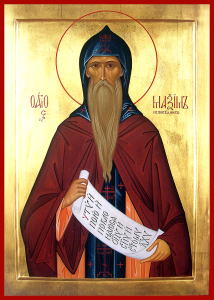
“The great Moses, having pitched his tent outside the camp, that is, having established his will and intellect outside visible realities, begins to worship God; and having entered the dark cloud [γνόφον], the formless and immaterial place of knowledge, he remains there, performing the holiest rites.
The dark cloud [γνόφος] is the formless, immaterial, and incorporeal condition containing the paradigmatic knowledge of beings; he who has come to be inside it, just like another Moses, understands invisible realities in a mortal nature; having depicted the beauty of the divine virtues in himself through this state, like a painting accurately rendering the representation of the archetypal beauty, he descends, offering himself to those willing to imitate virtue, and in this shows both love of humanity and freedom from envy of the grace of which he had partaken.”
~ from: Two Hundred Chapters on Theology, 1.84, 1.85.
The Chalcedonian Definition
Posted in Council of Chalcedon, Ekklesia and church on February 9, 2023
From: credomag.com/2021/02/the-chalcedonian-definition/
October 23, 2018
By Donald Fairbairn
Dr. Fairbairn is the Robert E. Cooley Professor of Early Christianity at Gordon Conwell Theological Seminary
The first thing one should notice from the title of this post is that the document produced at the Council of Chalcedon in October 451 was not a “creed”; it was a “definition.”
A creed, properly speaking, is not a statement of what Christians believe about our faith (That would be a “confession.”). Instead, a creed is a pledge of allegiance to the Father, the Son, and the Holy Spirit. Creeds answer the question, “In whom do you believe?” more than the question “What do you believe?”
Creeds were originally intended for liturgical use, as the people of God affirmed their allegiance to the persons of the Trinity prior to baptism or the celebration of the Eucharist. In contrast, a definition is a commentary on a creed, designed to give more terminological precision to the content of that creed.
The Council of Chalcedon
At the Council of Chalcedon (the Fourth Ecumenical Council in the Greco-Roman world), the bishops who assembled were firmly convinced that the Nicene Creed was sufficient to affirm their faith in God, his Son, and his Spirit.
They were right: the Nicene Creed clearly identifies each of the divine persons, shows that they are equal to one another, and emphasizes that for us and for our salvation, the Son came down from heaven through the incarnation. At the same time, the bishops at Chalcedon were under intense pressure from the Emperor [Marcian] to produce a new creed, because he wanted to be able to call himself a new Constantine, presiding over the writing of a creed as Constantine had done at Nicaea in 325. The bishops also recognized that they needed more specificity than the Nicene Creed gave about how to understand Christ as both divine and human. As a result, they decided to write not a creed, but a “definition.”
Contrary to popular opinion, the Chalcedonian Definition is actually about five pages long— far too long to recite as part of a worship service. It includes the full text of two different version of the Nicene Creed: the original form from the First Ecumenical Council at Nicaea in 325, and the expanded version (the one familiar to us) from the Second Ecumenical Council at Constantinople in 381.
It includes descriptions of heresies that had arisen since 381 (Nestorianism—which regarded Christ not as God the Son incarnate but as a man inspired by God, and Eutychianism— which truncated the full humanity of the incarnate Son by refusing to accept his consubstantiality with us). Then the Definition concludes with a paragraph that gives specificity and terminological precision to the church’s articulation of the incarnate Christ. This paragraph is usually regarded mistakenly as being the entire definition, but with that mistake duly noted, it is still worth our while to read and consider that paragraph.
As I translate it, the paragraph reads as follows:
“Therefore, following the holy fathers, we all unite in teaching that we should confess one and the same Son, our Lord Jesus Christ. This same one is perfect in deity, and the same one is perfect in humanity; the same one is true God and true man, comprising a rational soul and a body. He is of the same essence (homousios) as the Father according to his deity, and the same one is of the same essence (homousios) with us according to his humanity, like us in all things except sin. He was begotten before the ages from the Father according to his deity, but in the last days for us and our salvation, the same one was born of the Virgin Mary, the bearer of God (Theotokos), according to his humanity. He is one and the same Christ, Son, Lord, and Only Begotten, who is made known in two natures (physeis) united unconfusedly, unchangeably, indivisibly, inseparably. The distinction between the natures (physeis) is not at all destroyed because of the union, but rather the property of each nature (physis) is preserved and concurs together into one person (prosopon) and subsistence (hypostasis). He is not separated or divided into two persons (prosopa), but he is one and the same Son, the Only Begotten, God the Logos, the Lord Jesus Christ. This is the way the prophets spoke of him from the beginning, and Jesus Christ himself instructed us, and the Council of the fathers has handed the faith down to us.”
Key Ideas
There are several things we should notice. First, even if one looks only at this paragraph rather than at the whole definition, it is obvious that it was not meant to be recited in church. It is written to teachers and leaders, indicating what we should teach about Christ. It is not a pledge of allegiance on the order of “we believe in one Lord Jesus Christ.” The Chalcedonian Definition seeks to affirm that the Son, who is fully equal to the Father, has genuinely become fully human without ceasing to be divine, in order to accomplish our salvation.
Second, this paragraph, like the definition as a whole, is a commentary on one line of the Nicene Creed, the line that asserts that for us and for our salvation, the Son came down from heaven and was incarnated. Accordingly, this paragraph insists in no uncertain terms that the man Jesus after the incarnation is the same person as the eternal Son of God before the incarnation. The phrases “the same one” and “one and the same” occur eight times in this brief paragraph. This personal continuity between the eternal Son and the man Jesus is essential: Jesus is not (as Nestorius believed) a man with a special connection to God. He is God the Son himself, who is now fully human because he has become incarnate.
Third, this paragraph provides much more specificity than the Nicene Creed about what it meant for the Son to come down through the incarnation. It uses the Greek word physis in the sense of “nature” (previously, many theologians had used that word differently), and thus it indicates that the incarnate Son is made known “in two natures” (deity and humanity). It uses two Greek words, prosopon and hypostasis, in the sense of “person,” and thus emphasizes that the Son is a single person—indeed, the same person before and after the incarnation.
Thus, the Chalcedonian Definition seeks to affirm that the Son, who is fully equal to the Father, has genuinely become fully human without ceasing to be divine, in order to accomplish our salvation.
Conclusion
Sadly, the definition proved to be tragically divisive, as many in the African and Asian churches misunderstood its use of the word physis and thought it was proclaiming the Son and Jesus as two different persons. But properly understood, the definition provides terminological precision for speaking theologically about the incarnation. It isn’t a creed and was never meant to be, but it helps the theologians—and the rest of us—understand what we mean when we say in the creed that the one who is “true God from true God” truly “came down from heaven and was incarnated and was made man.”
The Great Schism of 1054
Posted in Ekklesia and church on February 5, 2023
The early united Christian Church consisted of five co-equal Patriarchates: Rome, Constantinople, Antioch, Jerusalem, and Alexandria. On July 16, 1054, Patriarch of Constantinople Michael Cerularius was excommunicated from the Christian church based in Rome, Italy. Cerularius’s excommunication was a breaking point in long-rising tensions between the Roman church based in Rome and the Byzantine church based in Constantinople (now Istanbul). The resulting split divided the European Christian church into two major branches: the Western Roman Catholic Church and the Eastern Orthodox Church. This split is known as the “Great Schism”, or the “Schism of 1054.”
The Great Schism came about due to a complex mix of religious disagreements and political conflicts festering within the church since the 8th century. From 756 to 857, the Roman papacy shifted from the orbit of the Byzantine Empire to that of the kings of the Franks. The period was characterized by “battles between Franks, Lombards and Romans for control of the Italian peninsula and of supreme authority within Christendom.”1
Some of the many religious disagreements between the western (Roman) and eastern (Byzantine) include:
- Disagreement over a unilateral Roman change to the Nicene Creed (of AD 325/381) adding the words “and the Son” (“filioque” in Latin), thus changing the ontological understanding of the Holy Spirit.
- Dispute whether or not it was acceptable to use unleavened bread for the sacrament of communion. (The west supported the practice, while the east did not.)
- Western belief that clerics should remain celibate.
Other than the dispute over the “filioque”, one can conclude that the remaining religious issues were mainly adiaphora, “indifferent things” that are neither right nor wrong, spiritually neutral things. Afterthoughts of man.
These religious disagreements were made worse by a variety of political conflicts, particularly regarding the power of Rome.
- Rome believed that the pope—the religious leader of the western Roman church—should have authority over the other four Christian Patriarchates— and thus have the religious authority over the eastern church and all of Christendom.
- Constantinople disagreed, pointing out that each of the five co-equal Patriarchates of the united church historically recognized their own leaders.
The western church eventually excommunicated Michael Cerularius and the entire eastern church. The eastern church retaliated by excommunicating the Roman pope Leo III and the Roman church with him.
The Schism became so politically charged that Western Latin Crusaders actually attacked and sacked the Eastern Byzantine capitol of Constantinople in 1204 during the corrupted Fourth Crusade. As with the religious disagreements, discussed above, these political conflicts were mainly adiaphora, “indifferent things”, that had little to no basis in spiritual matters. Afterthoughts of man.
This was the Great Schism of 1054.
1 Goodson, Caroline J. The Rome of Pope Paschal I: Papal Power, Urban Renovation, Church Rebuilding and Relic Translation, 817-824. Cambridge University Press. 2010
The Seven Ecumenical Councils
Posted in Council of Chalcedon, Ekklesia and church on February 3, 2023
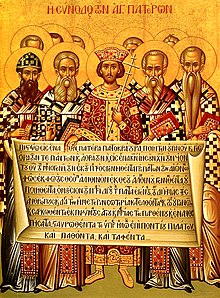
A Church Council is an official ad hoc gathering of representatives to settle Church business. Such Councils are called rarely and are not the same as the regular gatherings of church leaders (synods, etc.). An ecumenical council is one at which the whole Church is represented. The three major contemporary branches of the Church (Orthodox, Roman Catholic, Protestant) recognize seven ecumenical councils: Nicea (325), Constantinople (381), Ephesus (431), Chalcedon (451), Constantinople II (553), Constantinople III (680), Nicaea II (787). Further ecumenical councils were rendered impossible by the widening split between Eastern Orthodox (Greek speaking) and Roman Catholic (Latin speaking) Churches, a split that was rendered official in AD 1054 and has not yet been healed.
Note: In addition to these universally-acknowledged councils, the Roman Catholic Church recognizes a further fourteen ecumenical councils: Constantinople IV (869-70), Lateran I (1123), Lateran II (1139), Lateran III (1179), Lateran IV (1215), Lyons I (1245), Lyons II (1274), Vienne (1311-12), Constance (1414-18), Florence (1438-45), Lateran V (1512-17), Trent (1545-63), Vatican I (1869-70), Vatican II (1965). But these were councils of only the Catholic Church, and are not recognized by the Orthodox or Protestant Churches.
The Council of Nicaea, 325
In 324 Constantine became sole ruler of the Roman Empire, reuniting an empire that had been split among rival rulers since the retirement of Domitian in 305. Constantine, the first Christian emperor, reunified the empire but found the Church bitterly divided over the nature of Jesus Christ. He wanted to reunify the Church as he had reunified the Empire. The major dispute was over the teaching of Arius, but there were other doctrinal issues also.
- Arianism: teaching of Arius of Alexandria (d. 335), who believed that Jesus Christ was created ex nihilo (out of nothing) by the Father to be the means of creation and redemption. Jesus was fully human, but not fully divine. He was elevated as a reward for his successful accomplishment of his mission. The Arian rallying cry was “There was a time when the Son was not.”
- Monarchianism: defended the unity (mono arche, “one source”) of God by denying that the Son and the Spirit were separate persons.
- Sabellianism: a form of monarchianism taught by Sabellias, that God revealed himself in three successive modes, as Father (creator), as Son (redeemer), as Spirit (sustainer). Hence there is only one person in the Godhead.
Constantine summoned the bishops at imperial expense to Nicea, 30 miles from his imperial capital in Nicomedia. Here they were to settle their differences in a council over which he presided. The council rejected Arianism. The Council issued a creed based upon an existing baptismal creed from Syria and Palestine. This creed became known as the Nicene Creed, or Confession of the Faith.
The Council also issued a set of canons, primarily dealing with church order.
The Council of Constantinople, 381
The second council met in Constantinople, the new imperial capital. The council issued a new creed, clarifying the understanding of the Holy Spirit as a co-equal Person of the Trinitarian Godhead as expressed in the Nicene Creed adopted in 325. This creed became known as the Niceno-Constantinopolitan Creed and remains the Confession of the Faith today in the Eastern Church.
Later, the Roman Church, under the influence of the Franks in the 8th century, unilaterally added a single word to the Creed, inserting Filioque “and the Son” to the statement about the Spirit, so as to read “the Spirit…proceeds from the Father and the Son.” In 867 the Patriarch of Constantinople declared Rome heretical for unilaterally inserting this clause into the Niceno-Constantinopolitan Creed. To this day the Western Church (Roman Catholic and Protestant) accepts the filioque clause, while the Eastern Church (Orthodox) does not.
The Council of Ephesus, 431
Condemned Nestorius and his teaching (Nestorianism) that Christ had two separable natures, human and divine. Declared Mary to be theotokos (lit. God-bearer, i.e., Mother of God) in order to strengthen the claim that Christ was fully divine.
The Council of Chalcedon, 451
Issued the Chalcedonian Formula, affirming that Christ is two natures in one person.
The Council of Constantinople II, 553
Condemned the Three Chapters, which emphasized Christ’s humanity at the expense of his deity. Their opponents held Alexandrian theology emphasizing Christ’s deity.
The Council of Constantinople III, 680
Condemned monothelitism (Christ has a single will), affirming that Christ had a human will and a divine will that functioned in perfect harmony.
The Council of Nicea II, 787
Declared that icons are acceptable aids to worship, rejecting the iconoclasts (icon-smashers)

