The earliest written reference to the Eucharist (Lord’s Supper/Communion) is 1 Corinthians 11:23–26, written by St. Paul around A.D. 55.
Paul’s description in 1 Corinthians 11 is the earliest written witness to Christians “eating the bread and drinking the cup of the Lord.” He explicitly links this practice to Jesus’ actions at the Last Supper and treats it as an already-established ritual in the Corinthian church.
This predates the earliest Gospel by at least a decade and is the oldest surviving Christian text describing the rite. However, scholars do not believe that the gospel writers used Paul as a source for their unique Eucharist accounts, which indicates that practice of the rite was widespread in the Eastern Mediterranean in the first century.
Paul also says he is passing on a tradition he himself received, implying the Eucharist was practiced orally even earlier than his letter.
The earliest known manuscript source for 1 Corinthians is Papyrus 46 (𝔓46) — one of the famous Chester Beatty Papyri — and it is one of the oldest surviving New Testament manuscripts of any kind.
Most scholars date 𝔓46 to around 175–225 A.D., though a minority have argued for an even earlier date. Even using the conservative date, 𝔓46 is roughly 150 years earlier than the great parchment codices (Vaticanus, Sinaiticus).
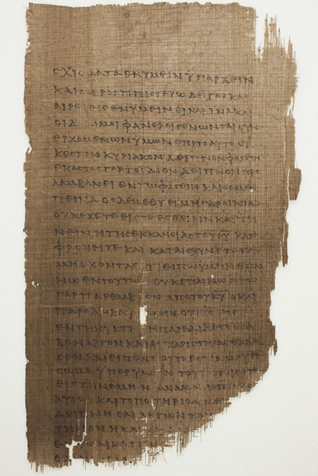
Beatty Papyrus 𝔓46, the earliest extant manuscript containing 1 Cor 11:18-25 (175–225 A.D.)
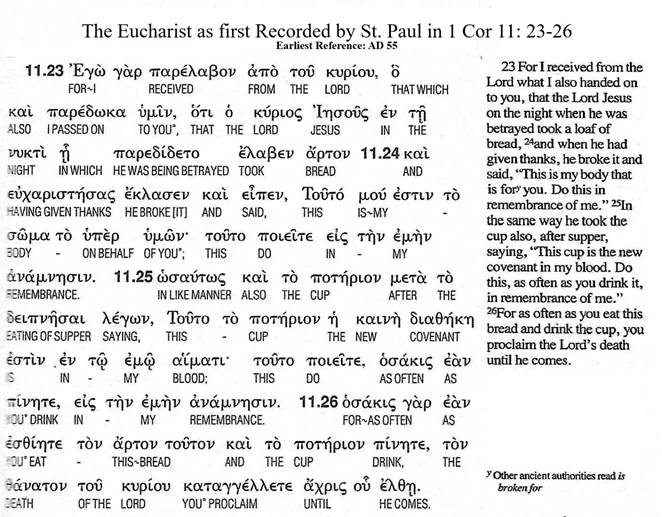
Detailed Illustration of the earliest account of the Eucharist (Greek and English)


#1 by Darrell Stall on June 7, 2026 - 9:19 AM
Since you write so positively about Eastern Orthodox theology, would you please explain what it is that you hold against the Orthodox Church?
Please correct me if I’m misunderstanding, but you seem to think that the physical development and establishment of “Church” in the world is wrong, that it is frought with “afterthoughts” as you say (which you seem to base on a 19th century English Protestant clergyman on whom you much rely). You seem to hold to a Protestant spiritualized understanding of “Church” with no order, whereby there is no physical counterpart, no One, Holy, Catholic and Apostolic Church wherein is contained undistorted Church teaching.
I may be the first to agree with you that there are many “afterthoughts”, especially when it comes to Western forms of “christianity”, but Holy Writ is clear that the gates of hell will not prevail against The Church. Yet in Protestant fashion, you seem to insist that there is a “primitive” “New Testament” church that is other than the Orthodox Church
I agree that the Orthodox Church is full of “warts and all”, and yet it is the Church that still maintains the teaching of all that you seem to hold to be good about Christianity. I would much rather be part of The Church that is imperfect than find excuses for going it alone.
There is much about the Orthodox Church I do not like which you have already identified — firstly, ethnophyletism and the jurisdictional confusion and impropriety that follows in its wake, but also “true church” schismatic rigorists with their fear of associating with the unpure, “worldly” Orthodox who like Protestant “reformers” choose to become separatists who break the Church apart rather than strive for purity within the Church, the Old Calendarists who are another form of rigorism who could be cured with a simple sundial and stonehenge whereby they could set by the sun the equinoxes and solstices and interpret months, weeks, days and years from there so there would not be confusion of two calendar systems in the Church, etc.
There is more that could be criticized, but all criticism seems to serve to do is ignore and obscure all that is good and true in the Orthodox Church, and which, incidently, has managed to survive for two millennium, which brings me to this point. We are living in the end times. Every day that passes is but one day closer to the rise of Antichrist, the Parousia, and the Final Judgement. Holy Writ and Church teaching are clear that “the world”, being transitory (temporal, not eternal) will become much, much worse before truly becoming better, the best that Creation can ever be.
I call the modern world “American-led, Western Mammon-worshipping money-loving modern times, Antichrist Rising, driving under the influence of the devil”. The vast majority of moderns are not in their right mind, because that is the mind of Christ, which is the Church’s phronema. Hence Christ’s prayer on the Cross, “Father forgive them for they know not what they do.” That is the only way I can deal with the world, while accepting that all that befalls me is from the hand of God and ultimately for my good, for strengthening of my faith unto salvation.
I find the modern world to be the legacy of Rome and the West (Western Europe), while The Church is the legacy of Constantinople and the East. Expecting perfection of the Church in the end times is improbable and spiritually immature. Some Church fathers have even prophesied that the Antichrist will arise from within the Church. The Logos exists in all Creation, but it is from the Church that Christ most directly, and most assuredly imparts grace (His uncreated Divine energies) to believers and His followers, so they can be empowered to become like Him. Flying solo spiritually is dangerous and unproven; it may end well, but can just as likely not. We all need the grit of rubbing along together in One Body in order for our faith to be tested and strengthened, our sins forgiven through humility, repentance, and confession, and Divine power granted through the Sacraments.
I have no problem with Chalcedon; but it is to the eternal shame of the Orthodox Church that it mercilessly persecuted those who disagreed and were not in consensus. I’ve read that the Monophysites and Copts preferred the Ottoman yoke to the Byzantines. But that is something of which to repent, not an excuse for staying away from the Church.
#2 by Darrell Stall on June 7, 2026 - 9:36 AM
Since you write so positively about Eastern Orthodox theology, would you please explain what it is that you hold against the Orthodox Church? Please correct me if I’m misunderstanding, but you seem to think that the physical development and establishment of “Church” in the world is wrong, that it is frought with “afterthoughts” as you say (which you seem to base on J.B. Heard, a 19th century English Protestant clergyman on whom you much rely). You seem to hold to a Protestant spiritualized understanding of “Church” with no order, whereby there is no physical counterpart, no One, Holy, Catholic and Apostolic Church wherein is contained undistorted Church teaching.
I may be the first to agree with you that there are many “afterthoughts”, especially when it comes to Western forms of “christianity”, but Holy Writ is clear that the gates of hell will not prevail against The Church. Yet in Protestant fashion, you seem to insist that there is a “primitive” “New Testament” church that is other than the Orthodox Church.
I agree that the Orthodox Church is full of “warts and all”, and yet it is the Church that still maintains the teaching of all that you seem to hold to be good about Christianity. I would much rather be part of The Church that is imperfect than find excuses for going it alone.
There is much about the Orthodox Church I do not like which you have already identified – firstly, ethnophyletism and the jurisdictional confusion and impropriety that follows in its wake, but also “true church” schismatic rigorists with their fear of associating with the impure, “worldly” Orthodox who like Protestant “reformers” choose to become separatists who break the Church apart rather than strive for purity within the Church, the Old Calendarists who are another form of rigorism who could be cured with a simple sundial and stonehenge whereby they could set by the sun the equinoxes and solstices and interpret months, weeks, days and years from there so there would not be confusion of two calendar systems in the Church, etc.
There is more that could be criticized, but all criticism seems to serve to do is ignore and obscure all that is good and true in the Orthodox Church, and which, incidentally, has managed to survive for two millennium, which brings me to this point. We are living in the end times. Every day that passes is but one day closer to the rise of Antichrist, the Parousia, and the Final Judgement. Holy Writ and Church teaching are clear that “the world”, being transitory (temporal, not eternal) will become much, much worse before truly becoming better, the best that Creation can ever be.
I think of the modern world as “American-led, Western Mammon-worshipping money-loving modern times, Antichrist Rising, driving under the influence of the devil”. The vast majority of moderns are not in their right mind, because that is the mind of Christ, which is the Church’s phronema. Hence Christ’s prayer on the Cross, “Father forgive them for they know not what they do.” That is the only way I can deal with the world, while accepting that all that befalls me is from the hand of God and ultimately for my good, for strengthening of my faith unto salvation. As St John Chrysostom said, “Glory to God for ALL things!”
I find the modern world to be the legacy of Rome and the West (Western Europe), while the legacy of Constantinople and the East is The Church. I think expecting perfection of the Church in the end times is improbable and spiritually immature. Some Church fathers have even prophesied that the Antichrist will arise from within the Church. The Logos exists in all Creation, but it is from the Church that Christ most directly, and most assuredly imparts grace (His uncreated Divine energies) to believers and His followers, so they can be empowered to become like Him. Flying solo spiritually is dangerous and unproven; it may end well, but then again it may not. The Church is the Ark of Salvation where Christians are safe from the storm of the world. We all need the grit of rubbing along together in One Body in order for our faith to be tested and strengthened, our sins forgiven through humility, repentance, and confession, and Divine power granted through the Sacraments for spiritual struggle, spiritual warfare, the good fight of faith.
I have no problem with Chalcedon and do not consider it yet another “afterthought’; but it is to the eternal shame of the Orthodox Church that her leaders at the time mercilessly persecuted those who disagreed and were not in consensus. I’ve read that the Monophysites and Copts preferred the Ottoman yoke to the Byzantines. But that is something of which to repent, not an excuse for staying away from the Church.