Archive for category Monasticism
St. Athanasius on St. Antony the Great: “… learn what the life of monks ought to be;”
Posted by Dallas Wolf in Ekklesia and church, Monasticism, Patristic Pearls on April 8, 2023
St. Antony the Great (Greek: Ἀντώνιος) (251 – 356)- was a Christian ascetic monk from Egypt. Antony was among the first anchorites known to go into the Egyptian desert wilderness in about AD 270. Because of his importance among the Desert Fathers and to all later Christian monastics, he is also known as the Father of All Monks. Most of what is known about Antony comes from the Life of Antony, written around 360 by St. Athanasius of Alexandria. It depicts Anthony as an illiterate holy man who, through his stark solitary ascetic life in the desert, forges an absolute connection to the divine Truth. This biography of Antony’s life helped to spread the concept of Christian monasticism into both the Greek and Latin worlds. The excerpt below is from St. Athanasius’ Life of Antony:
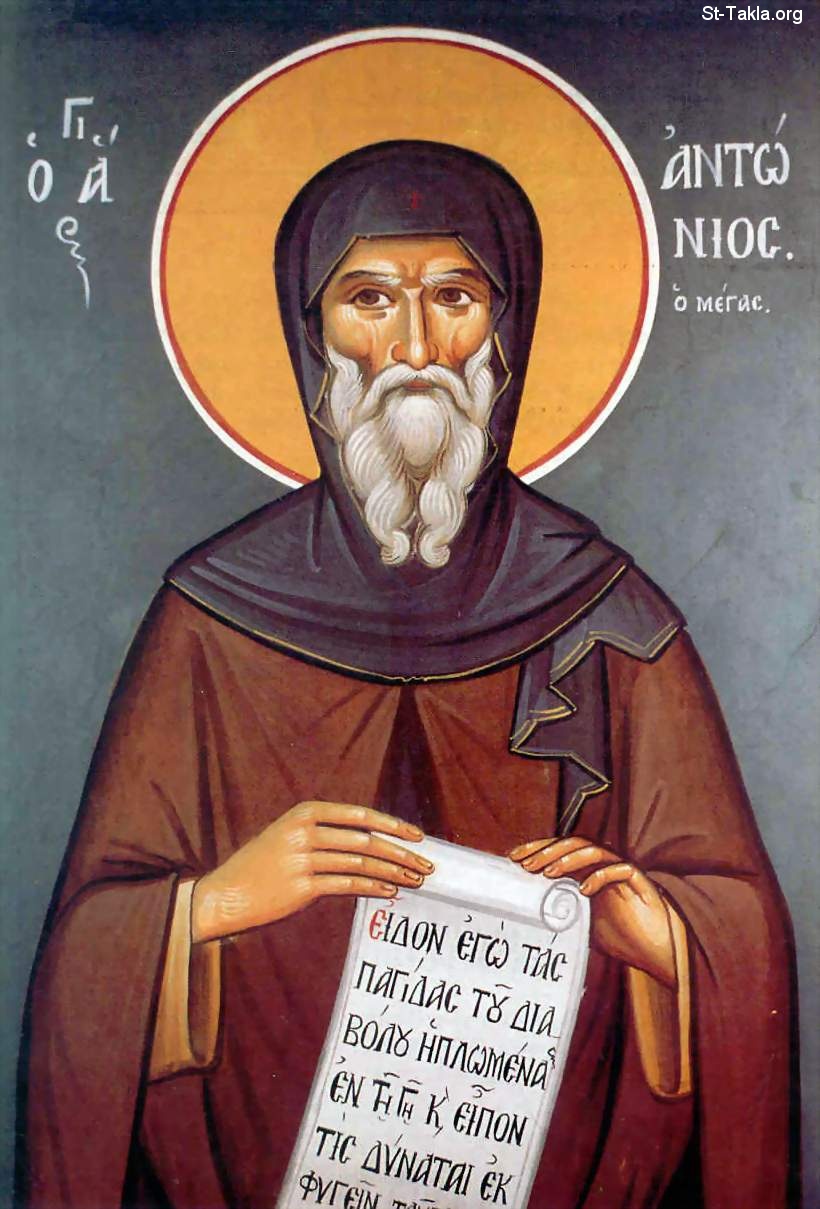
“Further, he was able to be of such use to all, that many soldiers and men who had great possessions laid aside the burdens of life, and became monks for the rest of their days. And it was as if a physician had been given by God to Egypt. For who in grief met Antony and did not return rejoicing? Who came mourning for his dead and did not forthwith put off his sorrow? Who came in anger and was not converted to friendship? What poor and low-spirited man met him who, hearing him and looking upon him, did not despise wealth and console himself in his poverty? What monk, having being neglectful, came to him and became not all the stronger? What young man having come to the mountain and seen Antony, did not forthwith deny himself pleasure and love temperance? Who when tempted by a demon, came to him and did not find rest? And who came troubled with doubts and did not get quietness of mind?” (87).
“Read these words, therefore, to the rest of the brethren that they may learn what the life of monks ought to be; and may believe that our Lord and Saviour Jesus Christ glorifies those who glorify Him: and leads those who serve Him unto the end, not only to the kingdom of heaven, but here also— even though they hide themselves and are desirous of withdrawing from the world— makes them illustrious and well known everywhere on account of their virtue and the help they render others. And if need be, read this among the heathen, that even in this way they may learn that our Lord Jesus Christ is not only God and the Son of God, but also that the Christians who truly serve Him and religiously believe in Him, prove, not only that the demons, whom the Greeks themselves think to be gods, are no gods, but also tread them under foot and put them to flight, as deceivers and corrupters of mankind, through Jesus Christ our Lord, to whom be glory for ever and ever. Amen.” (94)
~ from: St Athanasius, Life of Antony, 87, 94
St. Gregory of Nazianzus: “The Holy Ghost, which proceeds from the Father;”
Posted by Dallas Wolf in Ekklesia and church, First Thoughts, Monasticism, Patristic Pearls, The Cappadocians, The Holy Trinity on April 8, 2023
St. Gregory of Nazianzus (c. 329 – 25 January 390), also known as Gregory the Theologian or Gregory Nazianzen, was a 4th-century Archbishop of Constantinople, theologian, and one of the Cappadocian Fathers (along with Basil the Great and Gregory of Nyssa). He is widely considered the most accomplished rhetorical stylist of the patristic age. Gregory made a significant impact on the shape of Trinitarian theology among both Greek and Latin-speaking theologians, and he is remembered as the “Trinitarian Theologian”.

“The Holy Ghost, which proceeds from the Father; Who, inasmuch as He proceeds from That Source, is no Creature; and inasmuch as He is not Begotten is no Son; and inasmuch as He is between the Unbegotten and the Begotten is God. And thus escaping the toils of your syllogisms, He has manifested himself as God, stronger than your divisions. What then is Procession? Do you tell me what is the Unbegottenness of the Father, and I will explain to you the physiology of the Generation of the Son and the Procession of the Spirit, and we shall both of us be frenzy-stricken for prying into the mystery of God. And who are we to do these things, we who cannot even see what lies at our feet, or number the sand of the sea, or the drops of rain, or the days of Eternity, much less enter into the Depths of God, and supply an account of that Nature which is so unspeakable and transcending all words?”
~ from: The Orations and Letters of Saint Gregory Nazianzus, Oration 31 (5th Theological Oration), VIII.
St. Basil the Great: “Homily About Ascesis – How a Monk Should be Adorned”
Posted by Dallas Wolf in Ekklesia and church, Monasticism, Patristic Pearls, The Cappadocians on April 8, 2023
St. Basil of Caesarea, also called Saint Basil the Great (330 – January 379), was a bishop of Caesarea Mazaca in Cappadocia (modern-day Turkey). He was an influential theologian who supported the Nicene Creed and opposed the heresies of the early Christian church. Together with Pachomius, he is remembered as a father of communal (coenobitic) monasticism in Eastern Christianity. Basil, together with his brother Gregory of Nyssa and his friend Gregory of Nazianzus, are collectively referred to as the Cappadocian Fathers.

“The monk, above all, must not possess anything in his life. He must have bodily isolation, proper clothing, a moderate tone of voice, and discipline speech; he must not cause a ruckus about the food and drink and he must eat in silence; he must be silent before his elders and be attentive to wiser men; he must love his peers and advise those junior in a loving way; he must move away from the immoral and the carnal and the sophisticated; he must think much and say less; he must not become impudent in his words, nor gossip and not be amenable to laughter; he must be adorned with shame, directing his gaze to the ground and his soul upward; he must not object with words of contention but rather be compliant; he must work with his hands and always keep in remembrance the end of this age; he must rejoice with hope, endure sadness, pray unceasingly and thank God for everything; he must be humble towards all and hate pride; he must be vigilant in keeping his heart pure of any evil thought; he must gather treasures in Heaven by keeping the commandments, examine himself for his thoughts and actions each day and not be involved in vain things of life and in idle talk; he must not examine inquisitively the life of idle people, but imitate the lives of the Holy Fathers; he must be happy with those who achieve virtue and not be envious; he must suffer with those suffering and weep with them and be sorry for them, but not criticise them; he must not reproach one who returns from his sin and never justify himself. Above all else he must confess before God and the men that he is a sinner and admonish the unruly, strengthen the faint-hearted, minister unto the sick and washed the feet of the saints; he must attend to hospitality and brotherly love, to be at peace with those who have the same faith and abhor the heretics; he must read the canonical books and not open even a single one of the occult; he must not talk about the Father and the Son and the Holy Spirit, but think and confess the uncreated and consubstantial Trinity with courage, and tell those who ask that there is the need of to be baptised, as we have received it from the tradition, to believe, as we have confessed it according to our baptism, and to glorify God, as we have believed.”
~ from: The Monastic Rule of St. Basil the Great
St. Gregory of Sinai: ‘Sowing in the Light’
Posted by Dallas Wolf in Hesychasm - Jesus Prayer, Monasticism, Patristic Pearls on April 7, 2023
St. Gregory of Sinai (c. 1260s -1346) – was a well-travelled Greek Christian monk and writer from Smyrna (modern-day İzmir, Turkey). He was instrumental in the emergence of hesychasm on Mount Athos in the early 14th century. He was a contemporary of St. Gregory Palamas.

“According to St. Paul (cf. Rom. 15:16), you “minister” the Gospel only when, having yourself participated in the light of Christ, you can pass it on actively to others. Then you sow the Logos like a divine seed in the fields of your listeners’ souls. ‘Let your speech be always filled with grace’, says St Paul (Col. 4:6), ‘seasoned’ with divine goodness. Then it will impart grace to those who listen to you with faith. Elsewhere St. Paul, calling the teachers tillers and their pupils the field they till (cf. II Tim. 2:6), wisely presents the former as ploughers and sowers of the divine Logos and the latter as the fertile soil, yielding a rich crop of virtues. True ministry is not simply a celebration of sacred rites; it also involves participation in divine blessings and the communication of these blessings to others.”
~ from: The Philokalia
St. Basil the Great: “On the Holy Spirit”
Posted by Dallas Wolf in Ekklesia and church, First Thoughts, Monasticism, Patristic Pearls, The Cappadocians, The Holy Trinity, Theology on April 6, 2023
St. Basil of Caesarea, also called Saint Basil the Great (330 – January 379), was a bishop of Caesarea Mazaca in Cappadocia (modern-day Turkey). He was an influential theologian who supported the Nicene Creed and opposed the heresies of the early Christian church. Together with Pachomius, he is remembered as a father of communal (coenobitic) monasticism in Eastern Christianity. Basil, together with his brother Gregory of Nyssa and his friend Gregory of Nazianzus, are collectively referred to as the Cappadocian Fathers.
“Just as when a sunbeam falls on bright and transparent bodies, they themselves become brilliant too, and shed forth a fresh brightness from themselves, so souls wherein the Spirit dwells, illuminated by the Spirit, themselves become spiritual, and send forth their grace to others. Hence comes foreknowledge of the future, understanding of mysteries, apprehension of what is hidden, distribution of good gifts, the heavenly citizenship, a place in the chorus of angels, joy without end, abiding in God, the being made like to God, and, highest of all, the being made God. Such, then, to instance a few out of many, are the conceptions concerning the Holy Spirit, which we have been taught to hold concerning His greatness, His dignity, and His operations, by the oracles of the Spirit themselves.”
~ from: On the Holy Spirit (De Spiritu Sancto), Chap. 9
Evagrius Ponticus: “If you truly pray you are a theologian.”
Posted by Dallas Wolf in Hesychasm - Jesus Prayer, Monasticism, Patristic Pearls on February 4, 2019
Evagrius Ponticus (c. 346-399) – was originally from Pontus, on the southern coast of the Black Sea in what is modern-day Turkey. He served as a Lector under St. Basil the Great and was made Deacon and Archdeacon under St. Gregory of Nazianzus. He was also greatly influenced by Origen of Alexandria and St. Gregory of Nyssa. In about 383, Evagrius left Constantinople, eventually retreating to the Egyptian desert and joining a cenobitic community of Desert Fathers. As a classically trained scholar, Evagrius recorded the sayings of the desert monks and developed his own theological writings.

“If you are a theologian you truly pray. If you truly pray you are a theologian.”
from “The 153 Chapters on Prayer”, Chap. 60._____________________________________________________________________________
Note: This chapter is one of the key passages for the full understanding of the Evagrian identification of contemplation with prayer. It is also important to understand what Evagrius meant by the term “theologian”. According to David W. Fagerberg, associate professor of theology at the University of Notre Dame, to Evagrius, a “theologian is someone who has been shaped by the cooperative exercise of grace and ascetical submission, whose eyes can see after their light has been restored, whose heart wills only one thing, whose mind has changed, whose life has been reconnected to the source of life. This does not require a PhD, it requires a conversion of life.”
Fr. Seraphim (Aldea) – Making Your Theology be Reflected in Your Practical Life
Posted by Dallas Wolf in Monasticism, New Nuggets on March 4, 2018
Fr. Seraphim (Aldea) – was tonsured as an Orthodox monk in 2005 at Rasca monastery in Bucovine, North Moldavia. He has a PhD in Modern Theology from the University of Durham (UK) for a thesis on Archimandrite Sophrony (Sakharov)’s Ecclesiology. He is currently obeying God’s calling to found the Monastery of all Celtic Saints on the Scottish Isle of Mull. This will be the first Orthodox monastery in Celtic Britain in over a millennium (See http://www.mullmonastery.com).
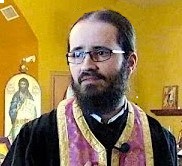 “The great thing about having this theology is that then it must be reflected in your practical life. And if you look at humanity the way Father Sophrony looked at humanity, very hot contemporary issues are instantly solved.
Questions concerning immigration, questions concerning war, or how to behave in times of war, questions concerning the use of guns and the right to kill other people in any context: all these extremely controversial issues suddenly become perfectly boring because it’s so clear, everything is so clear. Once you have his mind, his theology all these issues are perfectly clear.
You cannot be a Christian in his sense and allow for war or use of guns against other human beings at the same time. That can only mean two things. Either you have a wrong theology and that is reflected in your practical life, or you have a correct theology but you don’t allow that to affect your practical life.
…He used to say that somebody who has correct theology but that correct theology is not reflected in his life is like a bird with one wing. Forever looking up and thinking it will get there not knowing he is already condemned to forever be on Earth. If you don’t allow your theology to inform your life, your values, your choices, then you’ve missed the point and you’ll never fly.”
~ From a lecture delivered in 2016 reflecting on the theology of Elder Sophrony of Essex
Fr. Seraphim (Aldea): Foundation of True Prayer.
Posted by Dallas Wolf in Monasticism, New Nuggets on March 3, 2018
Fr. Seraphim (Aldea) (1965 – ) – was tonsured as an Orthodox monk in 2005 at Rasca monastery in Bucovine, North Moldavia. He has a PhD in Modern Theology from the University of Durham (UK) for a thesis on Archimandrite Sophrony (Sakharov)’s Ecclesiology. He is currently obeying God’s calling to found the Monastery of all Celtic Saints on the Scottish Isle of Mull. This will be the first Orthodox monastery in Celtic Britain in over a millennium (See http://www.mullmonastery.com).
“Prayer in the most early stages is something you have to do. You do it because your spiritual father says so, because the Holy Fathers say so, and because Christ Himself says so. Although this is not really prayer, by following someone else – the way the Apostles did – you lay the foundation for real prayer; this foundation is obedience. You do something not out of your own will, but because someone else tells you to. You may not be aware of it, but in doing this, you have declared war on your own nature, because it is deeply un-natural in our fallen world to oppose your own will, to reject your own logic and to let go of self-control. It is against reason, against instinct, against all the things we have become in order to survive.
When you start praying, you have in fact started your wandering through the desert. It may last less than forty years; it may last until the day you die. You may see the Promised Land while still in this life; you may die in the desert, and only enter the Kingdom after you have departed this life.
The one thing that matters is that you start; as long as you keep going, you will be all right. The advice you will find in all the Fathers is to keep praying, keep yourself on the path; although you may feel it has no effect and that it leads to nowhere, in reality the fruits of this cross are already present in you. The roots of the prayer are already growing in your flesh and soul, and that is a painful process; that is why you are in pain.
During these long years, you will not be levitating, you will not be swallowed in light, but you will become more humble, more aware of how weak and limited you are, and less inclined to judge other people. These fruits are the foundation upon which real prayer will be built at the right time. If you do not go through this process of transformation, if your faith does not survive this desert, if you do not conquer this hell by patience and humility, you will not reach the Resurrection of true prayer.”
~ Excerpt from the booklet, “On Prayer”, published by The Orthodox Monastery of All Celtic Saints
Father Seraphim (Aldea): Elder Sophrony on hypostasis, or person.
Posted by Dallas Wolf in Monasticism, New Nuggets on February 24, 2018
Fr. Seraphim (Aldea) – was tonsured as an Orthodox monk in 2005 at Rasca monastery in Bucovine, North Moldavia. He has a PhD in Modern Theology from the University of Durham (UK) for a thesis on Archimandrite Sophrony (Sakharov)’s Ecclesiology. He is currently obeying God’s calling to found the Monastery of all Celtic Saints on the Scottish Isle of Mull. This will be the first Orthodox monastery in Celtic Britain in over a millennium (See http://www.mullmonastery.com).
“In general terms, Fr. Sophrony used ‘hypostasis’ to refer to the ontological state of a being that has fully actualized its nature. And very frequently this is opposed with the idea or state of an ‘individual’.
Although they appear to be synonymous, the two concepts [‘hypostasis’ and ‘person’] carry different meanings for Father Sophrony. While ‘hypostasis’ denotes an ontological state of existence, the ‘personal’ principle, or ‘personhood’, refers to a process. It’s almost as if ‘hypostasis’ is the destination of a process [‘personhood’].”
~ Fr. Seraphim (Aldea) from a lecture on the theology of Fr. Sophrony (Sakharov) delivered in 2016.
St. Isaac of Nineveh: On Silence
Posted by Dallas Wolf in Hesychasm - Jesus Prayer, Monasticism, Patristic Pearls, Theology on February 19, 2018
St. Isaac of Nineveh – 7th century ascetic and mystic, born in modern-day Qatar, was made Bishop of Nineveh between 660-680. Here he speaks of the importance of silence in monastic life.
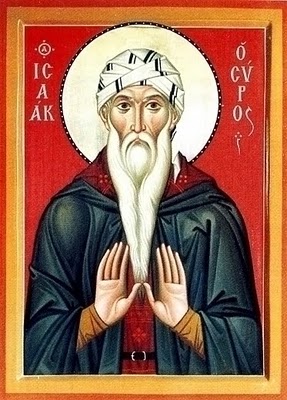
“Love silence above all things. It brings thee near the fruit which the tongue is too weak to interpret. At first we compel ourselves to be silent. Then from our silence something is born which draws us toward silence. May God grant thee to perceive that which is born of silence. If thou beginnest with this discipline, I do not know how much light will dawn in thee through it. Concerning what is said about the admirable Arsenius: that Fathers and brethren came to see him, but that he sat with them in silence and dismissed them in silence – do not think, my brother, that this happened by the action of his will alone, though in the beginning he had to compel himself. After some time some delight is born in the heart from the exercise of this service and by force it draws the body towards remaining in silence.”
“If thou placest all labors of this discipline [solitary life] on one side and silence on the other, silence will outweigh them.”
~St. Isaac of Nineveh, from Ascetical Treatises 65
 First Thoughts