Archive for category New Nuggets
Rohr: “Every time Paul uses the word flesh, just replace it with the word ego…”
Posted by Dallas Wolf in First Thoughts, New Nuggets on November 17, 2017
Fr. Richard Rohr – is a Franciscan priest, Christian mystic, and teacher of Ancient Christian Contemplative Prayer. He is the founding Director of the Center for Action and Contemplation in Albuquerque, NM.
 “The dialectic that we probably struggle with the most is the one Paul creates between flesh and spirit. I don’t think Paul ever intended for people to feel that their bodies are bad; he was not a Platonist. After all, God took on a human body in Jesus! Paul does not use the word “soma”, which literally means “body.” I think what Paul means by “sarx” is the trapped self, the small self, the partial self, or what Thomas Merton called the false self. Basically, spirit is the whole self, the Christ self that we were born into and yet must re-discover. The problem is not between body and spirit; it’s between part and whole. Every time Paul uses the word “flesh” [sarx], just replace it with the word “ego’, and you will be much closer to his point. Your spiritual self is your whole and True Self, which includes your body; it is not your self apart from your body. We are not angels, we are embodied human beings.” ~ From a meditation: “Paul as a Nondual Teacher“, Wednesday, May 17, 2017.
Romanides: “The schism between Eastern and Western Christianity was not between East and West Romans.”
Posted by Dallas Wolf in Ekklesia and church, New Nuggets on November 13, 2017
Father John Romanides (1927 – 2001) – was a prominent 20th century Orthodox Christian theologian, priest, and writer. He was Professor of Dogmatic Theology at the Holy Cross Theological School in Brookline, MA and later Professor of Dogmatic Theology at the University of Thessaloniki, Greece. His books include: The Ecclesiology of St Ignatius of Antioch (1956); Franks, Romans, Feudalism, and Doctrine: An Interplay Between Theology and Society (1982); Ancestral Sin (2002); An Outline of Orthodox Patristic Dogmatics (2004); and The Life in Christ (2010).
Romanides traced the 1054 split between the Eastern and Western Christian churches to a long political, military, and ethnic struggle between the Roman East and the Germanic conquerors of the Roman West. These German tribes started with the Visigoths in AD 410, culminating with Charlemagne and the Franks in AD 800. The Great Schism of 1054 had more to do with a Frankish – Eastern Roman power struggle than it did with religious doctrine. In the West, the church was simply used as a tool in that imperial struggle.
“The schism between Eastern and Western Christianity was not between East and West Romans. In actuality, it was a split between East Romans and the conquerors of the West Romans.”

Fr. John Romanides
“In the background of dialogue and the Ecumenical Movement for the reunion of Christendom lies the generally recognized fact that there is an interplay between theology and society, which may lead to a dogmatic formulation and become the cause of doctrinal differences.
Within the Roman Empire doctrinal conflicts took place usually among Roman citizens in a atmosphere of religious and philosophical pluralism. With the official recognition of Orthodox Christianity, we witness the beginning of the use of doctrinal differences in support of nationalistic movements of separate identity and secession from Roman rule, both political and ecclesiastical. Both Nestorianism and so-called Monophysitism, although initially promoted by Roman nationals, were finally supported by separatist tendencies among such ethnic groups as Syrians, Copts, and Armenians. Indeed, both Persians and Arabs took care to keep Christians separated.
By the eighth century, we meet for the first time the beginning of a split in Christianity which, from the start, took on ethnic names instead of names designating the heresy itself or its leader. Thus in West European sources we find a separation between a Greek East and a Latin West. In Roman sources this same separation constitutes a schism between Franks and Romans.
One detects in both terminologies an ethnic or racial basis for the schism which may be more profound and important for descriptive analysis than the doctrinal claims of either side. Doctrine here may very well be part of a political, military, and ethnic struggle and, therefore, intelligible only when put in proper perspective. The interplay between doctrine and ethnic or racial struggle may be such that the two can be distinguished, but not separated.
The schism between Eastern and Western Christianity was not between East and West Romans. In actuality, it was a split between East Romans and the conquerors of the West Romans.
The Roman Empire was conquered in three stages: 1st by Germanic tribes who became known as Latin Christianity, 2nd by Muslim Arabs, and finally, by Muslim Turks. In contrast to this, the ecclesiastical administration of the Roman Empire disappeared in stages from West European Romania (the Western part of the Roman nation), but has survived up to modern times in the Roman Orthodox Patriarchates of Constantinople, Alexandria, Antioch and Jerusalem.
The reason for this is that the conquerors of the West Romans used the Church to suppress the Roman nation, whereas under Islam the Roman nation survived by means of the Church. In each instance of conquest, the bishops became the ethnarchs of the conquered Romans and administered Roman law on behalf of the emperor in Constantinople. As long as the bishops were Roman, the unity of the Roman Church was preserved, in spite of theological conflicts. The same was true when Romanized Franks became bishops during Merovingian times and shared with Roman bishops church administration.
During the seventh century, however, the seeds of schism appear. The Visigoths in Spain had abandoned their Arian heresy and had become nominally Orthodox. But they preserved their Arian customs of church administration, which became that of the Carolingian Franks, and finally, of the Normans. The Visigoths began subjugating the Spanish Romans by replacing Roman bishops with Goths and by 654, had abolished Roman law.
During this same century, especially after 683, the Franks also had appointed Frankish bishops en masse and had rid their government administration of Roman officials.
Earlier, during the sixth and early seventh century, rebellions of leaders in Francia were joint conspiracies of Franks and Romans. By 673, however, the rebellions had become purely Frankish.” ~From the Introduction to “Franks, Romans, Feudalism, and Doctrine; An Interplay Between Theology and Society“
Met. Kallistos: “God in Trinity”
Posted by Dallas Wolf in First Thoughts, New Nuggets, The Holy Trinity, Theology on November 10, 2017
Metropolitan Kallistos (Ware) of Diokleia – (1934 = 2022) was a titular metropolitan of the Orthodox Ecumenical Patriarchate in Great Britain. From 1966-2001, he was Spalding Lecturer of Eastern Orthodox Studies at Oxford University, and has authored numerous books and articles pertaining to the Orthodox faith. The following excerpt is taken from Chapter 11 of Met. Kallistos’ book, The Orthodox Church: An Introduction to Eastern Christianity (1993)

“Our social programme, said the Russian thinker Fedorov, is the dogma of the Trinity. Orthodoxy believes most passionately that the doctrine of the Holy Trinity is not a piece of ‘high theology’ reserved for the professional scholar, but something that has a living, practical importance for every Christian. Man, so the Bible teaches, is made in the image of God, and to Christians God means the Trinity: thus it is only in the light of the dogma of the Trinity that man can understand who he is and what God intends him to be. Our private lives, our personal relations, and all our plans of forming a Christian society depend upon a right theology of the Trinity. ‘Between the Trinity and Hell there lies no other choice (V. Lossky, The Mystical Theology of the Eastern Church, p. 66). As an Anglican writer has put it: ‘In this doctrine is summed up the new way of thinking about God, in the power of which the fishermen. went out to convert the Greco-Roman world. It marks a saving revolution in human thought (D. J. Chitty, ‘The Doctrine of the Holy Trinity told to the Children,’ in Sobornost, series 4, no. 5, 1961, p. 241).
The basic elements in the Orthodox doctrine of God have already been mentioned in the first part of this book, so that here they will only be summarized briefly:
1. God is absolutely transcendent.
‘No single thing of all that is created has or ever will have even the slightest communion with the supreme nature or nearness to it (Gregory Palamas, P.G. 150, 1176c (quoted on p. 77)). This absolute transcendence Orthodoxy safeguards by its emphatic use of the ‘way of negation,’ of ‘apophatic’ theology. Positive or ‘cataphatic’ theology — the ‘way of affirmation’ — must always be balanced and corrected by the employment of negative language. Our positive statements about God — that He is good, wise, just and so on — are true as far as they go, yet they cannot adequately describe the inner nature of the deity. These positive statements, said John of Damascus, reveal ‘not the nature, but the things around the nature.’ ‘That there is a God is clear; but what He is by essence and nature, this is altogether beyond our comprehension and knowledge (On the Orthodox Faith, 1, 4 (P.G. 94, 800B, 797B)).
2. God, although absolutely transcendent, is not cut of from the world which He has made.
God is above and outside His creation, yet He also exists within it. As a much used Orthodox prayer puts it: ‘Thou art everywhere and finest all things.’ Orthodoxy therefore distinguishes between God’s essence and His energies, thus safeguarding both divine transcendence and divine immanence: God’s essence remains unapproachable, but His energies come down to us. God’s energies, which are God Himself, permeate all His creation, and we experience them in the form of deifying grace and divine light. Truly our God is a God who hides Himself, yet He is also a God who acts — the God of history, intervening directly in concrete situations.
3. God is personal, that a to say, Trinitarian.
This God who acts is not only a God of energies, but a personal God. When man participates in the divine energies, he is not overwhelmed by some vague and nameless power, but he is brought face to face with a person. Nor is this all: God is not simply a single person confined within his own being, but a Trinity of three persons, Father, Son, and Holy Spirit, each of whom ‘dwells’ in the other two, by virtue of a perpetual movement of love. God is not only a unity but a union.
4. Our God is an Incarnate God.
God has come down to man, not only through His energies, but in His own person. The Second Person of the Trinity, ‘true God from true God,’ was made man: “The Word became flesh and dwelt among us” (John 1:14). A closer union than this between God and His creation there could not be. God Himself became one of His creatures (For the first and second of these four points, see pp. 72-9; for the third and fourth points, see pp. 28-37).
Those brought up in other traditions have sometimes found it difficult to accept the Orthodox emphasis on apophatic theology and the distinction between essence and energies; but apart from these two matters, Orthodox agree in their doctrine of God with the overwhelming majority of all who call themselves Christians. Monophysites and Lutherans, Nestorians and Roman Catholics, Calvinists, Anglicans, and Orthodox: all alike worship One God in Three Persons and confess Christ as Incarnate Son of God (In the past hundred years, under the influence of ‘Modernism,’ many Protestants have virtually abandoned the doctrines of the Trinity and the Incarnation. Thus when I speak here of Calvinists, Lutherans, and Anglicans, I have in mind those who still respect the classical Protestant formularies of the sixteenth century).
Yet there is one point in the doctrine of God the Trinity over which east and west part company — the filioque. We have already seen how decisive a part this one word played in the unhappy fragmentation of Christendom. But granted that the filioque is important historically, does it really matter from a theological point of view? Many people today — not excluding many Orthodox — find the whole dispute so technical and obscure that they are tempted to dismiss it as utterly trivial. From the viewpoint of traditional Orthodox theology there can be but one rejoinder to this: technical and obscure it undoubtedly is, like most questions of Trinitarian theology; but it is not trivial. Since belief in the Trinity lies at the very heart of the Christian faith, a tiny difference in Trinitarian theology is bound to have repercussions upon every aspect of Christian life and thought. Let us try therefore to understand some of the issues involved in the filioque dispute.
One essence in three persons. God is one and God is three: the Holy Trinity is a mystery of unity in diversity, and of diversity in unity. Father, Son, and Spirit are ‘one in essence’ (homoousios), yet each is distinguished from the other two by personal characteristics. ‘The divine is indivisible in its divisions (Gregory of Nazianzus, Orations, 31, 14). for the persons are ‘united yet not confused, distinct yet not divided’ (John of Damascus, On the Orthodox Faith, 1, 8 (P.G. 94, 809A)); ‘both the distinction and the union alike are paradoxical’ (Gregory of Nazianzus, Orations, 25, 17).
But if each of the persons is distinct, what holds the Holy Trinity together? Here the Orthodox Church, following the Cappadocian Fathers, answers that there is one God because there is one Father. In the language of theology, the Father is the ‘cause’ or ‘source’ of Godhead, He is the principle (arche) of unity among the three; and it is in this sense that Orthodoxy talks of the ‘monarchy’ of the Father. The other two persons trace their origin to the Father and are defined in terms of their relation to Him. The Father is the source of Godhead, born of none and proceeding from none; the Son is born of the Father from all eternity (‘before all ages,’ as the Creed says); the Spirit proceeds from the Father from all eternity.
It is at this point that Roman Catholic theology begins to disagree. According to Roman theology, the Spirit proceeds eternally from the Father and the Son; and this means that the Father ceases to be the unique source of Godhead, since the Son also is a source. Since the principle of unity in the Godhead can no longer be the person of the Father, Rome finds its principle of unity in the substance or essence which all three persons share. In Orthodoxy the principle of God’s unity is personal, in Roman Catholicism it is not.
But what is meant by the term ‘proceed?’ Unless this is properly understood, nothing is understood. The Church believes that Christ underwent two births, the one eternal, the other at a particular point in time: he was born of the Father ‘before all ages,’ and born of the Virgin Mary in the days of Herod, King of Judaea, and of Augustus, Emperor of Rome. In the same way a firm distinction must be drawn between the eternal procession of the Holy Spirit, and the temporal mission, the sending of the Spirit to the world: the one concerns the relations existing from all eternity within the Godhead, the other concerns the relation of God to creation. Thus when the west says that the Spirit proceeds from the Father and the Son, and when Orthodoxy says that He proceeds from the Father alone, both sides are referring not to the outward action of the Trinity towards creation, but to certain eternal relations within the Godhead — relations which existed before ever the world was. But Orthodoxy, while disagreeing with the west over the eternal procession of the Spirit, agrees with the west in saying that, so far as the mission of the Spirit to the world is concerned, He is sent by the Son, and is indeed the ‘Spirit of the Son.’
The Orthodox position is based on John 15:26, where Christ says: ‘When the Comforter has come, whom I will send to you from the Father — the Spirit of truth, who proceeds from the Father — he will bear witness to me.’ Christ sends the Spirit, but the Spirit proceeds from the Father: so the Bible teaches, and so Orthodoxy believes. What Orthodoxy does not teach, and what the Bible never says, is that the Spirit proceeds from the Son.
An eternal procession from Father and Son: such is the western position. An eternal procession of the Spirit from the Father alone, a temporal mission from the Son: such was the position upheld by Saint Photius against the west. But Byzantine writers of the thirteenth and fourteenth centuries — most notably Gregory of Cyprus, Patriarch of Constantinople from 1283 to 1289, and Gregory Palamas — went somewhat further than Photius, in an attempt to bridge the gulf between east and west. They were willing to allow not only a temporal mission, but an eternal manifestation of the Holy Spirit by the Son. While Photius had spoken only of a temporal relation between Son and Spirit, they admitted an eternal relation. Yet on the essential point the two Gregories agreed with Photius: the Spirit is manifested by the Son, but does not proceed from the Son. The Father is the unique origin, source, and cause of Godhead.
Such in outline are the positions taken up by either side; let us now consider the Orthodox objections to the western position. The filioque leads either to ditheism or to semi-Sabellianism (Sabellius, a heretic of the second century, regarded Father, Son, and Spirit not as three distinct persons, but simply as varying ‘modes’ or ‘aspects’ of the deity). If the Son as well as the Father is an arche, a principle or source of Godhead, are there then (the Orthodox asked) two independent sources, two separate principles in the Trinity? Obviously not, since this would be tantamount to belief in two Gods; and so the Reunion Councils of Lyons (1274) and Florence (1438-1439) were most careful to state that the Spirit proceeds from Father and Son ‘as from one principle,’ tanquam ex (or ab) uno principio. From the Orthodox point of view, however, this is equally objectionable: ditheism is avoided, but the persons of Father and Son are merged and confused. The Cappadocians regarded the ‘monarchy’ as the distinctive characteristic of the Father: He alone is a principle or arche within the Trinity. But western theology ascribes the distinctive characteristic of the Father to the Son as well, thus fusing the two persons into one; and what else is this but ‘Sabellius reborn, or rather some semi-Sabellian monster,’ as Saint Photius put it? (P.G. 102, 289B).
Let us look more carefully at this charge of semi-Sabellianism. Orthodox Trinitarian theology has a personal principle of unity, but the west finds its unitary principle in the essence of God. In Latin Scholastic theology, so it seems to Orthodox, the persons are overshadowed by the common nature, and God is thought of not so much in concrete and personal terms, but as an essence in which various relations are distinguished. This way of thinking about God comes to full development in Thomas Aquinas, who went so far as to identify the persons with the relations: personae sunt ipsae relationes (Summa Theologica, 1, question 40, article 2). Orthodox thinkers find this a very meagre idea of personality. The relations, they would say, are not the persons — they are the personal characteristics of Father, Son, and Holy Spirit; and (as Gregory Palamas put it) ‘personal characteristics do not constitute the person, but they characterize the person’ (Quoted in J. Meyendorff, Introduction à 1’étude de Grégoire Palamas, Paris, 1959, p. 294). The relations, while designating the persons, in no way exhaust the mystery of each.
Latin Scholastic theology, emphasizing as it does the essence at the expense of the persons, comes near to turning God into an abstract idea. He becomes a remote and impersonal being, whose existence has to be proved by metaphysical arguments — a God of the philosophers, not the God of Abraham, Isaac, and Jacob. Orthodoxy, on the other hand, has been far less concerned than the Latin west to find philosophical proofs of God’s existence: what is important is not that a man should argue about the deity, but that he should have a direct and living encounter with a concrete and personal God.
Such are some of the reasons why Orthodox regard the filioque as dangerous and heretical. Filioquism confuses the persons, and destroys the proper balance between unity and diversity in the Godhead. The oneness of the deity is emphasized at the expense of His threeness; God is regarded too much in terms of abstract essence and too little in terms of concrete personality.
But this is not all. Many Orthodox feel that, as a result of the filioque, the Holy Spirit in western thought has become subordinated to the Son — if not in theory, then at any rate in practice. The west pays insufficient attention to the work of the Spirit in the world, in the Church, in the daily life of each man.
Orthodox writers also argue that these two consequences of the filioque — subordination of the Holy Spirit, over-emphasis on the unity of God — have helped to bring about a distortion in the Roman Catholic doctrine of the Church. Because the role of the Spirit has been neglected in the west, the Church has come to be regarded too much as an institution of this world, governed in terms of earthly power and jurisdiction. And just as in the western doctrine of God unity was stressed at the expense of diversity, so in the western conception of the Church unity has triumphed over diversity, and the result has been too great a centralization and too great an emphasis on Papal authority.
Such in outline is the Orthodox attitude to the filioque, although not all would state the case in such an uncompromising form. In particular, many of the criticisms given above apply only to a decadent form of Scholasticism, not to Latin theology as a whole.”
Met. Hierotheos: “A night in the desert of the Holy Mountain”
Posted by Dallas Wolf in Hesychasm - Jesus Prayer, New Nuggets on November 5, 2017
Metropolitan Hierotheos (Vlachos) – (1945- ) is the Greek Orthodox Metropolitan of Nafpaktos, an author, and a theologian. He graduated from the Theological School of the University of Thessaloniki and is one of the finest Patristic scholars living. His books include: “Orthodox Psychotherapy: (the Science of the Fathers)“, “The Illness and Cure of the Soul in the Orthodox Tradition“, “The Person in the Orthodox Tradition“, and “A night in the desert of the Holy Mountain“.
Below is an excerpt of a discussion with an Athonite hermit on the Jesus Prayer. From “A night in the desert of the Holy Mountain”, by Met. of Nafpaktos Hierotheos, pp. 57-59
 “- Gerondas, allow me a few questions which arose while you were talking about the stages of the Jesus Prayer. What do you mean by the word heart?
– According to the teaching of the Holy Fathers, the heart is the center of the spiritual world. Among the many opinions of the Fathers on this subject I will mention a distinctive one of St. Epiphanios, Bishop of Konstantia in Cyprus: “For this reason, we need not in any way define or ascertain in what part of man the image of God rather is accomplished, but we need to confess that the image of God does exist in man, so that we will not despise the grace of God and disbelieve in Him. For whatever God says is true, although His word has to a certain extent, escaped our capacity to receive it”. Just as a beam when it falls upon a prism is refracted and shown from all sides, in the same way does the soul also express herself through the whole human being.
When we say the Jesus Prayer, however, we fix our attention on the physical organ, on the heart, so that we are distracted away from the outside world and bring it back into ourselves, into the “deep heart”. In this way the nous – the eye of the soul – returns to its home and is united there with the other powers.
– Allow me a second question. Do all who are enchanted by the enjoyment of God follow the course you have just described to me?
– Yes, most of them do. There are some however who, from the very beginning, seek to unite the nous with the heart by doing breathing exercise. They breath in the word “Lord Jesus Christ” and exhale the words “have mercy on me”. They follow the air as it comes into the nose all the way to the heart, and there they rest a little.
This, of course, is done to allow the nous to be fixed on the prayer, The Holy Fathers have also handed over to us another method, We breath in saying all the words of the Jesus Prayer and we breath out saying them again. This method, however, requires maturity in spiritual development. But using this way of breathing can cause many difficulties, many problems; that is why it should be avoided, if there is no guidance from a spiritual father. It can be used, however, simply to fix the nous on the words of the prayer so that the nous is not distracted. I repeat, this needs a special blessing (permission) of a discerning father.
– You said before, Gerondas, that the aim of the Jesus Prayer is to bring the nous back into the heart, that is the energy into the essence. We can experience this specifically at the third stage [prayer of the heart] of this holy pathway. When, however, you recounted the fifth stage [Christ living in the heart], you referred to a quotation from St. Basil the Great: “he who loves God having avoided all these, departs toward God”. How does the nous come into the heart and depart towards God? Is this perhaps a contradiction?
– No it is not, the holy hermit answered. As the Holy and God-fearing Fathers teach, those who pray are at various stages. There are the beginners as well as the advance; as they are better called to the teaching of the Fathers, the practical and the theoretical ones. For the practical ones, prayer is born of fear of God and a firm hope in Him, whereas to the theoretical ones, prayer is begotten by a divinely intense longing for God and by total purification. The characteristics of the first state – that of the practical ones – is the concentration of the nous within the heart; when the nous prays to God without distraction. The characteristic of the second state of prayer – that of the theoretical ones – is the rapture of the nous by the divine Light, so that it is aware neither of the world nor of itself. This is the ravishment (ecstasy) of the nous, and we say that, at this stage the nous “departs” to God. The god-bearing Fathers who experienced these blessed states describe the divine ravishment; “it is the ravishment of the nous by the divine and infinite light, so that is aware neither of itself nor of any created thing, but only of Him Who through love, has activated such radiance in the nous”. (St. Maximos)”
Markides: “Eastern Orthodox Mysticism and Transpersonal Theory”
Posted by Dallas Wolf in First Thoughts, Hesychasm - Jesus Prayer, New Nuggets on November 5, 2017

Dr. Kyriakos Markides
Kyriacos C. Markides (b. 1942) – Dr. Markides is a professor of sociology at the University of Maine. He has written several books on Christian mysticism including Mountain of Silence (2001), Gifts of the Desert (2005), and Inner River (2012). Dr. Markides is a contributor to Transpersonal Psychology, a sub-field or “school” of psychology that integrates the spiritual and transcendent aspects of the human experience with the framework of modern psychology. Based on the early works of Carl Jung, William James, and Abraham Maslow, it is also possible to define Transpersonal Psychology as a “spiritual psychology”. Dr. Markides is trying to introduce Eastern Orthodox Mysticism into Western secular Psychology, something that is long overdue and desperately needed.
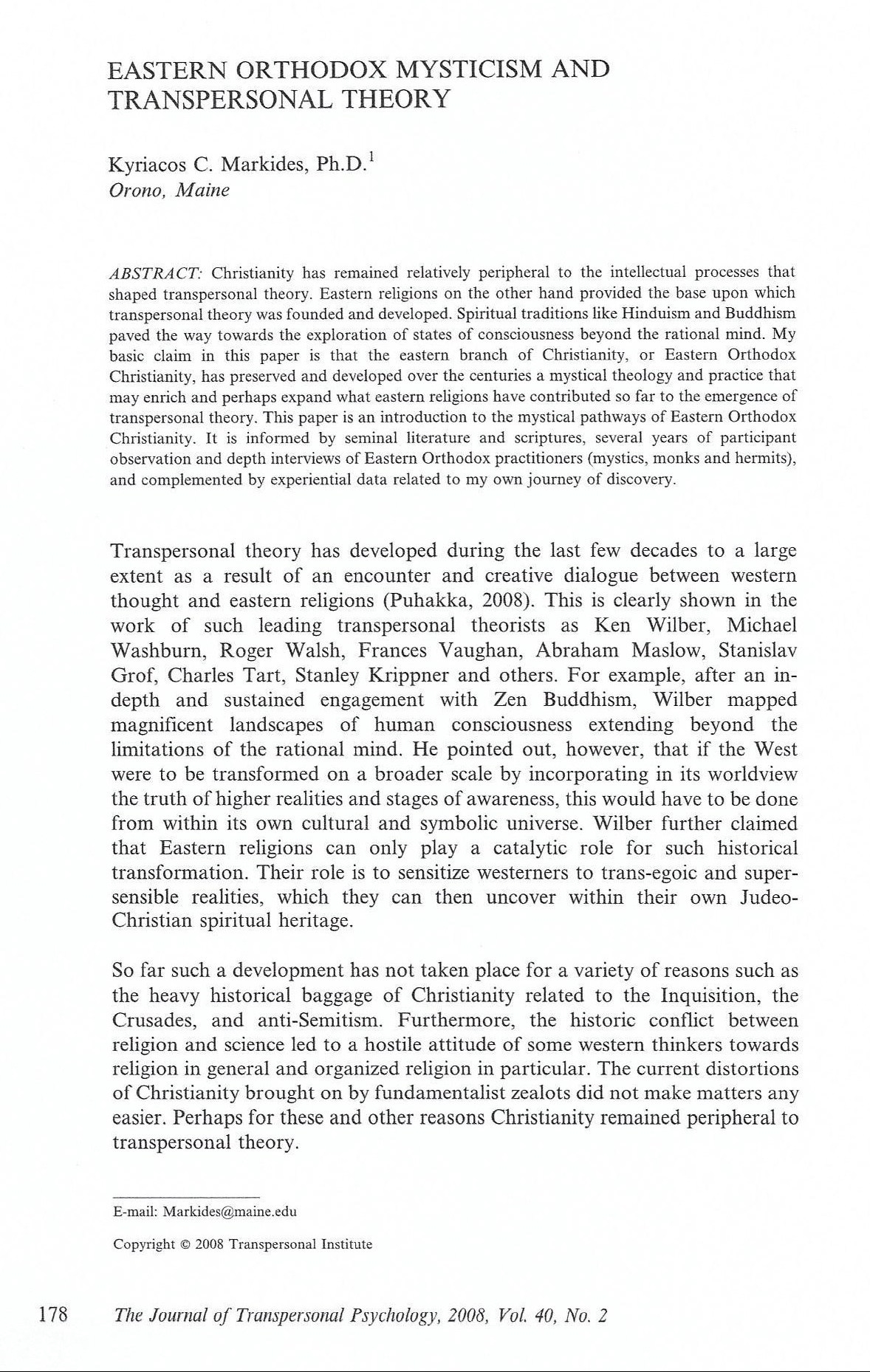
I attach a paper written by Dr. Markides and published in The Journal of Transpersonal Psychology, in 2008 (Vol. 40, No. 2). It is entitled, “Eastern Orthodox Mysticism and Transpersonal Theory”. As a “teaser” to the paper, I include Dr. Markides’ abstract:
ABSTRACT: Christianity has remained relatively peripheral to the intellectual processes that shaped transpersonal theory. Eastern religions on the other hand provided the base upon which transpersonal theory was founded and developed. Spiritual traditions like Hinduism and Buddhism paved the way towards the exploration of states of consciousness beyond the rational mind. My basic claim in this paper is that the eastern branch of Christianity, or Eastern Orthodox Christianity, has preserved and developed over the centuries a mystical theology and practice that may enrich and perhaps expand what eastern religions have contributed so far to the emergence of transpersonal theory. This paper is an introduction to the mystical pathways of Eastern Orthodox Christianity. It is informed by seminal literature and scriptures, several years of participant observation and depth interviews of Eastern Orthodox practitioners (mystics, monks and hermits), and complemented by experiential data related to my own journey of discovery.
Click on the blue hyperlink or the graphic, below, to open Dr. Markides paper:
Elder Sophrony: “The Jesus Prayer: Method”
Posted by Dallas Wolf in Hesychasm - Jesus Prayer, New Nuggets on November 1, 2017
Archimandrite Sophrony (Sakharov) (1896 – 1993) – also known as Elder Sophrony, was best known as the disciple and biographer of St Silouan the Athonite and compiler of St Silouan’s works, and as the founder of the Patriarchal Stavropegic Monastery of St. John the Baptist in Tolleshunt Knights, Maldon, Essex, England.

Elder Sophrony
“I propose to devote this chapter to setting out as briefly as possible the more important aspects of the Jesus Prayer and the commonsense views regarding this great culture of the heart that I met with on the Holy Mountain.
Year after year monks repeat the prayer with their lips, without trying by any artificial means to join mind and heart. Their attention is concentrated on harmonizing their life with the commandments of Christ. According to ancient tradition mind unites with heart through Divine action when the monk continues in the ascetic feat of obedience and abstinence; when the mind, the heart and the very body of the ‘old man’ to a sufficient degree are freed from the dominion over them of sin; when the body becomes worthy to be ‘the temple of the Holy Ghost’ (cf. Rom. 6. 11-14). However, both early and present day teachers occasionally permit recourse to a technical method of bringing the mind down into the heart. To do this, the monk, having suitably settled his body, pronounces the prayer with his head inclined on his chest, breathing in at the words ‘Lord Jesus Christ, (Son of God)’ and breathing out to the words ‘have mercy upon me (a sinner)’. During inhalation the attention at first follows the movement of the air breathed in as far as the upper part of the heart. In this manner concentration can soon be preserved without wandering, and the mind stands side by side with the heart, or even enters within it. This method eventually enables the mind to see, not the physical heart but that which is happening within it-the feelings that creep in and the mental images that approach from without. With this experience, the monk acquires the ability to feel his heart, and to continue with his attention centered in the heart without further recourse to any psychosomatic technique.
True Prayer Comes Through Faith and Repentance
This procedure can assist the beginner to understand where his inner attention should be stayed during prayer and, as a rule, at all other times, too. Nevertheless, true prayer is not to be achieved thus. True prayer comes exclusively through faith and repentance accepted as the only foundation. The danger of psychotechnics is that not a few attribute too great significance to method qua method. In order to avoid such deformation the beginner should follow another practice which, though considerably slower, is incomparably better and more wholesome to fix the attention on the Name of Christ and on the words of the prayer. When contrition for sin reaches a certain level the mind naturally heeds the heart.
The Complete Formula
The complete formula of the Jesus Prayer runs like this: Lord, Jesus Christ, Son of God, have mercy upon me, a sinner, and it is this set form that is recommended. In the first half of the prayer we profess Christ-God made flesh for our salvation. In the second we affirm our fallen state, our sinfulness, our redemption. The conjunction of dogmatic confession with repentance makes the content of the prayer more comprehensive.
Stages of Development
It is possible to establish a certain sequence in the development of this prayer.
…First, it is a verbal matter: we say the prayer with our lips while trying to concentrate our attention on the Name and the words.
…Next, we no longer move our lips but pronounce the Name of Jesus Christ, and what follows after, in our minds, mentally.
…In the third stage mind and heart combine to act together: the attention of the mind is centered in the heart and the prayer said there.
…Fourthly, the prayer becomes self-propelling. This happens when the prayer is confirmed in the heart and, with no especial effort on our part, continues there, where the mind is concentrated.
…Finally, the prayer, so full of blessing, starts to act like a gentle flame within us, as inspiration from on High, rejoicing the heart with a sensation of divine love and delighting the mind in spiritual contemplation. This last state is sometimes accompanied by a vision of Light.
Go step by step
A gradual ascent into prayer is the most trustworthy. The beginner who would embark on the struggle is usually recommended to start with the first step, verbal prayer, until body, tongue, brain and heart assimilate it. The time that this takes varies. The more earnest the repentance, the shorter the road.
The practice of mental prayer may for a while be associated with the hesychastic method-in other words, it may take the form of rhythmic or a-rhythmic articulation of the prayer as described above, by breathing in during the first half and breathing out during the second part. This can be genuinely helpful if one does not lose sight of the fact that every invocation of the Name of Christ must be inseparably coupled with a consciousness of Christ Himself. The Name must not be detached from the Person of God, lest prayer be reduced to a technical exercise and so contravene the commandment, ‘Thou shalt not take the name of the Lord thy God in vain’ (EX. 20.7; Deut. 5.11).
Attention of Mind gained
When the attention of the mind is fixed in the heart it is possible to control what happens in the heart, and the battle against the passions assumes a rational character. The enemy is recognized and can be driven off by the power of the Name of Christ. With this ascetic feat the heart becomes so highly sensitive, so discerning, that eventually when praying for anyone the heart can tell almost at once the state of the person prayed for. Thus the transition takes place from mental prayer to prayer of the mind and heart, which may be followed by the gift of prayer that proceeds of itself.
Do Not Hurry
We try to stand before God with the whole of our being. Invocation of the Name of God the Saviour, uttered in the fear of God, together with a constant effort to live in accordance with the commandments, little by little leads to a blessed fusion of all our powers. We must never seek to hurry in our ascetic striving. It. is essential to discard any idea of achieving the maximum in the shortest possible time. God does not force us but neither can we compel Him to anything whatsoever. Results obtained by artificial means do not last long and, more importantly, do not unite our spirit with the Spirit of the Living God.
It’s a Long Path
In the atmosphere of the world today prayer requires super human courage. The whole ensemble of natural energies is in opposition. To hold on to prayer without distraction signals victory on every level of existence. The way is long and thorny but there comes a moment when a heavenly ray pierces the dark obscurity, to make an opening through which can be glimpsed the source of the eternal Divine Light. The Jesus Prayer assumes a meta-cosmic dimension. St John the Divine asserts that in the world to come our deification will achieve plenitude since ‘we shall see Him as He is’. ‘And every man that hath this hope in him purifieth himself, even as he is pure … Whosoever abideth in him sinneth not: whosoever sinneth hath not seen him, neither known him’ (cf. 1John 3.2,3,6). In order in Christ’s Name to receive forgiveness of sins and the promise of the Father we must strive to dwell on His Name ‘until we be endued with power from on high’ (cf. Luke24-49).
In advising against being carried away by artificial practices such as transcendental meditation I am but repeating the age-old message of the Church, as expressed by St Paul: ‘Exercise thyself rather unto godliness. For bodily exercise profiteth little: but godliness is profitable unto all things, having promise of the life that now is, and of that which is to come. This is a faithful saying and worthy of all acceptation. For therefore we both labour and suffer reproach, because we trust in the living God, who is the Saviour of all men’ (1Tim. 4.7-10)
It’s Not Like Transcendental Meditation
The way of the fathers requires firm faith and long patience”, whereas our contemporaries want to seize every spiritual gift, including even direct contemplation of the Absolute God, by force and speedily, and will often draw a parallel between prayer in the Name of Jesus and yoga or transcendental meditation and the like. I must stress the danger of such errors-the danger of looking upon prayer as one of the simplest and easiest ‘technical’ means leading to immediate unity with God. It is imperative to draw a very definite line between the Jesus Prayer and every other ascetic theory. He is deluded who endeavors to divest himself mentally of all that is transitory and relative in order to cross some invisible threshold, to realize his eternal origin, his identity with the Source of all that exists; in order to return and merge with Him, the Nameless transpersonal Absolute. Such exercises have enabled many to rise to supra-rational contemplation of being; to experience a certain mystical trepidation; to know the state of silence of the mind, when mind goes beyond the boundaries of time and space. In such-like states man may feel the peacefulness of being withdrawn from the continually changing phenomena of the visible world; may even have a certain experience of eternity. But the God of Truth, the Living God, is not in all this. It is man’s own beauty, created in the image of God, that is contemplated and seen as Divinity, whereas he himself still continues within the confines of his creatureliness. This is a vastly important concern. The tragedy of the matter lies in the fact that man sees a mirage which, in his longing for eternal life, he mistakes for a genuine oasis. This impersonal form of ascetics leads finally to an assertion of divine principle in the very nature of man. Man is then drawn to the idea of self-deification- the cause of the original fall. The man who is blinded by the imaginary majesty of what he contemplates has in fact set his foot on the path to self-destruction. He has discarded the revelation of a Personal God. He finds the principle of the Person-Hypostasis a limiting one, unworthy of the Absolute. He tries to strip himself of like limitations and return to the state which he imagines has belonged to him since before his coming into this world. This movement into the depths of his own being is nothing else but attraction towards the non-being from which we were called by the will of the Creator.
Knowledge of Personal God
The true Creator disclosed Himself to us as a Personal Absolute. The whole of our Christian life is based on knowledge of God, the First and the Last, Whose Name is I AM. Our prayer must always be personal, face to Face. He created us to be joined in His Divine Being, without destroying our personal character. It is this form of immortality that was promised to us by Christ. Like St Paul we would not ‘be unclothed, but clothed upon, that mortality might be swallowed up of life’. For this did God create us and ‘hath given unto us the earnest of the Spirit’ (2 Cor. 5.4,5).
Personal immortality is achieved through victory over the world – a mighty task. The Lord said, ‘Be of good cheer; I have overcome the world’ (John 10. 3 3), and we know that the victory was not an easy one. ‘Beware of false prophets … Enter ye in at the strait gate: for wide is the gate, and broad is the way, that leadeth to destruction, and many there be which go in thereat: Because strait is the gate, and narrow is the way, which leadeth unto life, and few there be that find it’ (Matt. 7.13-115).
Wherein lies destruction? In that people depart from the Living God.
To believe in Christ one must have either the simplicity of little children – ‘Except ye be converted and become as little children, ye shall not enter into the kingdom of heaven’ (Matt. 18.3)-or else, like St Paul, be fools for Christ’s sake. ‘We are fools for Christ’s sake … we are weak … we are despised … we are made as the filth of the world, and are the offscouring of all things unto this day’ (1 Cor. 4. 10, 13). However, ‘other foundation can no man lay than that is laid, which is Jesus Christ’ (1 Cor. 3 .11). ʻWherefore I beseech you, be ye followers of me’ (1 Cor. 4. 16). In the Christian experience cosmic consciousness comes from prayer like Christ’s Gethsemane prayer, not as the result of abstract philosophical cogitations.
When the Very God reveals Himself in a vision of Uncreated Light, man naturally loses every desire to merge into a transpersonal Absolute. Knowledge which is imbued with life (as opposed to abstract knowledge) can in no wise be confined to the intellect: there must be a real union with the act of Being. This is achieved through love: ‘Thou shalt love the Lord thy God with all thy heart … and with all thy mind’ (Matt. 22.37). The commandment bids us love. Therefore love is not something given to us: it must be acquired by an effort made of our own free will. The injunction is addressed first to the heart as the spiritual centre of the individual. Mind is only one of the energies of the human. Love begins in the heart, and the mind is confronted with a new interior event and contemplates Being in the Light of Divine love.
A Difficult Task
There is no ascetic feat more difficult, more painful, than the effort to draw close to God, Who is Love (cf. i John 4.8, 16). Our inner climate varies almost from day to day: now we are troubled because we do not understand what is happening about us; now inspired by a new flash of knowledge. The Name Jesus speaks to us of the extreme manifestation of the Father’s love for us (cf.John 3.16). In proportion as the image of Christ becomes ever more sacred to us, and His word is perceived as creative energy, so a marvelous peace floods the soul while a luminous aura envelops heart and head. Our attention may hold steady. Sometimes we continue thus, as if it were a perfectly normal state to be in, not recognizing that it is a gift from on High. For the most part we only realize this union of mind with heart when it is interrupted.
In the Man Christ Jesus ‘dwelleth all the fullness of the Godhead bodily’ (Col. 2.9). in Him there is not only God but the whole human race. When we pronounce the Name Jesus Christ we place ourselves before the plenitude both of Divine Being and created being. We long to make His life our life; to have Him take His abode in us. In this lies the meaning of deification. But Adam’s natural longing for deification at the very outset took a wrong turning which led to a terrible deviation. His spiritual vision was insufficiently established in Truth.
Our life can become holy in all respects only when true knowledge of its metaphysical basis is coupled with perfect love towards God and our fellow-men. When we firmly believe that we are the creation of God the Primordial Being, it will be obvious that there is no possible deification for us outside the Trinity. If we recognize that in its ontology all human nature is one, then for the sake of the unity of this nature we shall strive to make love for our neighbor part of our being.
Our most dire enemy is pride. Its power is immense. Pride saps our every aspiration, vitiates our every endeavor. Most of us fall prey to its insinuations. The proud man wants to dominate, to impose his own will on others; and so conflict arises between brethren. The pyramid of inequality is contrary to revelation concerning the Holy Trinity in Whom there is no greater, no lesser; where each Person possesses absolute plenitude of Divine Being.
The Kingdom of Christ is founded on the principle that whosoever would be first should be the servant of all (cf. Mark 9.3 5). The man who humbles himself shall be raised up, and vice versa: he who exalts himself shall be brought low. In our struggle for prayer we shall cleanse our minds and hearts from any urge to prevail over our brother. Lust for power is death to the soul. People are lured by the grandeur of power but they forget that ‘that which is highly esteemed among men is an abomination in the sight of God’ (Matt. 16.15). Pride incites us to criticize, even scorn our weaker brethren; but the Lord warned us to ‘take heed that we despise not one of these little ones’ (cf. Matt. i8.io). If we give in to pride all our practice of the Jesus Prayer will be but profanation of His Name. ‘He that saith he abideth in Him ought himself also to walk, even as He walked’ (1John2.6). He who verily loves Christ will devote his whole strength to obeying His word. I stress this because it is our actual method for learning to pray. This, and not any psychosomatic technics, is the right way.
Not a Christian Yoga
I have lingered on the dogmatic justification for the Jesus Prayer largely because in the last decade or so the practice of this prayer has been distorted into a so-called ‘Christian yoga’ and mistaken for ‘transcendental meditation’. Every culture, not only every religious culture, is concerned with ascetic exercises. If a certain similarity either in their practice or their outward manifestations, or even their mystical formulation, can be discerned, that does not at all imply that they are alike fundamentally. Outwardly similar situations can be vastly different in inner content.
When we contemplate Divine wisdom in the beauty of the created world, we are at the same time attracted still more strongly by the imperishable beauty of Divine Being as revealed to us by Christ. The Gospel for us is Divine Self-Revelation. In our yearning to make the Gospel word the substance of our whole being we free ourselves by the power of God from the domination of passions. Jesus is the one and only Savior in the true sense of the word. Christian prayer is effected by the constant invocation of His Name: Lord Jesus Christ, Son of the Living God, have mercy upon us and upon Thy world.
Though prayer in the Name of Jesus in its ultimate realization unites man with Christ fully, the human hypostasis is not obliterated, is not lost in Divine Being like a drop of water in the ocean. ‘I am the light of the world … I am the truth and the life’ (John 8.12; 14.6). For the Christian-Being, Truth, Life are not ‘what’ but ‘who’. Where there is no personal form of being, there is no living form either. Where in general there is no life, neither is there good or evil; light or darkness. ‘Without him was not any thing made that was made. In him was life’ (John 1:3).
When contemplation of Uncreated Light is allied to invocation of the Name of Christ, the significance of this Name as ‘the kingdom of God come with power’ (Mark 9.1) is made particularly clear, and the spirit of man hears the voice of the Father: ‘This is my beloved Son’ (Mark 9.7). Christ in Himself showed us the Father: ‘he that hath seen me hath seen the Father’ (John 14:9). Now we know the Father in the same measure as we have known the Son. ‘I and my Father are one’ (John 10.30). And the Father bears witness to His Son. We therefore pray, 90 Son of God, save us and Thy world.’
To acquire prayer is to acquire eternity. When the body lies dying, the cry ‘Jesus Christ’ becomes the garment of the soul; when the brain no longer functions and other prayers are difficult to remember, in the light of the divine knowledge that proceeds from the Name our spirit will rise into life incorruptible.”
~From His Life is Mine by Archimandrite Sophrony, trans. Rosemary Edmonds, St. Valdimir Seminary Press, pp112-120
Met. Kallistos (Ware): “The Power of the Name”
Posted by Dallas Wolf in Hesychasm - Jesus Prayer, New Nuggets on November 1, 2017
Metropolitan Kallistos (Ware) of Diokleia – (b. 1934) is a titular metropolitan of the Orthodox Ecumenical Patriarchate in Great Britain. From 1966-2001, he was Spalding Lecturer of Eastern Orthodox Studies at Oxford University, and has authored numerous books and articles pertaining to the Orthodox faith.
I ran across this essay by Met. (then Bishop) Kallistos (Ware). I think that it is the most concise, complete, readable, and instructive summary of Orthodox theology, mysticism, hesychasm, and the Jesus Prayer I have ever read in a mere 20 pages.
Click on the graphic or the blue hyperlink below to open the document:
Met. Kallistos (Ware)-The Power of the Name

Elder Sophrony: “Experiencing the Uncreated Light”
Posted by Dallas Wolf in Contemplative Prayer (series), Hesychasm - Jesus Prayer, Monasticism, New Nuggets on October 31, 2017
Archimandrite Sophrony (Sakharov) (1896 – 1993) – also known as Elder Sophrony, was best known as the disciple and biographer of St Silouan the Athonite and compiler of St Silouan’s works, and as the founder of the Patriarchal Stavropegic Monastery of St. John the Baptist in Tolleshunt Knights, Maldon, Essex, England.
Below is an account of an encounter of Uncreated Divine Light; the Uncreated Thaboric Light of Gregory Palamas. It is written by a modern holy elder, Archimandrite Sophrony, described above. Five years before his repose in England at the age of 97, he recorded his experiences of Uncreated Light. These experiences had begun many years earlier, when he had been living as a monk on Mt. Athos in Greece, and, like all Orthodox monks, had been practicing, daily, the Jesus Prayer:
“Now at the close of my life, (he writes,) I have decided to talk to my brethren of things I would not have ventured to utter earlier, counting it unseemly. At the beginning of my monastic life on Mt. Athos, the Lord granted me unceasing prayer. I will relate what I remember well enough, since we are talking of the prayers which marked me indelibly. This is how it often used to be:
Towards evening at sunset I would shut the window and draw three curtains over it, to make my cell as quiet and dark as possible. With my forehead bent to the floor, I would slowly repeat words of prayer, one after the other. I had no feeling of being cooped up, and my mind, oblivious to the body, lived in the light of the gospel word. Concentrated on the fathomless wisdom of Christ’s word, my spirit, freed from all material concerns, would feel flooded, as it were, with light, from the celestial sun.
At the same time, a gentle peace would fill my soul, unconscious of all the needs and cares of this earth. The Lord gave me to live in this state, and my spirit yearned to cling to his feet in gratitude for this gift. This same experience was repeated at intervals for months, perhaps years. Early in the 1930s—I was a deacon then—for two weeks, God’s tender mercy rested upon me. At dusk, when the sun was sinking behind the mountains of Olympia, I would sit on the balcony near my cell, face turned to the dying light.
In those days, I contemplated the evening light of the sun, and at the same time, another light, which softly enveloped me, and gently invaded my heart, in some curious fashion making me feel compassionate and loving towards people who treated me harshly. I would also feel a quiet sympathy for all creatures in general. When the sun had set, I would retire to my cell, as usual, to perform the devotions preparatory to celebrating the Liturgy, and the light did not leave me while I prayed.
Under the influence of this light, prayer for mankind and travail possessed my whole being. It was clear that the inescapable, countless sufferings of the entire universe, are the consequence of man’s falling away from God, our creator, who revealed himself to us. If the world loved Christ and his commandments, everything would be radically transformed, and the earth would become a wonderful paradise.”
Igumen Damascene (Christensen): “The Jesus Prayer… is person-to-person”
Posted by Dallas Wolf in Hesychasm - Jesus Prayer, New Nuggets on October 31, 2017
Igumen Damascene (Christensen) (1961-) – is an igumen (ἡγούμενος – archimandrite or abbot) of the Serbian Orthodox Church, and abbot of St Herman of Alaska Monastery, Platina, California. He is the author of Fr Seraphim Rose: His Life and Works, 1993; Nihilism: The Root of the Revolution of the Modern Age (editor), 1994; and Christ the Eternal Tao, 1999.
 “When doing the Jesus Prayer as it should be done, one does not merely say the words, but actually prays them from the depths of one’s being, speaking person-to-person, always returning to the awareness that one is addressing someone. Here is an analogy that might make it a little more clear: I have a telephone, and I turned it off, so it is just a dead piece of metal, so I can talk on this phone, I can be saying something, but I know that nobody is listening on the other line. If I know nobody is listening, I can just talk and I am just talking into nothing. But if the phone is on, and I have called somebody, and I know that the person is on the other line, and when I am talking he or she is listening to what I am saying, then I know, and I am conscious, that I am addressing someone.
This is the way we have to be in prayer. In other words, we should not just repeat the prayer by rote: “Lord Jesus Christ, have mercy on me, Lord Jesus Christ, have mercy on me.” We should be concentrated on the words of the prayer, “Lord Jesus Christ.” We are addressing Christ, we are conscious of him, we are affirming that he is the Lord, that he is the Christ, he is the Messiah, that he is God, and we ask him to have mercy on us, which means to give us all that we need for our salvation and deification, and by extension, not only on us but on everyone around us.
We are conscious of this and we are conscious of the words of the prayer, but more so, on a deeper level, we are conscious of the one that we are addressing in the prayer. We are addressing Jesus Christ. We are not speaking into a dead telephone. We are speaking to someone who is present with us, who is before us, who is closer to us than our own soul, who within, is inside of us, all around us, and so we are addressing a live, living person. This is the consciousness of addressing someone that we need to have.”
Chumley: “… hesychia is quite possible and advisable”
Posted by Dallas Wolf in Hesychasm - Jesus Prayer, Monasticism, New Nuggets on October 26, 2017
Dr. Norris J. Chumley – is on the faculty of New York University’s Tisch School of the Arts, in the Kanbar Institute for Undergraduate Film and Television. He is also the author of several books including, “Be Still and Know: God’s Presence in Silence”, “Mysteries of the Jesus Prayer”, a companion book to the feature film and public television special.
 “It is a primary and natural human desire to seek peace and tranquility and to be united with God, our Creator. This is hesychia, a primal state of union with God.
The mystery of creation is that the Creator is present inside, behind, above, and below what he has created! There is no separation between God and creation. This is a major tenet of Orthodox teachings. This means he is also present in each of us. If we make worldly things of creation a priority, we miss the subtlety of the Creator. Remove the material and the worldly and become completely silent and still, and God the Father is there, awaiting us. Through his grace, divinity is revealed within us.
Removal of stimuli, and learning to not be deceived by material splendor is the practice of hesychia. It is a method of removal from illusion and dependence on outside factors. Stilling the mind of random thoughts (logismoi) allows us a space for God to enter our intellect, and then flow into our heart and soul (nous). By remaining still, limiting physical activity and the myriad desires of the body (through the practice of apatheia), we also feel God’s grace in a physical way; we are gifted by grace to realize that we are the embodiment of God.
We need silence in order to hear God. We also need places of quiet and stillness, where we can contemplate God and pray. Yet few… can or would wish to leave all behind and enter a monastic life. Not many people have the possibility or desire to give away all possessions, leave work, families, and colleagues and take on the ascetic life.
Finding a place and time to practice moments of hesychia is quite possible and advisable. One does not need to live in a cave, desert, or faraway forest in order to become attuned to God… Thinking of God, saying the Jesus Prayer for five to ten minutes in the morning, afternoon, and evening and tying it to inhalation and exhalation is a form of hesychasm. It may be helpful to integrate the Jesus Prayer into one’s work and recite it before beginning a new task, or after completing work.
Even at work one may still take time to be silent at one’s desk or to utter a silent prayer before or during a business meeting. Taking a prayer-walk at lunchtime, uniting one’s steps with the Jesus Prayer may bring a deep sense of peace. This practice of hesychia at the office may be significantly helpful in improving concentration and mood.”
~Dr. Norris Chumley, excerpts from Be Still and Know: God’s Presence in Silence, pp 117-119.
 First Thoughts