Archive for category Patristic Pearls
Origen: “For as man consists of body, and soul, and spirit, so in the same way does Scripture”
Posted by Dallas Wolf in Patristic Pearls, Theology on July 6, 2014
Origen of Alexandria, (c. 184 – c. 254) was Head of the famed Catechetical School in Alexandria at age 18 and arguably the most brilliant theologian of the early Christian church. He was probably the most able and successful defender of the faith against the heresy of Gnosticism in the third century. Saint and Church Father without question. In this quote he tells us that Scripture ought to be interpreted at three levels: starting with the lowest level, the body or literal interpretation; followed by the more advanced at the soul level, or moral interpretation; and culminating with the highest level of interpretation, the spiritual, or allegorical interpretation. 1,800 years ago, Origen very clearly articulated what contemporary Christian fundamentalists still haven’t figured out.

Origen of Alexandria (c. 184 – c. 254)
“The individual ought, then to portray the ideas of holy Scripture in a threefold manner upon his own soul; in order that the simple man may be edified by the “flesh”, as it were, of the Scripture, for so we name the obvious sense; while he who has ascended a certain way (may be edified) by the “soul”, as it were. The perfect man, again… (may receive edification) from the “spiritual” law, which has a shadow of good things to come. For as man consists of body, and soul, and spirit, so in the same way does Scripture, which has been arranged to be given by God for the salvation of men.” ~ Peri Archon; First Principles, Book IV, Chapter 1
Isaac of Nineveh: God’s Justice is not Rome’s Imperial ‘Iustitia’
Posted by Dallas Wolf in Monasticism, Patristic Pearls, Theology on July 4, 2014
Isaac of Nineveh – 7th century ascetic and mystic, born in modern-day Qatar, was made Bishop of Nineveh between 660-680. Here Isaac easily debunks the Western Latin notion that God’s righteousness, or “dikaiosyne theou“, is the same as secular Imperial Roman Justice, or “Iustitia“.

“How can you call God just when you read the parable of the laborers in the vineyard and their wages? ‘Friend, I am doing you no wrong… I choose to give to this last as I give to you… do you begrudge my generosity?’ Likewise how can you call God just when you read the parable of the prodigal son who squanders his father’s wealth in riotous living, and the moment he displays some nostalgia his father runs to him, throws his arms around his neck and gives him complete power over all his riches? It is not someone else who has told us this about God, so that we might have doubts. It is his own Son himself. He bore this witness to God. Where is God’s justice? Here, in the fact that we were sinners and Christ died for us…” ~ Ascetic Treatises, 60
Maximus: “The scriptural Word knows of two kinds of knowledge of divine things.”
Posted by Dallas Wolf in Hesychasm - Jesus Prayer, Patristic Pearls, Theology on July 3, 2014
Maximus the Confessor (c. 580 – 662) was a 7th century Christian monk, theologian, and scholar who many contemporary scholars consider to be the greatest theologian of the Patristic era. Two of his most famous works are “Ambigua” – An exploration of difficult passages in the work of Pseudo-Dionysius and Gregory of Nazianzus, focusing on Christological issues, and “Questions to Thalassius” or “Ad Thalassium” – a lengthy exposition on various Scriptural texts. This quote is from the latter work. It affirms the primacy of experience in an authentic spiritual life.
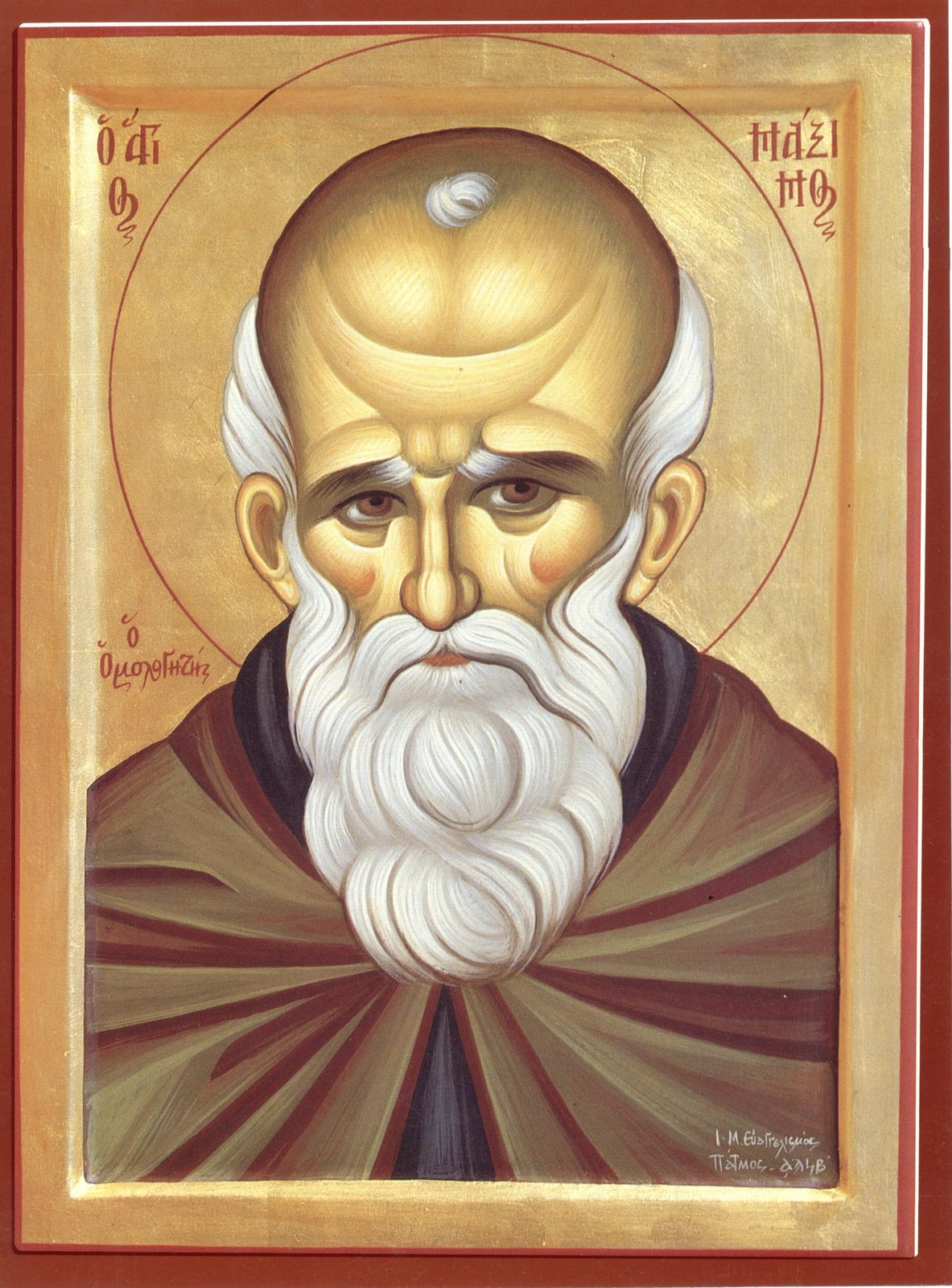
Maximus the Confessor (c. 580 – 662)
“The scriptural Word knows of two kinds of knowledge of divine things. On the one hand, there is relative knowledge, rooted only in reason and ideas, and lacking in the kind of experiential perception of what one knows through active engagement; such relative knowledge is what we use to order our affairs in our present life. On the other hand, there is that truly authentic knowledge, gained only by actual experience, apart from reason and ideas, which provides a total perception of the known object through a participation by grace. By this latter knowledge, we attain, in the future state, the supernatural deification that remains unceasingly in effect.” ~ Ad Thalassium 60
Justin: “Whatever things were rightly said among all men, are the property of us Christians”
Posted by Dallas Wolf in Patristic Pearls on June 28, 2014
St. Justin Martyr (c. 100 – 165) taught that all truth came from the Logos, or Word, of God. Therefore, whatever truth was stated by any human being at any time, anywhere, was the result of the influence of the immanent Logos within him/her; and was, therefore, Christian. It was later generations of Christians that claimed for the institutional Christian church a total monopoly on truth as its sole source and repository… as it does to this day.

St. Justin Martyr
“the teachings of Plato are different from those of Christ, … they are not in all respects similar, as neither are those of the others, Stoics, and poets, and historians. For each man spoke well in proportion to the share he had of the spermatic word [spermatikos logos; the Logos inherent in all humans], seeing what was related to it. But they who contradict themselves on the more important points appear not to have possessed the heavenly wisdom, and the knowledge which cannot be spoken against. Whatever things were rightly said among all men, are the property of us Christians… For all the writers were able to see realities darkly through the sowing of the implanted word [spermatikos logos] that was in them. For the seed and imitation imparted according to capacity is one thing, and quite another is the thing itself, of which there is the participation and imitation according to the grace which is from Him.” Second Apology, 13.
Justin: “those who lived reasonably are Christians”
Posted by Dallas Wolf in Patristic Pearls on June 28, 2014
Justin Martyr, (c. 100 – 165 AD), was an early Christian apologist, and is regarded as the foremost interpreter of the Logos Doctrine in the 2nd century. He was martyred alongside some of his students and is considered a saint by the Roman Catholic, the Anglican, and the Eastern Orthodox Churches. It is clear that the early church was much more inclusive, more cosmic, and less tribal and triumphalistic than the later and contemporary church.
St. Justin Martyr
“We have been taught that Christ is the first-born of God, and we have declared above that He is the Word [Logos] of whom every race of men were partakers; and those who lived reasonably (μετὰ λόγου, “with reason, or the Logos”) are Christians, even though they have been thought atheists;” First Apology, 46.
St. John Chrysostom: “Wealth is one thing, covetousness another”
Posted by Dallas Wolf in Patristic Pearls on June 26, 2014
St. John Chrysostom (344/354 – 407). There is a very definite difference between rich and rapacious; between wealth and covetousness. Wealth is not a bad thing. Misuse of it is.


“I am often reproached for continually attacking the rich. Yes, because the rich are continually attacking the poor. But those I attack are not the rich as such, only those who misuse their wealth. I point out constantly that those I accuse are not the rich but the rapacious. Wealth is one thing, covetousness another. Learn to distinguish.”
– St. John Chrysostom, Homily on the Fall of Eutropius
St. Symeon the New Theologian: “…by what other means can he ever obtain salvation? By no means!”
Posted by Dallas Wolf in Hesychasm - Jesus Prayer, Monasticism, Patristic Pearls on June 22, 2014
St. Symeon the New Theologian (949-1022) was absolutely insistent that every believer must receive a second baptism, the Baptism of the Holy Spirit. It is not to be confused with ritual Orthodox Chrismation.
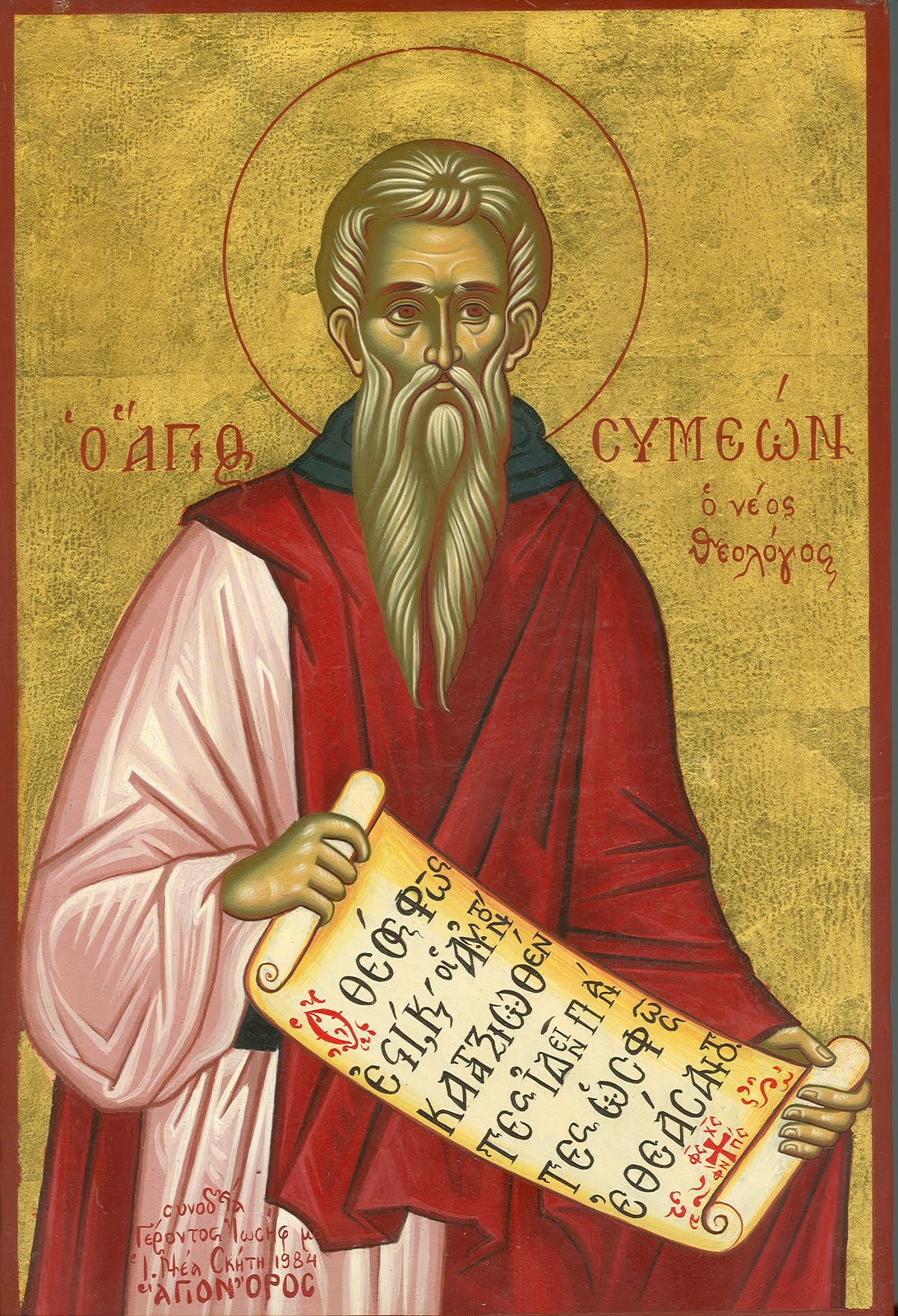
“… ‘John Baptized with water, but you shall be baptized with the Holy Spirit’. If one is ignorant of the Baptism wherewith he was baptized as a child and does not even realize that he was baptized, but only accepts it by faith and then wipes it away with thousands upon thousands of sins, and if he denies the second Baptism – I mean, that which is through the Spirit, given from above by the loving-kindness of God to those who seek it by penitence – by what other means can he ever obtain salvation? By no means!”
~ from: The Discourses. XXXII
St. Symeon the New Theologian: “… first seek to learn and experience these things in fact…”
Posted by Dallas Wolf in Hesychasm - Jesus Prayer, Monasticism, Patristic Pearls on June 21, 2014
St. Symeon the New Theologian (949-1022) excoriates the church clergy for not personally being contemplatives and experiencing the presence of God (theoria) themselves before trying to lead and teach the laity. This criticism is just as valid for the institutional church today as it was for the Byzantine church in AD 1000. Few, if any, of the contemporary institutional clergy practice contemplative Christian prayer.
“You priests and monks teach others with vain words and think that you are rulers – but falsely! Ask your elders and high priests, gather yourselves together in the love of God, and first seek to learn and experience these things in fact, and then have the will to see this and by experience become like God. Be anxious not merely to act a play and wear the garment thereof and so to approach apostolic dignities. Otherwise, as you in your imperfection rush to rule over others, before acquiring the knowledge of the mysteries of God, you will hear these words, ‘Woe to those who are wise in their own eyes and shrewd in their own sight! Woe to those who put darkness for light and light for darkness!'”
~ from: Discourses, XXXIII
St. Symeon the New Theologian: “…it is entirely possible when one desires it.”
Posted by Dallas Wolf in Monasticism, Patristic Pearls on June 18, 2014
St. Symeon the New Theologian (949-1022)
“Do not say that it is impossible to receive the Spirit of God.
Do not say that it is possible to be made whole without Him.
Do not say that one can possess Him without knowing it.
Do not say that God does not manifest Himself to man.
Do not say that men cannot perceive the divine light, or that it is impossible in this age!
Never is it found to be impossible, my friends.
On the contrary, it is entirely possible when one desires it.”
~ Hymns of Divine Love, 27
St. Clement of Alexandria: “Woman has the same spiritual dignity as man.” AD 198
Posted by Dallas Wolf in Patristic Pearls on June 17, 2014
St. Clement of Alexandria (150 CE — bet. 211 and 215) – Christian apologist and missionary theologian to the Hellenistic (Greek cultural) world, and second known leader and teacher of the catechetical School of Alexandria. The most important of his surviving works is a trilogy comprising the Protreptikos (“Exhortation”), the Paidagōgos (“Instructor”), and the Strōmateis (“Miscellanies”).

“Woman has the same spiritual dignity as man. Both of them have the same God, the same Teacher, the same Church. They breathe, see, hear, know, hope, and love in the same way. Beings who have the same life, grace and salvation are called … to the same manner of being.”
~ from: Paedagogus, 1,4
 First Thoughts