Archive for category Theology
Codex Sinaiticus: “God is love”
Posted by Dallas Wolf in Ancient Christian Manuscripts, First Thoughts, Theology on March 9, 2026

Modern Greek: Ὁ θεὸς ἀγάπη ἐστίν
English: God is love (from 1 John 4:8)
Codex Sinaiticus ca. AD 350
British Museum, London
The “God is love” graphic, above, is copied from the Codex Sinaiticus. Codex Sinaiticus is a manuscript of the Christian Bible written in the middle of the fourth century and contains the earliest complete copy of the Christian New Testament. The name ‘Codex Sinaiticus’ literally means ‘the Sinai Book’. The hand-written text is in Greek. The New Testament appears in the original vernacular language (koine) and the Old Testament in the version known as the Septuagint (LXX, ca. 130 B.C.), that was adopted by early Greek-speaking Christians. Codex Sinaiticus is one of only four great codices that have survived to the present day. They are written in a certain uncial (broad single-stroke letters using simple round forms) style of calligraphy using only majuscule (capital) letters, written in scriptio continua (meaning without regular gaps or spaces between words). Words do not necessarily end on the same line on which they start. All four of these manuscripts were made at great expense in material and labor, written on parchment or velum (animal skins) by professional scribes.
‘Codex’ means ‘book’. By the time Codex Sinaiticus was written, works of literature were increasingly written on sheets that were folded and bound together in the form that we still use today. This book format was steadily replacing the roll format which was more widespread just a century before. These rolls were made of animal skin (like most of the Dead Sea Scrolls) or the papyrus plant (commonly used for Greek and Latin literature). Using the papyrus codex was a distinctive feature of early Christian culture. The pages of Codex Sinaiticus, however, are made of animal skin parchment. This marks it out as standing at an important transition in book history. Before it we see many examples of Greek and Latin texts on papyrus roll or papyrus codex, but almost no traces of parchment codices. After it, the parchment codex becomes the norm.
In Christian scribal practice, nomina sacra is the abbreviation of frequently used divine names or titles, especially in Greek manuscripts of the Bible. A nomen sacrum consists of two or more letters from the original word spanned by an overline; in the case of the Sinaiticus graphic, above, the theta and sigma are the first and last letters in the Greek word Theos, or God.
David Bentley Hart: “Traditio Deformis – The long history of defective Christian scriptural exegesis occasioned by problematic translations”
Posted by Dallas Wolf in Ancient Christian Manuscripts, New Nuggets, Theology on March 8, 2026

David Bentley Hart (born 1965) is an American Orthodox Christian philosophical theologian, cultural commentator and polemicist. Here, in one short essay published in “First Things” in May 2015, Prof. Hart addresses, “The long history of defective Christian scriptural exegesis occasioned by problematic translations”.
The long history of defective Christian scriptural exegesis occasioned by problematic translations is a luxuriant one, and its riches are too numerous and exquisitely various adequately to classify. But I think one can arrange most of them along a single continuum in four broad divisions: some misreadings are caused by a translator’s error, others by merely questionable renderings of certain words, others by the unfamiliarity of the original author’s (historically specific) idiom, and still others by the “untranslatable” remoteness of the author’s own (culturally specific) theological concerns. And each kind comes with its own special perils and consequences.
But let me illustrate. Take, for example, Augustine’s magisterial reading of the Letter to the Romans, as unfolded in reams of his writings, and ever thereafter by his theological heirs: perhaps the most sublime “strong misreading” in the history of Christian thought, and one that comprises specimens of all four classes of misprision. Of the first, for instance: the notoriously misleading Latin rendering of Romans 5:12 that deceived Augustine into imagining Paul believed all human beings to have, in some mysterious manner, sinned “in” Adam, which obliged Augustine to think of original sin—bondage to death, mental and moral debility, estrangement from God—ever more insistently in terms of an inherited guilt (a concept as logically coherent as that of a square circle), and which prompted him to assert with such sinewy vigor the justly eternal torment of babes who died unbaptized. And of the second: the way, for instance, Augustine’s misunderstanding of Paul’s theology of election was abetted by the simple contingency of a verb as weak as the Greek proorizein (“sketching out beforehand,” “planning,” etc.) being rendered as praedestinare—etymologically defensible, but connotatively impossible. And of the third: Augustine’s frequent failure to appreciate the degree to which, for Paul, the “works” (erga, opera) he contradistinguishes from faith are works of the Mosaic law, “observances” (circumcision, kosher regulations, and so on). And of the fourth—well, the evidences abound: Augustine’s attempt to reverse the first two terms in the order of election laid out in Romans 8:29–30 (“Whom he foreknew he also marked out beforehand”); or his eagerness, when citing Romans 5:18, to quote the protasis (“Just as one man’s offence led to condemnation for all men”), but his reluctance to quote the (strictly isomorphic) apodosis (“so also one man’s righteousness led to justification unto life for all men”); or, of course, his entire reading of Romans 9–11 . . .
Ah—thereby hangs a tale.
Not that Paul’s argument there is difficult to follow. What preoccupies him is the agonizing mystery that the Messiah has come, yet so few of the house of Israel have accepted him, while so many Gentiles—outside the covenant—have. What then of God’s faithfulness to his promises? It is not an abstract question regarding who is “saved” and who “damned”: By the end of chapter 11, the former category proves to be vastly larger than that of the “elect,” or the “called,” while the latter category makes no appearance at all. It is a concrete question concerning Israel and the Church. And ultimately Paul arrives at an answer drawn, ingeniously, from the logic of election in Hebrew Scripture.
Before reaching that point, however, in a completely and explicitly conditional voice, he limns the problem in the starkest chiaroscuro. We know, he says, that divine election is God’s work alone, not earned but given; it is not by their merit that Gentile believers have been chosen. “Jacob have I loved, but Esau have I hated” (9:13)—here quoting Malachi, for whom Jacob is the type of Israel and Esau the type of Edom. For his own ends, God hardened Pharaoh’s heart. He has mercy on whom he will, hardens whom he will (9:15–18). If you think this unjust, who are you, O man, to reproach God who made you? May not the potter cast his clay for purposes both high and low, as he chooses (9:19–21)? And, so, what if (ei de, quod si) God should show his power by preparing vessels of wrath, solely for destruction, to provide an instructive counterpoint to the riches of the glory he lavishes on vessels prepared for mercy, whom he has called from among the Jews and the Gentiles alike (9:22–24)? Perhaps that is simply how it is: The elect alone are to be saved, and the rest left reprobate, as a display of divine might; God’s faithfulness is his own affair.
Well, so far, so Augustinian. But so also, again, purely conditional: “What if . . . ?” Rather than offering a solution to the quandary that torments him, Paul is simply restating it in its bleakest possible form, at the very brink of despair. But then, instead of stopping here, he continues to question God’s justice after all, and spends the next two chapters unambiguously rejecting this provisional answer altogether, in order to reach a completely different—and far more glorious—conclusion.
Throughout the book of Genesis, the pattern of God’s election is persistently, even perversely antinomian: Ever and again the elder to whom the birthright properly belongs is supplanted by the younger, whom God has chosen in defiance of all natural “justice.” This is practically the running motif uniting the whole text, from Cain and Abel to Manasseh and Ephraim. But—this is crucial—it is a pattern not of exclusion and inclusion, but of a delay and divagation that immensely widens the scope of election, taking in the brother “justly” left out in such a way as to redound to the good of the brother “unjustly” pretermitted. This is clearest in the stories of Jacob and of Joseph, and it is why Esau and Jacob provide so apt a typology for Paul’s argument. For Esau is not finally rejected; the brothers are reconciled, to the increase of both precisely because of their temporary estrangement. And Jacob says to Esau (not the reverse), “Seeing your face is like seeing God’s.”
And so Paul proceeds. In the case of Israel and the Church, election has become even more literally “antinomian”: Christ is the end of the law so that all may attain righteousness, leaving no difference between Jew and Gentile; thus God blesses everyone (10:11–12). As for the believing “remnant” of Israel (11:5), they are elected not as the number of the “saved,” but as the earnest through which all of Israel will be saved (11:26), the part that makes the totality holy (11:16). And, again, the providential ellipticality of election’s course vastly widens its embrace: For now, part of Israel is hardened, but only until the “full entirety” (pleroma) of the Gentiles enter in; they have not been allowed to stumble only to fall, however, and if their failure now enriches the world, how much more so will their own “full entirety” (pleroma); temporarily rejected for “the world’s reconciliation,” they will undergo a restoration that will be a “resurrection from the dead” (11:11–12, 15).
This, then, is the radiant answer dispelling the shadows of Paul’s grim “what if,” the clarion negative: There is no final “illustrative” division between vessels of wrath and of mercy; God has bound everyone in disobedience so as to show mercy to everyone (11:32); all are vessels of wrath so that all may be made vessels of mercy.
Not that one can ever, apparently, be explicit enough. One classic Augustinian construal of Romans 11, particularly in the Reformed tradition, is to claim that Paul’s seemingly extravagant language—“all,” “full entirety,” “the world,” and so on—really still means just that all peoples are saved only in the “exemplary” or “representative” form of the elect. This is, of course, absurd. Paul is clear that it is those not called forth, those allowed to stumble, who will still never be allowed to fall. Such a reading would simply leave Paul in the darkness where he began, reduce his glorious discovery to a dreary tautology, convert his magnificent vision of the vast reach of divine love into a ludicrous cartoon of its squalid narrowness. Yet, on the whole, the Augustinian tradition on these texts has been so broad and mighty that it has, for millions of Christians, effectively evacuated Paul’s argument of all its real content. It ultimately made possible those spasms of theological and moral nihilism that prompted John Calvin to claim (in book 3 of The Institutes) that God predestined even the Fall, and (in his commentary on 1 John) that love belongs not to God’s essence, but only to how the elect experience him. Sic transit gloria Evangelii. I have to say that, as an Orthodox scholar, I have made many efforts over the years to defend Augustine against what I take to be defective and purely polemical Eastern interpretations of his thought, in the realms of metaphysics, Trinitarian theology, and the soul’s knowledge of God (often to the annoyance of some of my fellow Orthodox). But regarding that part of his intellectual patrimony that has had the widest effect—his understanding of sin, grace, and election—not only do I share the Eastern distaste for (or, frankly, horror at) his conclusions; I am even something of an extremist in that respect. In the whole long, rich history of Christian misreadings of Scripture, none I think has ever been more consequential, more invincibly perennial, or more disastrous.
Dostoyevsky: “… all-embracing love.”
Posted by Dallas Wolf in First Thoughts, Heaven and Hell, New Nuggets, Theology, Universal Restoration (Apokatastasis) on March 6, 2026
Fyodor Dostoyevsky (1821 – 1881) – Russian novelist, short story writer, essayist, journalist, and philosopher.
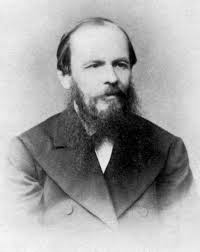
“Love [people] even in [their] sin, for that is the semblance of Divine Love and is the highest love on earth. Love all God’s creation, the whole and every grain of sand in it. Love every leaf, every ray of God’s light. Love the animals, love the plants, love everything. If you love everything, you will perceive the divine mystery in things. Once you have perceived it, you will begin to comprehend it better every day. And you will come at last to love the whole world with an all-embracing love.”
—Fyodor Dostoyevsky, from The Brothers Karamazov
Fr. Richard Rohr, OFM: “Jesus the Prophet”
Posted by Dallas Wolf in Ekklesia and church, New Nuggets, Theology on October 15, 2025
In a homily Father Richard Rohr, OFM, describes the tension between priestly and prophetic tasks—both necessary for healthy religion:

There are two great strains of spiritual teachers in Judaism, and I think, if the truth is told, in all religions. There’s the priestly strain that holds the system together by repeating the tradition. The one we’re less familiar with is the prophetic strain, because that one hasn’t been quite as accepted. Prophets are critical of the very system that the priests maintain.
If we have both, we have a certain kind of wholeness or integrity. If we just have priests, we keep repeating the party line and everything is about loyalty, conformity, and following the rules—and that looks like religion. But if we have the priest and the prophet, we have a system constantly refining itself and correcting itself from within. Those two strains very seldom come together. We see it in Moses, who both gathers Israel, and yet is the most critical of his own people. We see it again in Jesus, who loves his people and his Jewish religion, but is lethally critical of hypocrisy and illusion and deceit (see Matthew 23; Luke 11:37–12:3).
Choctaw elder and Episcopal bishop Steven Charleston considers how Jesus invited others to share in his prophetic vision:
Jesus … saw a vision that became an invitation for people to claim a new identity, to enter into a new sense of community.… Jesus offered the promise of justice, healing, and redemption.… Jesus became the prophetic teacher of a spiritual renewal for the poor and the oppressed…. Jesus was more than just the recipient of a vision or the messenger of a vision. What sets Jesus apart is that he brought the elements of his vision quest together in a way that no one else had ever done….
“This is my body,” he told them. “This is my blood.” For him, the culmination of his vision was not just the messiahship of believing in him as a prophet. Through the Eucharist, Jesus was not just offering people a chance to see his vision, but to become a part of it by becoming a part of him.
Richard honors the role of prophets in religious systems:
The only way evil can succeed is to disguise itself as good. And one of the best disguises for evil is religion. Someone can be racist, be against the poor, hate immigrants, and be totally concerned about making money and being a materialist but still go to church each Sunday and be “justified” in the eyes of religion.
Those are the things that prophets point out, so prophets aren’t nearly as popular as priests. Priests keep repeating the party line, but prophets do both: they put together the best of the conservative with the best of the liberal, to use contemporary language. They honor the tradition, and they also say what’s phony about the tradition. That’s what fully spiritually mature people can do.
Richard Rohr’s Daily Meditation – Monday, October 13, 2025
Codex Sinaiticus
Posted by Dallas Wolf in Ancient Christian Manuscripts, First Thoughts, Patristic Pearls, Theology on September 16, 2025
One of the four Great Uncials. The great uncial codices or four great uncials are the only remaining parchment uncial codices that contain (or originally contained) the entire text of the Bible (Old and New Testament) in Greek. They are the Codex Vaticanus in the Vatican Library, the Codex Sinaiticus and the Codex Alexandrinus in the British Library, and the Codex Ephraemi Rescriptus in the Bibliothèque Nationale de France in Paris. Uncial is a broad rounded majuscule script (written entirely in capital letters without regular gaps between words) commonly used from the 4th to 8th centuries AD by Latin and Greek scribes.

Let the same mind be in you that was in Christ Jesus, who, though he was in the form of God, did not regard equality with God as something to be exploited, but emptied himself, taking the form of a slave, being born in human likeness. And being found in human form, he humbled himself and became obedient to the point of death— even death on a cross. Therefore God also highly exalted him and gave him the name that is above every name, so that at the name of Jesus every knee should bend, in heaven and on earth and under the earth, and every tongue should confess that Jesus Christ is Lord, to the glory of God the Father. Philippians 2:5-11 (NRSV)
Codex Sinaiticus ca. AD 350
British Library, London
Codex Vaticanus
Posted by Dallas Wolf in Ancient Christian Manuscripts, First Thoughts, Patristic Pearls, Theology on September 16, 2025
One of the four Great Uncials. The great uncial codices or four great uncials are the only remaining uncial parchment codices that contain (or originally contained) the entire text of the Bible (Old and New Testament) in Greek. They are the Codex Vaticanus in the Vatican Library, the Codex Sinaiticus and the Codex Alexandrinus in the British Library, and the Codex Ephraemi Rescriptus in the Bibliothèque Nationale de France in Paris. Uncial is a broad rounded majuscule script (written entirely in capital letters without regular gaps between words) commonly used from the 4th to 8th centuries AD by Latin and Greek scribes.

According to John
In the beginning was the Word, and the Word was with God, and the Word was God. The same was in the beginning with God. All things were made by him; and without him was not any thing made that was made. In him was life; and the life was the light of men.And the light shineth in darkness; and the darkness comprehended it not. There was a man sent from God, whose name was John. The same came for a witness, to bear witness of the Light, that all men through him might believe. He was not that Light, but was sent to bear witness of that Light. That was the true Light, which lighteth every man that cometh into the world. He was in the world, and the world was made by him, and the world knew him not. He came unto his own, and his own received him not. But as many as received him, to them gave he power to become the sons of God, even to them that believe on his name: which were born, not of blood, nor of the will of the flesh, nor of the will of man, but of God. And the Word was made flesh, and dwelt among us, (and we beheld his glory, the glory as of the only begotten of the Father,) full of grace and truth. John 1:1-14 (KJV)
Codex Vaticanus ca. AD 350
Vatican Library, the Vatican
𝔓⁴⁶ – The Earliest Existing Manuscript of Paul’s Letters
Posted by Dallas Wolf in Ancient Christian Manuscripts, First Thoughts, Patristic Pearls, Theology on September 16, 2025
Known as Beatty Papyrus 46, designated by the siglum 𝔓⁴⁶, is an early uncial Greek New Testament codex written on papyrus. P 46 is dated to around AD 175–225. It contains portions of most of the Pauline epistles, including Romans (last eight chapters), Hebrews, 1&2 Corinthians, Ephesians, Galatians, Philippians, Colossians, and 1 Thessalonians.
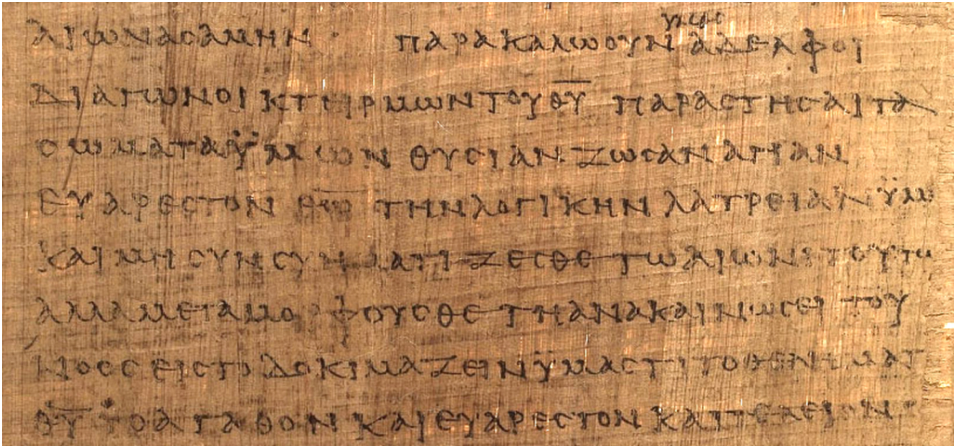
I appeal to you therefore, brothers, by the mercies of God, to present your bodies as a living sacrifice, holy and acceptable to God, which is your spiritual worship. Do not be conformed to this world, but be transformed by the renewal of your mind, that by testing you may discern what is the will of God, what is good and acceptable and perfect. Romans 12:1-2 (ESV)
Beatty Papyrus P46 ca. AD 200
University of Michigan, Ann Arbor
St. Gregory Of Nyssa: “Daily” Bread in the Lord’s Prayer? Not so fast!
Posted by Dallas Wolf in First Thoughts, Patristic Pearls, The Cappadocians, Theology on September 12, 2025
In the Lord’s Prayer, the petition for our “daily bread” is normally understood to signify all of our bodily needs and whatever we require to sustain our lives in this world. The Greek Patristic Fathers knew that the koine Greek word translated as “daily” is a unique term “ἐπιούσιον” (epiousion), which is only used in the New Testament Lord’s Prayer. This indicates that the word had special significance, as there were any number of other common Greek words to express the idea of “daily”. Epiousion literally means “needful”, “essential”, “super-substantial”, or “super-essential”. Understood in that sense, it takes on the more spiritual meaning of the nourishment of our souls by the Word of God, Jesus Christ who is the “Bread of Life;” the “Bread of God which has come down from heaven and given life to the world” (Jn 6.33–36); the bread which “a man may eat of it and not die,” but “live forever” (Jn 6.50–51). Thus the prayer for “daily bread” becomes the petition for daily spiritual nourishment through abiding communion with Christ so that one might live perpetually with God.
Origen of Alexandria and Gregory of Nyssa are two examples of early (3rd and 4th century) Church Fathers who contributed significantly to the understanding of the unique word epiousion; both interpreting it as referring to the spiritual sustenance provided by God, emphasizing the need for divine support in daily life.
With that introduction, here is what St. Gregory of Nyssa (335 – 395) had to say about it:
From: Ancient Christian Writers, No.18. Edited by Johannes Quasten and Joseph C. Plumpe. St. Gregory of Nyssa, The Lord’s Prayer – The Beatitudes, Trans. and annotated by Hilda C. Graef, 1954 Newman Press. Pp. 68-70
Excerpt from:
SERMON 4 Thy Will be done, on earth as it is in Heaven. Give us this day our daily [ἐπιούσιον (epiousion)] bread.
Full of meaning is also the addition of this day [σήμερον (sémeron)], when He says: Give us this day our daily [ἐπιούσιον (epiousion)] bread. These words contain yet another teaching. For you should learn through what you say that the human life is but the life of a day. Only the present each one of us can call his own; the hope of the future is uncertain, for we know not what the day to come may bring forth. Why then do we make ourselves miserable worrying about the future? He says, Sufficient for the day is the evil thereof, evil here meaning the enduring of evil. Why are we disturbed about the morrow? By the very fact that He gives you the commandment for today, He forbids you to be solicitous for the morrow. He says to you as it were: He who gives you the day will give you also the things necessary for the day. Who causes the sun to rise? Who makes the darkness of the night disappear? Who shows you the rays of light? Who revolves the sky so that the source of light is above the earth? Does He who gives you so great things need your help to supply for the needs of your flesh? Do animals take care for their livelihood? Do ravens have tilled land or eagles barns? Is not the one means of providing a livelihood for all the Will of God, by which all things are governed? Therefore even an ox or an ass, or any other animal is taught its way of life by instinct, and it manages the present well but does not concern itself in the least with what comes afterwards. And should we need special advisers in order to understand that the life of the flesh is perishable and transitory? Are we not taught by the misfortunes of others, not chastened by those of our own life?
What profits this rich man his wealth? Like a fool he chases vain hopes, pulling down, building up, hoarding and dissipating, shutting up long periods of years as it were in barns, without letting them bear fruit. Will not one night prove false all these imagined hopes, like some vain dream about a nonentity? The life of the body belongs only to the present, but that which lies beyond us and is apprehended by hope belongs to the soul. Yet men in their folly are quite wrong about the use of either; they would extend their physical lives by hope, and draw the life of the soul towards enjoyment of the present. Therefore the soul is occupied by the world of sense and necessarily estranged from the subsisting reality of hope. What hope it has leans upon unstable things over which it has no control or authority.
Let us therefore learn from the counsel under consideration what one must ask for today, and what for later. Bread is for our use today; the Kingdom belongs to the beatitude for which we hope. By bread He means all our bodily requirements. If we ask for this, the man who prays will clearly understand that he is occupied with something transitory; but if we ask for something of the good things of the soul it will be clear that the petition concerns the everlasting realities, for which He commands us to be most concerned in our prayers. Thus the first necessity is put in its right place by the greater one. Seek ye, He says, the kingdom and justice, and all these things shall be added unto you; in Christ Jesus Our Lord, to whom be glory and power for ever and ever. Amen.
Original Greek words used by Nyssen are in brackets []. From: Gregorii Nysseni, De Oratione Dominica, De Beatitudinibus, Edidit Johannes F. Callahan, 1992 E.J. Brill. P. 56
When Glory Explodes the Forms: Doxology, Faith, and the Exorcism of Epistemology
Posted by Dallas Wolf in First Thoughts, New Nuggets, Theology on July 14, 2025
 From Fr Aidan Kimel’s Eclectic Orthodoxy on 14 July 2025 From Fr Aidan Kimel’s Eclectic Orthodoxy on 14 July 2025  by John Stamps* Δόξα Πατρὶ καὶ Υἱῷ καὶ Ἁγίῳ Πνεύματι . . . I was paying attention in church last Sunday—really, I was. But when Fr. Nebojša intoned: “Glory to the Father and to the Son and to the Holy Spirit, both now and always and unto the ages of ages,” a strange Platonic thought hijacked my brain. Socrates wouldn’t understand a word of this. For him, doxa meant “opinion.” The Father has an opinion? The Son too? And the Holy Spirit? Three divine “opinions”? Socrates would be horrified. In Book VI of The Republic, he blurts out: “Have you not observed that opinions (doxai) divorced from knowledge (episteme) are ugly things? The best of them are blind.” (506c) Already, he’d be reaching for the hemlock. But it gets worse. At St. Nicholas Greek Orthodox Church, when we recite the Nicene Creed—first in Greek, then in English—we fervently confess: Πιστεύω εἰς ἕνα Θεὸν Πατέρα παντοκράτορα . . . “I believe in one God, the Father Almighty.” Or, more provocatively—and more Christianly—“I put my trust in one God, the Father Almighty.” Once again, Socrates would be scandalized. Pistis? Mere belief? Conviction at best? And you’re going to stake that on ultimate reality? Pistis may rise above illusion (eikasia), but it’s still fog—not the clear light of truth. Surely the divine deserves better. Surely epistēmē—solid, demonstrable knowledge—is the true coin of the metaphysical realm. To entrust pistis with the highest things would be like trying to buy eternity with Monopoly money. For Plato, pistis belongs low on the Divided Line—just above eikasia (imagination and shadows), and well below epistēmē. It’s trust in what we can see and touch, but without glimpsing the hidden reality behind it—the invisible Forms that give things their true meaning. Pistis is for the unphilosophical. The half-blind. The cave-dwellers huddled in the cave who mistake sensible things for what is really real. But Christian theology flips the entire Platonic ladder upside down. From Doxa to Glory For Socrates, doxa means “opinion”—an unreliable, subjective mental state. But in Christian liturgy, doxa is glory: not mental conjecture but the radiant, overwhelming presence of the living God. Doxa is Moses taking off his shoes before the burning bush. Doxa is Moses descending Sinai with a face that glows because he got too close to raw holiness. Doxa is the Word made flesh, full of grace and truth, dwelling among us. Doxa is not conjecture. It’s encounter. Somewhere between the Hebrew Bible and the Septuagint, doxa got an upgrade. And this raises a linguistic and theological mystery: How did the Hebrew word כָּבוֹד (kavod—weight, substance, heaviness, splendor) become doxa (opinion) in Greek? The Septuagint translators had choices. And their choice changed Christian theology forever. From Pistis to Trust In the New Testament, pistis is not an epistemic crutch. It is relational trust, covenant loyalty, and a faithful response to a God who reveals Himself not in abstractions but in history, flesh, and self-giving love. Far from being a lower form of knowledge, pistis becomes the primary way humans recognize and respond to divine glory—a deeper, riskier kind of knowing, grounded in love, testimony, and encounter. For Socrates, by contrast, pistis was barely a step above guesswork—an uncritical belief in the physical world, just above imagination (eikasia) and far below true knowledge (epistēmē). It belonged to the realm of opinion (doxa) and was reserved for the half-blind dwellers in the cave. But in the New Testament, pistis becomes something far more daring. It echoes the Hebrew word emunah (אֱמוּנָה): steadfast trust, covenant faithfulness, unwavering reliability. Christian faith isn’t vague optimism. It’s not mere intellectual assent or rearranging our mental furniture. Pistis is not a foggy feeling or private conviction. It is existential trust. It is covenantal loyalty. It is Semper Fi!— our fidelity to the God who speaks, acts, and keeps His promises and our willingness to stake everything on His trustworthiness. Faith is stepping out onto the water like Peter because Jesus said, “Come.” Faith is betting everything on the God who delivered Israel from Pharaoh’s tyranny and raised Jesus from the dead. Or, as Robert Jenson once put it: “God is whoever raised Jesus from the dead, having before raised Israel from Egypt.” This is how Christians reliably identify and name God: by His acts of faithfulness. And pistis is our answering act of trust and faithfulness in return. From Eikasia to Icon Images are tricky. Plato had his reasons to be suspicious. He especially distrusted imitative images—whether in poetry, painting, or shadowplay—because they were seductive lies, copies of copies, that lured the soul away from truth and down into the flickering cave of illusion. Teenagers glued to their 300-DPI iPhone screens aren’t so different from the cave-dwellers in The Republic, staring at shadows on the wall, mistaking illusion for reality. That’s why Plato wanted the image-makers banished from the ideal city. For him, images were not innocent—they were propaganda, simulacra, distortions. In his metaphysics, images were the lowest of the low. But Christian theology tells a different story. Scripture gives us strong reasons to trust—not all images, but certain ones—as truth-bearing windows into reality. First, just look at yourself in the mirror—warts and all. You are the imago Dei. Look at your spouse, your children, your friends. Knock on your neighbor’s door with cookies or a bottle of wine. Hand $20 to a homeless person. Pray for—and forgive—your bitterest enemy. Why this exercise? Because every one of them is the imago Dei. They are the spitting image of God. This is where Christian theology begins: with the startling claim that human beings are made in the image and likeness of God. We bear the weight of glory. This image (εἰκών) is not falsehood. It is truth-bearing. It carries the imprint of the Creator. The image is not a pale copy—it participates in the reality it reflects. This image is a site where divine glory dwells. Second, when the Word became flesh, God’s image wasn’t entering alien territory. The Incarnation is not some bizarre intrusion into a world God otherwise keeps at arm’s length. It is the culmination of God’s long purpose for creation: that divine glory would dwell bodily within it. The Incarnation is no invasion. The kosmos belongs to the Lord, and the fullness thereof. Third, Jesus of Nazareth is the Image-Bearer par excellence. He looks just like us. That God was one of us is the scandal at the heart of the Christian confession. And yet . . . the One in whom all the fullness of God dwells (Colossians 2:9) looks so much like us that we don’t recognize Him. Familiarity breeds contempt and generates its own kind of blindness. Glory walks right past us wearing dusty sandals. But if we have eyes to behold the mystery, Jesus—crucified, risen, and ascended—is the true Image (εἰκών) of the invisible God (Colossians 1:15). Not a photocopy. Not a metaphor. Not a shadow. He is one of us—bone of our bone, flesh of our flesh. And yet He reveals God to us fully and truly. We Orthodox insist on this incarnational truth: images matter because the Image matters. To celebrate this, we wallpaper our churches with icons—not as decoration, but as theological proclamation. Icons are not aesthetic accessories. They are visual participation in divine reality. Icons reveal. They manifest. They make present. They proclaim what words alone cannot say. Why do we venerate icons? Because images, rightly ordered, are truth-bearing. Because the Image became flesh and dwelt among us. And because, through Christ, we too are being transfigured—from glory to glory—into the image of God. For us, seeing is not believing lies. Seeing is encountering glory. Epistemology Needs an Exorcism My old philosophy professor, Nicholas Wolterstorff, used to warn us: “Ever since Plato, the Western world has been haunted by the lure of certitude.” And he’s right. That ghost still lingers. We need an exorcism. We need to turn epistemology into doxology. Or more precisely: episteme-logos into doxo-logos. Once you’re bewitched by epistemology and the certainty it promises, it’s hard to break the spell. You start—and you end—by measuring all truth, including theological truth, by mental clarity, logical deduction, and timeless abstraction. But Trinitarian doxology and the Nicene Creed don’t just challenge Greek epistemology—they scandalize it. We can’t start with clear and distinct ideas. We must begin with faithful witness. We begin where we actually encounter the glory of God. The Father who speaks. The Son who acts. The Spirit who breathes. Three Persons. One God. Doxology—not detached speculation—is the engine that drives Christian theology. To the Greek philosophical mind—fixated on unchanging forms, impersonal absolutes, and epistemic certainty—this kind of God-talk sounds like theological madness. A God who speaks? Acts? Loves? Suffers? Raises the dead? So yes—we fumble and stumble for the right words. Apophatic theology rightly reminds us that God always exceeds our categories and language. But that doesn’t mean we stay silent. Christian speech begins in worship—yes, in doxology—and in the risky act of saying something true about the God who cannot be contained. Let the Platonists chase certainty . . . we behold glory. For the life of me, I still don’t fully understand how kavod—a word of weight and substance—became doxa, a word that once meant “opinion.” But the Septuagint translators had choices. And their choice opened the door for Christian theology to do something the ancient philosophers never saw coming. Faithful God-talk begins not with control, but with wonder. Not with clarity, but with trust. Not with epistemic mastery, but with doxology. We speak because God has spoken. We bear witness because doxa showed up in history, and refused to stay abstract. We dare to name the Unnameable because the Word became flesh and dwelt among us, full of grace and truth . . . and we beheld His glory. Let the Platonists chase their Forms, the Cartesians polish their clear and distinct ideas, and the positivists flatten everything into data. And yes, let the American Fundamentalists obsess over the inerrancy of the original autographs—those long-lost parchments that somehow guarantee perfect doctrine, if only we squint hard enough. Scripture, for them, isn’t the living voice that calls us into communion, but a cosmic answer key dropped from heaven. The lure of certitude is still a mirage. We will not lose our nerve. We will render doxa to the God who acts— Who speaks, Who raises the dead, Who walks through our kosmos with dusty feet and scandalous grace. . . . καὶ νῦν καὶ ἀεὶ καὶ εἰς τοὺς αἰῶνας τῶν αἰώνων. Ἀμήν.  * * *John Stamps is Senior Technical Writer at Guidewire Software in San Mateo, California. He holds a BA in Greek from Abilene Christian University, an MDiv from Princeton Theological Seminary, and pursued further study in the philosophy of religion at Yale Divinity School—just long enough to accrue debt and existential questions. He attends St. Nicholas Greek Orthodox Church in San Jose, is married to the long-suffering Shelly Houston Stamps, plays mediocre tennis with misplaced confidence, and speaks Spanish that routinely scandalizes native speakers and small children. |
When was the Roman Catholic Pope Declared “Infallible”?
Posted by Dallas Wolf in Ekklesia and church, Theology on May 7, 2025
Papal infallibility was dogmatically defined by the First Vatican Council in 1870. This doctrine states that the Pope is preserved from error when he solemnly defines a doctrine concerning faith or morals.
“Ex cathedra” is a Latin term that means “from the chair.” In the context of the Roman Catholic Church, it refers to the Pope’s authority to make infallible declarations on matters of faith and morals when he speaks in his official capacity as the Bishop of Rome. When the Pope speaks ex cathedra, it is believed that he is guided by the Holy Spirit and is free from error in his teachings.
No such dogma exists in any form in Orthodox Christianity. Clearly a modern Afterthought of the Western Latin Church.
 First Thoughts