Posts Tagged eastern orthodox theology
The Concept of “Person” 2
Posted by Dallas Wolf in Concept of "Person" (series) on July 7, 2014
“… this idea of person comes to us from Christian theology.”
In discussing the concept of “person”, I will refer to the work of the church Fathers, especially the Cappadocian Fathers of the 4th century, through the collective wisdom and insights of four prominent contemporary theologians and mystics: Vladimir Lossky, Christos Yannaras, John Zizioulas, and Hierotheos Vlachos.
The great twentieth-century Orthodox theologian Vladimir Lossky (1903-1958), in his seminal work, The Mystical Theology of the Eastern Church, tells us that, “We commonly use the words ‘persons’ or ‘personal’ to mean individuals, or individual. We are in the habit of thinking of these two terms, person and individual, almost as though they were synonyms. We employ them indifferently to express the same thing. But, in a certain sense, individual and person mean opposite things, the word individual expressing a certain mixture of the person with elements which belong to the common nature, while person, on the other hand, means that which distinguishes it from nature”.
Lossky goes on to explain this distinction between “individual” and “person” in more detail: “The man who is governed by his nature and acts in the strength of his natural qualities, of his ‘character’, is the least personal. He sets himself up as an individual, proprietor of his own nature, which he pits against the natures of others and regards as his ‘me’, thereby confusing person and nature.” This is the condition of fallen man, best described in English as ‘egoism’.
Lossky continues to further contrast “individual” and “person”: “However, the idea of the person implies freedom vis-à-vis the nature. The person is free from nature, is not determined by it. The human hypostasis [person] can only realize itself by renunciation of its own will, of all that governs us, and makes us subject to natural necessity.”
Lossky goes on to tell us that the original idea of the “person” was conceived by, and can only be explained in terms of proper Christian theology: “…the theological notion of hypostasis in the thought of the eastern Fathers means not so much individual as person, in the modern sense of the word. Indeed, our ideas of human personality, of that personal quality which makes every human being unique, to be expressed only in terms of itself: this idea of person comes to us from Christian theology.”
Origen: “For as man consists of body, and soul, and spirit, so in the same way does Scripture”
Posted by Dallas Wolf in Patristic Pearls, Theology on July 6, 2014
Origen of Alexandria, (c. 184 – c. 254) was Head of the famed Catechetical School in Alexandria at age 18 and arguably the most brilliant theologian of the early Christian church. He was probably the most able and successful defender of the faith against the heresy of Gnosticism in the third century. Saint and Church Father without question. In this quote he tells us that Scripture ought to be interpreted at three levels: starting with the lowest level, the body or literal interpretation; followed by the more advanced at the soul level, or moral interpretation; and culminating with the highest level of interpretation, the spiritual, or allegorical interpretation. 1,800 years ago, Origen very clearly articulated what contemporary Christian fundamentalists still haven’t figured out.

Origen of Alexandria (c. 184 – c. 254)
“The individual ought, then to portray the ideas of holy Scripture in a threefold manner upon his own soul; in order that the simple man may be edified by the “flesh”, as it were, of the Scripture, for so we name the obvious sense; while he who has ascended a certain way (may be edified) by the “soul”, as it were. The perfect man, again… (may receive edification) from the “spiritual” law, which has a shadow of good things to come. For as man consists of body, and soul, and spirit, so in the same way does Scripture, which has been arranged to be given by God for the salvation of men.” ~ Peri Archon; First Principles, Book IV, Chapter 1
Concept of “Person” 3
Posted by Dallas Wolf in Concept of "Person" (series) on July 6, 2014
“To help explain the difference between “individual” and “person”, the model of the Holy Trinity is useful…”
To help explain the difference between “individual” and “person”, the model of the Holy Trinity is useful because it establishes a truth beyond the regular meaning of secular philosophical concepts. Two of the key terms in trinitarian theology are ousia and hypostasis; essence (nature) and subsistence (person). Just to confuse things, even in Greek, these two terms can be used as synonyms.
In terms of trinitarian doctrine, Vladimir Lossky explains to us in his book, In the Image and Likeness of God, that “… according to the doctrine of the Fathers, there is between ousia and hypostasis the same difference as between the common and the particular…”. Lossky continues his line of thinking with a complex thought, “The hypostasis is the same as ousia; it receives all the same attributes – or all the negations – which can be formulated on the subject of “superessence”; but it nonetheless remains irreducible to the ousia.”
Lossky tells us that the church Fathers of the fourth century worked diligently to develop and articulate a complete theology of the Holy Trinity. This was especially true of three men who became known as the Cappadocian Fathers (St. Basil the Great, St. Gregory of Nazianzus, and St. Gregory of Nyssa). They struggled mightily to articulate and differentiate between theological terms like hypostasis and ousia: “It was a great terminological discovery to introduce a distinction between the two synonyms, in order to express the irreducibility of the hypostasis to the ousia and of the person to the essence, without, however, opposing them as two different realities. This will enable St. Gregory of Nazianzus to say, ‘The Son is not the Father, because there is only one Father, but He is what the Father is; the Holy Spirit, although He proceeds from God, is not the Son, because there is only one Only Begotten Son, but He is what the Son is’ (Or. 31, 9)”
Meyendorff: “The fact that the Logos assumed human nature as such implied the universal validity of redemption…”
Posted by Dallas Wolf in New Nuggets, Universal Restoration (Apokatastasis) on July 5, 2014
Fr. John Meyendorff (1926 – 1992) – was a leading theologian of the Orthodox Church as well as a writer and teacher. He was a great student of 14th century Saint, Gregory Palamas. Meyendorff served as the Dean of St. Vladimir’s Orthodox Theological Seminary in New York until 1992. Here, Meyendorff explains that the Orthodox church does not reject the idea of universal salvation, or apokatastasis, because it conflicts with the notion of eternal damnation, but “because it presupposes an ultimate limitation of human freedom”.

Fr. John Meyendorff (1926-1992)
“The fact that the Logos assumed human nature as such implied the universal validity of redemption, but not the ‘apokatastasis’, or universal salvation, a doctrine which in 553 was formally condemned as Origenistic. Freedom must remain an inalienable element of every man, and no one is to be forced into the Kingdom of God against his own free choice; the ‘apokatastasis’ had to be rejected precisely because it presupposes an ultimate limitation of human freedom – the freedom to remain outside of God.” ~ Byzantine Theology, 163
Concept of “Person” 4
Posted by Dallas Wolf in Concept of "Person" (series) on July 5, 2014
“…’person’ signifies the irreducibility of man to his nature…”
While Lossky warns us that we cannot make a complete and direct analogy between “hypostasis” or “person” as it applies to the Holy Trinity to the idea of “person” in humankind, some useful conclusions can be drawn. He tells us that, “Under these conditions, it will be impossible for us to form a concept of the human person, and we will have to content ourselves with saying: “person” signifies the irreducibility of man to his nature— “irreducibility” and not “something irreducible” or “something which makes man irreducible to his nature” precisely because it cannot be a question here of “something” distinct from “another nature” but of someone who is distinct from his own nature, of someone who goes beyond his nature while still containing it, who makes it exist as human nature by this overstepping and yet does not exist in himself beyond the nature which he “enhypostasizes” and which he constantly exceeds.”
O.K., so Vladimir Lossky can be a little deep and dense at times. Let’s get some help from some other very gifted contemporary theologians who can help explain and round out the concept of the “person” for us.
We’ll start with contemporary Orthodox theologian Christos Yannaras (1935 – ) to further explain and expand on Lossky’s thinking:
“In everyday speech, we tend to distort the meaning of the word ‘person’. What we call ‘person’ or ‘personal’ designates rather more the individual. We have grown accustomed to regarding the terms “person” and “individual” as virtually synonymous, and we use the two indifferently to express the same thing. From one point of view, however, ‘person’ and ‘individual’ are opposite in meaning (see V. Lossky, The Mystical Theology of the Eastern Church (London, 1957), p. 121f.) The individual is the denial or neglect of the distinctiveness of the person, the attempt to define human existence using the objective properties of man’s common nature, and quantitative comparisons and analogies.”
Isaac of Nineveh: God’s Justice is not Rome’s Imperial ‘Iustitia’
Posted by Dallas Wolf in Monasticism, Patristic Pearls, Theology on July 4, 2014
Isaac of Nineveh – 7th century ascetic and mystic, born in modern-day Qatar, was made Bishop of Nineveh between 660-680. Here Isaac easily debunks the Western Latin notion that God’s righteousness, or “dikaiosyne theou“, is the same as secular Imperial Roman Justice, or “Iustitia“.

“How can you call God just when you read the parable of the laborers in the vineyard and their wages? ‘Friend, I am doing you no wrong… I choose to give to this last as I give to you… do you begrudge my generosity?’ Likewise how can you call God just when you read the parable of the prodigal son who squanders his father’s wealth in riotous living, and the moment he displays some nostalgia his father runs to him, throws his arms around his neck and gives him complete power over all his riches? It is not someone else who has told us this about God, so that we might have doubts. It is his own Son himself. He bore this witness to God. Where is God’s justice? Here, in the fact that we were sinners and Christ died for us…” ~ Ascetic Treatises, 60
Concept of “Person” 5
Posted by Dallas Wolf in Concept of "Person" (series) on July 4, 2014
“The demand of the person for “absolute freedom” involves a ‘new birth’, a birth ‘from on high’, a baptism.”
So, Yannaras adds to our concept of “person” the necessity of “personal immediacy” and “direct personal relationship”. At the zenith of this immediacy and relationship, of course, is love.
In his book, “Being as Communion”, Studies in Personhood and the Church”, Orthodox theologian Metropolitan John ( Zizioulas) of Pergamon (1931- ), maintains that the theology of the person would not have been possible without the mystery of the Church. Zizioulas maintains that humanity, being made in the image of God, has an inherent God-given drive for “absolute freedom”. However, existing as an “absolute freedom”, completely free and independent of its nature, is humanly impossible. He tells us that, “the being of each human person is given to him; consequently, the human person is not able to free himself absolutely from his “nature” or from his “substance”, from what biological laws dictate to him, without bringing about his annihilation.” To Zizioulas, deification and union with God involves escaping this “given” and sharing in the “absolute freedom” of divine existence; not after death, but beginning in this life.
Zizioulas tells us that escaping our “given” being, or nature, can only be accomplished through a “new birth”: “The demand of the person for “absolute freedom” involves a ‘new birth’, a birth ‘from on high’, a baptism. And it is precisely the ecclesial being which ‘hypostasizes’ the person according to God’s way of being. That is what makes the Church an image of the Triune God.” God’s way of being, Zizioulas notes, includes that “absolute freedom” which humans seek, and the Christian shares in this way of being even during his/her earthly pilgrimage.
This is the way in which a concrete, free “person” can emerge. Our “person” can emerge due to the fact that Christ deified our human nature through his incarnation. His perfect human nature deified humankind’s fallen nature.
Maximus: “The scriptural Word knows of two kinds of knowledge of divine things.”
Posted by Dallas Wolf in Hesychasm - Jesus Prayer, Patristic Pearls, Theology on July 3, 2014
Maximus the Confessor (c. 580 – 662) was a 7th century Christian monk, theologian, and scholar who many contemporary scholars consider to be the greatest theologian of the Patristic era. Two of his most famous works are “Ambigua” – An exploration of difficult passages in the work of Pseudo-Dionysius and Gregory of Nazianzus, focusing on Christological issues, and “Questions to Thalassius” or “Ad Thalassium” – a lengthy exposition on various Scriptural texts. This quote is from the latter work. It affirms the primacy of experience in an authentic spiritual life.
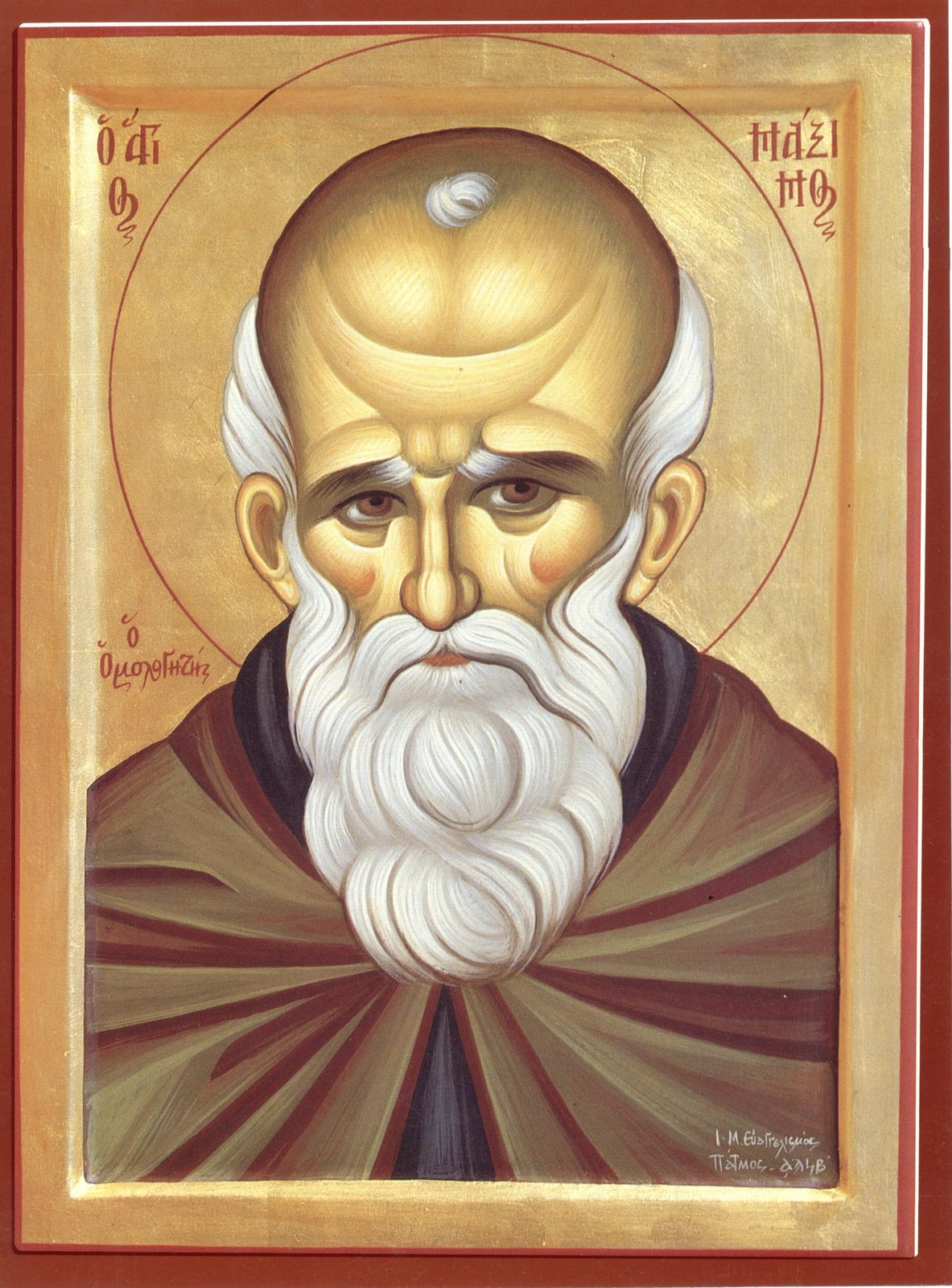
Maximus the Confessor (c. 580 – 662)
“The scriptural Word knows of two kinds of knowledge of divine things. On the one hand, there is relative knowledge, rooted only in reason and ideas, and lacking in the kind of experiential perception of what one knows through active engagement; such relative knowledge is what we use to order our affairs in our present life. On the other hand, there is that truly authentic knowledge, gained only by actual experience, apart from reason and ideas, which provides a total perception of the known object through a participation by grace. By this latter knowledge, we attain, in the future state, the supernatural deification that remains unceasingly in effect.” ~ Ad Thalassium 60
Concept of “Person” 6
Posted by Dallas Wolf in Concept of "Person" (series) on July 3, 2014
“…because humanity is created in the image of God with the drive for “absolute freedom”, it ‘is able to carry with [it] the whole of creation to its transcendence’.”
The Incarnation of the Logos, the Son, the Christ, created the possibility for humankind to attain by adoption, what Christ is by nature. Zizioulas tells us:
“Thanks to Christ man can henceforth “subsist”, can affirm his existence as personal not on the basis of immutable laws of his nature, but on the basis of a relationship with God which is identified with what Christ in freedom and love possesses as Son of God with the Father. This adoption of man by God, the identification of his hypostasis with the hypostasis of the Son of God, is the essence of baptism.”
“The ecclesial hypostasis exists historically in this manner as a confirmation of man’s capacity not to be reduced to his tendency to become a bearer of individuality, separation and death. The ecclesial hypostasis is the faith of man in his capacity to become a person and his hope that he will indeed become an authentic person. In other words it is faith and hope in the immortality of man as a person.”
Zizioulas concludes his thoughts on the concept of “person” with the vision of humanity in communion and in an intimate love relationship with humankind, all creation, and with God:
“It becomes a movement of free love with a universal character, that is, a love which, while it can concentrate on one person as the expression of the whole of nature, sees in this person the hypostasis through which all men and all things are loved and in relation to which they are hypostasized. The body for its part as the hypostatic expression of the human person, is liberated from individualism and egocentricity and becomes a supreme expression of community – the Body of Christ, the body of the Church, the body of the eucharist.”
Zizioulas tells us that the concept of person, “implies the ‘openness of being,’ and even more than that, the ek-stasis of being, i.e., a movement toward communion which leads to transcendence of the boundaries of the ‘self’ and thus to freedom.” Moreover, because humanity is created in the image of God with the drive for “absolute freedom”, it “is able to carry with [it] the whole of creation to its transcendence.”
This is some pretty awesome spiritual thinking and imagery, isn’t it?
Zizioulas: “a person cannot be imagined in himself but only within his relationships.”
Posted by Dallas Wolf in New Nuggets on July 3, 2014
Metropolitan John (Zizioulas) of Pergamon (1931- ). He is the Chairman of the Academy of Athens. He has degrees from the University of Thessaloniki, studied at Harvard Divinity School, and received his PhD from the University of Athens. He has taught at the Universities of Athens, Edinburgh, Glasgow, and King’s College in London.
Met. John (Zizioulas)
“The significance of the person rests in the fact that he represents two things simultaneously which are at first sight in contradiction: particularity and communion. Being a person is fundamentally different from being an individual or a “personality,” for a person cannot be imagined in himself but only within his relationships.” ~ Being as Communion
 First Thoughts