Posts Tagged eastern orthodox theology
Archimandrite George: “… a mystical union of God and man in the Holy Spirit”
Posted by Dallas Wolf in Hesychasm - Jesus Prayer, New Nuggets, Theology on August 22, 2015

“A Christian is not a Christian simply because he is able to talk about God. He is a Christian because he is able to have experience of God. And just as, when you really love someone and converse with him, you feel his presence, and you enjoy his presence, so it happens in man’s communion with God: there exists not a simply external relationship, but a mystical union of God and man in the Holy Spirit.” ~ Archimandrite George (Kapsanis), Abbott of the Holy Monastery of St. Gregorios on Mount Athos
Hierotheos: Orthodox Psychotherapy
Posted by Dallas Wolf in New Nuggets, Theology on August 21, 2015
Metropolitan Hierotheos (Vlachos) – (1945- ) is a Greek Orthodox metropolitan and theologian. He graduated from the Theological School of the University of Thessaloniki and is one of the finest Patristic scholars living.

“The term “Orthodox Psychotherapy” does not refer to specific cases of people suffering from psychological problems of neurosis. Rather it refers to all people. According to Orthodox Tradition, after Adam’s fall man became ill; his “nous” was darkened and lost communion with God. Death entered into the person’s being and caused many anthropological, social, even ecological problems. In the tragedy of his fall man maintained the image of God within him but lost completely the likeness of Him, since his communion with God was disrupted. However the incarnation of Christ and the work of the Church aim at enabling the person to attain to the likeness of God, that is to reestablish communion with God. This passage way from a fallen state to divinization is called the healing of the person, because it is connected with his return from a state of being contrary to nature, to that of a state according to nature and above nature. By adhering to Orthodox therapeutic treatment as conceived by the Holy Fathers of the Church man can cope successfully with the thoughts (logismoi) and thus solve his problems completely and comprehensively.” ~ Met. Hierotheos Vlachos, from “Orthodox Psychotherapy – The Science of the Fathers”
C.S. Lewis: “Love is not affectionate feeling”
Posted by Dallas Wolf in New Nuggets on August 6, 2015


“Love is not affectionate feeling, but a steady wish for the loved person’s ultimate good as far as it can be obtained.”
– C.S. Lewis
D.B. Hart: “For my money, if Origen was not a saint and church father, then no one has any claim to those titles.”
Posted by Dallas Wolf in Ekklesia and church, New Nuggets on May 13, 2015
David Bentley Hart (born 1965) an Eastern Orthodox scholar of religion, is a philosopher, writer, and cultural commentator. His books include The Experience of God: Being, Consciousness, Bliss and That All Shall Be Saved: Heaven, Hell, Universal Salvation, and The New Testament – A Translation. He lives in South Bend, IN.

“East or West, all Christians are burdened with the absurdities of Christian imperial history. But any conception of orthodoxy that obliges one to grant the title of “saint” to a murderous thug like Justinian while denying it to a man as holy as Origen is obviously—indeed ludicrously—self-refuting. And one does not defend tradition well by making it appear not only atrociously unjust, but utterly ridiculous.”
D.B. Hart, from Saint Origen, First Things, October 2015.
“For my money, if Origen was not a saint and church father, then no one has any claim to those titles. And the contrary claims made by a brutish imbecile Emperor are of no consequence.”
D.B. Hart, from Eclectic Orthodoxy blog post, 11 May 2015.
D.B. Hart: “Wisdom is the recovery of innocence at the far end of experience”
Posted by Dallas Wolf in New Nuggets on May 13, 2015
David Bentley Hart (1965- ), is a contemporary American Eastern Othodox theologian and philosopher.
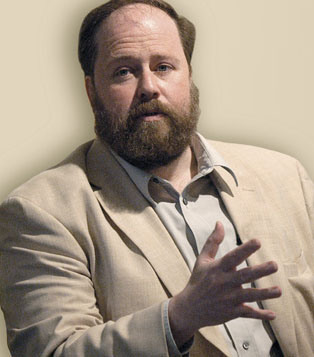 “I start from the conviction that many of the most important things we know are things we know before we can speak them; indeed, we know them—though with very little in the way of concepts to make them intelligible to us—even as children, and see them with the greatest immediacy when we look at them with the eyes of innocence. But, as they are hard to say, and as they are often so immediate to us that we cannot stand back from them objectively, we tend to put them out of mind as we grow older, and make ourselves oblivious to them, and try to silence the voice of knowledge that speaks within our own experiences of the world. Wisdom is the recovery of innocence at the far end of experience; it is the ability to translate some of that vision into words, however inadequate. There is a point, that is to say, where reason and revelation are one and the same.” ~ David Bentley Hart. from “The Experience of God”.
“There is an end to the deadly tedium of the impersonal”
Posted by Dallas Wolf in New Nuggets on March 22, 2015

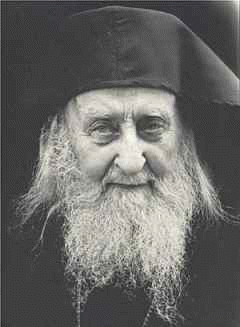 I AM THAT I AM. Yes, indeed, it is He Who is Being. He alone truly lives. Everything summoned from the abyss of non-being exists solely by His will. My individual life, down to the smallest detail, comes uniquely from Him. He fills the soul, binding her ever more intimately to Himself. Conscious contact with Him stamps a man for ever. Such a man will not now depart from the God of love Whom he has come to know. His mind is reborn. Hitherto he was inclined to see everywhere determined natural processes; now he begins to apprehend all things in the light of Person. Knowledge of the Personal God bears an intrinsically personal character. Like recognizes like. There is an end to the deadly tedium of the impersonal. The earth, the whole universe, proclaims Him: “heaven and earth praise him, the sea, and everything that moveth therein” (Ps. 69.34)…
View original post 32 more words
St. Gregory of Nyssa: Moses and “Luminous Darkness”… “seeing that consists in not seeing”.
Posted by Dallas Wolf in Hesychasm - Jesus Prayer, Monasticism, Patristic Pearls, Theology on March 15, 2015
St. Gregory of Nyssa (c. 335 – c. 395), is one of the three Great Cappadocian Fathers along with his older brother, St. Basil the Great, and friend, St. Gregory of Nazianzus. I especially love Gregory Nyssen for his deep spirituality and mysticism. He was a highly original and sophisticated thinker who remains controversial among both liberal and conservative theologians to this day. In his treatise The Life of Moses, St. Gregory tells us that a person’s encounter of the mystery of God corresponds to the three theophanies of Moses, involving successive entry into light, cloud, and darkness.
According to St. Gregory Nyssen, the first stage in our quest to encounter God is Moses’ vision of God as the light of the burning bush; illuminating the darkness of our sin and ignorance. The second stage involves a journey from light into partial darkness where Moses encounters God as the ‘cloud’; the intermingling of light and darkness, revealing the distance between the Creator and the created realm. The third and final stage entails Moses entering the darkness of Sinai where God is; and our realization upon encountering and even being united with God that He is utterly incomprehensible in his essence.
In this treatment, I think, St. Gregory of Nyssa clearly identifies both cataphatic and apophatic theology, bridges the two and holds the tension between them, drawing the best from both.

“What does it mean that Moses entered the darkness and then saw God in it? What is now recounted seems somehow to be contradictory to the first theophany, for then the divine was beheld in light but now He is seen in darkness. Let us not think that this is at variance with the sequence of things we have contemplated spiritually. Scripture teaches by this that religious knowledge comes at first to those who receive it as light. Therefore what is perceived to be contrary to religion is darkness; an escape from darkness comes about when one participates in the light. But as the mind progresses and, through an ever greater and more perfect diligence, comes to apprehend reality, as it approaches more nearly to contemplation, it sees more clearly that God cannot be contemplated. For leaving behind everything that is observed, not only what sense comprehends but also what the intelligence thinks it sees, it keeps on penetrating deeper until by the intelligence’s yearning for understanding it gains access to the invisible and the incomprehensible and there it sees God. This is the true knowledge of what is sought; this is the seeing that consists in not seeing, because that which is sought transcends all knowledge, being separated on all sides by incomprehensibility as by a kind of darkness. Therefore, John the sublime who penetrated into the luminous darkness [λαµπρός γνόφος – lamprós gnóphos], says “no one has ever seen God,” thus asserting that knowledge of the divine essence is unattainable not only by humans but also by every intelligent creature. When, therefore, Moses grew in knowledge, he declared that he had seen God in the darkness, that is, that he had then come to know that what is divine is beyond all knowledge and comprehension, for the text says,’Moses approached the dark cloud where God was‘.”
~ from: The Life of Moses
John of Kronstadt: ” the deceptive sweetness of sin separates us from the truly sweet life”
Posted by Dallas Wolf in New Nuggets on March 8, 2015
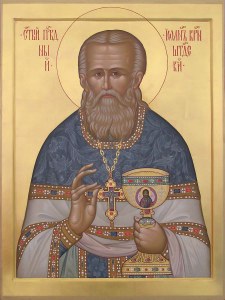
“All our attention must be centered on the parable of the Prodigal Son. We all see ourselves in it as in a mirror. In a few words the Lord, the knower of hearts, has shown in the person of one man how the deceptive sweetness of sin separates us from the truly sweet life according to God. He knows how the burden of sin on the soul and body, experienced by us, impels us by the action of divine grace to return, and how it actually does turn many again to God, to a virtuous life.”
– St. John of Kronstadt
Maximos the Confessor: “How is unceasing prayer possible?”
Posted by Dallas Wolf in Hesychasm - Jesus Prayer, Patristic Pearls, Theology on February 28, 2015
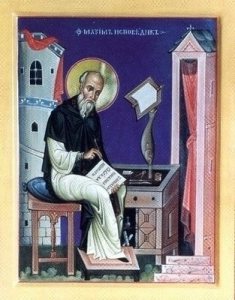
“How is unceasing prayer possible? When we are singing the Psalms, when we are reading the Scriptures, when we are serving our neighbor, even then it is easy enough for the mind to wander off after irrelevant thoughts and images.
Yet the Scriptures do not require impossibilities. St. Paul himself sang the Psalms, read the Scriptures, offered his own apostolic service, and nonetheless prayed uninterruptedly.
Unceasing prayer means to have the mind always turned to God with great love, holding alive our hope in Him, having confidence in Him whatever we are doing and whatever happens to us.
That is the attitude that the Apostle had when he wrote: ‘Who shall separate us from the love of Christ?”…
Thanks to this attitude of mind, Paul prayed without ceasing. In all that he did and in all that happened to him, he kept alive his hope in God.”
– St. Maximos…
View original post 5 more words
Stăniloae: “The latter [apophatic knowledge] is superior to the former [cataphatic knowledge] because it completes it.”
Posted by Dallas Wolf in Hesychasm - Jesus Prayer, New Nuggets, Theology on December 7, 2014
Dumitru Stăniloae (1903 – 1993) was an Orthodox priest and renowned as an Orthodox theologian, academic, and professor. In addition to commentary on the works of the Church Fathers Maximus the Confessor, Gregory Palamas, and Athanasias, his 1978 masterpiece “The Dogmatic Orthodox Theology” established him as one of the foremost Christian theologians of the later half of the twentieth century.
 “According to patristic tradition, there is a rational or cataphatic knowledge of God, and an apophatic or ineffable knowledge. The latter is superior to the former because it completes it. God is not known in his essence, however, through either of these. We know God through cataphatic knowledge only as creating and sustaining cause of the world, while through apophatic knowledge we gain a kind of direct experience of his mystical presence which surpasses the simple knowledge of him as cause who is invested with certain attributes similar to those of the world. This latter knowledge is termed apophatic because the mystical presence of God experienced through it transcends the possibility of being defined in words. This knowledge is more adequate to God than is cataphatic knowledge.” Dogmatic Orthodox Theology, I-95
 First Thoughts