Posts Tagged eastern orthodox tradition
Saint Maximus the Confessor: “Flee from self-love”, philautía (φιλαυτία)
Posted by Dallas Wolf in Hesychasm - Jesus Prayer, Patristic Pearls on November 28, 2014

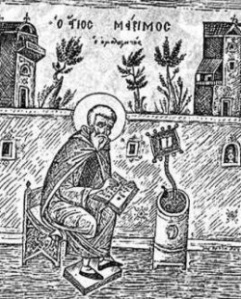
“Flee from self-love, the mother of malice, which is an irrational love for the body. For from it are born the three chief sinful passions: gluttony, avarice, and vainglory, which take their causes from bodily needs, and from them all the tribe of the passions is born. This why we must always oppose self-love and fight against it. Whoever rejects self-love will easily conquer all the other passions with the help of God: anger, despondency, rancor, and the others. But whoever is retained by self-love will even unwillingly be conquered by the above-named passions.”
– Saint Maximus the Confessor
St. Gregory of Nyssa – “… only wonder grasps anything”
Posted by Dallas Wolf in Hesychasm - Jesus Prayer, Monasticism, Patristic Pearls on August 5, 2014
St. Gregory of Nyssa (c. AD 335 – 395) – Along with his older brother, Basil of Caesarea, and their friend, Gregory of Nazianzus, Nyssen was one the three great Cappadocian Fathers of the 4th century. He was also younger brother of St. Macrina the Younger; virgin, mystic, monasatic, wonder worker, and philosopher of God.

“Concepts create idols; only wonder grasps anything; People kill one another over idols. Wonder makes us fall to our knees.”
~ from: The Life of Moses
Atonement Theory 1
Posted by Dallas Wolf in Atonement Theory (series) on July 13, 2014
“We know that the Atonement works; but how it works is not as clear.”
Jesus Christ died on the cross for our sins (cf., 1 Cor. 15:3). In this way he fulfilled the old covenant sacrificial system, reconciled us to God, and changed our lives forever.
That is the doctrine of the Atonement. Its reality is not in dispute. However, many Christians struggle to understand this doctrine. We know that the Atonement works; but how it works is not as clear. Over the centuries many different theories have been suggested to explain how the Atonement works.
Many contemporary Western Latin Christians (Roman Catholics and Protestants) are unaware that there are other theories of the nature of Jesus Christ’s atonement. Most are only familiar with their own Roman Catholic Satisfaction Theory of atonement or the related Protestant Penal Substitution Theory. My guess is that few Catholics or Protestants are aware that both of their respective atonement theories are relatively new innovations theologically and neither reflects the theology of the ancient Christian church. Consequently, even fewer Western Christians are likely familiar with the predominant atonement view held by those in the Eastern Orthodox Church, which is commonly called The Recapitulation Theory, which does reflect ancient Christian tradition dating back to the late 2nd century.
First, a very general chronological overview of the four major Christian atonement theories
- Moral Influence Theory (2nd century)
- “Christus Victor”/Ransom/Recapitulation Theory (late 2nd century)
- These are different, but generally considered together as the “Patristic” or “Classical” understandings of the early Church Fathers
- Satisfaction Theory (11th century)
- Developed by Anselm of Canterbury (1033-1109).
- Penal Substitution Theory (16th century)
- A variation of Anselm’s satisfaction theory developed by the Protestant Reformers, especially John Calvin (1509-1564), and is often treated together with the satisfaction theory
Atonement Theory 2
Posted by Dallas Wolf in Atonement Theory (series) on July 12, 2014
“…the classical or patristic view, … can be variously interpreted as the Ransom or Recapitulation view, under the general heading of ‘Christus Victor’.”
Throughout the centuries, Christians have used different metaphors and given differing explanations of Christ’s atonement to express how the atonement might work. The four most well-known theories are briefly described below:
The earliest explanation for how the atonement works is often called by contemporary scholarship the Moral Influence Theory. According to this view the core of Christianity is positive moral change, and the purpose of everything Jesus did was to lead humans toward that moral change. He is understood to have accomplished this through a combination of his teachings, personal example, his founding of the ekklesia (Church), and the inspiring power of his crucifixion and resurrection. This view was taught by the Church Fathers in the 2nd and 3rd centuries AD along with what is called the classical or patristic view, which can be variously interpreted as the Ransom or Recapitulation view, under the general heading of “Christus Victor”. Peter Abelard (1079-1142) re-popularized The Moral Influence Theory in the Medieval period partially in reaction against Anselm’s Satisfaction theory (below). It remains the most popular view of atonement among theologically liberal Protestant Christians.
Chronologically, the second theory, the “Christus Victor”/Ransom/RecapitulationTheory, was first clearly articulated by Irenaeus (early 2nd century – c. AD 202), Bishop of modern-day Lyon, France. Gustav Aulén, in his 1931 book Christus Victor: An Historical Study of the Three Main Types of the Idea of Atonement, gives us a description of “Christus Victor” as, “the work of Christ is first and foremost a victory over the powers which hold mankind in bondage: sin, death, and the devil.”
“Christus Victor” and “Ransom” differ slightly from each other: in the Ransom metaphor Jesus liberates mankind from slavery to sin and Satan and thus death by giving his own life as a ransom sacrifice (cf., Matthew 20:28). Victory over Satan consists of exchanging the life of the perfect man (Jesus), for the lives of the imperfect (mankind). The “Christus Victor” theory, on the other hand, does not see Jesus as a ransom, but rather as defeating Satan in a spiritual battle and thus freeing enslaved mankind by defeating the captor (Satan).
Atonement Theory 3
Posted by Dallas Wolf in Atonement Theory (series) on July 11, 2014
“Anselm used the analogy of Medieval Feudal society to illustrate his theory.”
The Recapitulation Theory is another variation of the “Christus Victor” model and also dates to the very early Church. In the recapitulation view of the atonement, Christ is seen as the new Adam who succeeds where the first Adam failed. Christ undoes the wrong that Adam did and, because of his union with humanity, leads humankind on to union with God and eternal life. This theory is found throughout the writings of the early Church Fathers. Athanasius of Alexandria (c. 296–373), the hero of the Council of Nicaea in AD 325, wrote the classic treatise On The Incarnation of the Logos in AD 318 which explains the overall Recapitulation view very well.
The “Christus Victor” Theory and its variants dominated Christian theology for a thousand years until Anselm of Canterbury moved the Latin West toward the “Satisfaction” theory in the 11th century.
The third atonement theory, the Satisfaction Theory, was developed by the 11th century theologian Anselm of Canterbury (1033-1109). According to this theory, mankind owes a debt not to Satan, but to the sovereign God himself. Anselm used the analogy of Medieval Feudal society to illustrate his theory. A sovereign may well be able to forgive an insult or an injury in his private capacity, but because he is a sovereign, he cannot if the state has been dishonored. Anselm argued that the insult given to God is so great that only a perfect sacrifice could satisfy, and that Jesus, being both God and man, was this perfect sacrifice. Therefore, the doctrine would be that Jesus gave himself as a “ransom for many”, to God the Father himself.
The next atonement theory, which was a development by the Reformers (including Luther, Calvin, Zwingli, and Melanchthon) is based on Anselm’s Satisfaction Theory. It is the widely held Protestant Penal Substitution Theory which, instead of considering sin as an affront to God’s honor, sees sin as the breaking of God’s moral law. Placing a particular emphasis on Romans 6:23 (‘the wages of sin is death’), Penal Substitution sees sinful man as being subject to God’s wrath with the essence of Jesus’ saving work being his substitution in the sinner’s place, bearing the curse in the place of man (cf., Galatians 3:13).
Atonement Theory 4
Posted by Dallas Wolf in Atonement Theory (series) on July 10, 2014
“The Penal Substitution Theory sees Christ’s suffering and death as the price for man’s sin.”
The Penal Substitution Theory sees Christ’s suffering and death as the price for man’s sin. In many ways, the model for Penal Substitutionary Atonement is a courtroom. Due to his sin, man needed to be made right with a perfect and just God. Therefore, Christ came to suffer and pay the price in our place, i.e., He substituted Himself for us. Now, in the courtroom of God, those who accept Christ as their Lord and Savior are judged innocent. They have a forensic righteousness imputed upon them.
Clearly, Eastern Orthodoxy and Western Latin Christianity have significantly different theories of atonement as part of their respective soteriologies (doctrines of salvation). The contemporary Orthodox Recapitulation Theory agrees with Western Satisfaction and Penal Substitution theories in so far as God needed to deal with man’s sin. Man was separated from God as a result of the fall and, left to his own devices, was incapable of returning to God. However, the Orthodox see God’s model of dealing with man’s sin as a hospital rather than a courtroom. This stands in sharp contrast to the forensic, legalistic models of Roman Catholic Satisfaction and Protestant Penal Substitution.
Instead of viewing the atonement as Christ paying the price for sin in order to satisfy a wrathful God, Recapitulation teaches that Christ became human to heal mankind by perfectly uniting the human nature to the Divine Nature in His person. Through the Incarnation, Christ took on human nature, becoming the Second Adam, and entered into every stage of humanity, from infancy to adulthood, uniting it to God. He then suffered death to enter Hades and destroy it. After three days, He resurrected and completed His task by destroying death.
By entering each of these stages and remaining perfectly obedient to the Father, Christ recapitulated every aspect of human nature. He said “Yes” where Adam said “No” and healed what Adam’s actions had damaged. This enables all of those who are willing to say yes to God to be perfectly united with the Holy Trinity through Christ’s person, the Logos, the Son. In addition, by destroying death, Christ reversed the consequence of the fall. Now, all can be resurrected. Those who choose to live their life in Christ can be perfectly united to the Holy Trinity, receiving the full love of God’s grace. However, those who reject Christ and choose to live their lives chasing after their passions will perceive the love of God as torment, as hell.
Atonement Theory 5
Posted by Dallas Wolf in Atonement Theory (series) on July 9, 2014
“… the Recapitulation model places great importance on the teaching that Christ is both fully man and fully God.”
Because of its focus on unification between God and man in the person of Christ, the Recapitulation model places great importance on the teaching that Christ is both fully man and fully God. If Christ did not have both natures, He would have been incapable of uniting humanity to divinity, which was the entire purpose of the Incarnation. As Saint Gregory of Nazianzus said in the 4th century, “That which is not assumed is not healed, but that which is united to God is saved.” The doctrine of the dual nature of Christ was a major topic of the third Ecumenical Council at Chalcedon in AD 431. During this council, the Church answered the Nestorian heresy and affirmed Christ’s humanity and divinity and upheld the title of Theotokos (Mother of God) for Mary. By giving Mary this title, the Church reinforced the teaching of the dual nature of Christ. If Mary is the Mother of God, then, by necessity, Christ truly is God. Additionally, since Mary is both human and Christ’s mother, Christ is also fully human.
The Greek word “hilasmos” is translated as both propitiation and expiation. In contrast to other forms of Christianity, the Orthodox tend to use the word “expiation” when describing what was accomplished in Christ’s sacrificial act. According to the Greek-English Lexicon (BDAG) “The unique feature relative to Gr-Rom. usage [of hilasterion] is the initiative taken by God to effect removal of impediments to a relationship with God’s self.” This gives “hilasmos” the meaning of “God’s initiative to remove all barriers and impediments between man and God”.
Thus, in the Orthodox understanding of “hilasmos”, Christ did not die to appease an angry and vindictive Father, or to avert the wrath of God, which is the sense in which the word “propitiation” is commonly used in Western Latin theology. Rather, the Orthodox use the word “expiation”, in order to convey the sense that Christ died to change people and remove impediments and barriers to God so that they might become divine, that is to say, that they may become “partakers of the divine nature” of God in his energies or operations. (cf. 2 Pet. 1:4)
The Concept of “Person” 1
Posted by Dallas Wolf in Concept of "Person" (series) on July 9, 2014
“… “individual” and “person” do not mean the same thing…”
Contemporary Western culture, especially American culture, idolizes and idealizes the “individual”. In my generation, we admired the “rugged individual”; the “John Wayne” or “Clint Eastwood” image of toughness, self-sufficiency, and self-reliance. Unfortunate side-effects of our society’s fixation with “individualism” have also led us to become alarmingly self-centered, self-indulgent and narcissistic, with a growing sense of entitlement. It is the ethic of the “me” generation; it’s all about “me”, self-fulfillment, “do your own thing”, you can have it all, you deserve it all. Secular science, the economy, and politics all support and pander to the “cult of the individual” because they have no inherent moral compass of their own and, in order to survive themselves, they can only focus on what “pop culture” will support and pay for.
In contemporary Western society, “individual” and “person” are used as synonyms; to most people they mean the same thing. But, “individual” and “person” do not mean the same thing and the difference between them is crucial to a fundamental understanding of Christian theology and the work of salvation.
There are pockets within Western Latin Christianity which have recently “re-discovered” their long-lost contemplative Christian tradition. Whether it’s called the “perennial tradition”, centering prayer, or Christian mysticism, all of them recognize, to a lesser or greater extent, the distinction between the “individual” and the “person”, referring it them as the “False Self” and “True Self” or by some other descriptive labels.
Although I think these movements to re-capture our contemplative Christian prayer tradition are good and positive, I do not believe that we need to re-invent the wheel. The answer is staring us right in the face in our ancient Christian theology and tradition itself. It didn’t go anywhere, it just has been ignored by Western Latin (Roman Catholic/Protestant) Christianity over the past five centuries, give or take. This series is designed to re-acquaint Western Christians with the ancient Christian concept of the “person”.
The Concept of “Person” 2
Posted by Dallas Wolf in Concept of "Person" (series) on July 7, 2014
“… this idea of person comes to us from Christian theology.”
In discussing the concept of “person”, I will refer to the work of the church Fathers, especially the Cappadocian Fathers of the 4th century, through the collective wisdom and insights of four prominent contemporary theologians and mystics: Vladimir Lossky, Christos Yannaras, John Zizioulas, and Hierotheos Vlachos.
The great twentieth-century Orthodox theologian Vladimir Lossky (1903-1958), in his seminal work, The Mystical Theology of the Eastern Church, tells us that, “We commonly use the words ‘persons’ or ‘personal’ to mean individuals, or individual. We are in the habit of thinking of these two terms, person and individual, almost as though they were synonyms. We employ them indifferently to express the same thing. But, in a certain sense, individual and person mean opposite things, the word individual expressing a certain mixture of the person with elements which belong to the common nature, while person, on the other hand, means that which distinguishes it from nature”.
Lossky goes on to explain this distinction between “individual” and “person” in more detail: “The man who is governed by his nature and acts in the strength of his natural qualities, of his ‘character’, is the least personal. He sets himself up as an individual, proprietor of his own nature, which he pits against the natures of others and regards as his ‘me’, thereby confusing person and nature.” This is the condition of fallen man, best described in English as ‘egoism’.
Lossky continues to further contrast “individual” and “person”: “However, the idea of the person implies freedom vis-à-vis the nature. The person is free from nature, is not determined by it. The human hypostasis [person] can only realize itself by renunciation of its own will, of all that governs us, and makes us subject to natural necessity.”
Lossky goes on to tell us that the original idea of the “person” was conceived by, and can only be explained in terms of proper Christian theology: “…the theological notion of hypostasis in the thought of the eastern Fathers means not so much individual as person, in the modern sense of the word. Indeed, our ideas of human personality, of that personal quality which makes every human being unique, to be expressed only in terms of itself: this idea of person comes to us from Christian theology.”
Origen: “For as man consists of body, and soul, and spirit, so in the same way does Scripture”
Posted by Dallas Wolf in Patristic Pearls, Theology on July 6, 2014
Origen of Alexandria, (c. 184 – c. 254) was Head of the famed Catechetical School in Alexandria at age 18 and arguably the most brilliant theologian of the early Christian church. He was probably the most able and successful defender of the faith against the heresy of Gnosticism in the third century. Saint and Church Father without question. In this quote he tells us that Scripture ought to be interpreted at three levels: starting with the lowest level, the body or literal interpretation; followed by the more advanced at the soul level, or moral interpretation; and culminating with the highest level of interpretation, the spiritual, or allegorical interpretation. 1,800 years ago, Origen very clearly articulated what contemporary Christian fundamentalists still haven’t figured out.

Origen of Alexandria (c. 184 – c. 254)
“The individual ought, then to portray the ideas of holy Scripture in a threefold manner upon his own soul; in order that the simple man may be edified by the “flesh”, as it were, of the Scripture, for so we name the obvious sense; while he who has ascended a certain way (may be edified) by the “soul”, as it were. The perfect man, again… (may receive edification) from the “spiritual” law, which has a shadow of good things to come. For as man consists of body, and soul, and spirit, so in the same way does Scripture, which has been arranged to be given by God for the salvation of men.” ~ Peri Archon; First Principles, Book IV, Chapter 1
 First Thoughts