Posts Tagged Origen of Alexandria
St. Gregory Of Nyssa: “Daily” Bread in the Lord’s Prayer? Not so fast!
Posted by Dallas Wolf in First Thoughts, Patristic Pearls, The Cappadocians, Theology on September 12, 2025
In the Lord’s Prayer, the petition for our “daily bread” is normally understood to signify all of our bodily needs and whatever we require to sustain our lives in this world. The Greek Patristic Fathers knew that the koine Greek word translated as “daily” is a unique term “ἐπιούσιον” (epiousion), which is only used in the New Testament Lord’s Prayer. This indicates that the word had special significance, as there were any number of other common Greek words to express the idea of “daily”. Epiousion literally means “needful”, “essential”, “super-substantial”, or “super-essential”. Understood in that sense, it takes on the more spiritual meaning of the nourishment of our souls by the Word of God, Jesus Christ who is the “Bread of Life;” the “Bread of God which has come down from heaven and given life to the world” (Jn 6.33–36); the bread which “a man may eat of it and not die,” but “live forever” (Jn 6.50–51). Thus the prayer for “daily bread” becomes the petition for daily spiritual nourishment through abiding communion with Christ so that one might live perpetually with God.
Origen of Alexandria and Gregory of Nyssa are two examples of early (3rd and 4th century) Church Fathers who contributed significantly to the understanding of the unique word epiousion; both interpreting it as referring to the spiritual sustenance provided by God, emphasizing the need for divine support in daily life.
With that introduction, here is what St. Gregory of Nyssa (335 – 395) had to say about it:
From: Ancient Christian Writers, No.18. Edited by Johannes Quasten and Joseph C. Plumpe. St. Gregory of Nyssa, The Lord’s Prayer – The Beatitudes, Trans. and annotated by Hilda C. Graef, 1954 Newman Press. Pp. 68-70
Excerpt from:
SERMON 4 Thy Will be done, on earth as it is in Heaven. Give us this day our daily [ἐπιούσιον (epiousion)] bread.
Full of meaning is also the addition of this day [σήμερον (sémeron)], when He says: Give us this day our daily [ἐπιούσιον (epiousion)] bread. These words contain yet another teaching. For you should learn through what you say that the human life is but the life of a day. Only the present each one of us can call his own; the hope of the future is uncertain, for we know not what the day to come may bring forth. Why then do we make ourselves miserable worrying about the future? He says, Sufficient for the day is the evil thereof, evil here meaning the enduring of evil. Why are we disturbed about the morrow? By the very fact that He gives you the commandment for today, He forbids you to be solicitous for the morrow. He says to you as it were: He who gives you the day will give you also the things necessary for the day. Who causes the sun to rise? Who makes the darkness of the night disappear? Who shows you the rays of light? Who revolves the sky so that the source of light is above the earth? Does He who gives you so great things need your help to supply for the needs of your flesh? Do animals take care for their livelihood? Do ravens have tilled land or eagles barns? Is not the one means of providing a livelihood for all the Will of God, by which all things are governed? Therefore even an ox or an ass, or any other animal is taught its way of life by instinct, and it manages the present well but does not concern itself in the least with what comes afterwards. And should we need special advisers in order to understand that the life of the flesh is perishable and transitory? Are we not taught by the misfortunes of others, not chastened by those of our own life?
What profits this rich man his wealth? Like a fool he chases vain hopes, pulling down, building up, hoarding and dissipating, shutting up long periods of years as it were in barns, without letting them bear fruit. Will not one night prove false all these imagined hopes, like some vain dream about a nonentity? The life of the body belongs only to the present, but that which lies beyond us and is apprehended by hope belongs to the soul. Yet men in their folly are quite wrong about the use of either; they would extend their physical lives by hope, and draw the life of the soul towards enjoyment of the present. Therefore the soul is occupied by the world of sense and necessarily estranged from the subsisting reality of hope. What hope it has leans upon unstable things over which it has no control or authority.
Let us therefore learn from the counsel under consideration what one must ask for today, and what for later. Bread is for our use today; the Kingdom belongs to the beatitude for which we hope. By bread He means all our bodily requirements. If we ask for this, the man who prays will clearly understand that he is occupied with something transitory; but if we ask for something of the good things of the soul it will be clear that the petition concerns the everlasting realities, for which He commands us to be most concerned in our prayers. Thus the first necessity is put in its right place by the greater one. Seek ye, He says, the kingdom and justice, and all these things shall be added unto you; in Christ Jesus Our Lord, to whom be glory and power for ever and ever. Amen.
Original Greek words used by Nyssen are in brackets []. From: Gregorii Nysseni, De Oratione Dominica, De Beatitudinibus, Edidit Johannes F. Callahan, 1992 E.J. Brill. P. 56
Origen of Alexandria on the Logos
Posted by Dallas Wolf in First Thoughts, Patristic Pearls, The Logos Doctrine (series), Theology on April 15, 2025
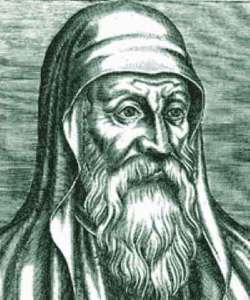
Origen of Alexandria (c. 185 – c. 253), was an early Christian scholar, ascetic, and theologian who was head the Catechetical School of Alexandria. He was a prolific writer who wrote roughly 2,000 treatises in multiple branches of theology. He has been described by John Anthony McGuckin as “the greatest genius the early church ever produced”.
Excerpts from Περὶ Ἀρχῶν / Perí Archón / On the First Principles

It is one thing to see, and another to know: to see and to be seen is a property of bodies; to know and to be known, an attribute of intellectual being. (Book 1 Chap. I.8)
For he [Solomon] knew that there were within us two kinds of senses: the one mortal, corruptible, human; the other immortal and intellectual, which he now termed divine. By this divine sense, therefore, not of the eyes, but of a pure heart, which is the mind, God may be seen by those who are worthy. For you will certainly find in all the Scriptures, both old and new, the term “heart” repeatedly used instead of “mind,” i.e., intellectual power. (Book 1 Chap. I.9)
For He is termed Wisdom, according to the expression of Solomon “The Lord created me–the beginning of His ways, and among His works, before He made any other thing; He founded me before the ages. In the beginning, before He formed the earth, before He brought forth the fountains of waters, before the mountains were made strong, before all the hills, He brought me forth.” He is also styled First-born, as the apostle has declared: “who is the first-born of every creature.” The first-born, however, is not by nature a different person from the Wisdom, but one and the same. Finally, the Apostle Paul says that “Christ (is) the power of God and the wisdom of God.” (Book 1 Chap. II.1)
Let no one, however, imagine that we mean anything impersonal when we call Him the wisdom of God; or suppose, for example, that we understand Him to be, not a living being endowed with wisdom, but something which makes men wise, giving itself to, and implanting itself in, the minds of those who are made capable of receiving His virtues and intelligence. If, then, it is once rightly understood that the only-begotten Son of God is His wisdom hypostatically existing, I know not whether our curiosity ought to advance beyond this,… (Book 1 Chap. II.2)
Now, in the same way in which we have understood that Wisdom was the beginning of the ways of God, and is said to be created, forming beforehand and containing within herself the species and beginnings of all creatures, must we understand her to be the Word of God, because of her disclosing to all other beings, i.e., to universal creation, the nature of the mysteries and secrets which are contained within the divine wisdom; and on this account she is called the Word, because she is, as it were, the interpreter of the secrets of the mind. And therefore that language which is found in the Acts of Paul, [1962] where it is said that “here is the Word a living being,” appears to me to be rightly used. John, however, with more sublimity and propriety, says in the beginning of his Gospel, when defining God by a special definition to be the Word, “And God was the Word, and this was in the beginning with God.” Let him, then, who assigns a beginning to the Word or Wisdom of God, take care that he be not guilty of impiety against the unbegotten Father Himself, seeing he denies that He had always been a Father, and had generated the Word, and had possessed wisdom in all preceding periods, whether they be called times or ages, or anything else that can be so entitled.
…therefore was the Word and Wisdom of God made the Way. And it was so termed because it leads to the Father those who walk along it. Whatever, therefore, we have predicated of the wisdom of God, will be appropriately applied and understood of the Son of God, in virtue of His being the Life, and the Word, and the Truth and the Resurrection:…(Book I Chap. II.3, II.4)
Now we say, as before, that Wisdom has her existence nowhere else save in Him who is the beginning of all things: from whom also is derived everything that is wise, because He Himself is the only one who is by nature a Son, and is therefore termed the Only-begotten. (Book I Chap. II.5)
And I am therefore of opinion that the will of the Father ought alone to be sufficient for the existence of that which He wishes to exist. For in the exercise of His will He employs no other way than that which is made known by the counsel of His will. And thus also the existence of the Son is generated by Him.
For the Son is the Word, and therefore we are not to understand that anything in Him is cognisable by the senses. He is wisdom, and in wisdom there can be no suspicion of anything corporeal. He is the true light, which enlightens every man that cometh into this world; but He has nothing in common with the light of this sun. Our Saviour, therefore, is the image of the invisible God, inasmuch as compared with the Father Himself He is the truth: and as compared with us, to whom He reveals the Father, He is the image by which we come to the knowledge of the Father, whom no one knows save the Son, and he to whom the Son is pleased to reveal Him. (Book I Chap. II.6)
Consider, then, whether the Son of God, seeing He is His Word and Wisdom, and alone knows the Father, and reveals Him to whom He will (i.e., to those who are capable of receiving His word and wisdom),… (Book I Chap. II.8)
That the working of the Father and the Son operates both in saints and in sinners, is manifest from this, that all who are rational beings are partakers of the word, i.e., of reason, and by this means bear certain seeds, implanted within them, of wisdom and justice, which is Christ. Now, in Him who truly exists, and who said by Moses, “I Am Who I Am,” all things, whatever they are, participate; which participation in God the Father is shared both by just men and sinners, by rational and irrational beings, and by all things universally which exist. (Book I Chap. III.6)
Note: In the above text, when you see “Word”, substitute the Greek word “Logos”. There is no English word that spans the same conceptual range. Likewise, when you see “Wisdom”, substitute the Greek word “Sophia”.
“Daily” Bread in the Lord’s Prayer? A Word Study
Posted by Dallas Wolf in First Thoughts, Patristic Pearls, Theology on January 9, 2025
Sources:
1. http://aramaicnt.org/articles/the-lords-prayer-in-galilean-aramaic/
2. Origen of Alexandria (c. 185 – c. 254): On Prayer (Περί Ευχής), Chapter XVII
The Lord’s Prayer is with little debate the most significant prayer in Christianity. Although many theological and ideological differences may divide Christians across the world, it is a prayer that unites the faith as a whole.
Within the New Testament tradition, the Prayer appears in two places. The first and more elaborate version is found in Matthew 6:9-13 where a simpler form is found in Luke 11:2-4, and the two of them share a significant amount of overlap.
The prayer’s absence from the Gospel of Mark, taken together with its presence in both Luke and Matthew, has brought some modern scholars to conclude that it is a tradition from the hypothetical “Q” source (from German: Quelle, meaning “source”) which both Luke and Matthew relied upon in many places throughout their individual writings. Given the similarities and unique character of the Matthaean and Lukan versions of the Lord’s Prayer may be evidence that what we attribute to the Greek of “Q” may ultimately trace back to an Aramaic source.
One of the trickiest problems of translating the Lord’s Prayer into Aramaic is finding out what επιούσιος (epiousios), usually translated as “daily”, originally intended. It is a unique word in Greek, only appearing twice in the all of Greek literature: Once in the Lord’s Prayer in Matthew, and the other time in the Lord’s Prayer in Luke.
This raises some curious questions that have baffled scholars. Why would Jesus have used a singular, entirely unique word? In more recent times, the bafflement has turned to a different possible solution. Jesus, someone known to have spoken Aramaic in a prayer that was originally recited in Aramaic, would not have used the Greek επιούσιος, at all. So, the question has evolved to “What Aramaic word was επιούσιος supposed to represent?” It would have to be something unique or difficult enough that whoever translated it into Greek needed to coin a word to express or preserve some meaning that they thought was important, or something that they couldn’t quite wrap the Greek language around.
The first question to answer is the meaning of the unique koine Greek word ἐπιούσιον (epiousion). To do this, we consult the writings of Origen of Alexandria. Origen was a third century native koine Greek speaker, head of the famed Catechetical School of Alexandria, the greatest theologian of the early church, and first to perform an exegesis of the Lord’s Prayer (ca. AD 240).
Origen begins: ”Let us now consider what the word epiousion, needful, means. First of all it should be known that the word epiousion is not found in any Greek writer whether in philosophy or in common usage, but seems to have been formed by the evangelists. At least Matthew and Luke, in having given it to the world, concur in using it in identical form.”
Origen concludes his in-depth discussion of epiousion, needful, by stating, “Needful, therefore, is the bread which corresponds most closely to our rational nature and is akin to our very essence, which invests the soul at once with well being and with strength, and, since the Word of God is immortal, imparts to its eater its own immortality.”
In Aramaic, the best fit for επιούσιος is probably the word çorak. It comes from the root çrk, which means to be poor, to need, or to be necessary. It is a very common word in Galilean Aramaic that is used in a number of senses to express both need and thresholds of necessity, such as “as much as is required” (without further prepositions) or with pronominal suffixes “all that [pron.] needs” (çorki = “All that I need”; çorkak = “All that you need”; etc.). Given this multi-faceted nature of the word, it’s hard to find a one-to-one Greek word that would do the job, and επιούσιος is a very snug fit in the context of the Prayer’s petition. This might even give us a hint that the Greek translator literally read into it a bit.
The Aramaic word yelip is another possible solution. It is interesting to note that it comes from the root yalap or “to learn.” Etymologically speaking, learning is a matter of repetition and routine, and this connection may play off the idea of regular physical bread, but actually mean “daily learning from God” (i.e. that which is necessary for living, as one cannot live off of bread alone).
Bottom line:
Origen’s understanding of epiousion in his context of needful certainly has no connection or relationship to a simplistic English translation of epiousion as “daily’. Nor is the translation of epiousion as “daily” supported by either hypothetical original Aramaic word çorkak or yelip.
In fact, a translation of epiousion as “daily” makes this petition in the Lord’s Prayer (Matt. 6:11) directly contradict Jesus’ lengthy admonition 14 verses later, starting at Matt 6:25:
25 “Therefore I say to you, do not worry about your life, what you will eat or what you will drink; nor about your body, what you will put on. Is not life more than food and the body more than clothing?
26 “Look at the birds of the air, for they neither sow nor reap nor gather into barns; yet your heavenly Father feeds them. Are you not of more value than they?
31 “Therefore do not worry, saying, ‘What shall we eat?’ or ‘What shall we drink?’ or ‘What shall we wear?’
32 “For after all these things the Gentiles seek. For your heavenly Father knows that you need all these things.
33 “But seek first the kingdom of God and His righteousness, and all these things shall be added to you.
The Gospel writers of Matthew and Luke both used the same totally unique Greek word solely in the context of the Lord’s Prayer. There were other frequently used koine Greek words available to express the simple idea of “daily”. Perhaps the unique use of epiousion was not accidental or coincidental, but needed to express the intent of the original Aramaic prayer. Origen may provide the best insight into the intended meaning of ἐπιούσιον as needful of the supra-essential Word of God.
David Bentley Hart: “Saint Origen”
Posted by Dallas Wolf in First Thoughts, New Nuggets, Universal Restoration (Apokatastasis) on February 28, 2018
David Bentley Hart (born 1965) is an American Orthodox Christian philosophical theologian, cultural commentator and polemicist. Here, in one short essay published in First Things in 2015, Prof. Hart addresses three topics that institutional Orthodoxy would prefer to avoid: apokatastasis, Saint Origen, and the church’s chronic propensity to sleep with worldly empire (e.g., Byzantium and Russia)
Met. Kallistos: “Dare We Hope for the Salvation of All?”
Posted by Dallas Wolf in New Nuggets, Universal Restoration (Apokatastasis) on October 18, 2017
Metropolitan Kallistos (Ware) (born 1934) – is an English-born bishop and theologian of the Eastern Orthodox Church. From 1966 to 2001, Ware was Lecturer of Eastern Orthodox Studies at the University of Oxford. He has authored numerous books and articles pertaining to the Orthodox Christian faith.
 “If the strongest argument in favor of universal salvation is the appeal to divine love, and if the strongest argument on the opposite side is the appeal to human freedom, then we are brought back to the dilemma with which we started: how are we to bring into concord the two principles God is love and Human beings are free? For the time being we cannot do more than hold fast with equal firmness to both principles at once, while admitting that the manner of their ultimate harmonization remains a mystery beyond our present comprehension. What St Paul said about the reconciliation of Christianity and Judaism is applicable also to the final reconciliation of the total creation: “O the depth of the riches and wisdom and knowledge of God! How unsearchable are His judgments and how inscrutable His ways!” (Rom 11:33).
When I am waiting at Oxford Station for the train to London, sometimes I walk up to the northernmost stretch of the long platform until I reach a notice: “Passengers must not proceed beyond this point. Penalty: £50.” In discussion of the future hope, we need a similar notice: “Theologians must not proceed beyond this point”—Let my readers devise a suitable penalty. Doubtless, Origen’s mistake was that he tried to say too much. It is a fault that I admire rather than execrate, but it was a mistake nonetheless.
Our belief in human freedom means that we have no right to categorically affirm, “All must be saved.” But our faith in God’s love makes us dare to hope that all will be saved.
Is there anybody there? said the traveler,
Knocking on the moonlit door.
Hell exists as a possibility because free will exists. Yet, trusting in the inexhaustible attractiveness of God’s love, we venture to express the hope—it is no more than a hope—that in the end, like Walter de la Mare’s Traveller, we shall find that there is nobody there. Let us leave the last word, then, with St Silouan of Mount Athos: ‘Love could not bear that… We must pray for all’.”
~ From “Dare We Hope for the Salvation of All? Origen, St Gregory of Nyssa and St Isaac the Syrian”
Louth: “On Universal Salvation”
Posted by Dallas Wolf in New Nuggets, Universal Restoration (Apokatastasis) on October 15, 2017
Fr. Andrew Louth is Professor of Patristic and Byzantine Studies, University of Durham, England. In the last chapter of his book, Introducing Eastern Orthodox Theology, Dr. Louth writes the following about “Universal Salvation” :
 “Origen hoped for the ‘restoration of all’, apokatastasis panton… His conviction did not simply rest on a philosophical belief that ‘the end is like the beginning’ a principle he affirmed several times in On First Principles… There is a deeper reason for Origen’s conviction of final restoration for all: for him it is inconceivable that Christ is to remain in sorrow for all eternity on account of the failure of any rational creature to respond to his love and benefit from his sacrifice.
Whereas in Western theology, such a conviction rapidly dies out, in Orthodox theology hope in universal salvation, based on a conviction of the boundlessness of God’s love, has never gone away. St. Gregory of Nyssa interprets the words of the apostle Paul’s teaching that God will be ‘all in all’ (1 Cor. 15.28) to mean the ‘complete annihilation of evil.’ St. Maximos the Confessor likewise holds out the hope of the salvation of all. The grounds for this are principally the long-suffering love of God for all creation, and also the conviction that evil is without substance, but is rather a corruption of distortion of what is good. These two motives find striking expression in St Maximos’ contemporary, St. Isaac the Syrian, who asserts that,
‘there exists within the Creator a single love and compassion which is spread out over all creation, a love which is without alteration, timeless and everlasting… No part belonging to any single one of all rational beings will be lost, as far as God is concerned, in the preparation of that supernatural kingdom’
and then adds, quoting Diodore of Tarsus, ‘not even the immense wickedness of the demons can overcome the measure of God’s goodness.’ The pain of hell is the result of love: ‘those who are punished in Gehenna are scourged by the scourge of love… For the sorrow caused in the heart by sin against love is more poignant than any torment.’ Evil and hell cannot be eternal: ‘Sin, Gehenna, and death do not exist at all with God, for they are effects, not substances. Sin is the fruit of free will. There was a time when sin did not exist, and there will be a time when it will not exist.’
This conviction that there is nothing outside God’s loving care finds expression in the prayers of the Orthodox Church. In the service of kneeling at Vespers on the evening of Pentecost, we pray ‘for those who are held fast in hell, granting us great hopes that there will be sent down from you to the departed repose and comfort from the pains which hold them’. This hope, amounting to a conviction, that there is nothing beyond the infinite love of God, that there is no limit to our hope in the power of his love, at least regards as a legitimate hope the universal salvation of all rational creatures, maybe even of the devil himself and his demons. Such a belief has found its defenders among modern Orthodox theologians, such as Olivier Clément, Metropolitan Kallistos Ware and Metropolitan Hilarion Alfeyev. It was also the conviction of one of the greatest Orthodox saints of recent times, St. Silouan of Athos, manifest in a conversation with another Athonite hermit, who declared ‘with evident satisfaction’,
‘God will punish all atheists. They will burn in hell in everlasting fire’.
Obviously upset, the Staretz said,
‘Tell me, supposing you went to paradise, and there looked down and saw somebody burning in hell-fire – would you feel happy?’
‘It can’t be helped. It would be their own fault’, said the hermit.
The Staretz answered with a sorrowful countenance:
‘Love could not bear that’, he said, ‘We must pray for all’.”
Essence and Energies of God – 1
Posted by Dallas Wolf in Essence and Energies (series) on August 30, 2015

Thaboric Light
One of my main goals in writing is to discover and bring the ancient theology and doctrines of the early charismatic Christian church to the contemporary Charismatic Renewal Movement.
There is a clear disconnect between the doxis of Western Latin Christianity and the praxis of the contemporary Charismatic Renewal Movement which operates in the gifts and fruit of the indwelling presence and power of the Holy Spirit. The Renewal Movement certainly has the basic praxis (how beliefs are practiced, embodied and realized in conduct) of the early charismatic Apostolic church, but does not have a corresponding supportive, complementary doxis (religious beliefs, worship, doctrines, and creeds) which explains and supports that praxis.
The world needs to see lives transformed, but it also needs to know why and how they have been transformed. To do this, the world must see a complementary balance of belief and action at work. But, just as vital, the world must see something else in mutual support and balance: orthodoxy and orthopraxis– that is, right belief and right action.
A key essential in an orthodoxy which supports a Renewal Movement (apostolic church) orthopraxis is an understanding of the Essence and Energies of God and the distinction between them. It is only in understanding Essence (transliterated ousía in Greek) and Energies (transliterated enérgeia in Greek) of God that we can reconcile the seeming paradox of the unknowable transcendence of God with the universal, yet very personal indwelling presence and power of God in all humankind.
Throughout this discussion, I will rely heavily on the writings of 20th century theologians including Vladimir Lossky, Christos Yannaras, and Fr. John Meyendorff. They, in turn, refer to the authority of many early Church Fathers including St. Gregory of Nyssa, St. Gregory of Nazianzus, and St. Macarius the Great (all 4th century); St. Dionysius the Aeropagite (5th century); St. Maximus the Confessor (7th century); St. Symeon the New Theologian (11th century); and last, but not least, St. Gregory Pálamas (14th century). I make all of these citations so that the reader may understand that the theology and doctrines on the Essence and Energies of God are both ancient and continuously attested to throughout the Patristic literature up to this day. These citations also make it clear that none of what you are about to read is my original work or thoughts.
To be continued…
D.B. Hart: “For my money, if Origen was not a saint and church father, then no one has any claim to those titles.”
Posted by Dallas Wolf in Ekklesia and church, New Nuggets on May 13, 2015
David Bentley Hart (born 1965) an Eastern Orthodox scholar of religion, is a philosopher, writer, and cultural commentator. His books include The Experience of God: Being, Consciousness, Bliss and That All Shall Be Saved: Heaven, Hell, Universal Salvation, and The New Testament – A Translation. He lives in South Bend, IN.

“East or West, all Christians are burdened with the absurdities of Christian imperial history. But any conception of orthodoxy that obliges one to grant the title of “saint” to a murderous thug like Justinian while denying it to a man as holy as Origen is obviously—indeed ludicrously—self-refuting. And one does not defend tradition well by making it appear not only atrociously unjust, but utterly ridiculous.”
D.B. Hart, from Saint Origen, First Things, October 2015.
“For my money, if Origen was not a saint and church father, then no one has any claim to those titles. And the contrary claims made by a brutish imbecile Emperor are of no consequence.”
D.B. Hart, from Eclectic Orthodoxy blog post, 11 May 2015.
Origen: “For as man consists of body, and soul, and spirit, so in the same way does Scripture”
Posted by Dallas Wolf in Patristic Pearls, Theology on July 6, 2014
Origen of Alexandria, (c. 184 – c. 254) was Head of the famed Catechetical School in Alexandria at age 18 and arguably the most brilliant theologian of the early Christian church. He was probably the most able and successful defender of the faith against the heresy of Gnosticism in the third century. Saint and Church Father without question. In this quote he tells us that Scripture ought to be interpreted at three levels: starting with the lowest level, the body or literal interpretation; followed by the more advanced at the soul level, or moral interpretation; and culminating with the highest level of interpretation, the spiritual, or allegorical interpretation. 1,800 years ago, Origen very clearly articulated what contemporary Christian fundamentalists still haven’t figured out.

Origen of Alexandria (c. 184 – c. 254)
“The individual ought, then to portray the ideas of holy Scripture in a threefold manner upon his own soul; in order that the simple man may be edified by the “flesh”, as it were, of the Scripture, for so we name the obvious sense; while he who has ascended a certain way (may be edified) by the “soul”, as it were. The perfect man, again… (may receive edification) from the “spiritual” law, which has a shadow of good things to come. For as man consists of body, and soul, and spirit, so in the same way does Scripture, which has been arranged to be given by God for the salvation of men.” ~ Peri Archon; First Principles, Book IV, Chapter 1
 First Thoughts