Posts Tagged Theology

Codex Sinaiticus

One of the four Great Uncials. The great uncial codices or four great uncials are the only remaining parchment uncial codices that contain (or originally contained) the entire text of the Bible (Old and New Testament) in Greek. They are the Codex Vaticanus in the Vatican Library, the Codex Sinaiticus and the Codex Alexandrinus in the British Library, and the Codex Ephraemi Rescriptus in the Bibliothèque Nationale de France in Paris. Uncial is a broad rounded majuscule script (written entirely in capital letters without regular gaps between words) commonly used from the 4th to 8th centuries AD by Latin and Greek scribes.

Let the same mind be in you that was in Christ Jesus, who, though he was in the form of God, did not regard equality with God as something to be exploited, but emptied himself, taking the form of a slave, being born in human likeness. And being found in human form, he humbled himself and became obedient to the point of death— even death on a cross. Therefore God also highly exalted him and gave him the name that is above every name, so that at the name of Jesus every knee should bend, in heaven and on earth and under the earth, and every tongue should confess that Jesus Christ is Lord, to the glory of God the Father. Philippians 2:5-11 (NRSV)

Codex Sinaiticus  ca. AD 350

British Library, London

, , , , ,

Leave a comment

Codex Vaticanus

One of the four Great Uncials. The great uncial codices or four great uncials are the only remaining uncial parchment codices that contain (or originally contained) the entire text of the Bible (Old and New Testament) in Greek. They are the Codex Vaticanus in the Vatican Library, the Codex Sinaiticus and the Codex Alexandrinus in the British Library, and the Codex Ephraemi Rescriptus in the Bibliothèque Nationale de France in Paris. Uncial is a broad rounded majuscule script (written entirely in capital letters without regular gaps between words) commonly used from the 4th to 8th centuries AD by Latin and Greek scribes.

According to John

In the beginning was the Word, and the Word was with God, and the Word was God. The same was in the beginning with God. All things were made by him; and without him was not any thing made that was made. In him was life; and the life was the light of men.And the light shineth in darkness; and the darkness comprehended it not. There was a man sent from God, whose name was John. The same came for a witness, to bear witness of the Light, that all men through him might believe. He was not that Light, but was sent to bear witness of that Light. That was the true Light, which lighteth every man that cometh into the world. He was in the world, and the world was made by him, and the world knew him not. He came unto his own, and his own received him not. But as many as received him, to them gave he power to become the sons of God, even to them that believe on his name: which were born, not of blood, nor of the will of the flesh, nor of the will of man, but of God. And the Word was made flesh, and dwelt among us, (and we beheld his glory, the glory as of the only begotten of the Father,) full of grace and truth.  John 1:1-14 (KJV)

Codex Vaticanus  ca. AD 350

Vatican Library, the Vatican

, , , ,

Leave a comment

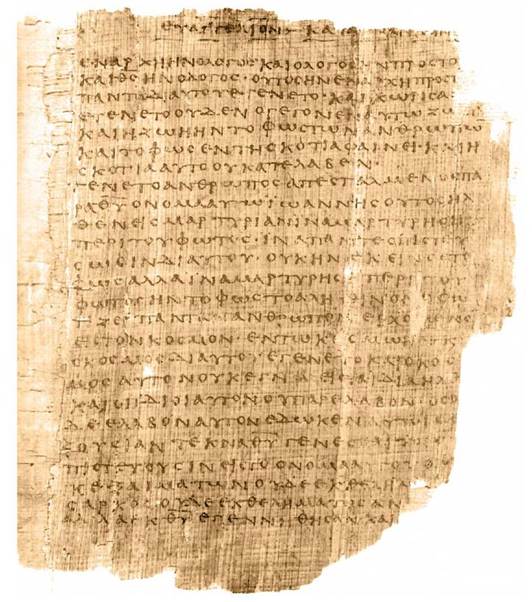
𝔓66 – The Earliest Known NT Manuscript Containing John 1. “In the beginning was the Word…”

Dated c. AD 150-250 (most likely around AD 200), Papyrus 66, designated by the siglum 𝔓66, is an early uncial Greek New Testament codex written on papyrus. It contains text from the Gospel of Luke 3:18-24:53, and John 1:1-15:8.  Part of the Bodmer Papyri, Bodmer Library, Cologny, Switzerland.
, , , , ,

Leave a comment

St. Gregory Of Nyssa: “Daily” Bread in the Lord’s Prayer? Not so fast!

From:  Ancient Christian Writers, No.18. Edited by Johannes Quasten and Joseph C. Plumpe. St. Gregory of Nyssa, The Lord’s Prayer – The Beatitudes, Trans. and annotated by Hilda C. Graef, 1954 Newman Press.  Pp. 68-70

Excerpt from:

Original Greek words used by Nyssen are in brackets [].  From: Gregorii Nysseni, De Oratione Dominica, De Beatitudinibus, Edidit Johannes F. Callahan, 1992 E.J. Brill. P. 56

, , , , , ,

Leave a comment

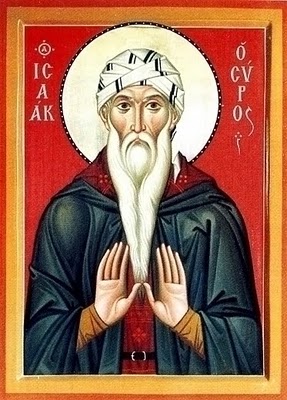
Isaac of Nineveh: “In love did He bring the world into existence…”

St. Isaac of Nineveh – 7th century ascetic and mystic, born in modern-day Qatar, was made Bishop of Nineveh between 660-680.  Especially influential in the Syriac tradition, Isaac has had a great influence in Russian culture, impacting the works of writers like Dostoyevsky.
Isaac composed dozens of homilies that he collected into seven volumes on topics of spiritual life, divine mysteries, judgements, providence, and more. Today, these seven volumes have survived in five Parts, titled from the First Part to the Fifth Part. Only the First Part was widely known outside of Aramaic speaking communities until 1983.
Some scholars argue that Isaac’s views from the Second Part appear to confirm earlier claims that Isaac advocated for universal reconciliation, or apokatastasis.
“What profundity of richness, what mind and exalted wisdom is God’s! What compassionate kindness and abundant goodness belongs to the Creator! …
In love did He bring the world into existence; in love does He guide it during this its temporal existence; in love is He going to bring it to that wondrous transformed state, and in love will the world be swallowed up in the great mystery of Him who has performed all these things; in love will the whole course of the governance of creation be finally comprised.” (II.38.1-2)

Isaac the Syrian, The Second Part, trans. Sebastian Brock (Peeters: Corpus Scriptorum Christianorum Orientalium, 1995).

, , , , ,

Leave a comment

J.B. Heard: Theology Proper

Rev. John Bickford Heard (28 Oct 1828 – 29 Feb 1908) was born in Dublin, Ireland. He was a British clergyman and graduate/lecturer at Cambridge University (M.A. 1864). His series of lectures at the Cambridge Hulsean Lectures of 1892-93 served as the basis of his book, Alexandrian and Carthaginian Theology Contrasted, published by T&T Clark, Edinburgh, in 1893.  Excerpts below are from this work:

“Nor need we be at a loss for a definition of theology, since the Master has himself deigned to define it.  At the crowning stage of His ministry, in summing up all He had been given to teach, He sums it up: “And this is life eternal: that they might know Thee the only true God, and Jesus Christ whom Thou hast sent.” [John 17:3]

Theology, rightly considered, is the knowledge of God in His relation to us, the cardinal point of which lies in the truth which the old Greek poet [Acts 17:28] had glanced at. “For we are also His offspring” – this is the true keynote; and theology, setting out from this kinship between us and God, we at once soar, as on wings of a spiritual intuition, across the abyss between creature and Creator.”

Op. cit.  pp. 31, 32. Brackets [ ] mine.

, , , , , ,

Leave a comment

The Didaché: The Lord’s Teaching Through the Twelve Apostles to the Gentiles (1st century)

The Didaché (Greek: Διδαχή, romanized: Didakhé, lit. ’Teaching’), also known as The Lord’s Teaching Through the Twelve Apostles to the Gentiles is a brief anonymous early Christian treatise written in Koine Greek. Only relatively recently discovered in 1873, “few manuscript discoveries in modern times have created the stir caused by the discovery and publication of the Didache in the late nineteenth century. ” (Bart Ehrman). Many scholars once dated the text to the early second century, but most scholars now assign the Didaché to the first century.  The community that produced the Didaché could have been based in Syria, as it addressed the gentiles but from a Judaic perspective, at some remove from Jerusalem, and shows no evidence of Pauline influence.  The text, parts of which constitute the oldest extant written catechism, has three main sections dealing with Christian ethics, rituals such as baptism and Eucharist, and organization.

Author J.B. Heard tells us: “The “teaching of the twelve” clearly marks a state of transition in which the importance of a sacramental system and sacerdotal order is beginning to dawn on the Christian consciousness; but as yet the new theology, as it was then considered, had not taken dogmatic form.  It nestled behind the phrase διδαχή; it has not as yet been formulated.  It is only a δόξα [doxa], or private opinion, which in the end, as a δόγμα [dogma] would put on the air of authority, and enforce itself under the threat of an Anathema.”

The Ekklesía of the first-century Didaché was still very much one of First Thoughts.

Didaché Notes: Translations of the Didaché are readily available online. It is very short (under 10 pages) and is really worth the read. Below are my notes and highlights.

Chap. 1.2 The path of life consists of three Commandments:  Love God, Love your neighbor as yourself, and the Golden Rule. (First Thoughts)

Chap. 1.3 Further exhortations from the Sermon on the Mount. (First Thoughts)

Chaps. 2 – 4 Ethical Injunctions (First Thoughts)

Chaps 7-10 Rituals of the Ekklesía:

—– Chap. 7. How to Baptize (First Thought)

—– Chap. 8.1 How to fast (First Thought)

—– Chap. 8.2 How to pray (Πάτερ ἡμῶν. Our Father- (First Thought))

—– Chaps. 9 – 10 How to celebrate the communal thanksgiving meal or Eucharist (First Thoughts)

Chap. 11  How to deal with itinerant Christian teachers, apostles, and, especially, prophets indicating their special status before God (First Thoughts). Note the alignment with Paul’s list of ministries in 1Cor.12:28.

Chaps. 14 – 15  Further instructions for communal worship, including election of bishops and deacons… “for these also conduct the ministry of the prophets and teachers among you.” (the rationalization of an After Thought?!) The nascent arrival of earthly institutional organization, administration, and control can be sensed.

Chap. 16  an apocalyptic scenario as the 1st century Ekklesía realized that the Parousia may not be as imminent as they had previously believed.

, , , , , ,

Leave a comment

Origen of Alexandria on the Logos

Origen of Alexandria (c. 185 – c. 253), was an early Christian scholar, ascetic, and theologian who was head the Catechetical School of Alexandria. He was a prolific writer who wrote roughly 2,000 treatises in multiple branches of theology. He has been described by John Anthony McGuckin as “the greatest genius the early church ever produced”.

Excerpts from Περὶ Ἀρχῶν / Perí Archón / On the First Principles

It is one thing to see, and another to know: to see and to be seen is a property of bodies; to know and to be known, an attribute of intellectual being. (Book 1 Chap. I.8)

For he [Solomon] knew that there were within us two kinds of senses: the one mortal, corruptible, human; the other immortal and intellectual, which he now termed divine. By this divine sense, therefore, not of the eyes, but of a pure heart, which is the mind, God may be seen by those who are worthy. For you will certainly find in all the Scriptures, both old and new, the term “heart” repeatedly used instead of “mind,” i.e., intellectual power. (Book 1 Chap. I.9)

For He is termed Wisdom, according to the expression of Solomon “The Lord created me–the beginning of His ways, and among His works, before He made any other thing; He founded me before the ages. In the beginning, before He formed the earth, before He brought forth the fountains of waters, before the mountains were made strong, before all the hills, He brought me forth.”  He is also styled First-born, as the apostle has declared: “who is the first-born of every creature.”  The first-born, however, is not by nature a different person from the Wisdom, but one and the same. Finally, the Apostle Paul says that “Christ (is) the power of God and the wisdom of God.” (Book 1 Chap. II.1)

Let no one, however, imagine that we mean anything impersonal when we call Him the wisdom of God; or suppose, for example, that we understand Him to be, not a living being endowed with wisdom, but something which makes men wise, giving itself to, and implanting itself in, the minds of those who are made capable of receiving His virtues and intelligence. If, then, it is once rightly understood that the only-begotten Son of God is His wisdom hypostatically existing, I know not whether our curiosity ought to advance beyond this,… (Book 1 Chap. II.2)

Now, in the same way in which we have understood that Wisdom was the beginning of the ways of God, and is said to be created, forming beforehand and containing within herself the species and beginnings of all creatures, must we understand her to be the Word of God, because of her disclosing to all other beings, i.e., to universal creation, the nature of the mysteries and secrets which are contained within the divine wisdom; and on this account she is called the Word, because she is, as it were, the interpreter of the secrets of the mind. And therefore that language which is found in the Acts of Paul, [1962] where it is said that “here is the Word a living being,” appears to me to be rightly used. John, however, with more sublimity and propriety, says in the beginning of his Gospel, when defining God by a special definition to be the Word, “And God was the Word, and this was in the beginning with God.” Let him, then, who assigns a beginning to the Word or Wisdom of God, take care that he be not guilty of impiety against the unbegotten Father Himself, seeing he denies that He had always been a Father, and had generated the Word, and had possessed wisdom in all preceding periods, whether they be called times or ages, or anything else that can be so entitled.

…therefore was the Word and Wisdom of God made the Way.  And it was so termed because it leads to the Father those who walk along it. Whatever, therefore, we have predicated of the wisdom of God, will be appropriately applied and understood of the Son of God, in virtue of His being the Life, and the Word, and the Truth and the Resurrection:…(Book I Chap. II.3, II.4)

Now we say, as before, that Wisdom has her existence nowhere else save in Him who is the beginning of all things: from whom also is derived everything that is wise, because He Himself is the only one who is by nature a Son, and is therefore termed the Only-begotten. (Book I Chap. II.5)

And I am therefore of opinion that the will of the Father ought alone to be sufficient for the existence of that which He wishes to exist.  For in the exercise of His will He employs no other way than that which is made known by the counsel of His will.  And thus also the existence of the Son is generated by Him.

For the Son is the Word, and therefore we are not to understand that anything in Him is cognisable by the senses.  He is wisdom, and in wisdom there can be no suspicion of anything corporeal.  He is the true light, which enlightens every man that cometh into this world; but He has nothing in common with the light of this sun.  Our Saviour, therefore, is the image of the invisible God, inasmuch as compared with the Father Himself He is the truth: and as compared with us, to whom He reveals the Father, He is the image by which we come to the knowledge of the Father, whom no one knows save the Son, and he to whom the Son is pleased to reveal Him. (Book I Chap. II.6)

Consider, then, whether the Son of God, seeing He is His Word and Wisdom, and alone knows the Father, and reveals Him to whom He will (i.e., to those who are capable of receiving His word and wisdom),… (Book I Chap. II.8)

That the working of the Father and the Son operates both in saints and in sinners, is manifest from this, that all who are rational beings are partakers of the word, i.e., of reason, and by this means bear certain seeds, implanted within them, of wisdom and justice, which is Christ.  Now, in Him who truly exists, and who said by Moses, “I Am Who I Am,” all things, whatever they are, participate; which participation in God the Father is shared both by just men and sinners, by rational and irrational beings, and by all things universally which exist. (Book I Chap. III.6)

Note:  In the above text, when you see “Word”, substitute the Greek word “Logos”.  There is no English word that spans the same conceptual range. Likewise, when you see “Wisdom”, substitute the Greek word “Sophia”.

, , , , ,

Leave a comment

Athanasius of Alexandria on the Logos

Athanasius of Alexandria (c. 296–298 – 2 May 373), also called Athanasius the Great, was a Christian theologian and the 20th patriarch of Alexandria.  In 325, at age 27, Athanasius began his leading role against the Arians as a deacon and assistant to Bishop Alexander of Alexandria during the First Council of Nicaea.

Excerpted from: The Complete Works of St. Athanasius, Against the Heathen, Part 3, pp., 40-44.

40. The rationality and order of the Universe proves that it is the work of the Reason or Word of God.

Who then might this Maker be? For this is a point most necessary to make plain, lest, from ignorance with regard to him, a man should suppose the wrong maker, and fall once more into the same old godless error, but I think no one is really in doubt about it. For if our argument has proved that the gods of the poets are no gods, and has convicted of error those that deify creation, and in general has shown that the idolatry of the heathen is godlessness and impiety, it strictly follows from the elimination of these that the true religion is with us, and that the God we worship and preach is the only true One, Who is Lord of Creation and Maker of all existence.

2. Who then is this, save the Father of Christ, most holy and above all created existence , Who like an excellent pilot, by His own Wisdom and His own Word, our Lord and Saviour Christ, steers and preserves and orders all things, and does as seems to Him best? But that is best which has been done, and which we see taking place, since that is what He wills; and this a man can hardly refuse to believe.

3. For if the movement of creation were irrational, and the universe were borne along without plan, a man might fairly disbelieve what we say. But if it subsist in reason and wisdom and skill, and is perfectly ordered throughout, it follows that He that is over it and has ordered it is none other than the [reason or] Word of God.

4. But by Word I mean, not that which is involved and inherent in all things created, which some are wont to call the seminal principle, which is without soul and has no power of reason or thought, but only works by external art, according to the skill of him that applies it—nor such a word as belongs to rational beings and which consists of syllables, and has the air as its vehicle of expression—but I mean the living and powerful Word of the good God, the God of the Universe, the very Word which is God [ John 1:1 ], Who while different from things that are made, and from all Creation, is the One own Word of the good Father, Who by His own providence ordered and illumines this Universe.

5. For being the good Word of the Good Father He produced the order of all things, combining one with another things contrary, and reducing them to one harmonious order. He being the Power of God and Wisdom of God causes the heaven to revolve, and has suspended the earth, and made it fast, though resting upon nothing, by His own nod. Illumined by Him, the sun gives light to the world, and the moon has her measured period of shining. By reason of Him the water is suspended in the clouds; the rains shower upon the earth, and the sea is kept within bounds, while the earth bears grasses and is clothed with all manner of plants.

6. And if a man were incredulously to ask, as regards what we are saying, if there be a Word of God at all , such an one would indeed be mad to doubt concerning the Word of God, but yet demonstration is possible from what is seen, because all things subsist by the Word and Wisdom of God, nor would any created thing have had a fixed existence had it not been made by reason, and that reason the Word of God, as we have said.

41. The Presence of the Word in nature necessary, not only for its original Creation, but also for its permanence.

But though He is Word, He is not, as we said, after the likeness of human words, composed of syllables; but He is the unchanging Image of His own Father. For men, composed of parts and made out of nothing, have their discourse composite and divisible. But God possesses true existence and is not composite, wherefore His Word also has true Existence and is not composite, but is the one and only-begotten God , Who proceeds in His goodness from the Father as from a good Fountain, and orders all things and holds them together.

2. But the reason why the Word, the Word of God, has united Himself with created things is truly wonderful, and teaches us that the present order of things is none otherwise than is fitting. For the nature of created things, inasmuch as it is brought into being out of nothing, is of a fleeting sort, and weak and mortal, if composed of itself only. But the God of all is good and exceeding noble by nature,— and therefore is kind. For one that is good can grudge nothing : for which reason he does not grudge even existence, but desires all to exist, as objects for His loving-kindness.

3. Seeing then all created nature, as far as its own laws were concerned, to be fleeting and subject to dissolution, lest it should come to this and lest the Universe should be broken up again into nothingness, for this cause He made all things by His own eternal Word, and gave substantive existence to Creation, and moreover did not leave it to be tossed in a tempest in the course of its own nature, lest it should run the risk of once more dropping out of existence ; but, because He is good He guides and settles the whole Creation by His own Word, Who is Himself also God, that by the governance and providence and ordering action of the Word, Creation may have light, and be enabled to abide always securely. For it partakes of the Word Who derives true existence from the Father, and is helped by Him so as to exist, lest that should come to it which would have come but for the maintenance of it by the Word,— namely, dissolution— ​”​ for He is the Image of the invisible God, the first-born of all Creation, for through Him and in Him all things consist, things visible and things invisible, and He is the Head of the Church, ​”​ as the ministers of truth teach in their holy writings.

42. This function of the Word described at length.

The holy Word of the Father, then, almighty and all-perfect, uniting with the universe and having everywhere unfolded His own powers, and having illumined all, both things seen and things invisible, holds them together and binds them to Himself, having left nothing void of His own power, but on the contrary quickening and sustaining all things everywhere, each severally and all collectively; while He mingles in one the principles of all sensible existence, heat namely and cold and wet and dry, and causes them not to conflict, but to make up one concordant harmony.

2. By reason of Him and His power, fire does not fight with cold nor wet with dry, but principles mutually opposed, as if friendly and brotherly combine together, and give life to the things we see, and form the principles by which bodies exist. Obeying Him, even God the Word, things on earth have life and things in the heaven have their order. By reason of Him all the sea, and the great ocean, move within their proper bounds, while, as we said above, the dry land grows grasses and is clothed with all manner of diverse plants. And, not to spend time in the enumeration of particulars, where the truth is obvious, there is nothing that is and takes place but has been made and stands by Him and through Him, as also the Divine [ John 1:1 ] says, ​”​ In the beginning was the Word, and the Word was with God, and the Word was God; all things were made by Him, and without Him was not anything made. ​”​

3. For just as though some musician, having tuned a lyre, and by his art adjusted the high notes to the low, and the intermediate notes to the rest, were to produce a single tune as the result, so also the Wisdom of God, handling the Universe as a lyre, and adjusting things in the air to things on the earth, and things in the heaven to things in the air, and combining parts into wholes and moving them all by His beck and will, produces well and fittingly, as the result, the unity of the universe and of its order, Himself remaining unmoved with the Father while He moves all things by His organising action, as seems good for each to His own Father.

4. For what is surprising in His godhead is this, that by one and the same act of will He moves all things simultaneously, and not at intervals, but all collectively, both straight and curved, things above and beneath and intermediate, wet, cold, warm, seen and invisible, and orders them according to their several nature. For simultaneously at His single nod what is straight moves as straight, what is curved also, and what is intermediate, follows its own movement; what is warm receives warmth, what is dry dryness, and all things according to their several nature are quickened and organised by Him, and He produces as the result a marvellous and truly divine harmony.

43. Three similes to illustrate the Word’s relation to the Universe.

And for so great a matter to be understood by an example, let what we are describing be compared to a great chorus. As then the chorus is composed of different people, children, women again, and old men, and those who are still young, and, when one, namely the conductor, gives the sign, each utters sound according to his nature and power, the man as a man, the child as a child, the old man as an old man, and the young man as a young man, while all make up a single harmony;

2. or as our soul at one time moves our several senses according to the proper function of each, so that when some one object is present all alike are put in motion, and the eye sees, the ear hears, the hand touches, the smell takes in odour, and the palate tastes—and often the other parts of the body act too, as for instance if the feet walk;

3. or, to make our meaning plain by yet a third example, it is as though a very great city were built, and administered under the presence of the ruler and king who has built it; for when he is present and gives orders, and has his eye upon everything, all obey; some busy themselves with agriculture, others hasten for water to the aqueducts, another goes forth to procure provisions—one goes to senate, another enters the assembly, the judge goes to the bench, and the magistrate to his court. The workman likewise settles to his craft, the sailor goes down to the sea, the carpenter to his workshop, the physician to his treatment, the architect to his building; and while one is going to the country, another is returning from the country, and while some walk about the town others are going out of the town and returning to it again: but all this is going on and is organised by the presence of the one Ruler, and by his management:

4. in like manner then we must conceive of the whole of Creation, even though the example be inadequate, yet with an enlarged idea. For with the single impulse of a nod as it were of the Word of God, all things simultaneously fall into order, and each discharge their proper functions, and a single order is made up by them all together.

44. The similes applied to the whole Universe, seen and unseen.

For by a nod and by the power of the Divine Word of the Father that governs and presides over all, the heaven revolves, the stars move, the sun shines, the moon goes her circuit, and the air receives the sun’s light and the æther his heat, and the winds blow: the mountains are reared on high, the sea is rough with waves, and the living things in it grow, the earth abides fixed, and bears fruit, and man is formed and lives and dies again, and all things whatever have their life and movement; fire burns, water cools, fountains spring forth, rivers flow, seasons and hours come round, rains descend, clouds are filled, hail is formed, snow and ice congeal, birds fly, creeping things go along, water-animals swim, the sea is navigated, the earth is sown and grows crops in due season, plants grow, and some are young, some ripening, others in their growth become old and decay, and while some things are vanishing others are being engendered and are coming to light.

2. But all these things, and more, which for their number we cannot mention, the worker of wonders and marvels, the Word of God, giving light and life, moves and orders by His own nod, making the universe one. Nor does He leave out of Himself even the invisible powers; for including these also in the universe inasmuch as he is their maker also, He holds them together and quickens them by His nod and by His providence. And there can be no excuse for disbelieving this.

3. For as by His own providence bodies grow and the rational soul moves, and possesses life and thought, and this requires little proof, for we see what takes place—so again the same Word of God with one simple nod by His own power moves and holds together both the visible universe and the invisible powers, allotting to each its proper function, so that the divine powers move in a diviner way, while visible things move as they are seen to do. But Himself being over all, both Governor and King and organising power, He does all for the glory and knowledge of His own Father, so that almost by the very works that He brings to pass He teaches us and says, ​”​ By the greatness and beauty of the creatures proportionably the maker of them is seen [Wisdom 13:5].​”​

Note:  In the above text, when you see “Word”, substitute the Greek word “Logos”.  There is no English word that spans the same conceptual range.

, , , , , ,

Leave a comment

Clement of Alexandria on the Logos

Clement of Alexandria (c. 150 – c. 215 AD), was a Christian theologian and philosopher who founded the Catechetical School of Alexandria. Among his pupils were Origen of Alexandria and Alexander of Jerusalem.

Excerpted from: Exhortation to the Heathen, By Clement of Alexandria.

You have, then, God’s promise; you have His love: become partaker of His grace. And do not suppose the song of salvation to be new, as a vessel or a house is new. For “before the morning star it was;” and “in the beginning was the Word, and the Word was with God, and the Word was God.”  Error seems old, but truth seems a new thing. (Chap. I)

But before the foundation of the world were we, who, because destined to be in Him, pre-existed in the eye of God before,–we the rational creatures of the Word of God, on whose account we date from the beginning; for “in the beginning was the Word.”  Well, inasmuch as the Word was from the first, He was and is the divine source of all things; but inasmuch as He has now assumed the name Christ, consecrated of old, and worthy of power, he has been called by me the New Song. This Word, then, the Christ, the cause of both our being at first (for He was in God) and of our well-being, this very Word has now appeared as man, He alone being both, both God and man–the Author of all blessings to us; by whom we, being taught to live well, are sent on our way to life eternal.  For, according to that inspired apostle of the Lord, “the grace of God which bringeth salvation hath appeared to all men, teaching us, that, denying ungodliness and worldly lusts, we should live soberly, righteously, and godly, in this present world; looking for the blessed hope, and appearing of the glory of the great God and our Saviour Jesus Christ.” This is the New Song, the manifestation of the Word that was in the beginning, and before the beginning. The Saviour, who existed before, has in recent days appeared. He, who is in Him that truly is, has appeared; for the Word, who “was with God,” and by whom all things were created, has appeared as our Teacher. The Word, who in the beginning bestowed on us life as Creator when He formed us, taught us to live well when He appeared as our Teacher; that as God He might afterwards conduct us to the life which never ends. He did not now for the first time pity us for our error; but He pitied us from the first, from the beginning. But now, at His appearance, lost as we already were, He accomplished our salvation. (Chap. I)

For into all men whatever, especially those who are occupied with intellectual pursuits, a certain divine effluence has been instilled; wherefore, though reluctantly, they confess that God is one, indestructible, unbegotten, and that somewhere above in the tracts of heaven, in His own peculiar appropriate eminence, whence He surveys all things, He has an existence true and eternal. (Chap. VI)

For if, at the most, the Greeks, having received certain scintillations of the divine word, have given forth some utterances of truth, they bear indeed witness that the force of truth is not hidden, and at the same time expose their own weakness in not having arrived at the end. (Chap. VII)

Note:  In the above text, when you see “Word”, substitute the Greek word “Logos”.  There is no English word that spans the same conceptual range.

Clement of Alexandria. The Works of Clement of Alexandria: The Stromata, On the Salvation of the Rich Man, Fragments, Pædagogus, and Exhortation to the Heathen. Kindle Edition.

, , , , ,

Leave a comment