Archive for category Ancient Christian Manuscripts
Codex Sinaiticus
Posted by Dallas Wolf in Ancient Christian Manuscripts, First Thoughts, Patristic Pearls, Theology on September 16, 2025
One of the four Great Uncials. The great uncial codices or four great uncials are the only remaining parchment uncial codices that contain (or originally contained) the entire text of the Bible (Old and New Testament) in Greek. They are the Codex Vaticanus in the Vatican Library, the Codex Sinaiticus and the Codex Alexandrinus in the British Library, and the Codex Ephraemi Rescriptus in the Bibliothèque Nationale de France in Paris. Uncial is a broad rounded majuscule script (written entirely in capital letters without regular gaps between words) commonly used from the 4th to 8th centuries AD by Latin and Greek scribes. Codex Sinaiticus is considered a Alexandrian text-type manuscript.

Let the same mind be in you that was in Christ Jesus, who, though he was in the form of God, did not regard equality with God as something to be exploited, but emptied himself, taking the form of a slave, being born in human likeness. And being found in human form, he humbled himself and became obedient to the point of death— even death on a cross. Therefore God also highly exalted him and gave him the name that is above every name, so that at the name of Jesus every knee should bend, in heaven and on earth and under the earth, and every tongue should confess that Jesus Christ is Lord, to the glory of God the Father. Philippians 2:5-11 (NRSV)
Codex Sinaiticus ca. AD 350
British Library, London
Codex Vaticanus
Posted by Dallas Wolf in Ancient Christian Manuscripts, First Thoughts, Patristic Pearls, Theology on September 16, 2025
One of the four Great Uncials. The great uncial codices or four great uncials are the only remaining uncial parchment codices that contain (or originally contained) the entire text of the Bible (Old and New Testament) in Greek. They are the Codex Vaticanus in the Vatican Library, the Codex Sinaiticus and the Codex Alexandrinus in the British Library, and the Codex Ephraemi Rescriptus in the Bibliothèque Nationale de France in Paris. Uncial is a broad rounded majuscule script (written entirely in capital letters without regular gaps between words) commonly used from the 4th to 8th centuries AD by Latin and Greek scribes. Codex Vaticanus is a Alexandrian text-type manuscript.

According to John
In the beginning was the Word, and the Word was with God, and the Word was God. The same was in the beginning with God. All things were made by him; and without him was not any thing made that was made. In him was life; and the life was the light of men.And the light shineth in darkness; and the darkness comprehended it not. There was a man sent from God, whose name was John. The same came for a witness, to bear witness of the Light, that all men through him might believe. He was not that Light, but was sent to bear witness of that Light. That was the true Light, which lighteth every man that cometh into the world. He was in the world, and the world was made by him, and the world knew him not. He came unto his own, and his own received him not. But as many as received him, to them gave he power to become the sons of God, even to them that believe on his name: which were born, not of blood, nor of the will of the flesh, nor of the will of man, but of God. And the Word was made flesh, and dwelt among us, (and we beheld his glory, the glory as of the only begotten of the Father,) full of grace and truth. John 1:1-14 (KJV)
Codex Vaticanus ca. AD 350
Vatican Library, the Vatican
𝔓⁴⁶ – The Earliest Existing Manuscript of Paul’s Letters
Posted by Dallas Wolf in Ancient Christian Manuscripts, First Thoughts, Patristic Pearls, Theology on September 16, 2025
Known as Beatty Papyrus 46, designated by the siglum 𝔓⁴⁶, is an early uncial Greek New Testament codex written on papyrus. P 46 is dated to around AD 175–225. It contains portions of most of the Pauline epistles, including Romans (last eight chapters), Hebrews, 1&2 Corinthians, Ephesians, Galatians, Philippians, Colossians, and 1 Thessalonians. P 46 is considered a Alexandrian text-type manuscript by textual criticism scholars.
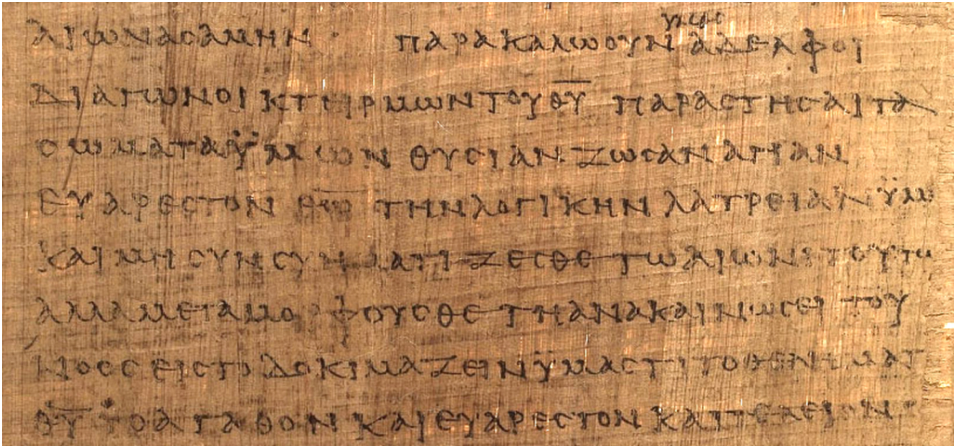
I appeal to you therefore, brothers, by the mercies of God, to present your bodies as a living sacrifice, holy and acceptable to God, which is your spiritual worship. Do not be conformed to this world, but be transformed by the renewal of your mind, that by testing you may discern what is the will of God, what is good and acceptable and perfect. Romans 12:1-2 (ESV)
Beatty Papyrus P46 ca. AD 200
University of Michigan, Ann Arbor
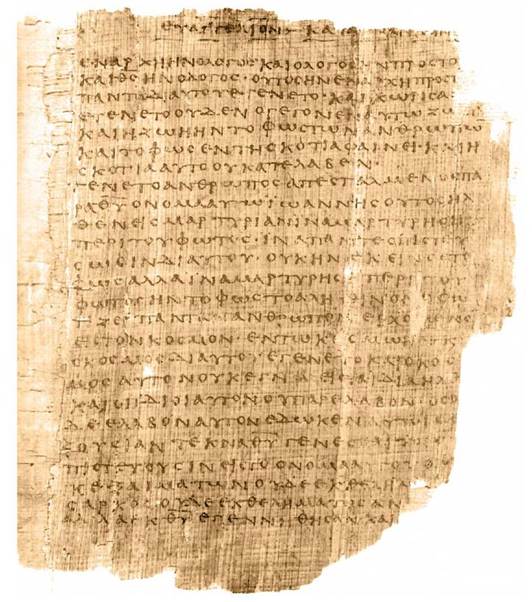
𝔓66 – The Earliest Known NT Manuscript Containing John 1. “In the beginning was the Word…”
Posted by Dallas Wolf in Ancient Christian Manuscripts, First Thoughts, Patristic Pearls, The Logos Doctrine (series) on September 15, 2025
Dated c. AD 150-250 (most likely around AD 200), Papyrus 66, designated by the siglum 𝔓66, is an early uncial Greek New Testament codex written on papyrus. It contains text from the Gospel of Luke 3:18-24:53, and John 1:1-15:8. P66 is considered a Alexandrian text-type manuscript by textual criticism scholars. Part of the Bodmer Papyri, Bodmer Library, Cologny, Switzerland.
The Apostle Paul: Radical, Conservative, or Reactionary?
Posted by Dallas Wolf in Ancient Christian Manuscripts, Ekklesia and church, First Thoughts, Theology, Women in Early Christianity on March 21, 2025
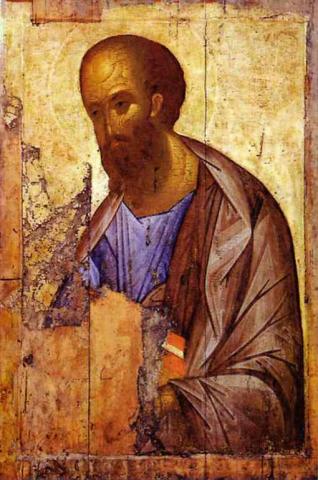
The Apostle Paul is a controversial figure. More than half of the New Testament is written by him, about him, or in his name. There is a general consensus among contemporary scholars that the Apostle Paul did not write all 13 New Testament letters attributed to him.
Modern scholarship attributes seven of Paul’s 13 canonical letters as unquestionably authentic:
- Romans,
- Galatians,
- I Corinthians,
- II Corinthians,
- I Thessalonians,
- Philippians, and
- Philemon
Three others are generally considered deutero or (pseudo) – Pauline and are Pauline in theology, with a couple of notable exceptions, but are different in style and much more mainline and conservative in tone than the undisputed letters. They were probably written in the generation after Paul’s death by people very familiar with his teaching. The deutero (or pseudo)-Pauline letters are:
- Colossians,
- Ephesians, and
- II Thessalonians
The last three, the “Pastoral Letters”, are largely considered pseudepigrapha (a bible scholar’s politically-correct term for “forgery”) and were probably written around the beginning of the 2nd century and exhibit patriarchal, sexist, and reactionary social attitudes one would expect of an entrenched Greco-Roman cultural institution (exactly what the early Church was becoming by that time).1,2 The pseudepigraphical letters are:
- I Timothy,
- II Timothy, and
- Titus
What follows are estimates of the percentages of biblical scholars who reject Paul’s authorship of the six books in question:
- 2 Thessalonians = 50 percent;
- Colossians = 60 percent;
- Ephesians = 70 percent;
- 2 Timothy = 80 percent;
- 1 Timothy and Titus = 90 percent.2
In addition to judgments about entire letters, scholars also question the authorship of certain passages in the undisputed letters. Post-Pauline texts are those alleged to have been inserted into a letter after its composition and are generally called scribal “interpolations”.
Among the passages that some scholars label as interpolations are:
- Romans 5:5-7, 13:1-7, 16:17-20, 16:25-27;
- 1 Corinthians 4:6b, 11:2-16, 14:33b-35 or 36;
- 2 Corinthians 6:14-7:1; and
- 1 Thessalonians 2:14-16.2,3
Given the above, one could argue that there are really three “Pauls” in the New Testament:
- The Radical Paul of the seven undisputed authentic letters
- The Conservative Paul of the three deutero-Pauline letters
- The Reactionary Paul of the three pseudepigraphical Pastoral Letters
___________________________________________________________
- The First Paul, Reclaiming the Radical Visionary Behind the Church’s Conservative Icon, By Marcus J. Borg and John Dominic Crossan , 2009 HarperCollins, NY, NY
- Apostle of the Crucified Lord, A Theological Introduction to Paul & His Letters, by Michael J. Gorman, 2004 Wm. B. Eerdmans, Grand Rapids, MI / Cambridge, UK
- The Authentic Letters of Paul, A New Reading of Paul’s Rhetoric and Meaning, by Arthur J. Dewey, Roy W. Hoover, Lane C. Mc Gaughy, and Daryl D. Schmidt, 2010 Polebridge Press, Salem, OR

