Posts Tagged St. Paul
The Earliest Account of the Eucharist, (i.e., Lord’s Supper/Communion)
Posted by Dallas Wolf in Ancient Christian Manuscripts, Ekklesia and church, First Thoughts, New Nuggets, Theology on May 31, 2026
The earliest written reference to the Eucharist (Lord’s Supper/Communion) is 1 Corinthians 11:23–26, written by St. Paul around A.D. 55.
Paul’s description in 1 Corinthians 11 is the earliest written witness to Christians “eating the bread and drinking the cup of the Lord.” He explicitly links this practice to Jesus’ actions at the Last Supper and treats it as an already-established ritual in the Corinthian church.
This predates the earliest Gospel by at least a decade and is the oldest surviving Christian text describing the rite. However, scholars do not believe that the gospel writers used Paul as a source for their unique Eucharist accounts, which indicates that practice of the rite was widespread in the Eastern Mediterranean in the first century.
Paul also says he is passing on a tradition he himself received, implying the Eucharist was practiced orally even earlier than his letter.
The earliest known manuscript source for 1 Corinthians is Papyrus 46 (𝔓46) — one of the famous Chester Beatty Papyri — and it is one of the oldest surviving New Testament manuscripts of any kind.
Most scholars date 𝔓46 to around 175–225 A.D., though a minority have argued for an even earlier date. Even using the conservative date, 𝔓46 is roughly 150 years earlier than the great parchment codices (Vaticanus, Sinaiticus).
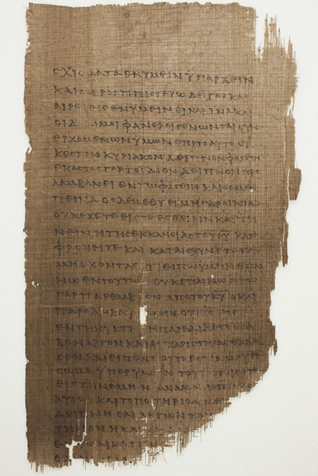
Beatty Papyrus 𝔓46, the earliest extant manuscript containing 1 Cor 11:18-25 (175–225 A.D.)
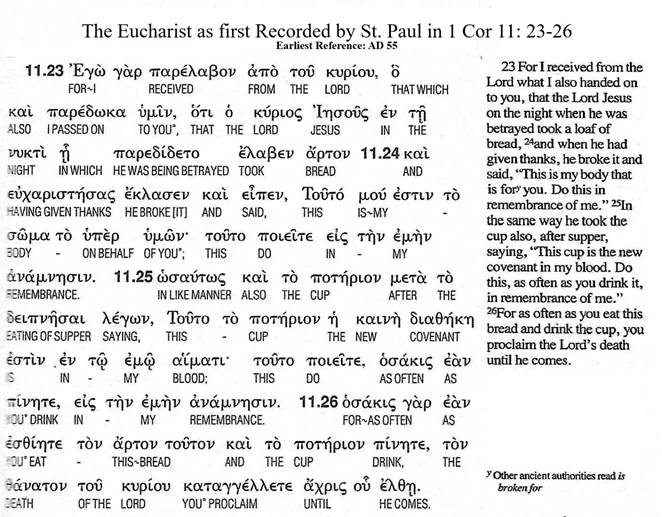
Detailed Illustration of the earliest account of the Eucharist (Greek and English)
Kenosis: “… but emptied himself [ἐκένωσεν (ekénōsen)], taking the form of a slave,…”
Posted by Dallas Wolf in First Thoughts, Patristic Pearls, The Holy Trinity, Theology on March 31, 2025
Philippians 2:6-11 is probably one of the earliest Christian hymns ever recorded. Within the hymn are the words, “who, though he was in the form of God, did not regard equality with God as something to be exploited, but emptied himself, taking the form of a slave, being born in human likeness.” (Phil 2:6,7). This part of the hymn describes how Christ humbled himself in his divinity in obedience to the will and desire of God in an act of selfless sacrifice, even to death on a Cross, for the salvation and redemption of mankind. It is a powerful image.
The term kenosis comes from the Greek κενόω (kenóō), meaning “to empty out”. When talking about how Christ “emptied himself” in Philippians 2:7, the Greek word used is ἐκένωσεν (ekénōsen). It is the only time the word appears in the New Testament.
The fact that Christ was willing and able to “empty himself” in order to do the will of God the Father is key to His success as both savior and redeemer. Without this “kenosis”, He could not have done, or been either.
The Apostle Paul: Radical, Conservative, or Reactionary?
Posted by Dallas Wolf in Ancient Christian Manuscripts, Ekklesia and church, First Thoughts, Theology, Women in Early Christianity on March 21, 2025
The Apostle Paul is a controversial figure. More than half of the New Testament is written by him, about him, or in his name. There is a general consensus among contemporary scholars that the Apostle Paul did not write all 13 New Testament letters attributed to him.
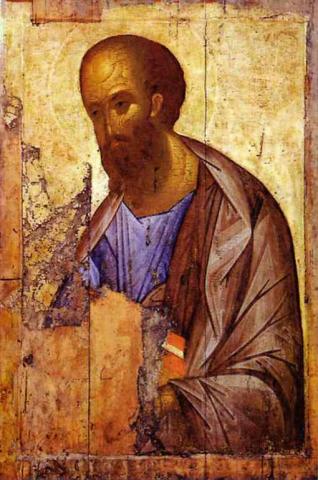
Modern scholarship attributes seven of Paul’s 13 canonical letters as unquestionably authentic:
- Romans,
- Galatians,
- I Corinthians,
- II Corinthians,
- I Thessalonians,
- Philippians, and
- Philemon
Three others are generally considered deutero or (pseudo) – Pauline and are Pauline in theology, with a couple of notable exceptions, but are different in style and much more mainline and conservative in tone than the undisputed letters. They were probably written in the generation after Paul’s death by people very familiar with his teaching. The deutero (or pseudo)-Pauline letters are:
- Colossians,
- Ephesians, and
- II Thessalonians
The last three, the “Pastoral Letters”, are largely considered pseudepigrapha (a bible scholar’s politically-correct term for “forgery”) and were probably written around the beginning of the 2nd century and exhibit patriarchal, sexist, and reactionary social attitudes one would expect of an entrenched Greco-Roman cultural institution (exactly what the early Church was becoming by that time).1,2 The pseudepigraphical letters are:
- I Timothy,
- II Timothy, and
- Titus
What follows are estimates of the percentages of biblical scholars who reject Paul’s authorship of the six books in question:
- 2 Thessalonians = 50 percent;
- Colossians = 60 percent;
- Ephesians = 70 percent;
- 2 Timothy = 80 percent;
- 1 Timothy and Titus = 90 percent.2
In addition to judgments about entire letters, scholars also question the authorship of certain passages in the undisputed letters. Post-Pauline texts are those alleged to have been inserted into a letter after its composition and are generally called scribal “interpolations”.
Among the passages that some scholars label as interpolations are:
- Romans 5:5-7, 13:1-7, 16:17-20, 16:25-27;
- 1 Corinthians 4:6b, 11:2-16, 14:33b-35 or 36;
- 2 Corinthians 6:14-7:1; and
- 1 Thessalonians 2:14-16.2,3
Given the above, one could argue that there are really three “Pauls” in the New Testament:
- The Radical Paul of the seven undisputed authentic letters
- The Conservative Paul of the three deutero-Pauline letters
- The Reactionary Paul of the three pseudepigraphical Pastoral Letters
___________________________________________________________
- The First Paul, Reclaiming the Radical Visionary Behind the Church’s Conservative Icon, By Marcus J. Borg and John Dominic Crossan , 2009 HarperCollins, NY, NY
- Apostle of the Crucified Lord, A Theological Introduction to Paul & His Letters, by Michael J. Gorman, 2004 Wm. B. Eerdmans, Grand Rapids, MI / Cambridge, UK
- The Authentic Letters of Paul, A New Reading of Paul’s Rhetoric and Meaning, by Arthur J. Dewey, Roy W. Hoover, Lane C. Mc Gaughy, and Daryl D. Schmidt, 2010 Polebridge Press, Salem, OR

