Archive for category Hesychasm – Jesus Prayer
Apophatic and Cataphatic Theology: An Issue of Emphasis and Balance
Posted by Dallas Wolf in Contemplative Prayer (series), Ekklesia and church, Essence and Energies (series), First Thoughts, Hesychasm - Jesus Prayer, The Cappadocians, Theology on April 6, 2025
Overview
Apophatic and Cataphatic are two terms used in theology to describe different approaches to understanding God. The Eastern Orthodox and Latin West each use both types. The issue comes down to one of emphasis and balance: The Orthodox East is overwhelmingly Apophatic in approach, while the Latin West is predominantly Cataphatic.
Definitions
Apophatic theology (from Greek: ἀπόφημι apophēmi, meaning “to deny”) uses “negative” terminology to indicate what it is believed the divine is not. It means emptying the mind of words and ideas and simply resting in the presence of God. Apophatic prayer is prayer that occurs without words, images, or concepts. This approach to prayer regards silence, stillness, unknowing and even darkness as doorways, rather than obstacles, to communication with God. Apophatic theology relies primarily on experience and revelation.
Cataphatic theology (from the Greek word κατάφασις kataphasis meaning “affirmation”) uses “positive” terminology to describe or refer to the divine, i.e. terminology that describes or refers to what the divine is believed to be. Cataphatic prayer is prayer that speaks thoroughly, intensively, or positively of God: prayer that uses words, images, ideas, concepts, and the imagination to relate to God. Cataphatic theology relies heavily on logic and reason.
Background
Apophatic theology—also known as negative theology or via negativa—is a theology that attempts to describe God by negation. In Orthodox Christianity, Apophatic theology is based on the assumption that God’s essence is unknowable or ineffable and on the recognition of the inadequacy of human language to describe God. The Apophatic tradition in Orthodoxy is balanced with Cataphatic theology (positive theology) via belief in the Incarnation and the self-revealed energies of God, through which God has revealed himself in the person of Jesus Christ. However, Apophatic theology is the dominant traditional Eastern paradigm of an experiential, revealed theology, intimately linking doctrine with contemplation through purgation (catharsis), illumination (theoria), and union (theosis).
Clement of Alexandria (c. 150 – 215) was an early proponent of Apophatic theology with elements of Cataphatic. Clement holds that God is unknowable, although God’s unknowability, concerns only his essence, not his energies, or powers. According to Clement’s writings, the term theoria develops further from a mere intellectual “seeing” toward a spiritual form of contemplation. Clement’s Apophatic theology or philosophy is closely related to this kind of theoria and the “mystic vision of the soul.” For Clement, God is both transcendent in essence and immanent in self-revelation.
The Cappadocian Fathers (Basil the Great, Gregory of Nyssa, and Gregory of Nazianzus (4th century)) were early exemplars of this Apophatic theology. They stated that mankind can acquire an incomplete knowledge of God in his attributes, positive and negative, by reflecting upon and participating in his self-revelatory operations (energeia). But, the essence of God is completely unknowable.
A century later Pseudo-Dionysius the Areopagite (late 5th century) in his short work Mystical Theology, first introduced and explained what came to be known as Apophatic or negative theology.
Maximus the Confessor (7th century) maintained that the combination of Apophatic theology and hesychasm—the practice of silence and stillness—made theosis or union with God possible.
John of Damascus (8th century) employed Apophatic theology when he wrote that positive (cataphatic) statements about God reveal “not the nature, but the things around the nature.”
All in all, Apophatic theology remains crucial to much of the theology in Eastern Orthodox Christianity. The opposite tends to be true in Western Latin Christianity, with a few notable exceptions to this rule.
Cataphatic theology
In the Latin West a heavily Cataphatic theology, or via positiva, developed, which remains today in most forms of Western Christianity. This type of Cataphatic theology is based on using human reason to make positive statements about the nature of God. It slowly developed from the 5th to the 11th century, emerging as Scholasticism in the Medieval Period (11th-17th centuries). (see entries for Anselm and Thomas Aquinas, below)
Augustine of Hippo (354–430) significantly influenced scholasticism, emphasizing the integration of faith and reason. His ideas laid the groundwork for later Scholastic thinkers who sought to reconcile Christian theology with classical philosophy, particularly through dialectic reasoning. Augustine’s doctrines of the filioque, original sin, the doctrine of grace, and predestination found little support outside of the Western Roman Church. Within the Western Latin church, ‘Augustinianism’ dominated early theology.
Anselm of Canterbury (c. 1033 – 1109) is widely considered the father of Scholasticism, endeavoring to render Christian tenets of faith, traditionally taken as a revealed truth, as a rational system. Scholasticism prescribed that Aristotelian dialectic reason be used in the elucidation of spiritual truth and in defense of the dogmas of Faith.
Thomas Aquinas (c. 1225 – 7 March 1274) reflects the mature emergence of this new medieval Scholastic paradigm, which promoted the use of formal intellectual reason, putting it at odds with the predominantly Eastern revealed tradition of hesychastic contemplation. Aquinas’ Summa Theologica (1265–1274), is considered to be the pinnacle of Medieval Scholastic Christian philosophy and theology. The resulting ‘Thomism’ remains the foundation of contemporary Western Latin theology.
Silence
Posted by Dallas Wolf in Ekklesia and church, Hesychasm - Jesus Prayer, Theology on March 24, 2025

“No wonder that silence is probably the foundational spiritual discipline in all the world’s religions at the more mature levels. At the less mature levels, religion is mostly noise, entertainment, and words. Catholics and Orthodox Christians prefer theatre and wordy symbols; Protestants prefer music and endless sermons.”
“And we believe in one, holy, catholic, and apostolic Church.”
Posted by Dallas Wolf in Ekklesia and church, First Thoughts, Hesychasm - Jesus Prayer, Monasticism on December 28, 2024
In the original koine Greek of the Nicene-Constantinopolitan Creed of AD 381, the subject line reads: Εἰς μίαν, Ἁγίαν, Καθολικὴν καὶ Ἀποστολικὴν Ἐκκλησίαν.
I find it sadly ironic that The Nicene-Constantinopolitan Creed, as it is recited in most worship services today, uses the first person singular (“I believe…”/”Πιστεύω”) rather than the first person plural (“We believe…”/”Πιστεύομεν”) as it was enacted at the first and second ecumenical councils (Nicaea AD 325 and Constantinople AD 381) of the undivided Church. In this self-centered, affluent, secularized, and fragmented Western world, I guess the shift from a collective “we” to an individual “I” should come as no surprise.
Christianity became the State Religion of the Roman Empire in AD 380. Since becoming that key religious institution in the social and political infrastructure of worldly power, very little has changed to this day, regardless of the form or character of the Church’s earthbound imperial partners. Fr. Richard Rohr, OFM, calls it the Church’s 1,700 year addiction to Power, Prestige, and Possessions.
Let’s analyze our subject line from the Creed: “And we believe in one, holy, catholic, and apostolic Church.”
The institutional Christian Church was no longer “One” after 451 AD; increasingly less “Holy” after 313 AD; no longer “Catholic” after 1054 (worse after 1517); and “Apostolic” only in origin (and Rome’s claim to Peter and Constantinople’s claim to Andrew are tenuous, at best.). So, nothing in this line from the Creed has been objectively true in more than 1,000 years. Reciting this line from the Nicene-Constantinopolitan Creed now is not so much a proclamation of faith, as a largely an unsupportable exercise in wishful thinking. Don’t believe it? “Google” the dated Church events and read for yourself.
Until the issues raised in the preceding paragraphs are meaningfully addressed (read: confession and repentance) by the legacy institutional Church, I think it will continue to shrink in numbers, authority, influence, and credibility. I believe the Ecclesia (Ἐκκλησία) of scripture will endure and eventually prevail; the institutional imperial Church, not so much. And Ecclesia and Church are not the same thing, in spite of institutional protests to the contrary.
In the meantime, solitary Christian hermits patiently remain in silent prayer within their virtual deserts.
Prayer Ropes and Rosaries
Posted by Dallas Wolf in Ekklesia and church, Hesychasm - Jesus Prayer, Monasticism, New Nuggets, Patristic Pearls on December 21, 2024
Both the prayer rope and the rosary are revered traditional aids to Christian prayer, yet each has its own unique origin, symbolism, and devotional use.

The Prayer Rope, now largely associated with the Eastern Orthodox Church, is a loop of knots (each knot containing seven crosses), usually made of wool, that is used to focus and intensify prayer, particularly the Jesus Prayer. It acts as a physical guide for a repeated, meditative style of prayer, allowing practitioners to keep count while reflecting and meditating. The prayer rope has its beginnings in early fourth century Christian monasticism in the Egyptian Desert, where it was devised as a tool to aid in the ascetic practice of continuous prayer (1 Thes. 5:17).
Origins: The prayer rope is known as a ‘komboskini’ in Greek and ‘chotki’ in Russian. The prayer rope owes its origins to St. Pachomius the Great, a fourth century “Desert Father” in upper Egypt and founder of cenobitic monasticism (a monastic tradition that stresses community life, over the older, eremitic, or solitary tradition). St. Pachomius established the prayer rope as a practical solution for the monks under his supervision to count prayers and prostrations consistently. The prayer rope evolved as a useful instrument for monks to keep track of their prayers, particularly the Jesus Prayer, without distraction. It gradually took on a deeper spiritual value, with each knot symbolizing a request for mercy and humility.
Symbolic Significance: Wool knots, each knot containing seven crosses, are commonly used on traditional prayer ropes to represent Christ’s flock and the shepherd’s care. The number of knots in a prayer rope varies; typically 33 (Christ’s age at crucifixion), 50, or 100.
Traditional Use: In Orthodox Christian practice, the prayer rope is typically used for private prayer in reciting the Jesus Prayer, acting as a physical and spiritual guide to help the mind (nous) and heart concentrate on prayer.

The Rosary, strongly associated with the Roman Catholic Church, is a string of beads that ends with a crucifix and is used to guide Catholics through a sequence of prayers that reflect on the lives of Christ and the Virgin Mary. Each bead signifies a specific prayer, such as the Hail Mary, and each set of beads makes a ‘decade’ that corresponds to a mystery in Christ’s life. The rosary has a long history, dating back to the Middle Ages when it first arose as a popular form of laity devotion, eventually becoming a prominent practice in Catholic piety.
Origins: The rosary is typically identified with Saint Dominic in the early 13th century. The rosary began as a simple way for lay people to join in the monastic practice of reciting the Psalms, but has since evolved into a systematic form of prayer. The rosary prayers are split into decades, each with ten Hail Marys, an Our Father, and a Glory Be, and are frequently accompanied by meditations on the Mysteries of the Rosary.
Symbolic Significance: Each rosary bead represents a prayer as well as a step in the meditation journey through Jesus Christ’s and the Virgin Mary’s lives. The rosary culminates with a crucifix, which represents Christ’s sacrifice.
Traditional Use: Roman Catholics utilize the rosary for both personal meditation and social worship. It is frequently prayed privately for personal spiritual development or in groups for social objectives and celebrations.
The “Icon Corner”
Posted by Dallas Wolf in Contemplative Prayer (series), Ekklesia and church, First Thoughts, Hesychasm - Jesus Prayer, Monasticism on November 21, 2024

The Book of Acts and the Epistles of the Apostle Paul record that in the early Church, Christians used to meet in the homes of the faithful. This tradition of the House church assembly continues to this day in Eastern Christianity. An Orthodox Christian is expected to pray constantly. Thus the house, just like the Temple (church building), is considered to be a consecrated place. The center of worship in the house is the icon corner (Greek: εικονοστάσι, iconostási).
An icon corner is normally oriented to face east. It is often located in a corner to eliminate worldly distractions and allow prayer to be more concentrated. Here is where the family’s icons were located and displayed. From the earliest days, Light has been an important part of Christian worship. It not only provides a beautiful and calming ambience; it takes on a theological significance with Christ as the Light of the World. Thus, oil lamps and candles frequently illuminate the icons in the icon corner.
In the theology of Orthodox iconography, the prayers and veneration directed to the icons are passed on to the prototype—the person depicted in the image. For, as St. John of Damascus wrote, “we do not worship paint or wood, we do not worship matter; we worship the God who created matter, who became matter (flesh) for our sake“.
The icons in the icon corner also remind us of the declaration in Hebrews 12:1, that “we are surrounded by so great a cloud of witnesses“; so we need never pray alone. We venerate these witnesses through their icons, petition them and join them in prayer and worship of our Triune God.
St. Gregory of Sinai: ‘Sowing in the Light’
Posted by Dallas Wolf in Hesychasm - Jesus Prayer, Monasticism, Patristic Pearls on April 7, 2023
St. Gregory of Sinai (c. 1260s -1346) – was a well-travelled Greek Christian monk and writer from Smyrna (modern-day İzmir, Turkey). He was instrumental in the emergence of hesychasm on Mount Athos in the early 14th century. He was a contemporary of St. Gregory Palamas.

“According to St. Paul (cf. Rom. 15:16), you “minister” the Gospel only when, having yourself participated in the light of Christ, you can pass it on actively to others. Then you sow the Logos like a divine seed in the fields of your listeners’ souls. ‘Let your speech be always filled with grace’, says St Paul (Col. 4:6), ‘seasoned’ with divine goodness. Then it will impart grace to those who listen to you with faith. Elsewhere St. Paul, calling the teachers tillers and their pupils the field they till (cf. II Tim. 2:6), wisely presents the former as ploughers and sowers of the divine Logos and the latter as the fertile soil, yielding a rich crop of virtues. True ministry is not simply a celebration of sacred rites; it also involves participation in divine blessings and the communication of these blessings to others.”
~ from: The Philokalia
Rohr: “Finding God in the depths of silence”
Posted by Dallas Wolf in First Thoughts, Hesychasm - Jesus Prayer, New Nuggets, Theology on January 24, 2023
Fr. Richard Rohr OFM, a Sojourners contributing editor, is founder of the Centre for Action and Contemplation http://www.cacradicalgrace.org in Albuquerque, New Mexico.
This article was first published in the March 2013 edition of Sojourners
Reprinted with permission from Sojourners, (800) 714-7474, http://www.sojo.net
Source: http://www.goodsams.org.au/good-oil/finding-god-in-the-depths-of-silence
BY Richard Rohr OFM
When I first began to write this article, I thought to myself, “How do you promote something as vaporous as silence? It will be like a poem about air!” But finally I began to trust my limited experience, which is all that any of us have anyway.
I do know that my best writings and teachings have not come from thinking but, as Malcolm Gladwell writes in Blink, much more from not thinking. Only then does an idea clarify and deepen for me. Yes, I need to think and study beforehand, and afterward try to formulate my thoughts. But my best teachings by far have come in and through moments of interior silence – and in the “non-thinking” of actively giving a sermon or presentation.
Aldous Huxley described it perfectly for me in a lecture he gave in 1955 titled “Who Are We?” There he said, “I think we have to prepare the mind in one way or another to accept the great uprush or downrush, whichever you like to call it, of the greater non-self”. That precise language might be off-putting to some, but it is a quite accurate way to describe the very common experience of inspiration and guidance.
All grace comes precisely from nowhere – from silence and emptiness, if you prefer – which is what makes it grace. It is both not-you and much greater than you at the same time, which is probably why believers chose both inner fountains (John 7:38) and descending doves (Matthew 3:16) as metaphors for this universal and grounding experience of spiritual encounter. Sometimes it is an uprush and sometimes it is a downrush, but it is always from a silence that is larger than you, surrounds you, and finally names the deeper truth of the full moment that is you. I call it contemplation, as did much of the older tradition.
It is always an act of faith to trust silence, because it is the strangest combination of you and not-you of all. It is deep, quiet conviction, which you are not able to prove to anyone else – and you have no need to prove it, because the knowing is so simple and clear. Silence is both humble in itself and humbling to the recipient. Silence is often a momentary revelation of your deepest self, your true self, and yet a self that you do not yet know. Spiritual knowing is from a God beyond you and a God that you do not yet fully know. The question is always the same: “How do you let them both operate as one – and trust them as yourself?” Such brazenness is precisely the meaning of faith, and why faith is still somewhat rare, compared to religion.
And yes, such inner revelations are always beyond words. You try to sputter out something, but it will never be as good as the silence itself is. We just need the words for confirmation to ourselves and communication with others. So God graciously allows us words, and gives us words, but they are almost always a regression from the more spacious and forgiving silence. Words are a much smaller container. They are always an approximation. Surely some approximations are better than others, which is why we all like good novelists, poets, and orators. Yet silence is the only thing deep enough, spacious enough, and wide enough to hold all of the contradictions that words cannot contain or reconcile.
We need to “grab for words”, as we say, but invariably they tangle us up in more words to explain, clarify, and justify what we meant by the first words – and to protect us from our opponents. From there we often exacerbate many of our own problems by babbling on even further. In Matthew 6:7, Jesus had a word for heaping up empty phrases: paganism! Only those who love us will stay with us at that point, and often love will also tell us to stop talking – which is precisely why so many saints and mystics said that love precedes and prepares the way for all true knowing. Maybe silence is even another word for love?
Most of the time, “to make a name for ourselves” like the people building the tower of Babel, we multiply words and find ourselves saying more and more about less and less. This is sometimes called gossip, or just chatter. No wonder Yahweh “scattered them”, for they were only confusing themselves (Genesis 11:4-8). Really, they were already scattered people: scattered inside and out because there was no silence.
We are all forced to overhear cell phone calls in cafés, airports, and other public places today. People now seem to fill up their available time, reacting to their boredom – and their fear of silence – often by talking about nothing, or making nervous attempts at mutual flattery and reassurance. One wonders if the people on the other end of the line really need your too-easy comforts. Maybe they do, and maybe we all have come to expect it. But that is all we can settle for when there is no greater non-self, no gracious silence to hold all of our pain and our self-doubt. Cheap communication is often a substitute for actual communion.
Words are necessarily dualistic. That is their function. They distinguish this from that, and that’s good. But silence has the wonderful ability to not need to distinguish this from that! It can hold them together in a quiet, tantric embrace. Silence, especially loving silence, is always non-dual, and that is much of its secret power. It stays with mystery, holds tensions, absorbs contradictions, and smiles at paradoxes – leaving them unresolved, and happily so. Any good poet knows this, as do many masters of musical chords. Politicians, engineers, and most Western clergy have a much harder time.
Silence is what surrounds everything, if you look long enough. It is the space between letters, words, and paragraphs that makes them decipherable and meaningful. When you can train yourself to reverence the silence around things, you first begin to see things in themselves and for themselves. This “divine” silence is before, after, and between all events for those who see respectfully (to re-spect is “to see again”).
All creation is creatio ex nihilo – from “a trackless waste and an empty void” it all came (Genesis 1:2). But over this darkness God’s spirit hovered and “there was light” – and everything else too. So there must be something pregnant, waiting, and wonderful in such voids and darkness. God’s ongoing – and maybe only – job description seems to be to “create out of nothing”. We call it grace.
God follows this pattern, as do many saints, but most of us don’t. We prefer light (read: answers, certitude, moral perfection, and conclusions) but forget that it first came from a formless darkness. This denial of silence and darkness as good teachers emerged ever more strongly after the ironically named “Enlightenment” of the seventeenth and eighteenth centuries. Our new appreciation of a kind of reason was surely good and necessary on many levels, but it also made us impatient and forgetful of the much older tradition of not knowing, unsaying, darkness, and silence. We decided that words alone would give us truth, not realising that all words are metaphors and approximations. The desert Jesus, Pseudo-Dionysius, The Cloud of Unknowing, and John of the Cross have not been ‘in’ for several centuries now, and we are much the worse for it.
The low point has now become religious fundamentalism, which ironically knows so little about the real fundamentals. We all fell in love with words, even those of us who said we believed that “the Word became flesh”. Words offer a certain light, but flesh is much better known in humble silence and waiting.
As a general spiritual rule, you can trust this one: The ego gets what it wants with words. The soul finds what it needs in silence. The ego prefers light – immediate answers, full clarity, absolute certitude, moral perfection, and undeniable conclusion – whereas the soul prefers the subtle world of darkness and light. And by that, of course, I mean a real interior silence, not just the absence of noise.
Robert Sardello, in his magnificent, demanding book Silence: The Mystery of Wholeness, writes that “Silence knows how to hide. It gives a little and sees what we do with it”. Only then will or can it give more. Rushed, manipulative, or opportunistic people thus find inner silence impossible, even a torture. They never get to the “more”. Wise Sardello goes on to say, “But in Silence everything displays its depth, and we find that we are a part of the depth of everything around us”. Yes, this is true.
When our interior silence can actually feel and value the silence that surrounds everything else, we have entered the house of wisdom. This is the very heart of prayer. When the two silences connect and bow to one another, we have a third dimension of knowing, which many have called spiritual intelligence or even “the mind of Christ” (1 Corinthians 2:10-16). No wonder that silence is probably the foundational spiritual discipline in all the world’s religions at the more mature levels. At the less mature levels, religion is mostly noise, entertainment, and words. Catholics and Orthodox Christians prefer theatre and wordy symbols; Protestants prefer music and endless sermons.
Probably more than ever, because of iPads, cell phones, billboards, TVs, and iPods, we are a toxically overstimulated people. Only time will tell the deep effects of this on emotional maturity, relationship, communication, conversation, and religion itself. Silence now seems like a luxury, but it is not so much a luxury as it is a choice and decision at the heart of every spiritual discipline and growth. Without it, most liturgies, Bible studies, devotions, ‘holy’ practices, sermons, and religious conversations might be good and fine, but they will never be truly great or life-changing – for ourselves or for others. They can only represent the surface; God is always found at the depths, even the depths of our sin and brokenness. And in the depths, it is silent.
It comes down to this: God is, and will always be, Mystery. Only a non-arguing presence, only a non-assertive self, can possibly have the humility and honesty to receive such mysterious silence.
When you can remain at peace inside of your own mysterious silence, you are only beginning to receive the immense “Love that moves the sun and the other stars”, as Dante so beautifully says – along with the immeasurable silent space between those trillions of stars, through which this Mystery is also choosing to communicate. Silence is space, and space beyond time. Those who learn to live there are spacious and timeless people. They make and leave room for all the rest of us.
Rohr: “Third Eye Seeing”
Posted by Dallas Wolf in Hesychasm - Jesus Prayer, New Nuggets on February 4, 2019
Fr. Richard Rohr – is a Franciscan priest, Christian mystic, and teacher of Ancient Christian Contemplative Prayer. He is the founding Director of the Center for Action and Contemplation in Albuquerque, NM.
“In the early medieval period, two Christian philosophers offered names for three different ways of seeing, and these names had a great influence on scholars and seekers in the Western tradition. Hugh of St. Victor (1078-1141) and Richard of St. Victor (1123-1173) wrote that humanity was given three different sets of eyes, each building on the previous one. The first eye was the eye of the flesh (thought or sight), the second was the eye of reason (meditation or reflection), and the third was the intuitive eye of true understanding (contemplation).
I describe this third eye as knowing something simply by being calmly present to it (no processing needed!). This image of “third eye” thinking, beyond our dualistic vision, is also found in most Eastern religions. We are onto something archetypal here, I think!
The loss of the “third eye” is at the basis of much of the shortsightedness and religious crises of the Western world, about which even secular scholars like Albert Einstein and Iain McGilchrist have written. Lacking such wisdom, it is hard for churches, governments, and leaders to move beyond ego, the desire for control, and public posturing. Everything divides into dualistic oppositions like liberal vs. conservative, with vested interests pulling against one another. Truth is no longer possible at this level of conversation. Even theology becomes more a quest for power than a search for God and Mystery.
One wonders how far spiritual and political leaders can genuinely lead us without some degree of contemplative seeing and action. It is hardly an exaggeration to say that “us-and-them” seeing, and the dualistic thinking that results, is the foundation of almost all discontent and violence in the world. It allows heads of religion and state to avoid their own founders, their own national ideals, and their own better instincts. Lacking the contemplative gaze, such leaders will remain mere functionaries and technicians, or even dangers to society.
We need all three sets of eyes in both a healthy culture and a healthy religion. Without them, we only deepen and perpetuate our problems.”
Evagrius Ponticus: “If you truly pray you are a theologian.”
Posted by Dallas Wolf in Hesychasm - Jesus Prayer, Monasticism, Patristic Pearls on February 4, 2019
Evagrius Ponticus (c. 346-399) – was originally from Pontus, on the southern coast of the Black Sea in what is modern-day Turkey. He served as a Lector under St. Basil the Great and was made Deacon and Archdeacon under St. Gregory of Nazianzus. He was also greatly influenced by Origen of Alexandria and St. Gregory of Nyssa. In about 383, Evagrius left Constantinople, eventually retreating to the Egyptian desert and joining a cenobitic community of Desert Fathers. As a classically trained scholar, Evagrius recorded the sayings of the desert monks and developed his own theological writings.

“If you are a theologian you truly pray. If you truly pray you are a theologian.”
from “The 153 Chapters on Prayer”, Chap. 60._____________________________________________________________________________
Note: This chapter is one of the key passages for the full understanding of the Evagrian identification of contemplation with prayer. It is also important to understand what Evagrius meant by the term “theologian”. According to David W. Fagerberg, associate professor of theology at the University of Notre Dame, to Evagrius, a “theologian is someone who has been shaped by the cooperative exercise of grace and ascetical submission, whose eyes can see after their light has been restored, whose heart wills only one thing, whose mind has changed, whose life has been reconnected to the source of life. This does not require a PhD, it requires a conversion of life.”
St. Isaac of Nineveh: On Silence
Posted by Dallas Wolf in Hesychasm - Jesus Prayer, Monasticism, Patristic Pearls, Theology on February 19, 2018
St. Isaac of Nineveh – 7th century ascetic and mystic, born in modern-day Qatar, was made Bishop of Nineveh between 660-680. Here he speaks of the importance of silence in monastic life.
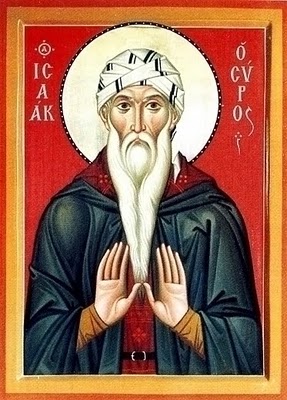
“Love silence above all things. It brings thee near the fruit which the tongue is too weak to interpret. At first we compel ourselves to be silent. Then from our silence something is born which draws us toward silence. May God grant thee to perceive that which is born of silence. If thou beginnest with this discipline, I do not know how much light will dawn in thee through it. Concerning what is said about the admirable Arsenius: that Fathers and brethren came to see him, but that he sat with them in silence and dismissed them in silence – do not think, my brother, that this happened by the action of his will alone, though in the beginning he had to compel himself. After some time some delight is born in the heart from the exercise of this service and by force it draws the body towards remaining in silence.”
“If thou placest all labors of this discipline [solitary life] on one side and silence on the other, silence will outweigh them.”
~St. Isaac of Nineveh, from Ascetical Treatises 65
 First Thoughts