Archive for category Hesychasm – Jesus Prayer
St. Symeon the New Theologian: “… first seek to learn and experience these things in fact…”
Posted by Dallas Wolf in Hesychasm - Jesus Prayer, Monasticism, Patristic Pearls on June 21, 2014
St. Symeon the New Theologian (949-1022) excoriates the church clergy for not personally being contemplatives and experiencing the presence of God (theoria) themselves before trying to lead and teach the laity. This criticism is just as valid for the institutional church today as it was for the Byzantine church in AD 1000. Few, if any, of the contemporary institutional clergy practice contemplative Christian prayer.
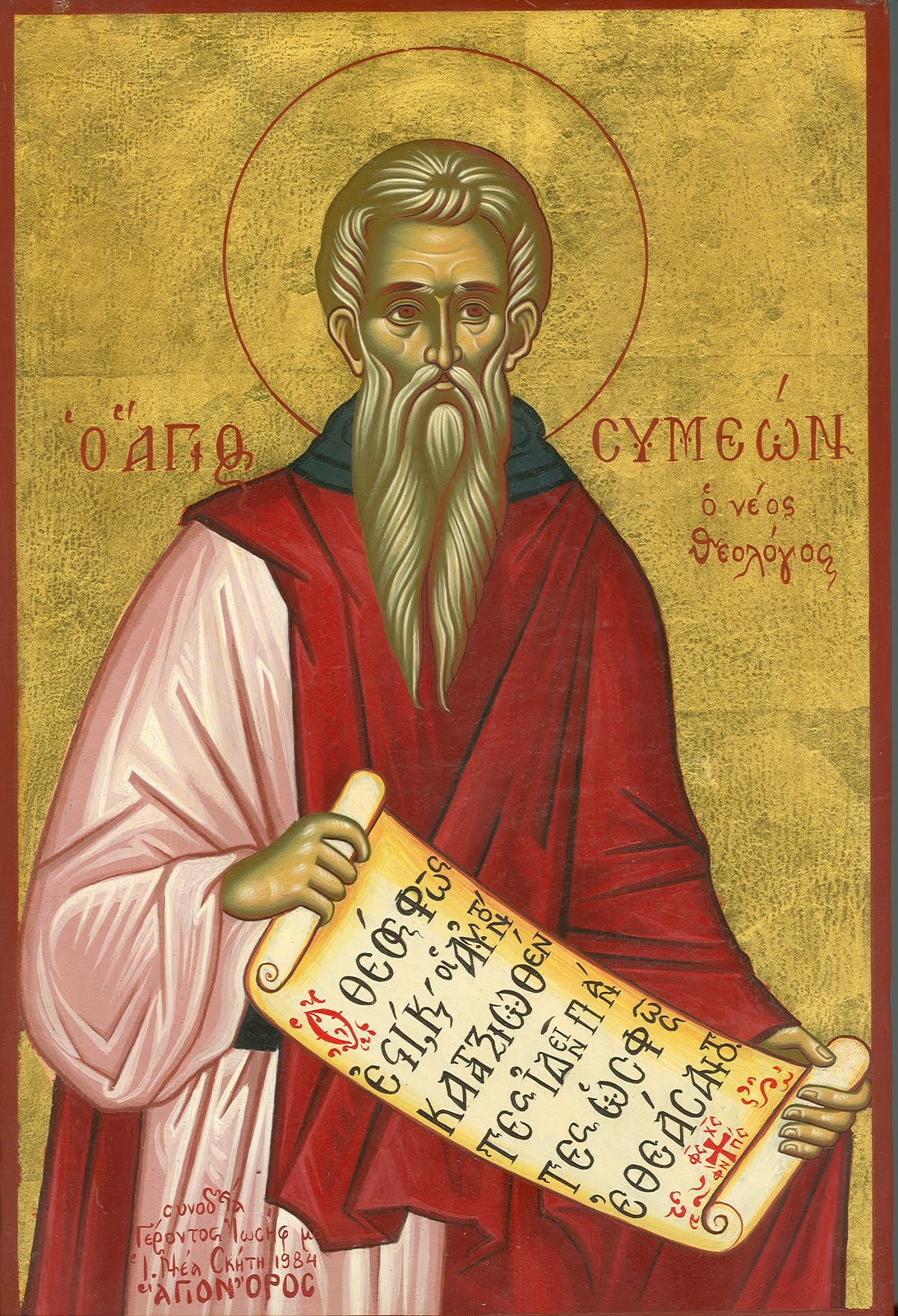
“You priests and monks teach others with vain words and think that you are rulers – but falsely! Ask your elders and high priests, gather yourselves together in the love of God, and first seek to learn and experience these things in fact, and then have the will to see this and by experience become like God. Be anxious not merely to act a play and wear the garment thereof and so to approach apostolic dignities. Otherwise, as you in your imperfection rush to rule over others, before acquiring the knowledge of the mysteries of God, you will hear these words, ‘Woe to those who are wise in their own eyes and shrewd in their own sight! Woe to those who put darkness for light and light for darkness!'”
~ from: Discourses, XXXIII
St. Isaac of Nineveh: “…hell is in my opinion: remorse.”
Posted by Dallas Wolf in Heaven and Hell, Hesychasm - Jesus Prayer, Monasticism, Patristic Pearls on June 16, 2014
St. Isaac of Nineveh – 7th century ascetic and mystic, born in modern-day Qatar, was made Bishop of Nineveh between 660-680. Especially influential in the Syriac tradition, Isaac has had a great influence in Russian culture, impacting the works of writers like Dostoyevsky.

“As for me I say that those who are tormented in hell are tormented by the invasion of love. What is there more bitter and violent than the pains of love? Those who feel they have sinned against love bear in themselves a damnation much heavier than the most dreaded punishments. The suffering with which sinning against love afflicts the heart is more keenly felt than any other torment. It is absurd to assume that the sinners in hell are deprived of God’s love. Love is offered impartially. But by its very power it acts in two ways. It torments sinners, as happens here on earth when we are tormented by the presence of a friend to whom we have been unfaithful. And it gives joy to those who have been faithful. That is what the torment of hell is in my opinion: remorse.”
~ from: Ascetic Treatises, 84
St. Symeon the New Theologian: “We bear witness that ‘God is light’…”
Posted by Dallas Wolf in Hesychasm - Jesus Prayer, Monasticism, Patristic Pearls, Theology on June 16, 2014
St. Symeon the New Theologian (949-1022) was a 10th century mystic monk. His many direct experiences of God (theoría) convinced him that all Christians must have an actual baptism of the Holy Spirit in addition to the ritualized water baptism and chrismation of the church. His mystical experiences also taught him that God is always received in the form of divine light. Symeon wrote about that light and its power to transform:
“It shines on us without evening, without change, without alteration, without form. It speaks, works, lives, gives life, and changes into light those whom it illuminates. We bear witness that “God is light,” and those to whom it has been granted to see Him have all beheld Him as light. Those who have seen Him have received Him as light, because the light of His glory goes before Him, and it is impossible for Him to appear without light. Those who have not seen His light have not seen Him, for He is the light, and those who have not received the light have not yet received grace. Those who have received grace have received the light of God and have received God, even as Christ Himself, who is the Light, has said, “I will live in them and move among them.” (2 Cor. 6:16)
~ from: Discourses, No. XXVIII
The Jesus Prayer – The Gospel in a Sentence
Posted by Dallas Wolf in Hesychasm - Jesus Prayer on February 10, 2014
“Κύριε Ιησού Χριστέ, Υιέ του Θεού, ελέησόν με τον αμαρτωλόν.”
“Lord Jesus Christ, Son of God, have mercy on me, the sinner.”
The “Jesus Prayer”, quoted above, is a central part of the Eastern Orthodox contemplative prayer tradition known as hesychasm (Greek: silence or quietude). This contemplative prayer tradition has an uninterrupted history dating back to the 4th-century Desert Fathers and Mothers. A key part of that tradition, the “Jesus Prayer”, in its various forms, is used as a continuously repeated prayer, to quiet and still the soul while invoking the name of the living God.
When I was first introduced the Orthodox “Jesus Prayer”, I was a bit put-off and skeptical. My problem was in saying over and over again, “me, the sinner” … “me, the sinner” … “me, the sinner”. Regardless of how true it might be, I thought, “Oh great, another “church” prayer designed to plunge me into an endless cycle of guilt and self-condemnation, putting me in bondage”.
Not long after my first introduction to the “Jesus Prayer”, I read then-Bishop Kallistos Ware’s book, The Orthodox Way. Bishop Kallistos described the “Jesus Prayer” as consisting of two poles. The first pole is the glory of God as expressed in the words “Lord Jesus Christ, Son of God”. The second pole is our post-Fall condition summarized in the words “me, a sinner”. Bishop Kallistos explained that it is the revelation of God in the incarnate Christ who reconciles these poles and announces the “mercy” of God for “me, the sinner”. In other words, I only address myself as “the sinner” in the context of the Son of God already having shown his “mercy” and grace to me. So being “the sinner” is not a problem I have to solve, but something I look back on after the problem has already been solved for me by Jesus.
Calling myself (repeatedly) “the sinner” then, is not so much guilt-ridden, self-flagellation over my sinful state as it is a proclamation of my deliverance and salvation. It is no coincidence that this is the same point that Jesus made in the story of the Pharisee and the Publican (Luke 18:9-14), the parable on which the “Jesus Prayer” is based. The Publican called out for mercy in his recognized condition of sin, a problem that had already been solved through the free gift of grace, and he “went home justified before God”. So, the “Jesus Prayer” is really the Gospel message condensed into one short line. The Lord of the universe, Jesus of Nazareth, Christ (Messiah), Anointed (Christos) with the Holy Spirit, Son of the living God, has already provided us mercy (“love in action”) and salvation from our problems (sin and diseased nature) before we ask him. All we have to do is cry out, like the Publican, and receive the unmerited grace already provided for us. That is the heart of the Gospel. That is the life in Christ.
I don’t have a problem praying the “Jesus Prayer” anymore.
 First Thoughts