St. Isaac of Nineveh – 7th century ascetic and mystic, born in modern-day Qatar, was made Bishop of Nineveh between 660-680. Especially influential in the Syriac tradition, Isaac has had a great influence in Russian culture, impacting the works of writers like Dostoyevsky.
“As for me I say that those who are tormented in hell are tormented by the invasion of love. What is there more bitter and violent than the pains of love? Those who feel they have sinned against love bear in themselves a damnation much heavier than the most dreaded punishments. The suffering with which sinning against love afflicts the heart is more keenly felt than any other torment. It is absurd to assume that the sinners in hell are deprived of God’s love. Love is offered impartially. But by its very power it acts in two ways. It torments sinners, as happens here on earth when we are tormented by the presence of a friend to whom we have been unfaithful. And it gives joy to those who have been faithful. That is what the torment of hell is in my opinion: remorse.”
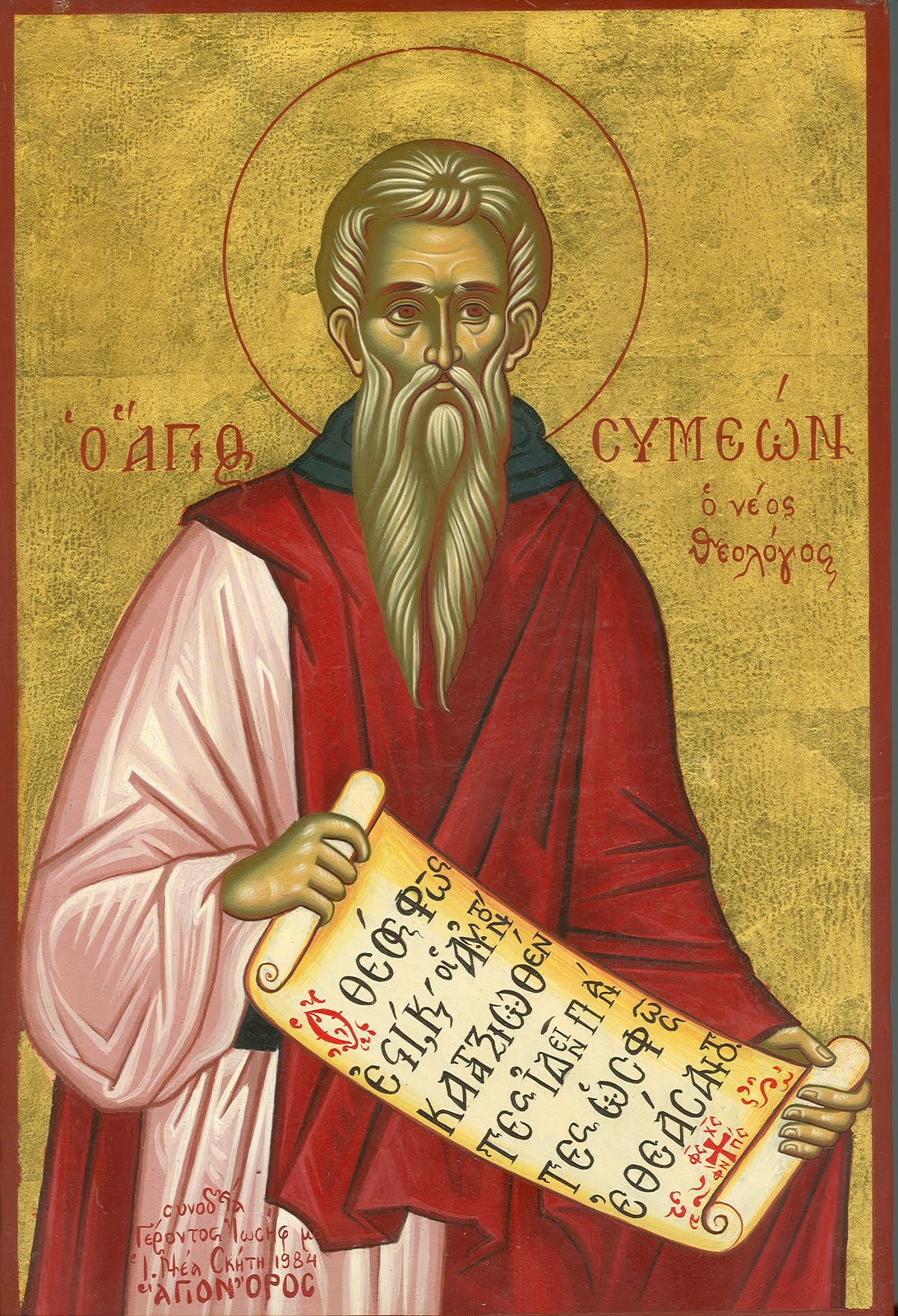
St. Symeon the New Theologian (949-1022) was a 10th century mystic monk. His many direct experiences of God (theoría) convinced him that all Christians must have an actual baptism of the Holy Spirit in addition to the ritualized water baptism and chrismation of the church. His mystical experiences also taught him that God is always received in the form of divine light. Symeon wrote about that light and its power to transform:
“It shines on us without evening, without change, without alteration, without form. It speaks, works, lives, gives life, and changes into light those whom it illuminates. We bear witness that “God is light,” and those to whom it has been granted to see Him have all beheld Him as light. Those who have seen Him have received Him as light, because the light of His glory goes before Him, and it is impossible for Him to appear without light. Those who have not seen His light have not seen Him, for He is the light, and those who have not received the light have not yet received grace. Those who have received grace have received the light of God and have received God, even as Christ Himself, who is the Light, has said, “I will live in them and move among them.” (2 Cor. 6:16)
St. John Chrysostom (344/354 – 407) -Born in Antioch into an aristocratic family, John bore witness to God as the ‘friend of humankind’ and to an uncompromising ethic of social service. Known as ‘golden-mouthed’ (Chrysostom) because of his ability as a speaker and preacher, he became Archbishop of Constantinople in AD 397. He was deposed in 404 for attempting to reform the higher clergy and for preaching against the luxury and depravity of the court of Roman Emperor Arcadius, which earned him the enmity of empress Eudoxia. He died in exile in 407. The principal Liturgy of the Eastern Orthodox Church is named in his honor; The Divine Liturgy of St. John Chrysostom.
“Enter into the church and wash away your sins. For there is a hospital for sinners and not a court of law.”
I support the notion that Christianity is about experiencing an intimate personal relationship with God. Proper theology is about how we experience that relationship from God to us. Classically, Greek Eastern (Orthodox) theology has been largely based on the experience of God’ relationship to man. The theology of the Latin West (Roman Catholic and Protestant), at least since the days of St. Augustine, has been largely based on philosophical speculation of man’s relationship to God.
For example, let’s contrast these two different approaches as they apply to Trinitarian doctrine. According to Orthodox theologian Fr. John Meyendorff, in the Eastern Greek tradition, “the incarnate Logos and the Holy Spirit are met and experienced first as divine agents of salvation, and only then are they discovered to be essentially one God.” In contrast, 19th century Jesuit theologian Fr. Theodore de Regnon stated, “Latin philosophy considers the nature in itself first and proceeds to the agent; Greek philosophy considers the agent first and passes through it to find the nature. The Latins think of personality as a mode of nature; the Greeks think of nature as the content of the person”.
The Latin approach is based on philosophical concept from man’s view of God. The Greek approach is based on how we experience God’s Biblical relationship to man.



 First Thoughts