Posts Tagged contemplative prayer
St. Macrina and the Healing of the Soldier’s Daughter
Posted by Dallas Wolf in Patristic Pearls, The Cappadocians, Women in Early Christianity on April 6, 2023
St. Macrina the Younger (ca. AD 327 – July 379), was the older sister of three Cappadocian Saints and Bishops: Basil of Caesarea, Gregory of Nyssa, and Peter of Sebasteia. She was also friends with St. Gregory of Nanzianzus. Macrina transformed one of her family’s rural estates in Pontus (modern Turkey) into a monastery for ascetic virgins who came from both an aristocratic and non-aristocratic backgrounds. All members, including those from her own household, were free and ex-slaves received the same rights and obligations as their former masters. St. Basil established a men’s monastery nearby. Macrina was so well respected and loved by her younger brother, Gregory, that he wrote two books about her virtues, holiness, and intellect soon after her death in AD 379: The Life of Saint Macrina and On the Soul and the Resurrection. The post below is an excerpt from The Life of Saint Macrina, written in about AD 381.

“Along the way [from Macrina’s funeral], a distinguished military man who had command of a garrison in a little town of the district of Pontus, called Sebastopolis, and who lived there with his subordinates, came with the kindly intentions to meet me [Gregory of Nyssa] when I arrived there. He had heard of our misfortune [the death of Macrina] and he took it badly (for, in fact, he was related to our family by kinship and also by close friendship). He gave me an account of a miracle worked by Macrina; and this will be the last event I shall record in my story before concluding my narrative. When we stopped weeping and were standing in conversation, he said to me, “Hear what a great good has departed from human life.” And with this he stated his story.
“It happened that my wife and I once desired to visit that powerhouse of virtue; for that’s what I think that place should be called in which the blessed soul spent her life. Our little daughter was also with us and she suffered from an eye ailment as a result of an infectious disease. And it was a hideous and pitiful sight, since the membrane around the pupil was swollen and because of the disease had taken on a whitish tinge. As we entered that divine place, we separated, my wife and I, to make our visit to those who lived a life of philosophy1 therein, I going to the monks’ enclosure where your brother, Peter [of Sebaste], was abbot, and my wife entering the convent to be with the holy one. After a suitable interval had passed, we decided it was time to leave the monastery retreat and we were already getting ready to go when the same, friendly invitation came to us from both quarters. Your brother asked me to stay and take part in the philosophic table, and the blessed Macrina would not permit my wife to leave, but she held our little daughter in her arms and said that she would not give her back until she had given them a meal and offered them the wealth of philosophy; and, as you might have expected, she kissed the little girl and was putting her lips to the girl’s eyes, when she noticed the infection around the pupil and said, “If you do me the favor of sharing our table with us, I will give you in return a reward to match your courtesy.” The little girl’s mother asked what it might be and the great Macrina replied, “It is an ointment I have that has the power to heal the eye infection.” When after this a message reached me from the women’s quarters telling me of Macrina’s promise, we gladly stayed, counting of little consequence the necessity which pressed us to make our way back home.
Finally the feasting was over and our souls were full. The great Peter with his own hands had entertained and cheered us royally, and the holy Macrina took leave of my wife with every courtesy one could wish for. And so, bright and joyful, we started back home along the same road, each of us telling the other what happened to each as we went along. And I recounted all I had seen and heard in the men’s enclosure, while she told me every little thing in detail, like a history book, and thought that she should omit nothing, not even the least significant details. On she went telling me about everything in order, as if in a narrative, and when she came to the part where a promise of a cure for the eye had been made, she interrupted the narrative to exclaim, “What’s the matter with us! How did we forget the promise she made us, the special eye ointment?” And I was angry about our negligence and summoned some one to run back quickly to ask for the medicine, when our baby, who was in her nurse’s arms, looked, as it happened, towards her mother. And the mother gazed intently at the child’s eyes and then loudly exclaimed with joy and surprise, “Stop being angry at our negligence! Look! There’s nothing missing of what she promised us, but the true medicine with which she heals diseases, the healing which comes from prayer, she has given us and it has already done its work, there’s nothing whatsoever left of the eye disease, all healed by that divine medicine!” And as she was saying this, she picked the child up in her arms and put her down in mine. And then I too understood the incredible miracles of the gospel, which I had not believed in, and exclaimed: “What a great thing it is when the hand of God restores sight to the blind, when today his servant heals such sicknesses by her faith in Him, an event no less impressive than those miracles!” All the while he was saying this, his voice was choked with emotion and the tears flowed into his story. This then is what I heard from the soldier.”
~ from The Life of Saint Macrina, by St. Gregory of Nyssa
__________________________________________________________________________________________________________________
1 Philosophy as the ideal of the Christian monastic life plays a central role in The Life of Saint Macrina (LSM) and will undoubtedly seem strange, even alien, to modern ears long accustomed to the scholasticism and secularization of academic disciplines. However, the essential and organic unity of the spiritual, intellectual, and physical ways of life, central to the monastic Rule of St. Basil, even yields such a remarkable phrase in the LSM as “the philosophic table”. This usage accurately reflects St. Gregory’s fourth-century Christian understanding of “philosophy”, i.e., love of wisdom, passion for the truth, care of the soul, contemplation (theoria), and ascetic physical discipline which spurns attachment to material things while recognizing that the body will be restored to its true God-created stature by the resurrection.
St. Maximus the Confessor: “…and having entered the dark cloud”
Posted by Dallas Wolf in Contemplative Prayer (series), First Thoughts, Patristic Pearls on April 4, 2023
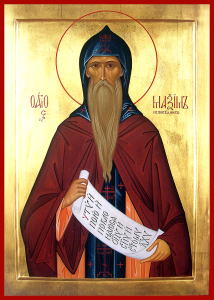
St. Maximus the Confessor (c. 580 – 662) was a 7th century Christian monk, theologian, and scholar who many contemporary scholars consider to be the greatest theologian of the Patristic era. Two of his most famous works are “Ambigua” – An exploration of difficult passages in the work of Pseudo-Dionysius and Gregory of Nazianzus, focusing on Christological issues, and “Questions to Thalassius” or “Ad Thalassium” – a lengthy exposition on various Scriptural texts. The following quote comes from Maximus’ “Two Hundred Chapters on Theology”, probably written after both Ambigua and Ad Thalassium, in about AD 633.
“The great Moses, having pitched his tent outside the camp, that is, having established his will and intellect outside visible realities, begins to worship God; and having entered the dark cloud [γνόφον], the formless and immaterial place of knowledge, he remains there, performing the holiest rites.
The dark cloud [γνόφος] is the formless, immaterial, and incorporeal condition containing the paradigmatic knowledge of beings; he who has come to be inside it, just like another Moses, understands invisible realities in a mortal nature; having depicted the beauty of the divine virtues in himself through this state, like a painting accurately rendering the representation of the archetypal beauty, he descends, offering himself to those willing to imitate virtue, and in this shows both love of humanity and freedom from envy of the grace of which he had partaken.”
~ from: Two Hundred Chapters on Theology, 1.84, 1.85.
Rohr: “Where the material and spirit coincide, there is the Christ”
Posted by Dallas Wolf in New Nuggets, Theology on October 30, 2022
Fr. Richard Rohr – is a Franciscan priest, Christian mystic, and teacher of Ancient Christian Contemplative Prayer. He is the founding Director of the Center for Action and Contemplation in Albuquerque, NM.

“If you had been present at the moment of the Resurrection, what would you have seen? If there had been a video camera outside the tomb, what would it have recorded? Perhaps there would have been a huge flash of light or a subtle glimmer of a dimension beyond our usual perception. At the Resurrection, we believe the historical body of Jesus moved beyond any confinement of space and time. The presence which was captured in finite form was revealed to be an infinite omnipresence. He moved from Jesus to Christ, which now includes in its sweep all of creation and even you and me. The texts all agree that this movement had a physical dimension to it, but it is a new kind of embodiment that is both of this world and yet not limited by it. Thanks to Einstein, we now know that matter and energy are convertible forces.
Whenever the material and the spiritual coincide, there is the Christ. Jesus accepted that full identity and walked it into history. He was fully human and fully divine at the same time. So now we can begin to imagine how they could coexist. The material and the spiritual are one, the human and the divine are forever, the physical plumbed to its depth finds transcendence! The hiding place of God is also the place of revelation—here and now and everywhere. This is an utterly new notion of religiosity, so much so that most of Christian history (Orthodox, Catholic, Protestant, or Pentecostal) missed this major point and lived in a split universe.
The mystery of Christ is revealed, and the Christ “comes again,” whenever you are able to see the spiritual and the material coexisting, in any moment, in any event, and in any person. God’s hope for history seems to be that humanity will one day be able to recognize its dignity as the divine dwelling place, which it shares with the rest of creation. I don’t know when it will happen or what it will look like to reach the tipping point, for the Christ Mystery to come to fullness. All I know is that this meaning, planted in the middle of things, was meant to give humanity both direction and immense confidence. I suspect “the Second Coming of Christ” happens whenever and wherever we allow this to be utterly true for us. We’re still living in the in-between right now, slowly edging forward, with much resistance. As it says in Romans 8:22-23, creation is “groaning in anticipation,” or as one translation states, “We are standing on tiptoe waiting for the revelation of the sons and daughters of God.” I hope such implanted hope gets your whole life up on its toes!”
Meditation – Monday, March 23, 2015
Rohr: “Third Eye Seeing”
Posted by Dallas Wolf in Hesychasm - Jesus Prayer, New Nuggets on February 4, 2019
Fr. Richard Rohr – is a Franciscan priest, Christian mystic, and teacher of Ancient Christian Contemplative Prayer. He is the founding Director of the Center for Action and Contemplation in Albuquerque, NM.
“In the early medieval period, two Christian philosophers offered names for three different ways of seeing, and these names had a great influence on scholars and seekers in the Western tradition. Hugh of St. Victor (1078-1141) and Richard of St. Victor (1123-1173) wrote that humanity was given three different sets of eyes, each building on the previous one. The first eye was the eye of the flesh (thought or sight), the second was the eye of reason (meditation or reflection), and the third was the intuitive eye of true understanding (contemplation).
I describe this third eye as knowing something simply by being calmly present to it (no processing needed!). This image of “third eye” thinking, beyond our dualistic vision, is also found in most Eastern religions. We are onto something archetypal here, I think!
The loss of the “third eye” is at the basis of much of the shortsightedness and religious crises of the Western world, about which even secular scholars like Albert Einstein and Iain McGilchrist have written. Lacking such wisdom, it is hard for churches, governments, and leaders to move beyond ego, the desire for control, and public posturing. Everything divides into dualistic oppositions like liberal vs. conservative, with vested interests pulling against one another. Truth is no longer possible at this level of conversation. Even theology becomes more a quest for power than a search for God and Mystery.
One wonders how far spiritual and political leaders can genuinely lead us without some degree of contemplative seeing and action. It is hardly an exaggeration to say that “us-and-them” seeing, and the dualistic thinking that results, is the foundation of almost all discontent and violence in the world. It allows heads of religion and state to avoid their own founders, their own national ideals, and their own better instincts. Lacking the contemplative gaze, such leaders will remain mere functionaries and technicians, or even dangers to society.
We need all three sets of eyes in both a healthy culture and a healthy religion. Without them, we only deepen and perpetuate our problems.”
Fr. Seraphim (Aldea): Foundation of True Prayer.
Posted by Dallas Wolf in Monasticism, New Nuggets on March 3, 2018
Fr. Seraphim (Aldea) (1965 – ) – was tonsured as an Orthodox monk in 2005 at Rasca monastery in Bucovine, North Moldavia. He has a PhD in Modern Theology from the University of Durham (UK) for a thesis on Archimandrite Sophrony (Sakharov)’s Ecclesiology. He is currently obeying God’s calling to found the Monastery of all Celtic Saints on the Scottish Isle of Mull. This will be the first Orthodox monastery in Celtic Britain in over a millennium (See http://www.mullmonastery.com).
“Prayer in the most early stages is something you have to do. You do it because your spiritual father says so, because the Holy Fathers say so, and because Christ Himself says so. Although this is not really prayer, by following someone else – the way the Apostles did – you lay the foundation for real prayer; this foundation is obedience. You do something not out of your own will, but because someone else tells you to. You may not be aware of it, but in doing this, you have declared war on your own nature, because it is deeply un-natural in our fallen world to oppose your own will, to reject your own logic and to let go of self-control. It is against reason, against instinct, against all the things we have become in order to survive.
When you start praying, you have in fact started your wandering through the desert. It may last less than forty years; it may last until the day you die. You may see the Promised Land while still in this life; you may die in the desert, and only enter the Kingdom after you have departed this life.
The one thing that matters is that you start; as long as you keep going, you will be all right. The advice you will find in all the Fathers is to keep praying, keep yourself on the path; although you may feel it has no effect and that it leads to nowhere, in reality the fruits of this cross are already present in you. The roots of the prayer are already growing in your flesh and soul, and that is a painful process; that is why you are in pain.
During these long years, you will not be levitating, you will not be swallowed in light, but you will become more humble, more aware of how weak and limited you are, and less inclined to judge other people. These fruits are the foundation upon which real prayer will be built at the right time. If you do not go through this process of transformation, if your faith does not survive this desert, if you do not conquer this hell by patience and humility, you will not reach the Resurrection of true prayer.”
~ Excerpt from the booklet, “On Prayer”, published by The Orthodox Monastery of All Celtic Saints
St. Ignaty Brianchaninov: “On Practicing the Jesus Prayer”
Posted by Dallas Wolf in Hesychasm - Jesus Prayer, Patristic Pearls on November 2, 2017
Saint Ignatius (Brianchaninov), (1807–1867) – was a bishop and theologian of the Russian Orthodox Church. His two most important books translated into English are: The Arena: An Offering to Contemporary Monasticism; and On the Prayer of Jesus.

St Ignatius (Brianchaninov)
“The correct practice of the Jesus Prayer proceeds naturally from correct notions about God, about the most holy name of the Lord Jesus, and about man’s relationship to God.
Approach Prayer with Humility
God is an infinitely great and all-perfect being. God is the Creator and Renewer of men, Sovereign Master over men, angels, demons and all created things, both visible and invisible. Such a notion of God teaches us that we ought to stand prayerfully before Him in deepest reverence and in great fear and dread, directing toward Him all our attention, concentrating in our attention all the powers of the reason, heart, and soul, and rejecting distractions and vain imaginings, whereby we diminish alertness and reverence, and violate the correct manner of standing before God, as required by His majesty (John 4:23-24; Matt. 22:37; Mark 12:29-30; Luke 10:27). St. Isaac the Syrian put it marvelously: “When you turn to God in prayer, be in your thoughts as an ant, as a serpent of the earth, like a worm, like a stuttering child. Do not speak to Him something philosophical or high-sounding, but approach Him with a child’s attitude” (Homily 49). Those who have acquired genuine prayer experience an ineffable poverty of the spirit when they stand before the Lord, glorify and praise Him, confess to him, or present to Him their entreaties. They feel as if they had turned to nothing, as if they did not exist. That is natural. For when he who is in prayer experiences the fullness of the divine presence, of Life Itself, of Life abundant and unfathomable, then his own life strikes him as a tiny drop in comparison to the boundless ocean. That is what the righteous and long-suffering Job felt as he attained the height of spiritual perfection. He felt himself to be dust and ashes; he felt that he was melting and vanishing as does snow when struck by the sun’s burning rays (Job 42:6).
The name of our Lord Jesus Christ is a divine name. The power and effect of that name are divine, omnipotent and salvific, and transcend our ability to comprehend it. With faith therefore, with confidence and sincerity, and with great piety and fear ought we to proceed to the doing of the great work which God has entrusted to us: to train ourselves in prayer by using the name of our Lord Jesus Christ. “The incessant invocation of God’s name,” says Barsanuphius the Great, “is a medicine which mortifies not just the passions, but even their influence. Just as the physician puts medications or dressings on a wound that it might be healed, without the patient even knowing the manner of their operation, so also the name of God, when we invoke it, mortifies all passions, though we do not know how that happens” (421st Answer).
Our ordinary condition, the condition of all mankind, is one of fallenness, of spiritual deception, of perdition. Apprehending—and to the degree that we apprehend, experiencing—that condition, let us cry out from it in prayer, let us cry in spiritual humility, let us cry with wails and sighs, let us cry for clemency! Let us turn away from all spiritual gratifications, let us renounce all lofty states of prayer of which we are unworthy and incapable! It is impossible “to sing the Lord’s song in a strange land” (Ps. 136:5), in a heart held captive by passions. Should we hear an invitation to sing, we can know surely that it emanates “from them that have taken us captive” (Ps. 136:3). “By the waters of Babylon” tears alone are possible and necessary (Ps. 136:1).
Rule for Practicing the Jesus Prayer
This is the general rule for practicing the Jesus Prayer, derived from the Sacred Scriptures and the works of the Holy Fathers, and from certain conversations with genuine men of prayer. Of the particular rules, especially for novices, I deem the following worthy of mention.
Be Attentive
St. John of the Ladder counsels that the mind should be locked into the words of the prayer and should be forced back each time it departs from it (Step XXVIII, ch. 17). Such a mechanism of prayer is remarkably helpful and suitable. When the mind, in its own manner, acquires attentiveness, then the heart will join it with its own offering— compunction. The heart will empathize with the mind by means of compunction, and the prayer will be said by the mind and heart together.
Do Not Hurry
The words of the prayer ought to be said without the feast hurry. even lingering, so that the mind can lock itself into each word.
Persevere bring attention Back to the Words when the Mind wanders
St. John of the Ladder consoles and instructs the coenobitic… “God does not expect a pure and undistracted prayer. Despair not should inattention come over you! Be of cheerful spirit and constantly compel your mind to return to itself! For the angels alone are not subject to any distraction” (Step IV, ch. 93). “Being enslaved by passions, let us persevere in praying to the Lord: for all those who have reached the state of passionlessness did so with the help of such indomitable prayer. If, therefore, you tirelessly train your mind never to stray from the words of the prayer, it will be there even at mealtime. A great champion of perfect prayer has said: ‘I had rather speak five words with my understanding … than ten thousand words in an unknown tongue’ (I Cor. 14:19). Such prayer,” that is, the grace-given prayer of the mind in the heart, which shuns imaginings, “is not characteristic of children; wherefore we who are like children, being concerned with the perfection of our prayer,” that is, the attentiveness which is acquired by locking the mind into the words of the prayer, “must pray a great deal. Quantity is the cause of quality. The Lord gives pure prayer to him who, eschewing laziness, prays much and regularly in his own manner, even if it is marred by inattention” (The Ladder, Step XXVI11, ch. 21).
It Takes Time
Novices need more time in order to train themselves in prayer… Asceticism needs both time and gradual progress, so that the ascetic can mature for prayer in every respect. In order that a flower might bloom or the fruit grow on a tree, the tree must first be planted and left to develop; thus also does prayer grow out of the soil of other virtues and nowhere else… Pulled hither and thither by its acquired predilections, impressions, memories and worries, the novice’s mind constantly breaks its salvific chains and strays from the narrow to the wide path. It prefers to wander freely, to stroll in the regions of falsehood in association with the fallen spirits, to stray aimlessly and mindlessly over great expanses, though this be damaging to him and cause him great loss. The passions, those moral infirmities of human nature, are the principal cause of inattentiveness and absentmindedness in prayer. The more they are weakened in a man, the less is he distracted in spirit when praying. The passions are brought under control and mortified little by little by means of obedience, as well as by self-reproach and humility—these are the virtues upon which successful prayer is built. Concentration, which is accessible to man, is granted by God in good time to every struggler in piety and asceticism who by persistence and ardor proves the sincerity of his desire to acquire prayer.
Begin by saying the Prayer Aloud
The Russian hieromonk Dorotheus, a great instructor in spiritual asceticism, who was in this respect very much like St. Isaac the Syrian, counsels those who are learning the Jesus Prayer to recite it aloud at first. The vocal prayer, he says, will of itself turn into the mental.
After much vocal prayer there comes Mental Prayer
“Mental prayer,” he continues, “is the result of much vocal prayer, and mental prayer leads to the prayer of the heart. The Jesus Prayer should not be said in a loud voice but quietly, just audibly enough that you can hear yourself.,’ It is particularly beneficial to practice the Jesus Prayer aloud when assailed by distraction, grief, spiritual despondency and laziness. The vocal Jesus Prayer gradually awakens the soul from the deep moral slumber into which grief and spiritual despair are wont to thrust it. It is also particularly beneficial to practice the Jesus Prayer aloud when attacked by images, appetites of the flesh, and anger; when their influence causes the blood to boil. It should be practiced when peace and tranquility vanish from the heart, and the mind hesitates, becomes weak, and—so to speak—goes into upheaval because of the multitude of unnecessary thoughts and images. The malicious princes of the air, whose presence is hidden to physical sight but who are felt by the soul through their influences upon it, hearing as they mount their attack the name of the Lord Jesus—which they dread—will become undecided and confused, and will take fright and withdraw immediately from the soul. The method of prayer which the hieromonk suggests is very simple and easy. It should be combined with the method of St. John of the Ladder: the Jesus Prayer should be recited loud enough that you can hear yourself, without any hurry, and by locking the mind into the words of the prayer. This last, the hieromonk enjoins upon all who pray by Jesus’ name….
Establish a Daily Rule for Prostrations
The novice who is studying the Jesus Prayer will advance greatly by observing a daily rule comprising a certain number of full prostrations and bows from the waist, depending upon the strength of each individual. These are all to be performed without any hurry, with a repentant feeling in the soul and with the Jesus Prayer on the lips during each prostration…. Twelve prostrations suffice in the beginning. Depending upon one’s strength, ability and circumstances, that number can be constantly increased. But when the number of prostrations increases, one should be careful to preserve the quality of one’s prayer, so that one not be carried away by a preoccupation with the physical into fruitless, and even harmful, quantity. The bows warm up the body and somewhat exhaust it, and this condition facilitates attention and compunction. But let us be watchful, very watchful, lest the state pass into a bodily preoccupation which is foreign to spiritual sentiments and recalls our fallen nature! Quantity, useful as it is when accompanied by the proper frame of mind and the proper objective, can be just as harmful when it leads to a preoccupation with the physical. The latter is recognized by its fruits which also distinguish it from spiritual ardor. The fruits of physical preoccupation are conceit, self-assurance, intellectual arrogance: in a word, pride in its various forms, all of which are easy prey to spiritual deception. The fruits of spiritual ardor are repentance, humility, weeping and tears. The rule of prostrations is best observed before going to sleep: then, after the cares of the day have passed, it can be practiced longer and with greater concentration…. Prostrations stimulate a prayerful state of the mind and mortify the body as well as support and strengthen fervor in prayer.
These suggestions are, I believe, sufficient for the beginner who is eager to acquire the Jesus Prayer. “Prayer,” said the divine St. Meletius the Confessor, “needs no teacher. It requires diligence, effort and personal ardor, and then God will be its teacher.” The Holy Fathers, who have written many works on prayer in order to impart correct notions and faithful guidance to those desiring to practice it, propose and decree that one must engage in it actively in order to gain experiential knowledge, without which verbal instruction, though derived from experience, is dead, opaque, incomprehensible and totally inadequate. Conversely, he who is carefully practicing prayer and who is already advanced in it, should refer often to the writings of the Holy Fathers about prayer in order to check and properly direct himself, remembering that even the great Paul, though possessing the highest of all testimonies for his Gospel—that of the Holy Spirit— nevertheless went to Jerusalem where he communicated to the apostles who had gathered there the Gospel that he preached to the gentiles, “lest by any means,” as he said, “I should run, or had run, in vain ” (Gal. 2:2).”
Translated by Stephen Karganovic from The Alphabet of Orthodox Life, Belgrade, 1974. This appeared in Orthodox Life, vol. 28, no. 5, Sept.-Oct. 1978, pp. 9-14. Reprinted with permission.
Source: http://orthodoxinfo.com/praxis/ignaty_jesus.aspx
Met. Kallistos (Ware): “On the Jesus Prayer”
Posted by Dallas Wolf in Hesychasm - Jesus Prayer, New Nuggets on October 21, 2017
Metropolitan Kallistos (Ware) of Diokleia – (b. 1934) is a titular metropolitan of the Orthodox Ecumenical Patriarchate in Great Britain. From 1966-2001, he was Spalding Lecturer of Eastern Orthodox Studies at Oxford University, and has authored numerous books and articles pertaining to the Orthodox faith.

“There is a Trinitarian dimension to the most dearly-loved of single-phrase Orthodox prayers, the Jesus Prayer, an ‘arrow prayer’ used both at work and during times of quiet. In its most common form this runs: Lord Jesus Christ, Son of God, have mercy on me a sinner. This is, in outward form, a prayer to the second person of the Trinity, the Lord Jesus Christ. But the other two persons are also present, although they are not named. For, by speaking of Jesus as ‘Son of God’, we point towards his Father; and the Spirit is also embraced in our prayer, since ‘no one can say “Lord Jesus”, except in the Holy Spirit’ (1 Cor. 12:3). The Jesus Prayer is not only Christ-centered but Trinitarian.
Let us now consider what it has to tell us about the Incarnation of Jesus Christ, and about our healing by and in him.
There are in the Jesus Prayer two ‘poles’ or extreme points. ‘Lord … Son of God’: the Prayer speaks first about God’s glory, acclaiming Jesus as the Lord of all creation and the eternal Son. Then at its conclusion the Prayer turns to our condition as sinners- sinful by virtue of the fall, sinful through our personal acts of wrongdoing: ‘. . . on me a sinner’. (In its literal meaning the Greek text is yet more emphatic, saying ‘on me the sinner’, as if I were the only one.)
So the Prayer begins with adoration and ends with penitence. Who or what is to reconcile these two extremes of divine glory and human sinfulness? There are three words in the Prayer which give the answer. The first is ‘Jesus’, the personal name conferred on Christ after his human birth from the Virgin Mary. This has the sense of Saviour: as the angel said to Christ’s foster-father St Joseph: ‘You shall call his name Jesus, for he shall save his people from their sins’ (Matt. 1:21).
The second word is the title ‘Christ’, the Greek equivalent of the Hebrew ‘Messiah’, meaning the Anointed One – anointed, that is, by the Holy Spirit of God. For the Jewish people of the Old Covenant, the Messiah was the coming deliverer, the future king, who in the power of the Spirit would set them free from their enemies.
The third word is ‘mercy’, a term that signifies love in action, love working to bring about forgiveness, liberation and wholeness. To have mercy is to acquit the other of the guilt which by his own efforts he cannot wipe away 1 to release him from the debts he himself cannot pay, to make him whole from the sickness for which he cannot unaided find any cure. The term ‘mercy’ means furthermore that all this is conferred as a free gift: the one who asks for mercy has no claims upon the other, no rights to which he can appeal.
The Jesus Prayer, then, indicates both man’s problem and God’s solution. Jesus is the Saviour, the anointed king, the one who has mercy. But the Prayer also tells us something more about the person of Jesus himself. He is addressed as ‘Lord’ and ‘Son of God’: here the Prayer speaks of his Godhead, of his transcendence and eternity. But he is addressed equally as ‘Jesus’, that is, by the personal name which his mother and his foster-father gave him after his human birth in Bethlehem. So the Prayer speaks also of his manhood, of the genuine reality of his birth as a human being.
The Jesus Prayer is thus an affirmation of faith in Jesus Christ as alike truly divine and fully human. He is the Theanthropos or ‘God-man’, who saves us from our sins precisely because he is God and man at once. Man could not come to God, so God has to come to man – by making himself human. In his outgoing or ‘ecstatic’ love, God unites himself to his creation in the closest of all possible unions, by himself becoming that which he has created. God, as man, fulfils the mediatorial task which man rejected at the fall. Jesus our Saviour bridges the abyss between God and man because he is both at once. As we say in one of the Orthodox hymns for Christmas Eve, ‘Heaven and earth are united today, for Christ is born. Today has God come down to earth, and man gone up to heaven’.” ~Met. Kallistos (Ware), from The Orthodox Way, p.48, 90-92.
Leloup: “Apophasis, Hesychasm, and Divinization”
Posted by Dallas Wolf in New Nuggets, Theology on September 26, 2016
“Thus, St. Thomas will say, ‘Concerning God, one cannot say what God is, but only what God is not.’ In this manner the apophatic way recalls the transcendence of God, that divine otherness which neither the mind, nor the senses of anything can grasp. […] Apophasis is the direct apprehension of the Real just as it is, without the projections of the discursive mind that distort the Real. It is to see without eyes, to comprehend without the mind.”
“Proceeding directly from this apophatic tradition, hesychasm will be profoundly Christocentric. Without Christ, in fact, divinization is not possible. Christ’s incarnation establishes the full communion between God and humanity. God became human so that humans might become God. ‘God became the bearer of flesh so that humanity might become the bearer of the Spirit’, said Athanasius of Alexandria. […] This paradoxical union, which is realized in the Spirit, recreates us in the image and likeness of the Son of God. Humanity rediscovers the beauty for which it was created.”
“This union also leads the hesychasts to affirm with Gregory of Palamas the reality of the experience of God, while continuing to affirm His transcendence. […] Two affirmations characterize hesychastic experience: the affirmation of divine transcendence, of God’s inaccessible essence, and the nearness of God, God’s immanence and presence in each of us, the divinization of humanity through the energies of the Word and the Spirit.”
From, Being Still, pp. 56, 59, 61, 62, 64
Met. Kallistos (Ware) – “The true aim of theology…”
Posted by Dallas Wolf in Hesychasm - Jesus Prayer, New Nuggets, Theology on August 24, 2016
Metropolitan Kallistos (Ware) of Diokleia – (b. 1934) is a titular metropolitan of the Orthodox Ecumenical Patriarchate in Great Britain. From 1966-2001, he was Spalding Lecturer of Eastern Orthodox Studies at Oxford University, and has authored numerous books and articles pertaining to the Orthodox faith.
“The true aim of theology is not rational certainty through abstract arguments, but personal communion with God through prayer.”
– Met. Kallistos Ware
Met. Hierotheos (Vlachos): “Man has two cognitive centers.”
Posted by Dallas Wolf in Hesychasm - Jesus Prayer, New Nuggets, Theology on August 22, 2016
 “Man has two cognitive centers. One is the nous, the organ suited for receiving God’s revelation which is then formulated by our reason, while the other is reason, which knows the tangible world around us. With our nous we acquire knowledge of God, while with our reason we acquire knowledge of the world and the learning offered by the science of sensory things.”
 First Thoughts