Posts Tagged contemplative prayer
Isaac of Nineveh: God’s Justice is not Rome’s Imperial ‘Iustitia’
Posted by Dallas Wolf in Monasticism, Patristic Pearls, Theology on July 4, 2014
Isaac of Nineveh – 7th century ascetic and mystic, born in modern-day Qatar, was made Bishop of Nineveh between 660-680. Here Isaac easily debunks the Western Latin notion that God’s righteousness, or “dikaiosyne theou“, is the same as secular Imperial Roman Justice, or “Iustitia“.

“How can you call God just when you read the parable of the laborers in the vineyard and their wages? ‘Friend, I am doing you no wrong… I choose to give to this last as I give to you… do you begrudge my generosity?’ Likewise how can you call God just when you read the parable of the prodigal son who squanders his father’s wealth in riotous living, and the moment he displays some nostalgia his father runs to him, throws his arms around his neck and gives him complete power over all his riches? It is not someone else who has told us this about God, so that we might have doubts. It is his own Son himself. He bore this witness to God. Where is God’s justice? Here, in the fact that we were sinners and Christ died for us…” ~ Ascetic Treatises, 60
Hierotheos: “Christ as physician; Church as hospital”
Posted by Dallas Wolf in Ekklesia and church, New Nuggets on June 28, 2014
Metropolitan Hierotheos (Vlachos) of Nafpaktos, born in Greece in 1945, is one of the greatest living Christian theologians. The influence of fellow theologian, Fr. John Romanides, the study of the patristic texts (particularly those of the neptic hesychast Fathers of the Philokalia), many years of studying St. Gregory Pálamas, association with the monks of the Holy Mountain (Mount Athos in northern Greece), and many years of pastoral experience, all brought him to the realization that Christian theology is a science of the healing of humankind’s fallen nature and damaged nous and that the early Church Fathers can be of immense help to modern society, so disturbed and afflicted as it is by its many internal and existential problems.

Met. Hierotheos (Vlachos) 1945 –
“In the parable of the Good Samaritan the Lord showed us several truths. As soon as the Samaritan saw the man who had fallen among thieves who had wounded him and left him half-dead, he “had compassion on him and went to him and bandaged his wounds, pouring on oil and wine; and he set him on his own animal, brought him to an inn and took care of him” (Luk. 10:33f). Christ treated the wounded man and brought him to the inn, to the Hospital which is the Church. Here Christ is presented as a physician who heals man’s illnesses, and the Church as a Hospital.” ~ Orthodox Psychotherapy, p.27.
The Logos Doctrine 2
Posted by Dallas Wolf in The Logos Doctrine (series) on June 28, 2014
“The Logos is the universal principle of the self-manifestation of God…”
The Logos is the universal principle of the self-manifestation of God to himself, in himself. That means that whenever God appears, either to himself or outside himself, it is the Logos that appears. The Logos is the first “work” or generation of God as Father.
God the Father is often called eternal mind (nous). The Father, being eternal mind, has the Logos within himself. This means that he has the power of self-manifestation within him. A human analogy would be the fact that there is no mental process going on in a human except in silent words. Likewise, the inner spiritual life of God includes the silent Word within him.
The Logos is a spiritual procession that goes out from God the Father to the created world. It’s the way that God the Father manifests himself to the created world. This procession does not produce separation. The Logos of God is not identical to God; it is the self-manifestation of God. It is like the rays from the sun; it is not the sun, yet it cannot be separated from the sun. If you separate the Logos from God, it becomes empty and without content. As St. Justin Martyr (AD 100–165) says, “The Logos is different from God according to number, but not according to concept.” He is God; he is not the God (the Father), but he is one with God in essence.
The Logos is the principle which gives order the created cosmos. The Logos is the dynamic principle, the providentially working power which directs the natural and moral laws of the universe. It is the natural law to which everything is subject, both matter and living beings.
In the Christian Bible, Logos means both word and reason. In the context of the Old Testament, you would best translate Logos (memra in Aramaic) as word. In New Testament (Greek) terms, you would translate Logos in the more personal sense of reason. This is reason not in the sense of rational, logical “reasoning”, but more in the sense of the meaningful structure of reality. The Logos is present in and permeates throughout all creation; it is ubiquitous in the universe and yet also contains it without being bounded by it.
St. Symeon the New Theologian: “…by what other means can he ever obtain salvation? By no means!”
Posted by Dallas Wolf in Hesychasm - Jesus Prayer, Monasticism, Patristic Pearls on June 22, 2014
St. Symeon the New Theologian (949-1022) was absolutely insistent that every believer must receive a second baptism, the Baptism of the Holy Spirit. It is not to be confused with ritual Orthodox Chrismation.
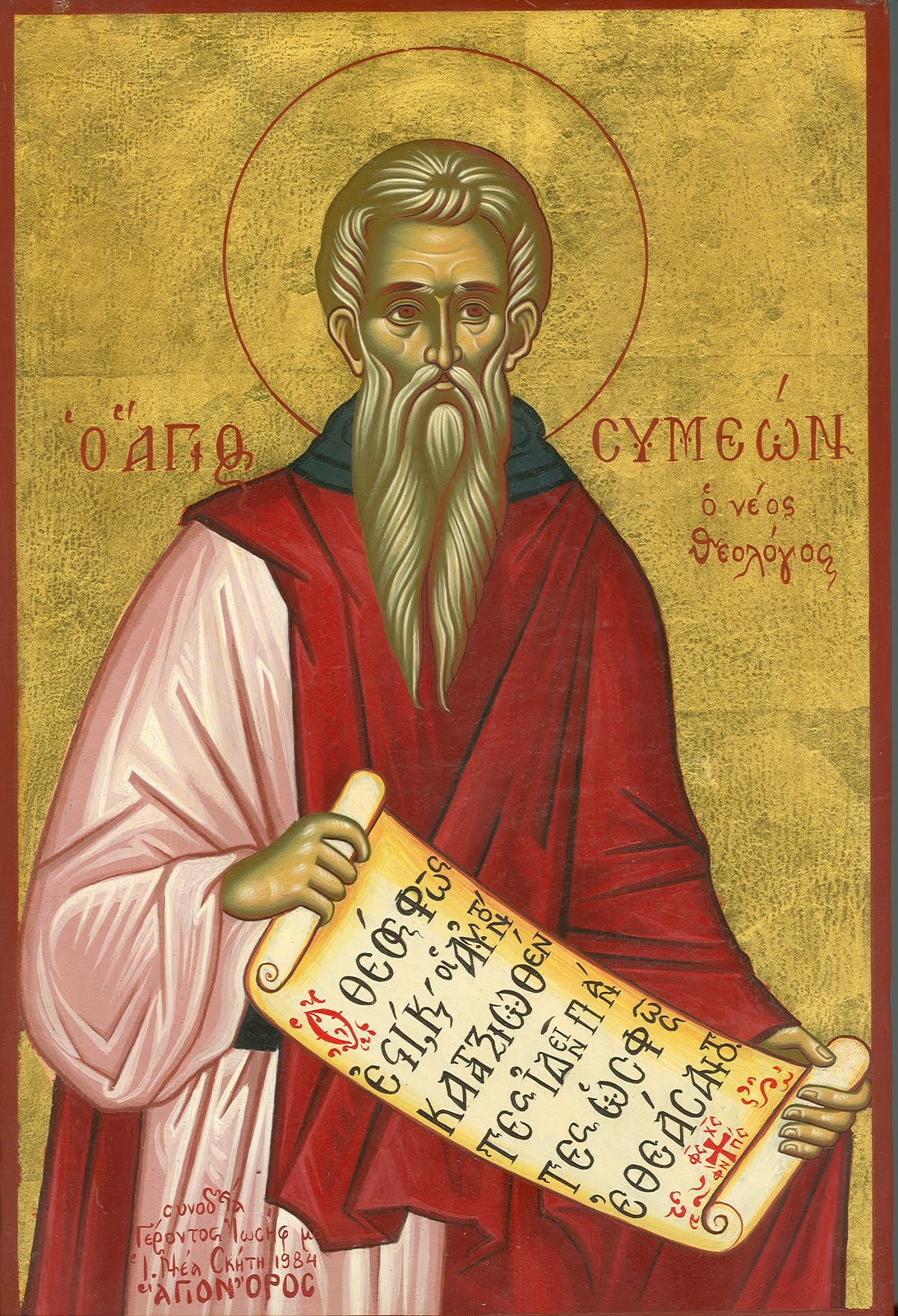
“… ‘John Baptized with water, but you shall be baptized with the Holy Spirit’. If one is ignorant of the Baptism wherewith he was baptized as a child and does not even realize that he was baptized, but only accepts it by faith and then wipes it away with thousands upon thousands of sins, and if he denies the second Baptism – I mean, that which is through the Spirit, given from above by the loving-kindness of God to those who seek it by penitence – by what other means can he ever obtain salvation? By no means!”
~ from: The Discourses. XXXII
St. Symeon the New Theologian: “… first seek to learn and experience these things in fact…”
Posted by Dallas Wolf in Hesychasm - Jesus Prayer, Monasticism, Patristic Pearls on June 21, 2014
St. Symeon the New Theologian (949-1022) excoriates the church clergy for not personally being contemplatives and experiencing the presence of God (theoria) themselves before trying to lead and teach the laity. This criticism is just as valid for the institutional church today as it was for the Byzantine church in AD 1000. Few, if any, of the contemporary institutional clergy practice contemplative Christian prayer.
“You priests and monks teach others with vain words and think that you are rulers – but falsely! Ask your elders and high priests, gather yourselves together in the love of God, and first seek to learn and experience these things in fact, and then have the will to see this and by experience become like God. Be anxious not merely to act a play and wear the garment thereof and so to approach apostolic dignities. Otherwise, as you in your imperfection rush to rule over others, before acquiring the knowledge of the mysteries of God, you will hear these words, ‘Woe to those who are wise in their own eyes and shrewd in their own sight! Woe to those who put darkness for light and light for darkness!'”
~ from: Discourses, XXXIII
Nous (νοῦς) – “…the highest faculty in man” 2
Posted by Dallas Wolf in The "Nous" (series) on June 19, 2014
“…the organ of contemplation…, the ‘eye of the heart’…”
The word “nous” has been translated into English as “mind”, “intellect”, and a variety of other meanings as well. The word “mind” was the choice made by Bishop Kallistos Ware (now Metropolitan Kallistos) and others in their translation of the Philokalia (the collection of Christian mystic writings from the 4th to the 15th centuries). But our modern conception of “mind” does not really capture the meaning of “nous”. Some use the word “intellect” as an equivalent. This also misses the nuanced meaning of “nous”. The problem is that we in the modern world only think of “mind” and “intellect” in terms of our rational, reasoning faculties. We can start to get a sense of the real meaning of “nous” from the definition contained in the Philokalia itself. Here, it translates “nous” as “intellect”, but you can see that it is clearly different from our contemporary idea of “intellect”:
“the highest faculty in man, through which – provided it is purified – he knows God or the inner essences or principles … of created things by means of direct apprehension or spiritual perception. Unlike the dianoia or reason…, from which it must be carefully distinguished, the intellect [nous] does not function by formulating abstract concepts and then arguing on this basis to a conclusion reached through deductive reasoning, but it understands divine truth by means of immediate experience, intuition or ‘simple cognition’ (the term used by St Isaac the Syrian). The intellect [nous] dwells in the ‘depths of the soul’; it constitutes the innermost aspect of the heart… The intellect [nous] is the organ of contemplation…, the ‘eye of the heart’ (Makarian Homilies).”
A lot of confusion surrounded the term “nous”, clearly. As a result, many secular philosophers have used it to refer to quite different concepts. “Nous” has been used to refer to anything from personal mental qualities or abilities all the way to qualities ascribed to God or the cosmos.
Nous (νοῦς) – “…the highest faculty in man” 3
Posted by Dallas Wolf in The "Nous" (series) on June 18, 2014
“… the noetic energy that functions in the heart of a person that is spiritually healthy.”
Originally, “nous” was understood by ancient (pre-Christian) Greek philosophers, most notably Plato and Aristotle, as man’s highest intellectual faculty. By intellectual faculty, the ancient Greeks did not mean the ability to reason things out to a logical conclusion, but rather the intuitive and immediate grasp of the reality of things. To them, “nous” was more of a direct contact between mind and truth.
The Church Fathers borrowed the term “nous” from Greek philosophy and gave it a distinctive Christian meaning. They used it to refer to the noetic energy that functions in the heart of a person that is spiritually healthy. The “nous” can be used to explain another borrowed concept from philosophy, the Logos Doctrine of the church. Second century Christian apologist Justin Martyr used the spermatikos logos (“seed” of the Word) to explain the universal indwelling presence of the Logos, the Word, or Son of God the Father within every human being (cf. the prologue to the Gospel of John, vv. 1:1-18). The idea of the “nous” also evolved over time among the Fathers. Early use of the term can be ambiguous as some early Fathers used the word “nous” when they were referring to the reasoning rational mind.
According to Orthodox theologian Fr. Michael Pomazansky (in his book, Orthodox Dogmatic Theology), it was the teaching of the overwhelming majority of the Church Fathers that the phrase ‘Image of God’ (cf. Genesis 1:26) refers to man’s soul, more precisely to the highest faculty of the soul, the “nous”. So, man is the “Image” by virtue of the spiritual nature of his “nous”. One common comparison made among patristic writers illustrates the relationship between body and the healthy “nous”. The analogy is that of the body being similar to a horse and the “nous” to the rider guiding and controlling the animal to move in the direction he would have it go.
St. Symeon the New Theologian: “…it is entirely possible when one desires it.”
Posted by Dallas Wolf in Monasticism, Patristic Pearls on June 18, 2014
St. Symeon the New Theologian (949-1022)
“Do not say that it is impossible to receive the Spirit of God.
Do not say that it is possible to be made whole without Him.
Do not say that one can possess Him without knowing it.
Do not say that God does not manifest Himself to man.
Do not say that men cannot perceive the divine light, or that it is impossible in this age!
Never is it found to be impossible, my friends.
On the contrary, it is entirely possible when one desires it.”
~ Hymns of Divine Love, 27
Nous (νοῦς) – “…the highest faculty in man” 4
Posted by Dallas Wolf in The "Nous" (series) on June 17, 2014
” As a consequence of the “Fall”, the “nous” became dissipated and diseased…”
The “nous” in all of humankind was severely injured, diseased, and damaged in the “Adamic Fall” (The “Fall” in the Garden of Eden). The “Fall” is seen as the misuse of free will; of focusing on oneself rather than on God for guidance, wisdom and worship. Free will gave man the right to choose. And choose he did. In the “Fall”, humans shifted their focus from God to themselves (and any number of other idols). As a consequence of the “Fall”, the “nous” became dissipated and diseased, overwhelmed with increasing concerns for individual survival and the needs and desires of the body in the physical, material world. The “nous” became estranged from God’s grace and humankind’s whole nature became sick. This sickness was handed on to later descendants as the inheritance of ancestral sin.
The Orthodox do not understand the “Fall” in legal terms, as Western Christianity does, but rather in medical terms. When Paul says in Romans 5:19, “as by one man’s disobedience many were made sinners,” it is understood in a medical sense, not a legal one. In other words, as a result of one man’s sin, human nature became sick.
The Incarnation and ministry of Jesus Christ is seen as a therapeutic (Greek therapeuo) mission of love from God to humankind in order to heal and restore our fallen sick souls. The key to this is the healing and restoration of the “nous”, the “eye of the heart”. Jesus possessed a complete human nature, not only on the lower side (body) but also on the higher spiritual side, the “nous”. His perfect human nature broke the grip of sin on fallen human nature, opening the possibility of restoring the diseased “nous” of every human being to its spiritual pre-Fall state.
In his book, Orthodox Psychotherapy: the Science of the Fathers, Archimandrite Hierotheos Vlachos (now Metropolitan Hierotheos) quotes Saint Maximus the Confessor (7th century) as saying “The nous functions in accordance with nature when it keeps the passions under control, contemplates the inner essences of created beings, and abides with God.” The “nous” is changed by every conceptual image that it accepts. When the “nous” is in a fallen state, confusion is created in the whole of the spiritual organism of man. In this “fallen” state, the “nous” needs therapy/purification.
St. Isaac of Nineveh: “…hell is in my opinion: remorse.”
Posted by Dallas Wolf in Heaven and Hell, Hesychasm - Jesus Prayer, Monasticism, Patristic Pearls on June 16, 2014
St. Isaac of Nineveh – 7th century ascetic and mystic, born in modern-day Qatar, was made Bishop of Nineveh between 660-680. Especially influential in the Syriac tradition, Isaac has had a great influence in Russian culture, impacting the works of writers like Dostoyevsky.
“As for me I say that those who are tormented in hell are tormented by the invasion of love. What is there more bitter and violent than the pains of love? Those who feel they have sinned against love bear in themselves a damnation much heavier than the most dreaded punishments. The suffering with which sinning against love afflicts the heart is more keenly felt than any other torment. It is absurd to assume that the sinners in hell are deprived of God’s love. Love is offered impartially. But by its very power it acts in two ways. It torments sinners, as happens here on earth when we are tormented by the presence of a friend to whom we have been unfaithful. And it gives joy to those who have been faithful. That is what the torment of hell is in my opinion: remorse.”
~ from: Ascetic Treatises, 84
 First Thoughts