Posts Tagged eastern orthodox tradition
Paradise and Hell
Posted by Dallas Wolf in First Thoughts, Heaven and Hell, Theology on October 8, 2024
Icons: “… we are surrounded by so great a cloud of witnesses,”
Posted by Dallas Wolf in Ekklesia and church on April 12, 2023

“Therefore, since we are surrounded by so great a cloud of witnesses1, let us also lay aside every weight and the sin that clings so closely, and let us run with perseverance the race that is set before us,” ~ Hebrews 12:1
________________________________________________________________________________
One of the most striking visuals in an Orthodox church is the great number and variety of highly stylized icons covering walls, ceilings, and seemingly any other available floor or shelf space.
Strictly speaking, an icon (εικών, eikon – image, picture) is a portable sacred image, painted on a piece of wood according to the style and techniques of Byzantine art. But in its broader sense, an icon is any sacred image painted, or otherwise reproduced, for the purpose of veneration2.
The Patristic Fathers taught that an “icon makes present that which it represents.” Veneration happens when we stop seeing an icon as an object of art or decoration and nothing more, and begin seeing it as a close, face-to-face encounter with the person represented. Veneration is far more than the acts of bowing, kissing, crossing oneself, offering incense or lighting candles. In fact, those things only become veneration when they are offered towards the person who is made present in an icon.
Many icons depict persons recognized as holy Saints by the church. Of these, some of them are martyrs, having died for their Christian witness; some are confessors, having maintained their witness under especially difficult and or dangerous conditions, but not lost their lives; but the majority of Saints are neither; just people in all ages recognized as extraordinarily holy. Saints are not an anachronist relic of the distant past. They have been recognized since the birth of the church and new Saints continue to be identified and recognized to this day.
For most of church history, the majority of Christians could not read or write. In the Greco-Roman world of the Apostles, it is estimated that less than 15% of the population was literate. Hearing the Scripture read during church services and understanding the stories and people depicted in the icons adorning the church building served as important tools for the transmission of Christian tradition and faith. It follows then that icons continue to serve as educational and worshiping aids. The Holy Spirit speaks to us through icons, as images that complement the written words of Scripture. Icons also serve to transport us into the realm of spiritual experience, to go beyond our material world, to show us the greatness and perfection of the divine reality that is invisible to us.
During an Orthodox church service, it feels like the entire congregation is worshiping along with all of the Saints depicted in the icons adorning the church. And even when praying alone in an empty Orthodox church, you cannot feel alone; but rather accompanied, comforted, and supported by all of the Saints present through the icons.
_____________________________________________________________________________
1 Witness (Gr. μάρτυς, mártys) in its original meaning, the Greek word martyr, was used in the secular sphere as well as in the New Testament. The process of bearing witness was not intended to lead to the death of the witness, although it is known from ancient writers (e.g., Josephus) and from the New Testament that witnesses often died for their testimonies. During the early Christian centuries, the term martyr came to mean one who gives his or her life for the faith. A confessor (ομολογητής) came to mean a person who does not actually die for the faith but witnesses to it under difficult and often dangerous conditions.
2 Veneration (Gr. σεβασμός) is a reverence, love, and recognition paid to all those persons portrayed in an icon. Many people in the West often misinterpret veneration as worship; however, worship (προσκύνησης, total devotion of the self) in the Eastern Orthodox Church is reserved for God alone.
The Rise of Monasticism in the 4th-Century Christian Church
Posted by Dallas Wolf in Monasticism, The Cappadocians, Women in Early Christianity on April 10, 2023
The following two momentous events impacting the 4th-century church serve as contextual bookends to this discussion:
- In AD 313 The Edict of Milan was issued by Constantine Augustus and Licinius Augustus. It legalized Christianity in the Roman Empire and ended Christian persecution.
- In AD 380 The Edict of Thessalonica was issued by Theodosius I, Gratian, and Valentinian. It made Nicene Christianity the State Religion of the Roman Empire.
After Constantine I legalized Christianity, under the Edict of Milan in 313 (first bullet, above), pagan elites in search of notoriety and political gain filled the institutional church. In this season of significant transition in the Roman Empire, opportunists took the title “Christian” and sought ecclesiastical positions to improve their socio-political status. People became Christian in name only, thus compromising the morality of the church. Already at the Council of Nicaea in 325, church officials recognized that too many ill-prepared pagan converts had been promoted to positions of leadership.

At the same time, there remained many faithful Christians who endured the final persecution under Emperor Diocletian (AD 305). These Christians abhorred the apathy of the recent status-seeking converts. They wanted a deeper, disciplined expression of worship. But as the church became more politicized and dominated by people with imperial connections, the faithful remnant increasingly lost their voice, and eventually their hope of change. So, in a public display of protest, many fervent Christians made an exodus into the Egyptian, Palestinian, and Syrian deserts as solitary (eremitic) monks. To these Desert Fathers and Mothers, this ascetic life replaced the institutional church as the means to salvation. On some occasions, their deep animosity towards the institutional church turned into physical aggression and violence. They had zeal and passion, but frequently lacked leadership or spiritual guidance.
By the mid-300’s Christianity was divided into two extremes—the institutional church, corrupted by Byzantine politics, and protesting monks who were living as independent Christians. Both sides needed reform and visionary leadership if the church was to survive long-term.

St. Basil the Great (329–379) was born into a wealthy Cappadocian family. As a young man Basil studied in Athens. In 357, Basil traveled to Egypt, Palestine, and Syria to study ascetics and monasticism. This included visiting not only the eremitic monks of the lower Nile region, but also the first cenobitic (communal) monasteries founded by St. Pachomius in the upper Nile region at Tabennis.
Basil sensed that retirement to a solitary eremitic monastic life was selfish. He felt called to use his education, zeal, and leadership abilities to restore Christians and the church to their true calling. Basil seized upon communal (cenobitic) monasticism to both renew the institutional church and reform the marginalized solitary monks. Vibrant monastic communities could address the dire problems on multiple fronts.

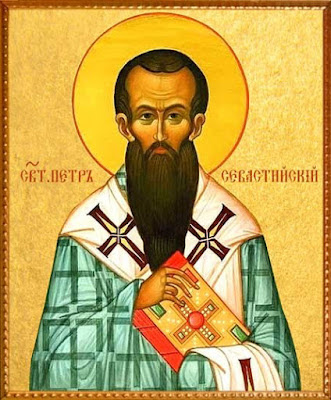

Basil was fortunate to have an existing cenobitic ‘domestic ascetic’ monastery on his family’s Pontus estate near Annisa (modern Uluköy, Turkey). This monastery was founded by his widowed mother, Emmelia, and his older sister, St. Macrina the Younger (c. 327 – 379), in the late 340’s and early 350’s. Together, mother and daughter had converted the Annisa estate into a domestic monastic settlement with several other ascetic virgin women and devoted themselves to pious lives of prayer and charitable works. Its asceticism was dedicated to the service of God, which was to be pursued through community life and obedience.
Returning to Annisa after touring the desert monasteries, by 358 Basil had gathered around him a group of like-minded male celibate ascetic disciples, including his youngest brother, St. Peter of Sebasteia (c. 340 – 391), who had been raised and trained by Macrina. This expanded the existing women’s monastery to include males, and later on orphans. Also in 358, Basil invited his school friend, St. Gregory of Nazianzus (c. 329 – 390) to join him in Annisa. When Gregory eventually arrived, they collaborated on Origen’s Philocalia, a collection of Origen’s works. This was the fulfillment of Basil’s monastic dream. Basil also wrote about monastic communal life. His writings became pivotal in developing monastic traditions of the Eastern Church. Basil’s experience during his monastic period at Annisa would later result in the monastic Rule of St. Basil (aka, Asketikon) which called for obligatory liturgical prayer and manual and mental work. It also enjoined or implied chastity and poverty. Basil’s rule was strict but not severe.
During this period of monastic retreat, Basil became increasingly concerned about the mounting problems in the church and society. He lamented the injustice of poverty, the oppressive “Christian” aristocracy, the church’s marriage to politics, and the spread of the Arian heresy. The institutional church had lapsed and disgruntled believers were continuing to withdraw to the desert. Both forms of Christianity needed restoration.
By the 360’s and 370’s, Basil considered the institutional Church as heading to “utter shipwreck… in addition to the open attack of the heretics, the Churches are reduced to utter helplessness by the war raging among those who are supposed to be orthodox.” (to the Italians and Gauls, Letter 92.3)
In 362, Bishop Meletius of Antioch ordained Basil as a Deacon. Bishop Eusebius then summoned Basil to Caesarea (Mazaca) and ordained him as presbyter (priest) of the Church there in 365. Basil described the situation of the collective institutional Christian church leadership in dire terms:
“The doctrines of true religion are overthrown. The laws of the Church are in confusion. The ambition of men, who have no fear of God, rushes into high posts, and exalted office is now publicly known as the prize of impiety. The result is, that the worse a man blasphemes, the fitter the people think him to be a bishop. Clerical dignity is a thing of the past. There is a complete lack of men shepherding the Lord’s flock with knowledge. Ambitious men are constantly throwing away the provision for the poor on their own enjoyment and the distribution of gifts. There is no precise knowledge of canons. There is complete immunity in sinning; for when men have been placed in office by the favor of men, they are obliged to return the favor by continually showing indulgence to offenders. Just judgment is a thing of the past; and everyone walks according to his heart’s desire. Vice knows no bounds; the people know no restraint. Men in authority are afraid to speak, for those who have reached power by human interest are the slaves of those to whom they owe their advancement.”
~ Basil, Letter 92.2
In 370, Bishop Eusebius died, and Basil was consecrated as Bishop in June 370. His new post as Bishop of Caesarea (Mazaca) also gave him the power of exarch of Pontus, and influence over all of Cappadocia.
The Church historian Rufinus of Aquileia in 397 AD explains Basil’s course of actions as Bishop:
“Basil went round the cities and countryside of Pontus and began by his words to rouse that province from its torpor and lack of concern for our hope for the future, kindling it by his preaching, and to banish the insensitivity resulting from long negligence; he compelled it to put away its concern for vain and worldly things and to give its attention to him. He taught people to assemble, to build monasteries, to take care of the poor and furnish them with proper housing and the necessities of life, to establish the way of life of virgins, and to make the life of modesty and chastity desirable to almost everyone.”
~ Rufinus, Church History, 11:9
Even though Basil was a prominent theologian and Bishop of Caesarea (Mazaca), he always remained committed to founding, developing, and strengthening Cappadocian monasteries. Basil corresponded with the satellite communities about various aspects of the Christian life. Basil’s book The Rule of St. Basil became the foundational text for Christian monasticism.
Through communal monasticism, Basil reformed Christianity at both the institutional and grassroots level. Monasticism had been pitted against the church, but Basil, ever the ecclesiastical statesman, incorporated the monastic movement into the church so they could benefit each other. As a powerful bishop over Cappadocia, Basil used his ecclesiastical authority to speak against the secularizing forces, refute the heresy of Arianism, appoint monk-bishops to leadership positions, publish theological treatises, and advocate for the poor among the elite.
At a grassroots level, Basil organized monastic communities of love-motivated disciples. These groups strengthened the church by providing true teaching, spiritual ministry, and capable leadership. Monks cared for lay people, both physically and spiritually. Monasticism expressed the true character of Christianity and thus restored confidence in the church. Monks would also purify the church by modeling faithful devotion to God. Their lives summoned the politicized church back to holiness and mission.
The following sections explain how Basil developed the cenobitic monastic communities to strategically address the social and ecclesiastical problems of his day.
1. Love in Community
Basil never developed a standardized rule for monasteries. In his view, love was the guiding rule for all the Christian life. The opening questions of Basil’s Asketika explain how the “utterly ineffable love of God” compels and guides the entire Christian life, including monastic communities. To fulfill the rule of love, each monastic community was free to develop in its own way. Byzantine monasteries constructed their own rules based on the monastic principles laid out in Basil’s books Moralia and Asketika.
Basil’s emphasis on love and community was a deliberate corrective to the lifestyle of the solitary (eremitic) monks. They practiced extreme forms of asceticism, such as competing to see who could most severely torment their body. Basil said asceticism without love was useless. This echoes the Apostle Paul’s teaching in 1 Corinthians 13:3, “If I deliver up my body to be burned, but have not love, I gain nothing.” In serving one another in a community of love, Basil encouraged the moderation of austere practices. Basil insisted that self-denial must be rooted in love and the power of the Holy Spirit. For Basil, the purpose of the monastic life was cultivating a true love for God and fellow humans.
Basil placed a strong emphasis on work as service. Monks were to work in groups for mutual edification, protection and to conduct prayer. Work was an expression of love. Monks assumed vows of poverty and shared property in common. This act resisted the allure and love of private property. Basil highlighted the loving purpose of mutual labor. In earlier models of asceticism, work was a way to overcome the lust of the flesh. But for Basil, work was an expression of love toward others.
2. Social Care
The monastic community not only served itself, but it was located near towns to serve as a public example and to help lay Christians. Social service was another overflow of the monastic life. Monks cared for the marginalized and poor. In 369 a severe famine caused mass starvation throughout Cappadocia. Strange weather patterns devastated crops and the rich stockpiled food. Basil explained, “The hungry are dying…The naked are stiff with cold. The man in debt is held by the throat.”
In response Basil constructed a large complex next to the original monastery at Annesi to care for the poor. So many people came to receive services that the growing region became known as “New Caesarea.” The Basilian complex was a source of great stability for the community. Both church and the State supported the work, and other monasteries followed suit by helping the poor. Almsgiving and generosity to the poor were defining aspects of monasticism.
3. Preaching and Teaching
Basil peppered monasteries throughout the populated areas of the Roman world to stop the spread of Arian heresy. Arianism taught that Jesus was not eternally God, but only “similar” to God. In the 360’s and 370’s when Basil was bishop, Arians controlled most episcopal leadership and enjoyed political support from the emperors in Constantinople. According to Basil, the champions of Arianism were waging war against Apostolic teaching, and were to be resisted. In Basil’s monasteries, monks studied the Nicene doctrines, learned rhetoric, and went into nearby towns to preach. Monasticism became a frontline defense against Arian heresy. As Christianity expanded into new areas, monks were ordained and sent out to evangelize.
4. Church Leadership
The leadership of the church had fallen into moral decline. Basil lamented there was “a complete immunity to sinning” among church bishops. As Arians gained political power, many Orthodox bishops were banished into exile and replaced by incompetent church leaders. In this perilous time, Basil developed the vision of the “bishop-monk.” The contemplative life at monasteries provided the biblical education and character development essential for church leadership. As a prominent bishop, Basil labored assiduously to recruit monks to serve as bishops. Their monastic training equipped them to shepherd local Christian communities. Monasteries trained and restored church leadership.
Summary
After Constantine’s political and religious reforms in the early 300’s (first bullet, above), the church quickly became diluted by political opportunists, neglected the needs of the marginalized, and fell into Arian heresy. Pious Christians grew disillusioned and retreated into isolated asceticism. In response to these crises, St. Basil of Caesarea formed monastic communities. These groups emphasized community, strived towards love, served the poor, refuted heresy, and trained leaders. These monastic communities that Basil shepherded became the antidote to the social and ecclesiastical problems that arose after Constantine. By the late 300’s, Theodosius I was confident enough in the church reforms and direction to declare Nicene Christianity as the sole State Religion of the Roman Empire (second bullet, above).
Evagrius Ponticus – Nous: “… like a sapphire or the color of heaven.”
Posted by Dallas Wolf in Contemplative Prayer (series), First Thoughts, Monasticism, Patristic Pearls, The Cappadocians, The Holy Trinity on April 10, 2023
Evagrius Ponticus (c. 346-399) – was originally from Pontus, on the southern coast of the Black Sea in what is modern-day Turkey. He served as a Lector under St. Basil the Great and was made Deacon and Archdeacon under St. Gregory of Nazianzus. He was also greatly influenced by Origen of Alexandria and St. Gregory of Nyssa. In about 383, Evagrius left Constantinople, eventually retreating to the Egyptian desert and joining a cenobitic community of Desert Fathers. As a classically trained scholar, Evagrius recorded the sayings of the desert monks and developed his own theological writings. The excerpt below is from Evagrius’ Skemmata (Reflections).

- If any would see the state of their nous, let them deprive themselves of all concepts (noemata): and then they will see themselves like a sapphire or the color of heaven (Exod. 24.10); but this cannot be accomplished without apatheia [dispassion] since it requires the cooperation of God who breathes into them the kindred light.
- Apatheia is the quiet state of the reasoning soul composed of gentle temperance.
- The state of the nous is the noetic [spiritual] height like the color of heaven, upon which the light of the holy Trinity comes at the time of prayer.
Skemmata, Gnostic Chapters 1-3
St. Maximus the Confessor: “…and having entered the dark cloud”
Posted by Dallas Wolf in Contemplative Prayer (series), First Thoughts, Patristic Pearls on April 4, 2023
St. Maximus the Confessor (c. 580 – 662) was a 7th century Christian monk, theologian, and scholar who many contemporary scholars consider to be the greatest theologian of the Patristic era. Two of his most famous works are “Ambigua” – An exploration of difficult passages in the work of Pseudo-Dionysius and Gregory of Nazianzus, focusing on Christological issues, and “Questions to Thalassius” or “Ad Thalassium” – a lengthy exposition on various Scriptural texts. The following quote comes from Maximus’ “Two Hundred Chapters on Theology”, probably written after both Ambigua and Ad Thalassium, in about AD 633.
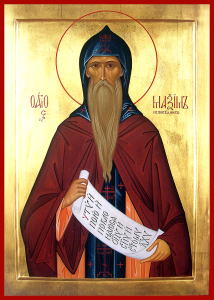
“The great Moses, having pitched his tent outside the camp, that is, having established his will and intellect outside visible realities, begins to worship God; and having entered the dark cloud [γνόφον], the formless and immaterial place of knowledge, he remains there, performing the holiest rites.
The dark cloud [γνόφος] is the formless, immaterial, and incorporeal condition containing the paradigmatic knowledge of beings; he who has come to be inside it, just like another Moses, understands invisible realities in a mortal nature; having depicted the beauty of the divine virtues in himself through this state, like a painting accurately rendering the representation of the archetypal beauty, he descends, offering himself to those willing to imitate virtue, and in this shows both love of humanity and freedom from envy of the grace of which he had partaken.”
~ from: Two Hundred Chapters on Theology, 1.84, 1.85.
St. Athanasius: “For he was incarnate that we might be made god”
Posted by Dallas Wolf in First Thoughts, Patristic Pearls, The Holy Trinity, Theology on January 18, 2023
St. Athanasius, also called Saint Athanasius of Alexandria or Saint Athanasius the Apostolic, (born c. 293, Alexandria—died May 2, 373, Alexandria), theologian, ecclesiastical statesman, and Egyptian national leader. He was the chief defender of Christian orthodoxy in the 4th-century battle against Arianism, the heresy that the Son of God was a creature of like, but not of the same, substance as God the Father. His important works include The Life of St. Antony, On the Incarnation, and Four Orations Against the Arians.

“Therefore, just as if someone wishes to see God, who is invisible by nature and not seen at all, understands and knows him from his works, so let one who does not see Christ with his mind learn of him from the works of his body, and test whether they be human or of God. And if they be human, let him mock; but if they are known to be not human, but of God, let him not laugh at things that should not be mocked, but let him rather marvel that through such a paltry thing things divine have been manifested to us, and that through death incorruptibility has come to all, and through the incarnation of the Word [Logos-Λόγου] the universal providence, and its giver and creator, the very Word [Logos-Λόγος] of God, have been made known. For he was incarnate that we might be made god; and he manifested himself through a body that we might receive an idea of the invisible Father; and he endured the insults of human beings, that we might inherit incorruptibility.” [Brackets and underline mine].
On the Incarnation (Footnote 54)
What it Means to be Human – East and West – 3
Posted by Dallas Wolf in Christian Anthropology -East & West (Series) on February 13, 2022
Western Latin Anthropology
We now examine the Latin West and the foundation of an alternative anthropology, which became increasingly pessimistic about the human condition. This pessimism would grow to have a profound impact upon the Middle Ages and lead to the large-scale abandonment of traditional Christianity during the Renaissance.
The foundation of this pessimistic anthropology is based on the early 5th century thought of St. Augustine (354-430), Bishop of Hippo Regius, in the Roman Province of Numidia on the North African coast (modern north-east Algeria).
Augustine outweighs, by far, the collective influence of all the other Latin Fathers (e.g., St. Jerome, St. Ambrose, Gregory the Great) and dominates the theological thinking and tradition of Western Latin Christianity from the 5th century all the way up to the present. By Western Latin Christianity I include the Roman Catholic Church and the vast majority of the 35,000+ denominations contained within Protestantism. As we shall see, the Protestant Reformer John Calvin will make much use of Augustine’s thought.
Augustine’s own life experiences, detailed in his book Confessions, and his disputes with British-born heretic Pelagius (c. 354- c.418) and his disciples did much to influence his thinking on the human will and grace.
Pelagius believed that humans are self-willed and autonomous in relationship to God. He even had a slogan for this belief: A deo emancipatus homo est. Man is emancipated from God.
How different this is from the Greek patristic understanding of human free will in synergy with God and totally dependent on God, finding fulfillment only in divine life.
But Augustine engaged Pelagius very differently. He took the opposite view of the human will from Pelagius, developing a doctrine of heteronomy; being ruled by another than oneself. Augustine believed that humans possess a free will, but that it has been vitiated, that is weakened and undermined and functionally powerless. Based on that conclusion, Augustine came up with his own slogan: non posse non peccare. [Man is] not able not to sin.
Not a very optimistic or positive view of humanity.
Therefore, to Augustine, salvation comes to depend on divine intervention in the form of a grace from God that precedes any action from a human being toward good; it came to be known as prevenient grace. It is prevenient grace that causes the human will to do good. Augustine saw this grace as created, and not God himself. How different this is from the Greek patristic doctrine of grace as the uncreated energies that really are God and penetrate and deify the believer and bring them ever more fully within the life of God himself.
To Augustine, if the human will is good, then it is through God and his prevenient grace activating the will. Of course, according to Augustine’s doctrine of heteronomy, there is the other (hetero) that could activate the human will as well. That would be the will of the devil. But in either case, it’s not the human will, but the will of another that leads the human in the direction he takes in life.
As a corollary, Augustine also developed the doctrine of “predestination”, which declares that, given that the human will as vitiated and powerless, God predestines those whom he has chosen as elect to save.
Again, not a very optimistic or positive assessment of the human will.
Augustine’s doctrine of predestination goes further than anything discussed to this point in undermining a belief that humans possess a free will and that they can work out their salvation in cooperation, or synergy, with God.
More than 1,100 years later, Protestant Reformer John Calvin would double-down and fully develop Augustine’s doctrine of predestination. If you believe that Augustine’s influence was limited to the Roman Catholic church and did not effect Protestant theology, I invite you to consider Calvin’s T.U.L.I.P., a summary of his principle doctrines; Total depravity, Unconditional election, Limited atonement, Irresistible grace, and Perseverance of the saints. Calvin drew directly from Augustine and is perhaps the most consistent theologian under his influence during the 16th century Protestant Reformation in the West. The Protestant Reformation bought Augustinian theology, pretty much in whole or at least in part.
Augustine, while rightly defending Orthodoxy against the anthropological heresy of Pelagius, had unfortunately taken positions that put him at odds with the consensus of the early unified church, East and West, concerning the condition of humanity, its inherent value and dignity, its place in this age, and the possibility of experiencing the divine, paradise itself, even in this world.
The last of Augustine’s unique doctrines we will discuss is arguably his most controversial; original sin. This doctrine goes well beyond the conception of the Fall and primordial sin of Adam and Eve that had been developed by Eastern Greek Fathers and even by Western Latin Fathers before the 5th century. For Augustine, the Fall resulted in humankind’s actual participation in the guilt of Adam’s original sin. This is a fundamental difference between the Eastern Greek patristic understanding of the Fall and the subsequent Western Latin Augustinian understanding.
This gets a little tedious but stay with me.
Augustine was led to this interpretation of the Fall by the translation of the Bible that was now being used in the West in his time. In the fourth century, St. Jerome translated the Bible into Latin (the Latin Vulgate bible), and in a very important passage from the epistle of Paul to the Romans 5:12, the original Greek was mistranslated by Jerome. Scholar David Bentley Hart, author of the recent The New Testament, a Translation, remarks that this “notoriously defective rendering in the Latin Vulgate (in quo omnes peccaverunt) constitutes one of the most consequential mistranslations in Christian history.” Below is the original Greek of Romans 5:12 (underline mine):
Διὰ τοῦτο ὥσπερ δι’ ἑνὸς ἀνθρώπου ἡ ἁμαρτία εἰς τὸν κόσμον εἰσῆλθεν καὶ διὰ τῆς ἁμαρτίας ὁ θάνατος, καὶ οὕτως εἰς πάντας ἀνθρώπους ὁ θάνατος διῆλθεν ἐφ’ ᾧ πάντες ἥμαρτον
The key here is that in the original Greek, above, the word “ἐφ’ ᾧ” (transliterated as “ef ho”), underlined near the end of the passage, is usually translated as “because” in English, as you can clearly see, underlined in the New King James Version (NKJ) translation, below:
Therefore, just as through one man [Adam] sin entered the world and death through sin, and thus death spread to all men because all sinned…
So, “Death and sin entered the world and spread to all human beings because all sinned.”
But in the Latin Vulgate, Jerome mistranslated “ef ho” and entirely changed the meaning of Romans 5:12. Jerome’s Latin translation of “ef ho” was “in quo”, which means “in whom”, and relates, in this passage, to Adam himself. This would mean that entire human race itself participated in Adam’s sin, in a willful act of transgression.
Augustine’s poor skills in Greek would not allow him to read the original Greek New Testament, so he was forced to rely solely on Jerome’s Latin Vulgate.
So, with this flawed translation of Romans 5:12 in hand, Augustine was able to assert that in Adam, in the person of Adam and in his very act of willful rebellion against God in the Fall, in the original sin, all human beings have sinned; all human beings have willfully participated, as descendants of Adam, in Adam’s personal sin.
Adam’s sin, for Augustine, was grounded in his concept of concupiscence, or evil desire. As a result, all of Adam’s descendants (all of humanity) participated in that act of will and are personally guilty for the transgression. His inclination toward this interpretation of the Fall came from his doctrine of grace and free will, that he had worked out early in his life in response to his personal experiences with lustful desires (cf. Confessions) and from his response to the earlier Pelagian controversy (both earlier in this summary).
It goes without saying that this reflects a negative, pessimistic view of humanity.
Augustine’s doctrine of original sin had important corollaries that were worked out in the Western Latin church over time. Some of these corollaries were worked out by Augustine himself. For example:
1. One corollary states that: if all human beings have sinned in Adam through original sin and been conceived in sin and have therefore come into the world personally guilty of original sin, then all human beings are deserving of punishment by God. The human condition is understood as one deserving of punishment, universal punishment.
2. Another corollary that grew out of Augustine’s doctrine of original sin was that unbaptized infants who died before they could be baptized were destined for hell because they were born with the guilt of Adam and, not having that guilt washed away by baptism, were destined to be punished in hell for it.
3. Yet another corollary to the doctrine of original sin is that baptism increasingly becomes understood as a sacrament exclusively of washing away, of remission of sins. Baptism lost its earlier traditional aspect of also imparting deification, the gift of the Holy Spirit deifying the believer.
4. Finally, a corollary to Augustine’s doctrine of original sin is that humanity became characterized by the condition of depravity: a moral bankruptcy. Augustine used the term massa damnata, a damned mass, for the entire human race awaiting punishment were it not for the life-creating sacraments of the Church.
Augustine’s anthropological pessimism saw the human condition in the world as one of misery, almost unmitigated misery. Salvation was seen as a release from punishment in the afterlife.
As Augustine reflected on these miseries, which result from the reality of original sin, he also discussed the role of punishment and the value of punishment, arguing that punishment can, and often does, play a valuable role in bringing the saints who have been predestined for paradise to that experience which awaits them after their death.
So, paradise, from which humanity was expelled, has no place in this world. It is something predestined saints will experience after death in this world. This life is penal, a place of punishment. But that punishment is good, purificatory, for the numbered elect saints being prepared for paradise.
For everybody else, it’s just punishment.
A very negative and pessimistic anthropology, indeed.
Leloup: “Apophasis, Hesychasm, and Divinization”
Posted by Dallas Wolf in New Nuggets, Theology on September 26, 2016
“Thus, St. Thomas will say, ‘Concerning God, one cannot say what God is, but only what God is not.’ In this manner the apophatic way recalls the transcendence of God, that divine otherness which neither the mind, nor the senses of anything can grasp. […] Apophasis is the direct apprehension of the Real just as it is, without the projections of the discursive mind that distort the Real. It is to see without eyes, to comprehend without the mind.”
“Proceeding directly from this apophatic tradition, hesychasm will be profoundly Christocentric. Without Christ, in fact, divinization is not possible. Christ’s incarnation establishes the full communion between God and humanity. God became human so that humans might become God. ‘God became the bearer of flesh so that humanity might become the bearer of the Spirit’, said Athanasius of Alexandria. […] This paradoxical union, which is realized in the Spirit, recreates us in the image and likeness of the Son of God. Humanity rediscovers the beauty for which it was created.”
“This union also leads the hesychasts to affirm with Gregory of Palamas the reality of the experience of God, while continuing to affirm His transcendence. […] Two affirmations characterize hesychastic experience: the affirmation of divine transcendence, of God’s inaccessible essence, and the nearness of God, God’s immanence and presence in each of us, the divinization of humanity through the energies of the Word and the Spirit.”
From, Being Still, pp. 56, 59, 61, 62, 64
Jean-Claude Larchet: “On the Work of Christ”
Posted by Dallas Wolf in Hesychasm - Jesus Prayer, New Nuggets on September 17, 2016
Dr. Jean-Claude Larchet (1949-) – is a French Orthodox researcher who is one of the foremost Orthodox Patristics scholars writing today.
 “By His Incarnation, Christ has overthrown the barrier which separated our nature from God and has opened that nature once more to the deifying energies of uncreated grace. By his redemptive work, He has freed us from the tyranny of the devil and destroyed the power of sin. By His death, He has triumphed over death and corruption. By His resurrection, He has granted us new and eternal life. And it is not only human nature, but also the creation as a whole which Christ heals and restores, by uniting it in Himself with God the Father, thereby abolishing the divisions and ending the disorders that reigned within it because of sin.” From The Theology of Illness, pp. 40, 41.
Met. Hierotheos (Vlachos): “Man has two cognitive centers.”
Posted by Dallas Wolf in Hesychasm - Jesus Prayer, New Nuggets, Theology on August 22, 2016
 “Man has two cognitive centers. One is the nous, the organ suited for receiving God’s revelation which is then formulated by our reason, while the other is reason, which knows the tangible world around us. With our nous we acquire knowledge of God, while with our reason we acquire knowledge of the world and the learning offered by the science of sensory things.”
 First Thoughts