Posts Tagged Monasticism
Gregory of Nyssa: Our Sister Macrina
Posted by Dallas Wolf in Monasticism, Patristic Pearls, The Cappadocians, Women in Early Christianity on March 7, 2025
Excerpt from Gregory of Nyssa: The Letters, by Ann M. Silvas, Brill, 2007
Gregory of Nyssa – Letter 19 To a certain John
The letter was written from Sebasteia in the first half of AD 380. The brief but intense cameo of Gregory’s sister, 19.6–10, is a foreshadowing and a promise of the Life of Macrina. It is the earliest documentation we have of Macrina’s existence, her way of life and her funeral led by Gregory, written less than a year after her death. The witness of her lifestyle, her conversations with him which were so formative and strengthening of his religious spirit, and above all his providential participation in her dying hours had a profound affect on him. It only needed time to absorb and reflect on these events. Then, when the occasion offered, he set out to make his remarkable sister better known to the world.
Our Sister Macrina

We had a sister who was for us a teacher of how to live, a mother in place of our mother. Such was her freedom towards God that she was for us a strong tower (Ps 60.4) and a shield of favour (Ps 5.13) as the Scripture says, and a fortified city (Ps 30.22, 59.11) and a name of utter assurance, through her freedom towards God that came of her way of life.
She dwelt in a remote part of Pontus, having exiled herself from the life of human beings. Gathered around her was a great choir of virgins whom she had brought forth by her spiritual labour pains (cf. 1 Cor 4.15, Gal 4.19) and guided towards perfection through her consummate care, while she herself imitated the life of angels in a human body.
With her there was no distinction between night and day. Rather, the night showed itself active with the deeds of light (cf. Rom 12.12–13, Eph 5.8) and day imitated the tranquility of night through serenity of life. The psalmodies resounded in her house at all times night and day.
You would have seen a reality incredible even to the eyes: the flesh not seeking its own, the stomach, just as we expect in the Resurrection, having finished with its own impulses, streams of tears poured out (cf. Jer. 9.1, Ps 79.6) to the measure of a cup, the mouth meditating the law at all times (Ps 1.2, 118.70), the ear attentive to divine things, the hand ever active with the commandments (cf. Ps 118.48). How indeed could one bring before the eyes a reality that transcends description in words?
Well then, after I left your region, I had halted among the Cappadocians, when unexpectedly I received some disturbing news of her. There was a ten days’ journey between us, so I covered the whole distance as quickly as possible and at last reached Pontus where I saw her and she saw me.
But it was the same as a traveler at noon whose body is exhausted from the sun. He runs up to a spring, but alas, before he has touched the water, before he has cooled his tongue, all at once the stream dries up before his eyes and he finds the water turned to dust.
So it was with me. At the tenth year I saw her whom I so longed to see, who was for me in place of a mother and a teacher and every good, but before I could satisfy my longing, on the third day I buried her and returned on my way.
Fr. Seraphim (Aldea): “Monasticism ‘Through a Monk’s Eyes’.”
Posted by Dallas Wolf in Monasticism, New Nuggets on April 18, 2023
Fr. Seraphim (Aldea) – was tonsured as a monk in 2005 at Rasca monastery in Bucovine, North Moldavia. He has a PhD in Modern Theology from the University of Durham (UK) for a thesis on Archimandrite Sophrony Sakharov’s Ecclesiology. He then became a Postdoctoral Research Fellow at the School of Theology, Oxford University, while working to found the Mull Monastery of all Celtic Saints ( www.mullmonastery.com), the first Orthodox monastery in the Hebrides in over a millennium. This post was taken from a transcription of Fr. Seraphim’s podcast, “Through a Monk’s Eyes”, on Ancient Faith Ministries (www.ancientfaith.com), May 12, 2015.
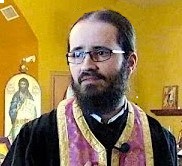
“The most important first question I get when people meet me—and not only in America, but also in England, where I live – is: Why have I become a monk? So, I try to answer that today, just to get it out of the way. I have learned along the years to come up with a series of either very cold and distant answers or some smart ones, depending who’s asking me the question, but the reality, the very simple truth, is that the only honest answer is that I had no choice. You know when you read in the psalter how the prophet speaks that God chooses us from the wombs of our mothers, that’s how I’ve grown to see my own life. I had no choice but to become a monk, simply because, in some strange way, I was a monastic from the womb of my mother. It simply took me a while to recognize who I am.
It took me a while to put a name to what I am, but the values and the principles of a monastic life have always been part of me, even when I was living a life that went entirely against these values. I’m sure you all can identify with this. We all go through periods in our lives when what we do and how we behave has very little to do with the things we actually cherish and the values we actually hold. There are years in our lives when there are almost two people living in each of us, at least two people, but once those years have become history, once I’ve survived those years, it became very clear that what I am is a monastic, and that the values I believe in are those of a monastic.
To me, being a monk can be reduced to being alone. There are all sorts of other ways to understand monasticism, and I will probably get into them in the future, but the simplest, basic understanding, the one that I always get back to, is being alone, with God, for God, preparing to meet God. All those words in the Scripture about being alone, about going into the mountains to pray, about leaving one’s friends and disciples behind so Christ can pray by himself, all those tiny descriptions in St. Luke about the mother of God hearing things and just holding them, putting them into her heart but not saying anything on the outside—all these things have always spoken to me.
To be a monk is to be alone before anything else. To live a monastic life is to be dead and buried before anything else. I remember all those stories from the lives of the Desert Fathers, all that beautiful advice concerning living your life as if you were dead, and those were the things that spoke to me; those were the things that made the greatest impression on my life.
Being alone doesn’t always mean having no one around you, just as being silent doesn’t always mean not speaking. One can be alone, surrounded by a whole nation, and in the history of all Christian Orthodox countries, there are countless examples of elders who have lived surrounded by thousands and thousands of people every day of their lives, and yet they managed, through the grace of God, to preserve their aloneness, their silence.
I wouldn’t want to go too much into this now, in the first podcast, but I want you to keep this in mind as you listen to this series. I do not want to be surrounded by people, but Christ has called me to do it, and I do not want to speak to people, and yet, here I am, going every week in a different parish and meeting different people and truly praying for them and truly asking God to intercede for them and to have mercy on them.
And I’m sure you know that when you truly pray for someone, even when you’ve never met that person before and you shall never see him or her again, when you truly pray of love and mercy, then somehow that person becomes part of you. It’s almost as if your flesh opens up and your heart can just see the heart of the other person. There’s an intimacy which prayer imposes on you. I have to go through this despite my calling to live alone, because this is what Christ wants me to do. So, if I sometimes seem grumpy or not in the mood to speak, or well, unfriendly, please forgive me and remember that this is a deeply unnatural thing for me to be doing and that I am only doing it because Christ asks me to do it.”
The Rise of Monasticism in the 4th-Century Christian Church
Posted by Dallas Wolf in Monasticism, The Cappadocians, Women in Early Christianity on April 10, 2023
The following two momentous events impacting the 4th-century church serve as contextual bookends to this discussion:
- In AD 313 The Edict of Milan was issued by Constantine Augustus and Licinius Augustus. It legalized Christianity in the Roman Empire and ended Christian persecution.
- In AD 380 The Edict of Thessalonica was issued by Theodosius I, Gratian, and Valentinian. It made Nicene Christianity the State Religion of the Roman Empire.
After Constantine I legalized Christianity, under the Edict of Milan in 313 (first bullet, above), pagan elites in search of notoriety and political gain filled the institutional church. In this season of significant transition in the Roman Empire, opportunists took the title “Christian” and sought ecclesiastical positions to improve their socio-political status. People became Christian in name only, thus compromising the morality of the church. Already at the Council of Nicaea in 325, church officials recognized that too many ill-prepared pagan converts had been promoted to positions of leadership.

At the same time, there remained many faithful Christians who endured the final persecution under Emperor Diocletian (AD 305). These Christians abhorred the apathy of the recent status-seeking converts. They wanted a deeper, disciplined expression of worship. But as the church became more politicized and dominated by people with imperial connections, the faithful remnant increasingly lost their voice, and eventually their hope of change. So, in a public display of protest, many fervent Christians made an exodus into the Egyptian, Palestinian, and Syrian deserts as solitary (eremitic) monks. To these Desert Fathers and Mothers, this ascetic life replaced the institutional church as the means to salvation. On some occasions, their deep animosity towards the institutional church turned into physical aggression and violence. They had zeal and passion, but frequently lacked leadership or spiritual guidance.
By the mid-300’s Christianity was divided into two extremes—the institutional church, corrupted by Byzantine politics, and protesting monks who were living as independent Christians. Both sides needed reform and visionary leadership if the church was to survive long-term.

St. Basil the Great (329–379) was born into a wealthy Cappadocian family. As a young man Basil studied in Athens. In 357, Basil traveled to Egypt, Palestine, and Syria to study ascetics and monasticism. This included visiting not only the eremitic monks of the lower Nile region, but also the first cenobitic (communal) monasteries founded by St. Pachomius in the upper Nile region at Tabennis.
Basil sensed that retirement to a solitary eremitic monastic life was selfish. He felt called to use his education, zeal, and leadership abilities to restore Christians and the church to their true calling. Basil seized upon communal (cenobitic) monasticism to both renew the institutional church and reform the marginalized solitary monks. Vibrant monastic communities could address the dire problems on multiple fronts.


Basil was fortunate to have an existing cenobitic ‘domestic ascetic’ monastery on his family’s Pontus estate near Annisa (modern Uluköy, Turkey). This monastery was founded by his widowed mother, Emmelia, and his older sister, St. Macrina the Younger (c. 327 – 379), in the late 340’s and early 350’s. Together, mother and daughter had converted the Annisa estate into a domestic monastic settlement with several other ascetic virgin women and devoted themselves to pious lives of prayer and charitable works. Its asceticism was dedicated to the service of God, which was to be pursued through community life and obedience.
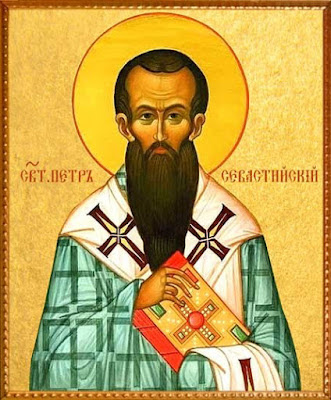
Returning to Annisa after touring the desert monasteries, by 358 Basil had gathered around him a group of like-minded male celibate ascetic disciples, including his youngest brother, St. Peter of Sebasteia (c. 340 – 391), who had been raised and trained by Macrina. This expanded the existing women’s monastery to include males, and later on orphans. Also in 358, Basil invited his school friend, St. Gregory of Nazianzus (c. 329 – 390) to join him in Annisa. When Gregory eventually arrived, they collaborated on Origen’s Philocalia, a collection of Origen’s works. This was the fulfillment of Basil’s monastic dream. Basil also wrote about monastic communal life. His writings became pivotal in developing monastic traditions of the Eastern Church. Basil’s experience during his monastic period at Annisa would later result in the monastic Rule of St. Basil (aka, Asketikon) which called for obligatory liturgical prayer and manual and mental work. It also enjoined or implied chastity and poverty. Basil’s rule was strict but not severe.
During this period of monastic retreat, Basil became increasingly concerned about the mounting problems in the church and society. He lamented the injustice of poverty, the oppressive “Christian” aristocracy, the church’s marriage to politics, and the spread of the Arian heresy. The institutional church had lapsed and disgruntled believers were continuing to withdraw to the desert. Both forms of Christianity needed restoration.
By the 360’s and 370’s, Basil considered the institutional Church as heading to “utter shipwreck… in addition to the open attack of the heretics, the Churches are reduced to utter helplessness by the war raging among those who are supposed to be orthodox.” (to the Italians and Gauls, Letter 92.3)
In 362, Bishop Meletius of Antioch ordained Basil as a Deacon. Bishop Eusebius then summoned Basil to Caesarea (Mazaca) and ordained him as presbyter (priest) of the Church there in 365. Basil described the situation of the collective institutional Christian church leadership in dire terms:
“The doctrines of true religion are overthrown. The laws of the Church are in confusion. The ambition of men, who have no fear of God, rushes into high posts, and exalted office is now publicly known as the prize of impiety. The result is, that the worse a man blasphemes, the fitter the people think him to be a bishop. Clerical dignity is a thing of the past. There is a complete lack of men shepherding the Lord’s flock with knowledge. Ambitious men are constantly throwing away the provision for the poor on their own enjoyment and the distribution of gifts. There is no precise knowledge of canons. There is complete immunity in sinning; for when men have been placed in office by the favor of men, they are obliged to return the favor by continually showing indulgence to offenders. Just judgment is a thing of the past; and everyone walks according to his heart’s desire. Vice knows no bounds; the people know no restraint. Men in authority are afraid to speak, for those who have reached power by human interest are the slaves of those to whom they owe their advancement.”
~ Basil, Letter 92.2
In 370, Bishop Eusebius died, and Basil was consecrated as Bishop in June 370. His new post as Bishop of Caesarea (Mazaca) also gave him the power of exarch of Pontus, and influence over all of Cappadocia.
The Church historian Rufinus of Aquileia in 397 AD explains Basil’s course of actions as Bishop:
“Basil went round the cities and countryside of Pontus and began by his words to rouse that province from its torpor and lack of concern for our hope for the future, kindling it by his preaching, and to banish the insensitivity resulting from long negligence; he compelled it to put away its concern for vain and worldly things and to give its attention to him. He taught people to assemble, to build monasteries, to take care of the poor and furnish them with proper housing and the necessities of life, to establish the way of life of virgins, and to make the life of modesty and chastity desirable to almost everyone.”
~ Rufinus, Church History, 11:9
Even though Basil was a prominent theologian and Bishop of Caesarea (Mazaca), he always remained committed to founding, developing, and strengthening Cappadocian monasteries. Basil corresponded with the satellite communities about various aspects of the Christian life. Basil’s book The Rule of St. Basil became the foundational text for Christian monasticism.
Through communal monasticism, Basil reformed Christianity at both the institutional and grassroots level. Monasticism had been pitted against the church, but Basil, ever the ecclesiastical statesman, incorporated the monastic movement into the church so they could benefit each other. As a powerful bishop over Cappadocia, Basil used his ecclesiastical authority to speak against the secularizing forces, refute the heresy of Arianism, appoint monk-bishops to leadership positions, publish theological treatises, and advocate for the poor among the elite.
At a grassroots level, Basil organized monastic communities of love-motivated disciples. These groups strengthened the church by providing true teaching, spiritual ministry, and capable leadership. Monks cared for lay people, both physically and spiritually. Monasticism expressed the true character of Christianity and thus restored confidence in the church. Monks would also purify the church by modeling faithful devotion to God. Their lives summoned the politicized church back to holiness and mission.
The following sections explain how Basil developed the cenobitic monastic communities to strategically address the social and ecclesiastical problems of his day.
1. Love in Community
Basil never developed a standardized rule for monasteries. In his view, love was the guiding rule for all the Christian life. The opening questions of Basil’s Asketika explain how the “utterly ineffable love of God” compels and guides the entire Christian life, including monastic communities. To fulfill the rule of love, each monastic community was free to develop in its own way. Byzantine monasteries constructed their own rules based on the monastic principles laid out in Basil’s books Moralia and Asketika.
Basil’s emphasis on love and community was a deliberate corrective to the lifestyle of the solitary (eremitic) monks. They practiced extreme forms of asceticism, such as competing to see who could most severely torment their body. Basil said asceticism without love was useless. This echoes the Apostle Paul’s teaching in 1 Corinthians 13:3, “If I deliver up my body to be burned, but have not love, I gain nothing.” In serving one another in a community of love, Basil encouraged the moderation of austere practices. Basil insisted that self-denial must be rooted in love and the power of the Holy Spirit. For Basil, the purpose of the monastic life was cultivating a true love for God and fellow humans.
Basil placed a strong emphasis on work as service. Monks were to work in groups for mutual edification, protection and to conduct prayer. Work was an expression of love. Monks assumed vows of poverty and shared property in common. This act resisted the allure and love of private property. Basil highlighted the loving purpose of mutual labor. In earlier models of asceticism, work was a way to overcome the lust of the flesh. But for Basil, work was an expression of love toward others.
2. Social Care
The monastic community not only served itself, but it was located near towns to serve as a public example and to help lay Christians. Social service was another overflow of the monastic life. Monks cared for the marginalized and poor. In 369 a severe famine caused mass starvation throughout Cappadocia. Strange weather patterns devastated crops and the rich stockpiled food. Basil explained, “The hungry are dying…The naked are stiff with cold. The man in debt is held by the throat.”
In response Basil constructed a large complex next to the original monastery at Annesi to care for the poor. So many people came to receive services that the growing region became known as “New Caesarea.” The Basilian complex was a source of great stability for the community. Both church and the State supported the work, and other monasteries followed suit by helping the poor. Almsgiving and generosity to the poor were defining aspects of monasticism.
3. Preaching and Teaching
Basil peppered monasteries throughout the populated areas of the Roman world to stop the spread of Arian heresy. Arianism taught that Jesus was not eternally God, but only “similar” to God. In the 360’s and 370’s when Basil was bishop, Arians controlled most episcopal leadership and enjoyed political support from the emperors in Constantinople. According to Basil, the champions of Arianism were waging war against Apostolic teaching, and were to be resisted. In Basil’s monasteries, monks studied the Nicene doctrines, learned rhetoric, and went into nearby towns to preach. Monasticism became a frontline defense against Arian heresy. As Christianity expanded into new areas, monks were ordained and sent out to evangelize.
4. Church Leadership
The leadership of the church had fallen into moral decline. Basil lamented there was “a complete immunity to sinning” among church bishops. As Arians gained political power, many Orthodox bishops were banished into exile and replaced by incompetent church leaders. In this perilous time, Basil developed the vision of the “bishop-monk.” The contemplative life at monasteries provided the biblical education and character development essential for church leadership. As a prominent bishop, Basil labored assiduously to recruit monks to serve as bishops. Their monastic training equipped them to shepherd local Christian communities. Monasteries trained and restored church leadership.
Summary
After Constantine’s political and religious reforms in the early 300’s (first bullet, above), the church quickly became diluted by political opportunists, neglected the needs of the marginalized, and fell into Arian heresy. Pious Christians grew disillusioned and retreated into isolated asceticism. In response to these crises, St. Basil of Caesarea formed monastic communities. These groups emphasized community, strived towards love, served the poor, refuted heresy, and trained leaders. These monastic communities that Basil shepherded became the antidote to the social and ecclesiastical problems that arose after Constantine. By the late 300’s, Theodosius I was confident enough in the church reforms and direction to declare Nicene Christianity as the sole State Religion of the Roman Empire (second bullet, above).
Evagrius Ponticus – Nous: “… like a sapphire or the color of heaven.”
Posted by Dallas Wolf in Contemplative Prayer (series), First Thoughts, Monasticism, Patristic Pearls, The Cappadocians, The Holy Trinity on April 10, 2023
Evagrius Ponticus (c. 346-399) – was originally from Pontus, on the southern coast of the Black Sea in what is modern-day Turkey. He served as a Lector under St. Basil the Great and was made Deacon and Archdeacon under St. Gregory of Nazianzus. He was also greatly influenced by Origen of Alexandria and St. Gregory of Nyssa. In about 383, Evagrius left Constantinople, eventually retreating to the Egyptian desert and joining a cenobitic community of Desert Fathers. As a classically trained scholar, Evagrius recorded the sayings of the desert monks and developed his own theological writings. The excerpt below is from Evagrius’ Skemmata (Reflections).

- If any would see the state of their nous, let them deprive themselves of all concepts (noemata): and then they will see themselves like a sapphire or the color of heaven (Exod. 24.10); but this cannot be accomplished without apatheia [dispassion] since it requires the cooperation of God who breathes into them the kindred light.
- Apatheia is the quiet state of the reasoning soul composed of gentle temperance.
- The state of the nous is the noetic [spiritual] height like the color of heaven, upon which the light of the holy Trinity comes at the time of prayer.
Skemmata, Gnostic Chapters 1-3
St. Basil the Great: “Homily About Ascesis – How a Monk Should be Adorned”
Posted by Dallas Wolf in Ekklesia and church, Monasticism, Patristic Pearls, The Cappadocians on April 8, 2023
St. Basil of Caesarea, also called Saint Basil the Great (330 – January 379), was a bishop of Caesarea Mazaca in Cappadocia (modern-day Turkey). He was an influential theologian who supported the Nicene Creed and opposed the heresies of the early Christian church. Together with Pachomius, he is remembered as a father of communal (coenobitic) monasticism in Eastern Christianity. Basil, together with his brother Gregory of Nyssa and his friend Gregory of Nazianzus, are collectively referred to as the Cappadocian Fathers.
“The monk, above all, must not possess anything in his life. He must have bodily isolation, proper clothing, a moderate tone of voice, and discipline speech; he must not cause a ruckus about the food and drink and he must eat in silence; he must be silent before his elders and be attentive to wiser men; he must love his peers and advise those junior in a loving way; he must move away from the immoral and the carnal and the sophisticated; he must think much and say less; he must not become impudent in his words, nor gossip and not be amenable to laughter; he must be adorned with shame, directing his gaze to the ground and his soul upward; he must not object with words of contention but rather be compliant; he must work with his hands and always keep in remembrance the end of this age; he must rejoice with hope, endure sadness, pray unceasingly and thank God for everything; he must be humble towards all and hate pride; he must be vigilant in keeping his heart pure of any evil thought; he must gather treasures in Heaven by keeping the commandments, examine himself for his thoughts and actions each day and not be involved in vain things of life and in idle talk; he must not examine inquisitively the life of idle people, but imitate the lives of the Holy Fathers; he must be happy with those who achieve virtue and not be envious; he must suffer with those suffering and weep with them and be sorry for them, but not criticise them; he must not reproach one who returns from his sin and never justify himself. Above all else he must confess before God and the men that he is a sinner and admonish the unruly, strengthen the faint-hearted, minister unto the sick and washed the feet of the saints; he must attend to hospitality and brotherly love, to be at peace with those who have the same faith and abhor the heretics; he must read the canonical books and not open even a single one of the occult; he must not talk about the Father and the Son and the Holy Spirit, but think and confess the uncreated and consubstantial Trinity with courage, and tell those who ask that there is the need of to be baptised, as we have received it from the tradition, to believe, as we have confessed it according to our baptism, and to glorify God, as we have believed.”
~ from: The Monastic Rule of St. Basil the Great
St. Macrina and the Healing of the Soldier’s Daughter
Posted by Dallas Wolf in Patristic Pearls, The Cappadocians, Women in Early Christianity on April 6, 2023
St. Macrina the Younger (ca. AD 327 – July 379), was the older sister of three Cappadocian Saints and Bishops: Basil of Caesarea, Gregory of Nyssa, and Peter of Sebasteia. She was also friends with St. Gregory of Nanzianzus. Macrina transformed one of her family’s rural estates in Pontus (modern Turkey) into a monastery for ascetic virgins who came from both an aristocratic and non-aristocratic backgrounds. All members, including those from her own household, were free and ex-slaves received the same rights and obligations as their former masters. St. Basil established a men’s monastery nearby. Macrina was so well respected and loved by her younger brother, Gregory, that he wrote two books about her virtues, holiness, and intellect soon after her death in AD 379: The Life of Saint Macrina and On the Soul and the Resurrection. The post below is an excerpt from The Life of Saint Macrina, written in about AD 381.
“Along the way [from Macrina’s funeral], a distinguished military man who had command of a garrison in a little town of the district of Pontus, called Sebastopolis, and who lived there with his subordinates, came with the kindly intentions to meet me [Gregory of Nyssa] when I arrived there. He had heard of our misfortune [the death of Macrina] and he took it badly (for, in fact, he was related to our family by kinship and also by close friendship). He gave me an account of a miracle worked by Macrina; and this will be the last event I shall record in my story before concluding my narrative. When we stopped weeping and were standing in conversation, he said to me, “Hear what a great good has departed from human life.” And with this he stated his story.
“It happened that my wife and I once desired to visit that powerhouse of virtue; for that’s what I think that place should be called in which the blessed soul spent her life. Our little daughter was also with us and she suffered from an eye ailment as a result of an infectious disease. And it was a hideous and pitiful sight, since the membrane around the pupil was swollen and because of the disease had taken on a whitish tinge. As we entered that divine place, we separated, my wife and I, to make our visit to those who lived a life of philosophy1 therein, I going to the monks’ enclosure where your brother, Peter [of Sebaste], was abbot, and my wife entering the convent to be with the holy one. After a suitable interval had passed, we decided it was time to leave the monastery retreat and we were already getting ready to go when the same, friendly invitation came to us from both quarters. Your brother asked me to stay and take part in the philosophic table, and the blessed Macrina would not permit my wife to leave, but she held our little daughter in her arms and said that she would not give her back until she had given them a meal and offered them the wealth of philosophy; and, as you might have expected, she kissed the little girl and was putting her lips to the girl’s eyes, when she noticed the infection around the pupil and said, “If you do me the favor of sharing our table with us, I will give you in return a reward to match your courtesy.” The little girl’s mother asked what it might be and the great Macrina replied, “It is an ointment I have that has the power to heal the eye infection.” When after this a message reached me from the women’s quarters telling me of Macrina’s promise, we gladly stayed, counting of little consequence the necessity which pressed us to make our way back home.
Finally the feasting was over and our souls were full. The great Peter with his own hands had entertained and cheered us royally, and the holy Macrina took leave of my wife with every courtesy one could wish for. And so, bright and joyful, we started back home along the same road, each of us telling the other what happened to each as we went along. And I recounted all I had seen and heard in the men’s enclosure, while she told me every little thing in detail, like a history book, and thought that she should omit nothing, not even the least significant details. On she went telling me about everything in order, as if in a narrative, and when she came to the part where a promise of a cure for the eye had been made, she interrupted the narrative to exclaim, “What’s the matter with us! How did we forget the promise she made us, the special eye ointment?” And I was angry about our negligence and summoned some one to run back quickly to ask for the medicine, when our baby, who was in her nurse’s arms, looked, as it happened, towards her mother. And the mother gazed intently at the child’s eyes and then loudly exclaimed with joy and surprise, “Stop being angry at our negligence! Look! There’s nothing missing of what she promised us, but the true medicine with which she heals diseases, the healing which comes from prayer, she has given us and it has already done its work, there’s nothing whatsoever left of the eye disease, all healed by that divine medicine!” And as she was saying this, she picked the child up in her arms and put her down in mine. And then I too understood the incredible miracles of the gospel, which I had not believed in, and exclaimed: “What a great thing it is when the hand of God restores sight to the blind, when today his servant heals such sicknesses by her faith in Him, an event no less impressive than those miracles!” All the while he was saying this, his voice was choked with emotion and the tears flowed into his story. This then is what I heard from the soldier.”
~ from The Life of Saint Macrina, by St. Gregory of Nyssa
__________________________________________________________________________________________________________________
1 Philosophy as the ideal of the Christian monastic life plays a central role in The Life of Saint Macrina (LSM) and will undoubtedly seem strange, even alien, to modern ears long accustomed to the scholasticism and secularization of academic disciplines. However, the essential and organic unity of the spiritual, intellectual, and physical ways of life, central to the monastic Rule of St. Basil, even yields such a remarkable phrase in the LSM as “the philosophic table”. This usage accurately reflects St. Gregory’s fourth-century Christian understanding of “philosophy”, i.e., love of wisdom, passion for the truth, care of the soul, contemplation (theoria), and ascetic physical discipline which spurns attachment to material things while recognizing that the body will be restored to its true God-created stature by the resurrection.
Fr. Seraphim (Aldea): Foundation of True Prayer.
Posted by Dallas Wolf in Monasticism, New Nuggets on March 3, 2018
Fr. Seraphim (Aldea) (1965 – ) – was tonsured as an Orthodox monk in 2005 at Rasca monastery in Bucovine, North Moldavia. He has a PhD in Modern Theology from the University of Durham (UK) for a thesis on Archimandrite Sophrony (Sakharov)’s Ecclesiology. He is currently obeying God’s calling to found the Monastery of all Celtic Saints on the Scottish Isle of Mull. This will be the first Orthodox monastery in Celtic Britain in over a millennium (See http://www.mullmonastery.com).
“Prayer in the most early stages is something you have to do. You do it because your spiritual father says so, because the Holy Fathers say so, and because Christ Himself says so. Although this is not really prayer, by following someone else – the way the Apostles did – you lay the foundation for real prayer; this foundation is obedience. You do something not out of your own will, but because someone else tells you to. You may not be aware of it, but in doing this, you have declared war on your own nature, because it is deeply un-natural in our fallen world to oppose your own will, to reject your own logic and to let go of self-control. It is against reason, against instinct, against all the things we have become in order to survive.
When you start praying, you have in fact started your wandering through the desert. It may last less than forty years; it may last until the day you die. You may see the Promised Land while still in this life; you may die in the desert, and only enter the Kingdom after you have departed this life.
The one thing that matters is that you start; as long as you keep going, you will be all right. The advice you will find in all the Fathers is to keep praying, keep yourself on the path; although you may feel it has no effect and that it leads to nowhere, in reality the fruits of this cross are already present in you. The roots of the prayer are already growing in your flesh and soul, and that is a painful process; that is why you are in pain.
During these long years, you will not be levitating, you will not be swallowed in light, but you will become more humble, more aware of how weak and limited you are, and less inclined to judge other people. These fruits are the foundation upon which real prayer will be built at the right time. If you do not go through this process of transformation, if your faith does not survive this desert, if you do not conquer this hell by patience and humility, you will not reach the Resurrection of true prayer.”
~ Excerpt from the booklet, “On Prayer”, published by The Orthodox Monastery of All Celtic Saints
St. Isaac of Nineveh: On Silence
Posted by Dallas Wolf in Hesychasm - Jesus Prayer, Monasticism, Patristic Pearls, Theology on February 19, 2018
St. Isaac of Nineveh – 7th century ascetic and mystic, born in modern-day Qatar, was made Bishop of Nineveh between 660-680. Here he speaks of the importance of silence in monastic life.
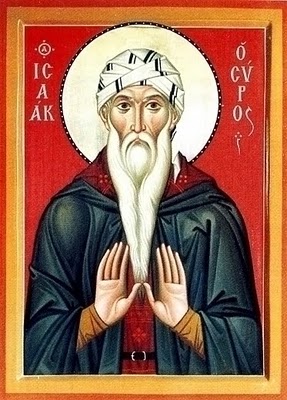
“Love silence above all things. It brings thee near the fruit which the tongue is too weak to interpret. At first we compel ourselves to be silent. Then from our silence something is born which draws us toward silence. May God grant thee to perceive that which is born of silence. If thou beginnest with this discipline, I do not know how much light will dawn in thee through it. Concerning what is said about the admirable Arsenius: that Fathers and brethren came to see him, but that he sat with them in silence and dismissed them in silence – do not think, my brother, that this happened by the action of his will alone, though in the beginning he had to compel himself. After some time some delight is born in the heart from the exercise of this service and by force it draws the body towards remaining in silence.”
“If thou placest all labors of this discipline [solitary life] on one side and silence on the other, silence will outweigh them.”
~St. Isaac of Nineveh, from Ascetical Treatises 65
Markides: “Eastern Orthodox Mysticism and Transpersonal Theory”
Posted by Dallas Wolf in First Thoughts, Hesychasm - Jesus Prayer, New Nuggets on November 5, 2017

Dr. Kyriakos Markides
Kyriacos C. Markides (b. 1942) – Dr. Markides is a professor of sociology at the University of Maine. He has written several books on Christian mysticism including Mountain of Silence (2001), Gifts of the Desert (2005), and Inner River (2012). Dr. Markides is a contributor to Transpersonal Psychology, a sub-field or “school” of psychology that integrates the spiritual and transcendent aspects of the human experience with the framework of modern psychology. Based on the early works of Carl Jung, William James, and Abraham Maslow, it is also possible to define Transpersonal Psychology as a “spiritual psychology”. Dr. Markides is trying to introduce Eastern Orthodox Mysticism into Western secular Psychology, something that is long overdue and desperately needed.
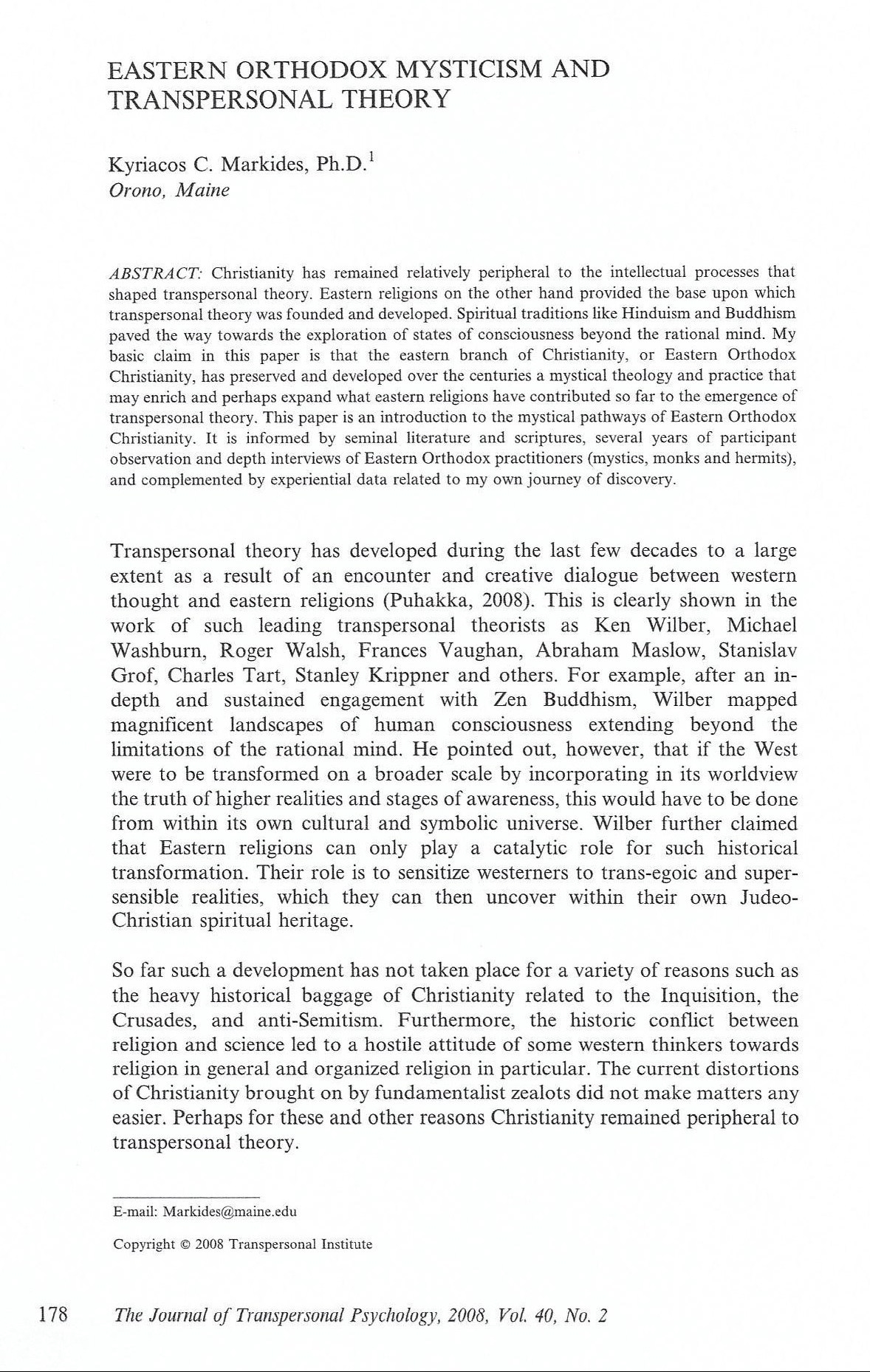
I attach a paper written by Dr. Markides and published in The Journal of Transpersonal Psychology, in 2008 (Vol. 40, No. 2). It is entitled, “Eastern Orthodox Mysticism and Transpersonal Theory”. As a “teaser” to the paper, I include Dr. Markides’ abstract:
ABSTRACT: Christianity has remained relatively peripheral to the intellectual processes that shaped transpersonal theory. Eastern religions on the other hand provided the base upon which transpersonal theory was founded and developed. Spiritual traditions like Hinduism and Buddhism paved the way towards the exploration of states of consciousness beyond the rational mind. My basic claim in this paper is that the eastern branch of Christianity, or Eastern Orthodox Christianity, has preserved and developed over the centuries a mystical theology and practice that may enrich and perhaps expand what eastern religions have contributed so far to the emergence of transpersonal theory. This paper is an introduction to the mystical pathways of Eastern Orthodox Christianity. It is informed by seminal literature and scriptures, several years of participant observation and depth interviews of Eastern Orthodox practitioners (mystics, monks and hermits), and complemented by experiential data related to my own journey of discovery.
Click on the blue hyperlink or the graphic, below, to open Dr. Markides paper:
St. Seraphim of Sarov: “The Acquisition of the Holy Spirit of God”
Posted by Dallas Wolf in Hesychasm - Jesus Prayer, Monasticism, Patristic Pearls on November 2, 2017
St Seraphim of Sarov (1754 – 1833) – is one of the most renowned Orthodox Russian saints. He is generally considered the greatest of the 19th-century startsy (elders). Seraphim extended the monastic teachings of asceticism, contemplation, and theosis to lay Christians. He taught that the purpose of the Christian life was to acquire the Holy Spirit. Perhaps his most popular quotation amongst Orthodox believers is “Acquire a peaceful spirit, and thousands around you will be saved.”
Nikolay Motovilov was a disciple of St Seraphim and wrote down many of his conversations with the starets, including this famous Talk On the Purpose of the Christian Life, that took place in November 1831 in the forest near Sarov. Motovilov’s account is considered one of the spiritual treasures of Russian Orthodoxy.
The Acquisition of the Holy Spirit of God
Click on the graphic or the blue hyperlink below to open the document:

 First Thoughts