Posts Tagged patristic fathers
Thomas Aquinas: “… all that I have written seems to me as so much straw”
Posted by Dallas Wolf in First Thoughts, Theology on December 10, 2024
Thomas Aquinas OP (c. 1225 – 7 March 1274) was an Italian Dominican friar and priest, the foremost Scholastic thinker, as well one of the most influential philosophers and theologians in the Western tradition. Thomas’s best-known work is the unfinished Summa Theologica, or Summa Theologiae (1265–1274). As a Doctor of the Church, Thomas Aquinas is considered one of the Roman Catholic Church’s greatest theologians and philosophers.
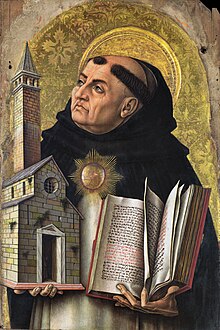
On December 6th, 1273, while Thomas Aquinas was celebrating Holy Communion during the Feast of Saint Nicholas, he received a revelation that so affected him he called his principal work, the Summa Theologica, nothing more than “straw” and left it unfinished.
Aquinas described his Divine Experience: “The most perfect union with God is the most perfect human happiness and the goal of the whole of the human life, a gift that must be given to us by God.”
When his friend and secretary tried to encourage Aquinas to write more, he replied:
“I can do no more. The end of my labors has come. Such things have been revealed to me that all that I have written seems to me as so much straw. Now I await the end of my life after that of my works.”
Aquinas would die just three short months later. The Great Doctor finally got it right, I think. Experience (theoria) trumps reason.
An Orthodox view on Heaven and Hell
Posted by Dallas Wolf in Heaven and Hell, Theology on November 2, 2024
From the The Orthodox Church in America (OCA)
The Kingdom of heaven is already in the midst of those who live the spiritual life. What the spiritual person knows in the Holy Spirit, in Christ and the Church, will come with power and glory for all men to behold at the end of the ages.
The final coming of Christ will be the judgment of all men. His very presence will be the judgment. Now men can live without the love of Christ in their lives. They can exist as if there were no God, no Christ, no Spirit, no Church, no spiritual life. At the end of the ages this will no longer be possible. All men will have to behold the Face of Him who “for us men and our salvation came down from heaven and was incarnate . . . who was crucified under Pontius Pilate, and suffered and was buried . . .” (Nicene Creed). All will have to look at Him whom they have crucified by their sins: Him “who was dead and is alive again” (Rev 1.17–18).
For those who love the Lord, His Presence will be infinite joy, paradise and eternal life. For those who hate the Lord, the same Presence will be infinite torture, hell and eternal death. The reality for both the saved and the damned will be exactly the same when Christ “comes in glory, and all angels with Him,” so that “God may be all in all” (1 Cor 15–28). Those who have God as their “all” within this life will finally have divine fulfillment and life. For those whose “all” is themselves and this world, the “all” of God will be their torture, their punishment and their death. And theirs will be “weeping and gnashing of teeth” (Mt 8.21, et al.).
The Son of Man will send His angels and they will gather out of His kingdom all causes of sin and all evil doers, and throw them into the furnace of fire; there men will weep and gnash their teeth. Then the righteous will shine like the sun in the Kingdom of their Father (Mt 13.41–43).
According to the saints, the “fire” that will consume sinners at the coming of the Kingdom of God is the same “fire” that will shine with splendor in the saints. It is the “fire” of God’s love; the “fire” of God Himself who is Love. “For our God is a consuming fire” (Heb 12.29) who “dwells in unapproachable light” (1 Tim 6.16). For those who love God and who love all creation in Him, the “consuming fire” of God will be radiant bliss and unspeakable delight. For those who do not love God, and who do not love at all, this same “consuming fire” will be the cause of their “weeping” and their “gnashing of teeth.”
Thus it is the Church’s spiritual teaching that God does not punish man by some material fire or physical torment. God simply reveals Himself in the risen Lord Jesus in such a glorious way that no man can fail to behold His glory. It is the presence of God’s splendid glory and love that is the scourge of those who reject its radiant power and light.
. . . those who find themselves in hell will be chastised by the scourge of love. How cruel and bitter this torment of love will be! For those who understand that they have sinned against love, undergo no greater suffering than those produced by the most fearful tortures. The sorrow which takes hold of the heart, which has sinned against love, is more piercing than any other pain. It is not right to say that the sinners in hell are deprived of the love of God . . . But love acts in two ways, as suffering of the reproved, and as joy in the blessed! (Saint Isaac of Syria, Mystic Treatises).
This teaching is found in many spiritual writers and saints: Saint Maximus the Confessor, the novelist Fyodor Dostoevsky. At the end of the ages God’s glorious love is revealed for all to behold in the face of Christ. Man’s eternal destiny—heaven or hell, salvation or damnation—depends solely on his response to this love.
Met. Kallistos Ware: On Hell
Posted by Dallas Wolf in First Thoughts, Heaven and Hell, Universal Restoration (Apokatastasis) on November 2, 2024
Metropolitan Kallistos (Ware) of Diokleia – (1934 – 2022) was a titular metropolitan of the Orthodox Ecumenical Patriarchate in Great Britain. From 1966-2001, he was Spalding Lecturer of Eastern Orthodox Studies at Oxford University, and has authored numerous books and articles pertaining to the Orthodox faith. The following excerpts are taken from Met. Kallistos’ book, The Orthodox Way (1986).

Hell is a point not in space but in the soul. It is the place where God is not. (And yet God is everywhere!) (p. 106)
The Last Judgement is best understood as the moment of truth when everything is brought to light, when all our acts of choice stand revealed to us in their full implications, when we realize with absolute clarity who we are and what has been the deep meaning and aim of our life. And so, following this final clarification, we shall enter – with soul and body reunited – into heaven or hell, into eternal life or eternal death.
Christ is the judge; and yet, from another point of view, it is we who pronounce judgement upon ourselves. If anyone is in hell, it is not because God has imprisoned him there, but because that is where he himself has chosen to be. The lost in hell are self-condemned, self-enslaved; it has been rightly said that the doors of hell are locked on the inside. (p. 181)
How can a God of love accept that even a single one of the creatures whom he has made should remain for ever in hell? There is a mystery here which, from our standpoint in this present life, we cannot hope to fathom. The best we can do is to hold in balance two truths, contrasting but not contradictory. First, God has given free will to man, and so to all eternity it lies within man’s power to reject God. Secondly, love signifies compassion, involvement; and so, if there are any who remain eternally in hell, in some sense God is also there with them. It is written in the Psalms, ‘If I go down to hell, thou art there also’ (139:7); and St. Isaac the Syrian says, ‘It is wrong to imagine that sinners in hell are cut off from the love of God.’ Divine love is everywhere, and rejects no one. But we on our side are free to reject divine love: we cannot, however, do so without inflicting pain upon ourselves, and the more final our rejection the more bitter our suffering. (p.182)
Meet St. Macrina the Younger; the “Fourth Cappadocian”
Posted by Dallas Wolf in Monasticism, Patristic Pearls, The Cappadocians, Women in Early Christianity on October 27, 2024
St. Macrina the Younger (AD 327-379) was a mystic consecrated virgin from a landed and committed Christian family. She was the elder sister of four Cappadocian Saints: St. Basil the Great, St. Gregory of Nyssa, St. Naucratius, and St. Peter of Sebasteia. She was also friends with fellow Cappadocian, St. Gregory of Nazianzus.

Brother Gregory of Nyssa records a powerful statement about Macrina, his older sister, in his 19th letter, “We had a sister who was for us a teacher of how to live, a mother in place of our mother.” It is well documented that big sister Macrina had significant influence in the spiritual development and careers of brothers Basil, Naucratius, Gregory, and Peter, all of whom became saints.
In addition to her role as teacher, guide, and exemplar to her younger siblings, Macrina transformed her family’s estate at Annisa, in Pontus [Uluköy, modern Turkey], into a cenobitic monastery, or domestic ascetic community, of virgin women. All of these women were treated as equals, regardless of their former social or economic status. Over time, Macrina added accommodations for ascetic celibate men and orphan children to her monastery.
But, there is more to Macrina’s story.
Brother Gregory records the story of the miraculous healing of Macrina of a disease which many hypothesize to have been breast cancer. Gregory writes, “she went into the sanctuary and remained there all night long prostrate before the God of healing, weeping a flood of tears to moisten the earth, and she used the mud from her tears as a salve to put on the effected place” (Gregory of Nyssa: “The Life of St. Macrina”, 48).
An example of Macrina as wonder worker is also recorded by Gregory, documenting the testimony of the garrison commander of the Pontus town of Sebastopolis. This distinguished military man reported that he, with his wife and daughter, had once visited Macrina’s monastery, “that powerhouse of virtue,” and when they left, their daughter’s severe eye disease was cured by Macrina’s prayers, “the true medicine with which she heals diseases.” (Life of Macrina, 52)
Macrina the Younger was a spiritual force of nature, according to the testimony of brother Gregory of Nyssa. Although her story may be embellished, her prophetic disposition and pastoral qualities, coupled with her direct divine experiences are both inspiring and edifying to modern ears.
Gregory finished his story of Macrina’s life by saying, “In order therefore that those who have too little faith, and who do not believe in the gifts of God, should come to no harm, for this reason I have declined to make a complete record here of the greater miracles, since I think that what I have already said is sufficient to complete Macrina’s story.” (The Life of Macrina, 54)
While Basil the Great, Gregory of Nyssa, and Gregory of Nazianzus have long been honored and revered as the three great “Cappadocian Fathers”, Macrina did not historically receive much serious attention from theologians or scholars. In more recent years Macrina has been hailed by the Orthodox theologian, Jaroslav Pelikan, and others as the “Fourth Cappadocian”.
Regardless of her title, Macrina has greatly influenced Christianity through her life as a consecrated virgin, prophet, monastic founder and leader, mother, father, sister, teacher, wonder worker, and philosopher of God.

Paradise and Hell
Posted by Dallas Wolf in First Thoughts, Heaven and Hell, Theology on October 8, 2024
St. Gregory of Nyssa: “Epektasis (ἐπέκτασις)- The soul’s eternal ‘straining toward’ God”.
Posted by Dallas Wolf in Ekklesia and church, First Thoughts, Monasticism, Patristic Pearls, The Cappadocians, Theology on April 20, 2023
“Brothers, I do not yet reckon myself to have seized hold, save of one thing: Both forgetting the things lying behind and also stretching out [ἐπεκτεινόμενος] to the things lying ahead,”
Philippians 3:13 from The New Testament- a translation by David Bentley Hart
_________________________________________________________________________
Background – A Brief Summary of Gregory of Nyssa’s Theology
In Gregory’s account of creation, the nature-energies distinction, developed to counter Eunomius, a defender of the 4th century Arian heresy, becomes extended into a general cosmological principle.
To Gregory, the essence of God is incomprehensible, transcendent, and cannot be defined by any set of human concepts. When speaking of God’s essence, or ousia, all that can be said is what that essence is not (Against Eunomius II, IV). In saying this, Gregory anticipates the via negativa (apophatic) theology of Pseudo-Dionysius (5th century) and much of subsequent Orthodox theological thought.

If God is simply some transcendent, unknowable entity, what possible relation to the world could God ever have? Gregory answers these questions by distinguishing between God’s “nature” (phusis) and God’s “energies” (energeiai). God’s energies are the projection of the divine nature into the world; initially creating it and ultimately guiding it to its appointed destination (Beatitudes VI). The idea of God’s energies in Gregory’s theology emphasizes God’s actual presence in those parts of creation which are perfected just because of that presence. Whereas God’s nature is totally transcendent and unknowable, God’s energies are immanent and knowable to mankind. With this revelation, Gregory anticipates the more famous substance-energies distinction of the 14th century Byzantine theologian Gregory Palamas.
Gregory’s view of human nature is dominated by his belief that humans were created in the image of God. This means that because God’s transcendent nature projects energies out into the world, we would expect the same structural relationship to exist in human beings between their minds and their bodies. In fact, that is precisely what Gregory argues concerning the human nous (a word that was traditionally translated as “mind”, but by the 4th century included the Christian idea of its nature also extending beyond and separate from the physical world).
The most important characteristic of the nature of the nous is that it provides for a unity of consciousness; where the myriad perceptions from various sense organs are all coordinated with each other. Using the metaphor of a city in which family members come in by various gates but all meet somewhere inside, Gregory’s assertion is that this can occur only if we presuppose a transcendent self to which all of one’s experiences are referred (Making of Man 10). But Gregory maintains that this unity of consciousness is entirely mysterious, much like the mysterious nature of the Godhead (Making of Man 11).
Yet the nous is also extended by its energies throughout the body, which includes our ordinary sensory and psychological experiences as well as our discursive, rational mind (dianoia) (Making of Man 15; Soul and Resurrection).
There are two further important characteristics of the human nous according to Gregory. First, because the human nous is created in the image of God, it possesses a certain “dignity of royalty” (to tes basileias axioma) that is lacking in the rest of creation. Second, the nous is free. Gregory derives the freedom of the nous from the freedom of God. For God, being dependent on nothing, governs the universe through the free exercise of will; and the nous is created in God’s image (Making of Man 4).
Epektasis – the eternal ‘stretching and straining’ of the soul toward God
This concept of epektasis features heavily throughout the writings of Gregory of Nyssa (most especially in his Life of Moses and Homilies on the Song of Songs). His work leans toward an ascetic, mystical approach to the faith. Gregory believed that man’s ultimate purpose was to grow in participation in the divine. Since God is transcendent and infinite and man is created and finite, he reasoned that man could never reach a point where he fully participated in God; hence the need for the concept of epektasis. Gregory rejected the more typical view that happiness and perfection are found in attaining a concrete spiritual goal. Rather, he suggested, since humanity is incapable of reaching the actual transcendent perfection of God, purpose and meaning are found in progress toward that relationship standard. Gregory’s views on spiritualty had an early and lasting impact on the Eastern Orthodox interpretation of theosis.
Epektasis is derived from a Greek word found in verses such as Philippians 3:13, where it is translated as “stretching out.” Epectasis, like askesis, is a term from athletics. It implies something that is becoming, developing, being strived for. It has alternately been understood as “evolving” or “growing.” As it pertains to Christian theology, epektasis implies that true joy in Christian living is found in the process of spiritual growth and development. That is, it is the internal change we experience that produces a sense of happiness, not the achievement of any particular goal. Specifically, epektasis emphasizes the need for continual “spiritual transformation” and suggests this process will continue forever in eternity. For Gregory, it is the journey that is important.
As Gregory puts it, “Deity is in everything, penetrating it, embracing it, and seated in it” (Great Catechism 25). So, we directly experience the divine energies in the only thing in the universe that we can view from within – ourselves. God’s energies are always a force for good. Thus, we encounter them in the experience of virtues such as purity, passionlessness (apatheia), sanctity, and simplicity in our own moral character. “if . . . these things be in you,” Gregory concludes, “God is indeed in you” (Beatitudes VI).
Gregory tells us epektasis also imposes certain obligations on us in relation to both others and ourselves. To others we owe mercy (Beatitudes V) and the Christian virtue of agape (Beatitudes VII). To ourselves we owe the effort to overcome (through askesis; athletic training) the deficiencies and shortcomings in our likeness to God; for we are unable to contemplate God directly, and morally our free will has been compromised by the passions (pathe). Thus, with respect to ourselves we must continuously stretch out our souls (epektasis; like a straining athlete), toward intellectual and moral perfection (Beatitudes III).
_________________________________________________________________________________
“Whereby he has given us his precious and majestic promises, so that through these you may become communicants in the divine nature, having escaped from the decay that is in the cosmos on account of desire.”
2 Peter 1:4 from The New Testament- a translation by David Bentley Hart
___________________________________________
Text references (by Gregory of Nyssa):
Against Eunomius
Homilies on the Beatitudes
On the Making of Man
On the Soul and the Resurrection
The Life of Moses
Homilies on the Song of Songs
The Great Catechism
Icons: “… we are surrounded by so great a cloud of witnesses,”
Posted by Dallas Wolf in Ekklesia and church on April 12, 2023

“Therefore, since we are surrounded by so great a cloud of witnesses1, let us also lay aside every weight and the sin that clings so closely, and let us run with perseverance the race that is set before us,” ~ Hebrews 12:1
________________________________________________________________________________
One of the most striking visuals in an Orthodox church is the great number and variety of highly stylized icons covering walls, ceilings, and seemingly any other available floor or shelf space.
Strictly speaking, an icon (εικών, eikon – image, picture) is a portable sacred image, painted on a piece of wood according to the style and techniques of Byzantine art. But in its broader sense, an icon is any sacred image painted, or otherwise reproduced, for the purpose of veneration2.
The Patristic Fathers taught that an “icon makes present that which it represents.” Veneration happens when we stop seeing an icon as an object of art or decoration and nothing more, and begin seeing it as a close, face-to-face encounter with the person represented. Veneration is far more than the acts of bowing, kissing, crossing oneself, offering incense or lighting candles. In fact, those things only become veneration when they are offered towards the person who is made present in an icon.
Many icons depict persons recognized as holy Saints by the church. Of these, some of them are martyrs, having died for their Christian witness; some are confessors, having maintained their witness under especially difficult and or dangerous conditions, but not lost their lives; but the majority of Saints are neither; just people in all ages recognized as extraordinarily holy. Saints are not an anachronist relic of the distant past. They have been recognized since the birth of the church and new Saints continue to be identified and recognized to this day.
For most of church history, the majority of Christians could not read or write. In the Greco-Roman world of the Apostles, it is estimated that less than 15% of the population was literate. Hearing the Scripture read during church services and understanding the stories and people depicted in the icons adorning the church building served as important tools for the transmission of Christian tradition and faith. It follows then that icons continue to serve as educational and worshiping aids. The Holy Spirit speaks to us through icons, as images that complement the written words of Scripture. Icons also serve to transport us into the realm of spiritual experience, to go beyond our material world, to show us the greatness and perfection of the divine reality that is invisible to us.
During an Orthodox church service, it feels like the entire congregation is worshiping along with all of the Saints depicted in the icons adorning the church. And even when praying alone in an empty Orthodox church, you cannot feel alone; but rather accompanied, comforted, and supported by all of the Saints present through the icons.
_____________________________________________________________________________
1 Witness (Gr. μάρτυς, mártys) in its original meaning, the Greek word martyr, was used in the secular sphere as well as in the New Testament. The process of bearing witness was not intended to lead to the death of the witness, although it is known from ancient writers (e.g., Josephus) and from the New Testament that witnesses often died for their testimonies. During the early Christian centuries, the term martyr came to mean one who gives his or her life for the faith. A confessor (ομολογητής) came to mean a person who does not actually die for the faith but witnesses to it under difficult and often dangerous conditions.
2 Veneration (Gr. σεβασμός) is a reverence, love, and recognition paid to all those persons portrayed in an icon. Many people in the West often misinterpret veneration as worship; however, worship (προσκύνησης, total devotion of the self) in the Eastern Orthodox Church is reserved for God alone.
Evagrius Ponticus – Nous: “… like a sapphire or the color of heaven.”
Posted by Dallas Wolf in Contemplative Prayer (series), First Thoughts, Monasticism, Patristic Pearls, The Cappadocians, The Holy Trinity on April 10, 2023
Evagrius Ponticus (c. 346-399) – was originally from Pontus, on the southern coast of the Black Sea in what is modern-day Turkey. He served as a Lector under St. Basil the Great and was made Deacon and Archdeacon under St. Gregory of Nazianzus. He was also greatly influenced by Origen of Alexandria and St. Gregory of Nyssa. In about 383, Evagrius left Constantinople, eventually retreating to the Egyptian desert and joining a cenobitic community of Desert Fathers. As a classically trained scholar, Evagrius recorded the sayings of the desert monks and developed his own theological writings. The excerpt below is from Evagrius’ Skemmata (Reflections).

- If any would see the state of their nous, let them deprive themselves of all concepts (noemata): and then they will see themselves like a sapphire or the color of heaven (Exod. 24.10); but this cannot be accomplished without apatheia [dispassion] since it requires the cooperation of God who breathes into them the kindred light.
- Apatheia is the quiet state of the reasoning soul composed of gentle temperance.
- The state of the nous is the noetic [spiritual] height like the color of heaven, upon which the light of the holy Trinity comes at the time of prayer.
Skemmata, Gnostic Chapters 1-3
St. Athanasius on St. Antony the Great: “… learn what the life of monks ought to be;”
Posted by Dallas Wolf in Ekklesia and church, Monasticism, Patristic Pearls on April 8, 2023
St. Antony the Great (Greek: Ἀντώνιος) (251 – 356)- was a Christian ascetic monk from Egypt. Antony was among the first anchorites known to go into the Egyptian desert wilderness in about AD 270. Because of his importance among the Desert Fathers and to all later Christian monastics, he is also known as the Father of All Monks. Most of what is known about Antony comes from the Life of Antony, written around 360 by St. Athanasius of Alexandria. It depicts Anthony as an illiterate holy man who, through his stark solitary ascetic life in the desert, forges an absolute connection to the divine Truth. This biography of Antony’s life helped to spread the concept of Christian monasticism into both the Greek and Latin worlds. The excerpt below is from St. Athanasius’ Life of Antony:
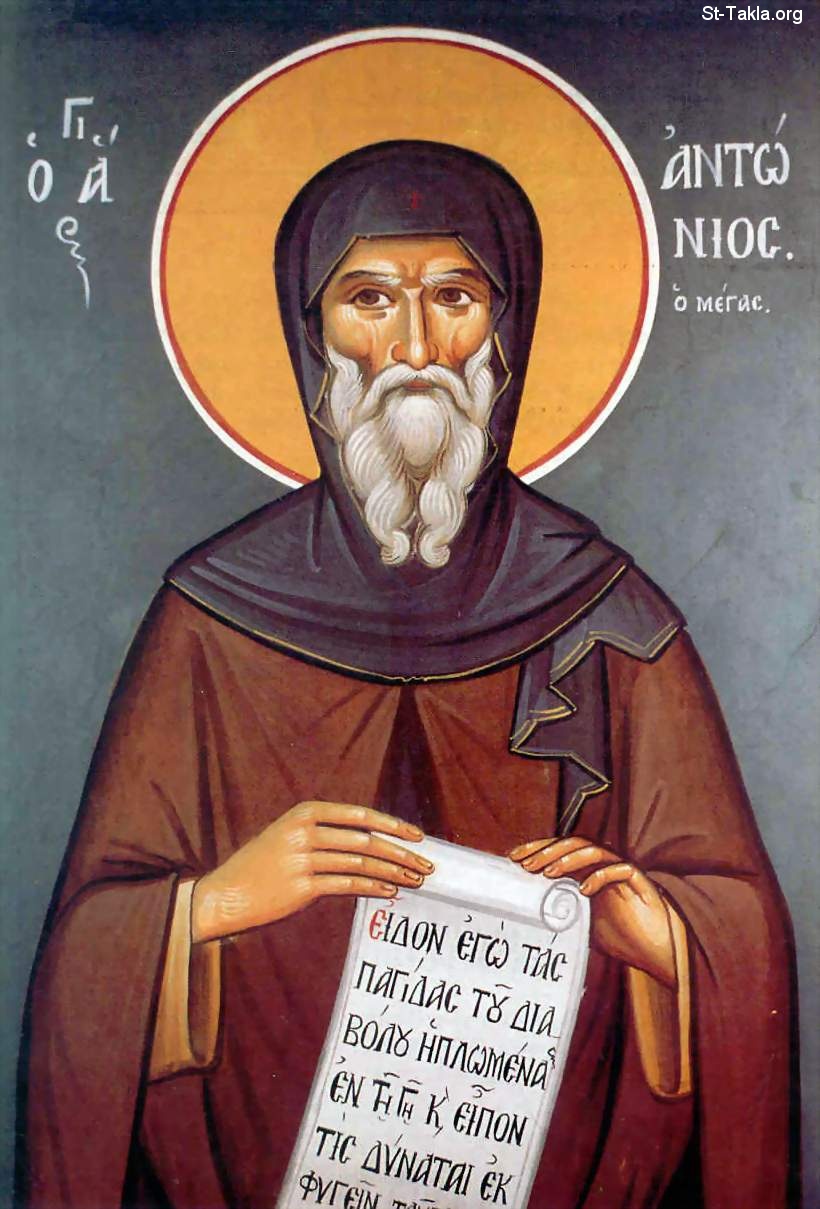
“Further, he was able to be of such use to all, that many soldiers and men who had great possessions laid aside the burdens of life, and became monks for the rest of their days. And it was as if a physician had been given by God to Egypt. For who in grief met Antony and did not return rejoicing? Who came mourning for his dead and did not forthwith put off his sorrow? Who came in anger and was not converted to friendship? What poor and low-spirited man met him who, hearing him and looking upon him, did not despise wealth and console himself in his poverty? What monk, having being neglectful, came to him and became not all the stronger? What young man having come to the mountain and seen Antony, did not forthwith deny himself pleasure and love temperance? Who when tempted by a demon, came to him and did not find rest? And who came troubled with doubts and did not get quietness of mind?” (87).
“Read these words, therefore, to the rest of the brethren that they may learn what the life of monks ought to be; and may believe that our Lord and Saviour Jesus Christ glorifies those who glorify Him: and leads those who serve Him unto the end, not only to the kingdom of heaven, but here also— even though they hide themselves and are desirous of withdrawing from the world— makes them illustrious and well known everywhere on account of their virtue and the help they render others. And if need be, read this among the heathen, that even in this way they may learn that our Lord Jesus Christ is not only God and the Son of God, but also that the Christians who truly serve Him and religiously believe in Him, prove, not only that the demons, whom the Greeks themselves think to be gods, are no gods, but also tread them under foot and put them to flight, as deceivers and corrupters of mankind, through Jesus Christ our Lord, to whom be glory for ever and ever. Amen.” (94)
~ from: St Athanasius, Life of Antony, 87, 94
St. Gregory of Nazianzus: “The Holy Ghost, which proceeds from the Father;”
Posted by Dallas Wolf in Ekklesia and church, First Thoughts, Monasticism, Patristic Pearls, The Cappadocians, The Holy Trinity on April 8, 2023
St. Gregory of Nazianzus (c. 329 – 25 January 390), also known as Gregory the Theologian or Gregory Nazianzen, was a 4th-century Archbishop of Constantinople, theologian, and one of the Cappadocian Fathers (along with Basil the Great and Gregory of Nyssa). He is widely considered the most accomplished rhetorical stylist of the patristic age. Gregory made a significant impact on the shape of Trinitarian theology among both Greek and Latin-speaking theologians, and he is remembered as the “Trinitarian Theologian”.

“The Holy Ghost, which proceeds from the Father; Who, inasmuch as He proceeds from That Source, is no Creature; and inasmuch as He is not Begotten is no Son; and inasmuch as He is between the Unbegotten and the Begotten is God. And thus escaping the toils of your syllogisms, He has manifested himself as God, stronger than your divisions. What then is Procession? Do you tell me what is the Unbegottenness of the Father, and I will explain to you the physiology of the Generation of the Son and the Procession of the Spirit, and we shall both of us be frenzy-stricken for prying into the mystery of God. And who are we to do these things, we who cannot even see what lies at our feet, or number the sand of the sea, or the drops of rain, or the days of Eternity, much less enter into the Depths of God, and supply an account of that Nature which is so unspeakable and transcending all words?”
~ from: The Orations and Letters of Saint Gregory Nazianzus, Oration 31 (5th Theological Oration), VIII.
 First Thoughts