Posts Tagged Textual Criticism
The Four Text-Types of NT Textual Criticism
Posted by Dallas Wolf in Ancient Christian Manuscripts, First Thoughts, New Nuggets, Theology on March 12, 2026
The four main text-types in New Testament textual criticism are the Alexandrian, Western, Byzantine, and Caesarean. These categories help scholars analyze and compare the thousands of existing manuscripts to reconstruct the original text.
Textual criticism of the New Testament categorizes manuscripts into several text types. The four main text types are:
1. Alexandrian Text-Type
- Date: 2nd–4th centuries CE
- Characteristics: Generally shorter readings, fewer expansions or paraphrases, and more abrupt readings. It is often considered more reliable than other text types. RSV, NRSV, ESV, NASB, NIV, and LEB Bibles are based on Alexandrian-type manuscripts.
2. Western Text-Type
- Date: 2nd–9th centuries CE
- Characteristics: Known for paraphrasing and free alterations. Scribes often changed words and clauses to enhance clarity and meaning. Witnessed in Latin and Syriac translations of the Greek, mainly in the Western Roman Empire.
3. Byzantine Text-Type
- Date: 4th century onward
- Characteristics: Characterized by a larger number of surviving manuscripts. It tends to have more expansions and harmonizations, reflecting a later formalization of the text. The King James and virtually all Reformation-era Bibles are based on Byzantine-Type manuscripts.
4. Caesarean Text-Type
- Date: 3rd–4th centuries CE
- Characteristics: A less common type that exhibits features of both the Alexandrian and Western text types. It is primarily associated with the region of Caesarea Maritima in Judea.
These text types help scholars classify and understand the variations in the New Testament manuscripts and work towards reconstructing the original text.
Major New Testament Text‑Types
| Text‑Type | Key Features | Comments |
| Alexandrian | Earliest, concise, less harmonized; includes Codices Vaticanus & Sinaiticus | Most reliable overall. Basis for RSV, NRSV, ESV, NASB, NIV, and LEB Bibles |
| Western | Paraphrastic, expansions, unique readings (e.g., Codex Bezae) | Valuable but secondary |
| Byzantine | Majority of later manuscripts; smoother, harmonized | Least reliable for earliest text. Basis for King James and Reformation era Bibles |
| Caesarean (disputed) | Regional; mixed features; mostly in Gospels | Interesting but not primary |
Bart Ehrman: “Textual Criticism 101”
Posted by Dallas Wolf in Ancient Christian Manuscripts, New Nuggets on March 12, 2026

Bart D. Ehrman (born October 5, 1955) is an American New Testament scholar whose research focuses on the textual criticism of the New Testament, the historical Jesus, and the origins and development of early Christianity. He is the James A. Gray Distinguished Professor of Religious Studies at the University of North Carolina at Chapel Hill. He is the author or editor of more than 30 books, including six New York Times bestsellers, and has created nine lecture series with The Great Courses. Misquoting Jesus: The Story Behind Who Changed the Bible and Why, HarperCollins, 2005, is his most popular New York Times bestseller mass-market book on Christian textual criticism.
The following excerpt is from his The New Testament – A Historical Introduction to the Early Christian Writings, 3rd Edition, Oxford University Press, 2004. Pp. 485-488.
Criteria for Establishing the Original Text of the New Testament
There is a subdiscipline within New Testament scholarship called “textual criticism,” which seeks to establish the original text of the New Testament based on the surviving manuscript evidence. It is a complex task but one that can be extremely intriguing – something like reading a detective story in which a few clues have to be pieced together in order to decide “whodunit.” When there are different forms of the text, that is, when a verse is worded in different ways in the surviving manuscripts, the question has to be asked, which manuscripts represent the text of the autograph and which ones represent changes of the text? Inevitably, a choice has to be made between one form of wording and another, and the choice can sometimes make a significant difference in how a document is interpreted. Since it is better to make an intelligent choice based on evidence than simply to guess, critics have developed certain principles for deciding which form of a text is more likely to be original.
- The Number of Witnesses That Support a Reading. In addition to the approximately 5,400 Greek manuscripts of the New Testament, we have tens of thousands of New Testament manuscripts in other languages into which it was eventually translated (especially Latin but also Syriac, Coptic, Armenian, and others). Moreover, there are dozens of ancient Christian authors from different times and places who quoted the New Testament. By collecting their quotations, we can reconstruct what their own manuscripts probably looked like.
Given the abundance of evidence, one might suppose that a fairly obvious criterion for deciding which reading is original is to count the witnesses in support of each (different) reading and to accept the one that is most abundantly attested. Suppose, for example, that for a given verse there were 500 witnesses that have one form of wording and only six that have a variant form. All other things being equal, one might suspect that the six represent a mistake.
The problem, however, is that all other things are rarely equal. If the six witnesses, for example, all derive from the third and fourth centuries, whereas the 500 are all later, from the fifth to the fifteenth centuries, then the six may preserve an earlier form of the text that came to be changed to the satisfaction of later scribes. Thus, simply counting the witnesses that support a certain form of the text is generally recognized as a rather unreliable method for reconstructing the original text. - The Age of the Witnesses. The form of the text that is supported by the oldest witness is more likely to be original than a different form found only in later manuscripts, even if these are more numerous. Most scholars recognize that this principle is better than simply counting the manuscripts, but it too can be problematic. For example, it is possible for a sixth-century manuscript to preserve an older form of the text than, say, a fourth-century one. This would happen if the sixth-century manuscript had been produced from a copy that was made in the second century, whereas the fourth-century manuscript derived from one made in the third.
- The Quality of the Witnesses. In a court of law, the testimony of some witnesses carries more weight than that of others. If there are two witnesses with contradictory testimony, and one is known to be a habitual liar, drunkard, and thief, whereas the other is an upstanding member of the community, most juries will have little difficulty deciding whom to believe. A similar situation occurs with manuscripts. Some are obviously full of errors, for instance, when their scribe was routinely inattentive or inept, and others appear to be on the whole trustworthy. The best manuscripts are those that do not regularly preserve forms of the text that are obviously in error.
- The Geographical Spread of the Witnesses. An even more useful criterion involves the geographical distribution of the different forms of the text, especially among the earliest manuscripts. Suppose our manuscripts support two different forms of a passage, one found only among manuscripts produced in a specific geographical area (say, southern Italy), the other found in witnesses spread throughout the Mediterranean (say, Northern Africa, Alexandria, Syria, Asia Minor, Gaul, and Spain). In this case, the former is more likely to be a local variation reproduced by scribes of the region, whereas the other is more likely to be older since it was more widely known.
The foregoing criteria often have a cumulative effect in helping scholars decide what the original text was. If one form of reading, for example, is found in geographically diverse witnesses that are early and of generally high quality, then there is a good chance that it is original. This judgment has to be borne out, however, by two other factors. - The Difficulty of the Reading. Scholars have found this criterion to be extraordinarily useful. We have seen that scribes sometimes eliminated possible contradictions and discrepancies, harmonized stories, and changed doctrinally questionable statements. Therefore, when we have two forms of a text, one that would have been troubling to scribes – for example, one that is possibly contradictory to another passage or grammatically inelegant or theologically problematic – and one that would not have been as troubling, it is the former form of the text, the one that is more “difficult,” that is more likely to be original. That is, since scribes were far more likely to have corrected problems than to have created them, the comparatively smooth, consistent, harmonious, and orthodox readings are more likely, on balance, to have been created by scribes. Our earliest manuscripts, interestingly enough, are the ones that tend to preserve the more difficult readings.
- Conformity with the Author’s Own Language, Style, and Theology. With the preceding criterion we were interested in determining which form of a passage could be most easily attributed to scribes who copied the text. With our sixth and final criterion we are interested in seeing which form of a passage would be easiest to ascribe to the author who originally produced the text in light of its vocabulary, writing style, and theology. If two forms of a passage are preserved among the New Testament manuscripts and one of them contains words, grammatical constructions, and theological ideas that never occur in the author’s writings elsewhere (or that conflict with his other writings), then that form of the text is less likely to be original than the other.
All of these criteria need to be applied to any particular passage in order to decide which reading among the manuscripts is likely to be original. In many instances, the arguments coalesce, so that the earliest and best manuscripts also support the reading that is most difficult and that conforms most closely with the author’s own language and style. When this happens, we can be relatively certain that we have uncovered the earliest available form of the text.
The Apostle Paul: Radical, Conservative, or Reactionary?
Posted by Dallas Wolf in Ancient Christian Manuscripts, Ekklesia and church, First Thoughts, Theology, Women in Early Christianity on March 21, 2025
The Apostle Paul is a controversial figure. More than half of the New Testament is written by him, about him, or in his name. There is a general consensus among contemporary scholars that the Apostle Paul did not write all 13 New Testament letters attributed to him.
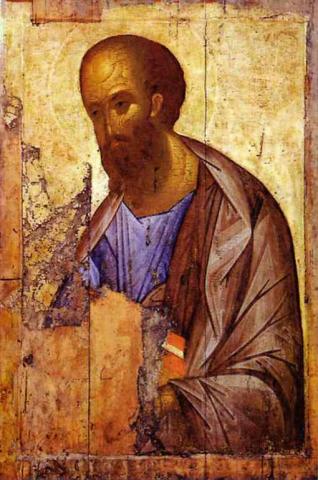
Modern scholarship attributes seven of Paul’s 13 canonical letters as unquestionably authentic:
- Romans,
- Galatians,
- I Corinthians,
- II Corinthians,
- I Thessalonians,
- Philippians, and
- Philemon
Three others are generally considered deutero or (pseudo) – Pauline and are Pauline in theology, with a couple of notable exceptions, but are different in style and much more mainline and conservative in tone than the undisputed letters. They were probably written in the generation after Paul’s death by people very familiar with his teaching. The deutero (or pseudo)-Pauline letters are:
- Colossians,
- Ephesians, and
- II Thessalonians
The last three, the “Pastoral Letters”, are largely considered pseudepigrapha (a bible scholar’s politically-correct term for “forgery”) and were probably written around the beginning of the 2nd century and exhibit patriarchal, sexist, and reactionary social attitudes one would expect of an entrenched Greco-Roman cultural institution (exactly what the early Church was becoming by that time).1,2 The pseudepigraphical letters are:
- I Timothy,
- II Timothy, and
- Titus
What follows are estimates of the percentages of biblical scholars who reject Paul’s authorship of the six books in question:
- 2 Thessalonians = 50 percent;
- Colossians = 60 percent;
- Ephesians = 70 percent;
- 2 Timothy = 80 percent;
- 1 Timothy and Titus = 90 percent.2
In addition to judgments about entire letters, scholars also question the authorship of certain passages in the undisputed letters. Post-Pauline texts are those alleged to have been inserted into a letter after its composition and are generally called scribal “interpolations”.
Among the passages that some scholars label as interpolations are:
- Romans 5:5-7, 13:1-7, 16:17-20, 16:25-27;
- 1 Corinthians 4:6b, 11:2-16, 14:33b-35 or 36;
- 2 Corinthians 6:14-7:1; and
- 1 Thessalonians 2:14-16.2,3
Given the above, one could argue that there are really three “Pauls” in the New Testament:
- The Radical Paul of the seven undisputed authentic letters
- The Conservative Paul of the three deutero-Pauline letters
- The Reactionary Paul of the three pseudepigraphical Pastoral Letters
___________________________________________________________
- The First Paul, Reclaiming the Radical Visionary Behind the Church’s Conservative Icon, By Marcus J. Borg and John Dominic Crossan , 2009 HarperCollins, NY, NY
- Apostle of the Crucified Lord, A Theological Introduction to Paul & His Letters, by Michael J. Gorman, 2004 Wm. B. Eerdmans, Grand Rapids, MI / Cambridge, UK
- The Authentic Letters of Paul, A New Reading of Paul’s Rhetoric and Meaning, by Arthur J. Dewey, Roy W. Hoover, Lane C. Mc Gaughy, and Daryl D. Schmidt, 2010 Polebridge Press, Salem, OR
 First Thoughts