Archive for category Contemplative Prayer (series)
Apophatic and Cataphatic Theology: An Issue of Emphasis and Balance
Posted by Dallas Wolf in Contemplative Prayer (series), Ekklesia and church, Essence and Energies (series), First Thoughts, Hesychasm - Jesus Prayer, The Cappadocians, Theology on April 6, 2025
Overview
Apophatic and Cataphatic are two terms used in theology to describe different approaches to understanding God. The Eastern Orthodox and Latin West each use both types. The issue comes down to one of emphasis and balance: The Orthodox East is overwhelmingly Apophatic in approach, while the Latin West is predominantly Cataphatic.
Definitions
Apophatic theology (from Greek: ἀπόφημι apophēmi, meaning “to deny”) uses “negative” terminology to indicate what it is believed the divine is not. It means emptying the mind of words and ideas and simply resting in the presence of God. Apophatic prayer is prayer that occurs without words, images, or concepts. This approach to prayer regards silence, stillness, unknowing and even darkness as doorways, rather than obstacles, to communication with God. Apophatic theology relies primarily on experience and revelation.
Cataphatic theology (from the Greek word κατάφασις kataphasis meaning “affirmation”) uses “positive” terminology to describe or refer to the divine, i.e. terminology that describes or refers to what the divine is believed to be. Cataphatic prayer is prayer that speaks thoroughly, intensively, or positively of God: prayer that uses words, images, ideas, concepts, and the imagination to relate to God. Cataphatic theology relies heavily on logic and reason.
Background
Apophatic theology—also known as negative theology or via negativa—is a theology that attempts to describe God by negation. In Orthodox Christianity, Apophatic theology is based on the assumption that God’s essence is unknowable or ineffable and on the recognition of the inadequacy of human language to describe God. The Apophatic tradition in Orthodoxy is balanced with Cataphatic theology (positive theology) via belief in the Incarnation and the self-revealed energies of God, through which God has revealed himself in the person of Jesus Christ. However, Apophatic theology is the dominant traditional Eastern paradigm of an experiential, revealed theology, intimately linking doctrine with contemplation through purgation (catharsis), illumination (theoria), and union (theosis).
Clement of Alexandria (c. 150 – 215) was an early proponent of Apophatic theology with elements of Cataphatic. Clement holds that God is unknowable, although God’s unknowability, concerns only his essence, not his energies, or powers. According to Clement’s writings, the term theoria develops further from a mere intellectual “seeing” toward a spiritual form of contemplation. Clement’s Apophatic theology or philosophy is closely related to this kind of theoria and the “mystic vision of the soul.” For Clement, God is both transcendent in essence and immanent in self-revelation.
The Cappadocian Fathers (Basil the Great, Gregory of Nyssa, and Gregory of Nazianzus (4th century)) were early exemplars of this Apophatic theology. They stated that mankind can acquire an incomplete knowledge of God in his attributes, positive and negative, by reflecting upon and participating in his self-revelatory operations (energeia). But, the essence of God is completely unknowable.
A century later Pseudo-Dionysius the Areopagite (late 5th century) in his short work Mystical Theology, first introduced and explained what came to be known as Apophatic or negative theology.
Maximus the Confessor (7th century) maintained that the combination of Apophatic theology and hesychasm—the practice of silence and stillness—made theosis or union with God possible.
John of Damascus (8th century) employed Apophatic theology when he wrote that positive (cataphatic) statements about God reveal “not the nature, but the things around the nature.”
All in all, Apophatic theology remains crucial to much of the theology in Eastern Orthodox Christianity. The opposite tends to be true in Western Latin Christianity, with a few notable exceptions to this rule.
Cataphatic theology
In the Latin West a heavily Cataphatic theology, or via positiva, developed, which remains today in most forms of Western Christianity. This type of Cataphatic theology is based on using human reason to make positive statements about the nature of God. It slowly developed from the 5th to the 11th century, emerging as Scholasticism in the Medieval Period (11th-17th centuries). (see entries for Anselm and Thomas Aquinas, below)
Augustine of Hippo (354–430) significantly influenced scholasticism, emphasizing the integration of faith and reason. His ideas laid the groundwork for later Scholastic thinkers who sought to reconcile Christian theology with classical philosophy, particularly through dialectic reasoning. Augustine’s doctrines of the filioque, original sin, the doctrine of grace, and predestination found little support outside of the Western Roman Church. Within the Western Latin church, ‘Augustinianism’ dominated early theology.
Anselm of Canterbury (c. 1033 – 1109) is widely considered the father of Scholasticism, endeavoring to render Christian tenets of faith, traditionally taken as a revealed truth, as a rational system. Scholasticism prescribed that Aristotelian dialectic reason be used in the elucidation of spiritual truth and in defense of the dogmas of Faith.
Thomas Aquinas (c. 1225 – 7 March 1274) reflects the mature emergence of this new medieval Scholastic paradigm, which promoted the use of formal intellectual reason, putting it at odds with the predominantly Eastern revealed tradition of hesychastic contemplation. Aquinas’ Summa Theologica (1265–1274), is considered to be the pinnacle of Medieval Scholastic Christian philosophy and theology. The resulting ‘Thomism’ remains the foundation of contemporary Western Latin theology.
The “Icon Corner”
Posted by Dallas Wolf in Contemplative Prayer (series), Ekklesia and church, First Thoughts, Hesychasm - Jesus Prayer, Monasticism on November 21, 2024

The Book of Acts and the Epistles of the Apostle Paul record that in the early Church, Christians used to meet in the homes of the faithful. This tradition of the House church assembly continues to this day in Eastern Christianity. An Orthodox Christian is expected to pray constantly. Thus the house, just like the Temple (church building), is considered to be a consecrated place. The center of worship in the house is the icon corner (Greek: εικονοστάσι, iconostási).
An icon corner is normally oriented to face east. It is often located in a corner to eliminate worldly distractions and allow prayer to be more concentrated. Here is where the family’s icons were located and displayed. From the earliest days, Light has been an important part of Christian worship. It not only provides a beautiful and calming ambience; it takes on a theological significance with Christ as the Light of the World. Thus, oil lamps and candles frequently illuminate the icons in the icon corner.
In the theology of Orthodox iconography, the prayers and veneration directed to the icons are passed on to the prototype—the person depicted in the image. For, as St. John of Damascus wrote, “we do not worship paint or wood, we do not worship matter; we worship the God who created matter, who became matter (flesh) for our sake“.
The icons in the icon corner also remind us of the declaration in Hebrews 12:1, that “we are surrounded by so great a cloud of witnesses“; so we need never pray alone. We venerate these witnesses through their icons, petition them and join them in prayer and worship of our Triune God.
Evagrius Ponticus – Nous: “… like a sapphire or the color of heaven.”
Posted by Dallas Wolf in Contemplative Prayer (series), First Thoughts, Monasticism, Patristic Pearls, The Cappadocians, The Holy Trinity on April 10, 2023
Evagrius Ponticus (c. 346-399) – was originally from Pontus, on the southern coast of the Black Sea in what is modern-day Turkey. He served as a Lector under St. Basil the Great and was made Deacon and Archdeacon under St. Gregory of Nazianzus. He was also greatly influenced by Origen of Alexandria and St. Gregory of Nyssa. In about 383, Evagrius left Constantinople, eventually retreating to the Egyptian desert and joining a cenobitic community of Desert Fathers. As a classically trained scholar, Evagrius recorded the sayings of the desert monks and developed his own theological writings. The excerpt below is from Evagrius’ Skemmata (Reflections).

- If any would see the state of their nous, let them deprive themselves of all concepts (noemata): and then they will see themselves like a sapphire or the color of heaven (Exod. 24.10); but this cannot be accomplished without apatheia [dispassion] since it requires the cooperation of God who breathes into them the kindred light.
- Apatheia is the quiet state of the reasoning soul composed of gentle temperance.
- The state of the nous is the noetic [spiritual] height like the color of heaven, upon which the light of the holy Trinity comes at the time of prayer.
Skemmata, Gnostic Chapters 1-3
St. Maximus the Confessor: “…and having entered the dark cloud”
Posted by Dallas Wolf in Contemplative Prayer (series), First Thoughts, Patristic Pearls on April 4, 2023
St. Maximus the Confessor (c. 580 – 662) was a 7th century Christian monk, theologian, and scholar who many contemporary scholars consider to be the greatest theologian of the Patristic era. Two of his most famous works are “Ambigua” – An exploration of difficult passages in the work of Pseudo-Dionysius and Gregory of Nazianzus, focusing on Christological issues, and “Questions to Thalassius” or “Ad Thalassium” – a lengthy exposition on various Scriptural texts. The following quote comes from Maximus’ “Two Hundred Chapters on Theology”, probably written after both Ambigua and Ad Thalassium, in about AD 633.
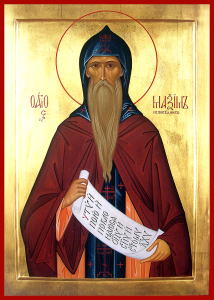
“The great Moses, having pitched his tent outside the camp, that is, having established his will and intellect outside visible realities, begins to worship God; and having entered the dark cloud [γνόφον], the formless and immaterial place of knowledge, he remains there, performing the holiest rites.
The dark cloud [γνόφος] is the formless, immaterial, and incorporeal condition containing the paradigmatic knowledge of beings; he who has come to be inside it, just like another Moses, understands invisible realities in a mortal nature; having depicted the beauty of the divine virtues in himself through this state, like a painting accurately rendering the representation of the archetypal beauty, he descends, offering himself to those willing to imitate virtue, and in this shows both love of humanity and freedom from envy of the grace of which he had partaken.”
~ from: Two Hundred Chapters on Theology, 1.84, 1.85.
Elder Sophrony: “Experiencing the Uncreated Light”
Posted by Dallas Wolf in Contemplative Prayer (series), Hesychasm - Jesus Prayer, Monasticism, New Nuggets on October 31, 2017
Archimandrite Sophrony (Sakharov) (1896 – 1993) – also known as Elder Sophrony, was best known as the disciple and biographer of St Silouan the Athonite and compiler of St Silouan’s works, and as the founder of the Patriarchal Stavropegic Monastery of St. John the Baptist in Tolleshunt Knights, Maldon, Essex, England.
Below is an account of an encounter of Uncreated Divine Light; the Uncreated Thaboric Light of Gregory Palamas. It is written by a modern holy elder, Archimandrite Sophrony, described above. Five years before his repose in England at the age of 97, he recorded his experiences of Uncreated Light. These experiences had begun many years earlier, when he had been living as a monk on Mt. Athos in Greece, and, like all Orthodox monks, had been practicing, daily, the Jesus Prayer:

“Now at the close of my life, (he writes,) I have decided to talk to my brethren of things I would not have ventured to utter earlier, counting it unseemly. At the beginning of my monastic life on Mt. Athos, the Lord granted me unceasing prayer. I will relate what I remember well enough, since we are talking of the prayers which marked me indelibly. This is how it often used to be:
Towards evening at sunset I would shut the window and draw three curtains over it, to make my cell as quiet and dark as possible. With my forehead bent to the floor, I would slowly repeat words of prayer, one after the other. I had no feeling of being cooped up, and my mind, oblivious to the body, lived in the light of the gospel word. Concentrated on the fathomless wisdom of Christ’s word, my spirit, freed from all material concerns, would feel flooded, as it were, with light, from the celestial sun.
At the same time, a gentle peace would fill my soul, unconscious of all the needs and cares of this earth. The Lord gave me to live in this state, and my spirit yearned to cling to his feet in gratitude for this gift. This same experience was repeated at intervals for months, perhaps years. Early in the 1930s—I was a deacon then—for two weeks, God’s tender mercy rested upon me. At dusk, when the sun was sinking behind the mountains of Olympia, I would sit on the balcony near my cell, face turned to the dying light.
In those days, I contemplated the evening light of the sun, and at the same time, another light, which softly enveloped me, and gently invaded my heart, in some curious fashion making me feel compassionate and loving towards people who treated me harshly. I would also feel a quiet sympathy for all creatures in general. When the sun had set, I would retire to my cell, as usual, to perform the devotions preparatory to celebrating the Liturgy, and the light did not leave me while I prayed.
Under the influence of this light, prayer for mankind and travail possessed my whole being. It was clear that the inescapable, countless sufferings of the entire universe, are the consequence of man’s falling away from God, our creator, who revealed himself to us. If the world loved Christ and his commandments, everything would be radically transformed, and the earth would become a wonderful paradise.”
Contemplative Primitive Christian Prayer 1
Posted by Dallas Wolf in Contemplative Prayer (series) on June 13, 2014
“after the fire a still small voice”. ~ 1 Kings 19:12
1 Kings 19 talks about Elijah running from a very evil queen Jezebel. God wants to talk with Elijah and Elijah experiences a great wind, an earthquake, and a fire, yet he does not hear the voice of God. He hears it in a “still small voice” or as the Greek Septuagint has it, “φωνὴ αὔρας λεπτῆς”, “a sound minute and poor”.
We can only hear “a sound minute and poor” when we ourselves are quiet, still, and attentive. We need to be calm in spirit, ignoring the endless blather of our own mind, and open to the moment without expectation or judgment. That is contemplation. It is how Jesus spent most of his time “praying”. It is what the early church meant by prayer.
Western Latin Christianity (Roman Catholicism) completely lost their contemplative prayer tradition by the rational argumentation of the Reformation of the 16th century and the rational intellectual revolution of the Enlightenment of 17th century. Protestantism never had a contemplative prayer tradition.
The bad news is that we in the West have no idea how to pray as Jesus prayed. The good news is that the tradition of contemplative prayer is being re-discovered in the West and has always been available in the Eastern Orthodox tradition of “hesychasm” to anyone motivated to quiet themselves and seek it.
Contemplative Primitive Christian Prayer 2
Posted by Dallas Wolf in Contemplative Prayer (series) on June 12, 2014
“Very early in the morning, while it was still dark, Jesus got up, left the house and went off to a solitary place, where he prayed.” ~ Mark 1:35
In my last post, I pointed out that Western Christianity lost its mystic tradition of contemplative prayer about 500 years ago. Contemplation was the prevailing type of Christian prayer for nearly 1,600 years in the Latin West and it still remains the principal prayer tradition of the Orthodox East. Today, I want to follow up on that thought and discuss the fact that contemplative prayer was established as the principal type of prayer of Christianity in the very beginning, by Jesus himself.
In the very first Chapter (v. 35) of our oldest Gospel, Mark tells how Jesus habitually prayed; alone in a solitary place without distraction. In fact, just before teaching the disciples the “Lord’s Prayer” in Matthew 6, Jesus tells them, “whenever you pray, go into your room and shut the door and pray to your Father who is in secret; and your Father who sees in secret will reward you.”(v.6). In these passages, Jesus also tells his disciple how not to pray: “And whenever you pray, do not be like the hypocrites; for they love to stand and pray in the synagogues and at the street corners, so that they may be seen by others” (v.5); and “When you are praying, do not heap up empty phrases as the Gentiles do; for they think that they will be heard because of their many words” (v. 7). These are not isolated incidents and remarks, but characteristic of Jesus’s prayer life throughout the Gospel accounts of his ministry. As Luke tells us, “So He Himself often withdrew into the wilderness and prayed.” (v. 5:16).
Clearly, Jesus set Contemplative Prayer as the standard for Christians, what I will call “Primitive Christian Prayer”. I use the word “primitive” not in the sense of the word that denotes “crude”, “unfinished”, or “simplistic”, but in the sense of being “primary, original, and pristine”. Primitive Christian Prayer is the way Jesus prayed. It was the principal prayer tradition of the early Church.
You have never heard that message preached from a Protestant pulpit (or Catholic, for that matter), have you?
Contemplative Primitive Christian Prayer 3
Posted by Dallas Wolf in Contemplative Prayer (series) on June 11, 2014
“a higher state still” ~ John Cassian, ca. AD 400
In this discussion over the next few posts, I will quote recognized Church Fathers from the early centuries of the Church in order to introduce the Primitive Christian Prayer tradition to a mostly Protestant audience. The reason for this is simple: it’s a prayer tradition that we Protestants do not have and never had; it had virtually disappeared from the institutional Roman Catholic Church by the time of the Protestant Reformation.
To the modern Roman Catholic and Protestant believer, prayer is usually broken down into five basic types: Blessing and Adoration, Petition, Intercession, Thanksgiving, and Praise (cf. Catechism of the Roman Catholic Church).
John Cassian (c. 350 – c.435) was a Christian mystic who spent 15 years in the Egyptian Desert with the Desert Fathers and Mothers of the 4th century. Highly educated, he was equally comfortable writing in either Greek or Latin. He tells us that Primitive Christian Prayer went well past the types we recognize today:
“The various kinds of prayer [cf. 1 Tim. 2:1; petition, prayer (i.e., praise), intercessions, thanksgiving] are followed by a higher state still… it is the contemplation of God alone, an immeasurable fire of love. The soul settles in it and sinks into its depths” (Conferences, IX, 18).
Contemplative Primitive Christian Prayer 4
Posted by Dallas Wolf in Contemplative Prayer (series) on June 10, 2014
“Be still, and know that I am God”. “Jesus said, “God is spirit, and His worshipers must worship in spirit and in truth” ~ John 4:24, Psalm 46:10
In discussing Contemplative or Primitive Christian Prayer, I will frequently quote early Church Fathers, like Evagrius Ponticus (346 – 399). Evagrius was one of the most important teachers of mysticism of the early Church. He was a contemporary and friend of the famous Cappadocian Fathers (Sts. Basil the Great, Gregory of Nyssa, and Gregory of Nazianzus) who led the Church through the Christological controversies of the 4th century (AD 300’s). St. Basil ordained Evagrius as reader and St. Gregory Nazianzen ordained him to the diaconate. In about AD 383 he, like John Cassian, was drawn to the Egyptian Desert where he became a monk, and was a close associate of the greatest of the Desert Fathers and Mothers, especially Macarius of Egypt. Evagrius was well trained in ancient philosophy and literature, was articulate and literate at a time when most of his contemplative fellow monks of the desert were illiterate.
Evagrius’s description of contemplative Primitive Christian Prayer makes it clear that he is talking about a foundational prayer life that is much different from what we contemporary Christians think of as prayer. First of all, it is not verbal and it is not actively projecting wishes or messages of any kind. In his work, “On Prayer”, Evagrius tells us that, “Prayer is the ascent of the spirit [nous*] to God”… “Prayer is a conversation of the spirit with God.” Second, contemplative primitive prayer requires a quiet, still soul in order for our spirit to ascend and commune with God. It means that all thoughts, whether bad thoughts (the “passions”) or good thoughts, must be stilled. Evagrius tells us that, “You will not be able to pray purely if you are all involved with material affairs and agitated with unremitting concerns. For prayer is the rejection of conceptions… Seek therefore the disposition that the spirit needs, in order to be able to reach out towards its Lord and to hold converse with him without any intermediary… Undistracted prayer is the highest intellection of the spirit [nous]… Try to make your intellect deaf and dumb during prayer; you will then be able to pray”.
Contemplative Primitive Christian Prayer 5
Posted by Dallas Wolf in Contemplative Prayer (series) on June 9, 2014
“then he will see the mind appear similar to sapphire or to the color of the sky.” Evagrius Ponticus, 4th century
This state of a quieted soul, what Evagrius calls a state of “dispassion” [apatheia] is very difficult to achieve. Dispassion was difficult enough in the isolation of the 4th century Egyptian desert (it took years of practice to achieve) and it is infinitely more difficult for us in the modern world. First of all, unlike the people of Evagrius’s time, we are culturally conditioned to respect and use only our rational intellect, which is not the part of us that ascends to the Lord in prayer (see the note on the “nous”, below). Second, we are also the most over stimulated people in history; if not with the endless chatter of our own self-centered desires and judgments, then certainly with the distractions of the modern world trying to capture our attention moment by moment with dazzling technology.
Again, in “On Prayer”, Evagrius tells us: “The state of prayer is one of dispassion [apatheia], which by virtue of the most intense love [agape] transports to the noetic realm the spirit [nous] that longs for wisdom. He who wishes to pray truly must not only control his incensive power [“thumos”- irascible faculty, anger] and his desire [epithumia], but must also free himself from every impassioned thought.” If we wish to reach that state beyond normal prayer, that “higher state” described by John Cassian, Evagrius advises us that, “If one wishes to see the state (katastasis) of the mind (nous) [referring to the state of contemplation, pure prayer, “gnosis”], let him deprive himself of all representations (noemata), and then he will see the mind appear similar to sapphire or to the color of the sky. But to do that without being passionless (apatheia) is impossible, for one must have the assistance of God who breathes into him the kindred light.”
This is ancient foundational Primitive Christian Prayer to which the early church aspired and practiced. This is praying like Jesus and Paul prayed.
*The nous is the “image of God” present in the consciousness of every human. It is the highest faculty of the human soul. The notion of man being created in the “image of God” is a constant throughout Christian theology and spirituality deriving from the creation story of Genesis 1. Note that the idea of “nous” has been totally lost to the Western world, where it has been completely subsumed by our obsession with the “rational intellect” since the Reformation and Enlightenment.
 First Thoughts