Archive for category Ekklesia and church
When was the Roman Catholic Pope Declared “Infallible”?
Posted by Dallas Wolf in Ekklesia and church, Theology on May 7, 2025
Papal infallibility was dogmatically defined by the First Vatican Council in 1870. This doctrine states that the Pope is preserved from error when he solemnly defines a doctrine concerning faith or morals.
“Ex cathedra” is a Latin term that means “from the chair.” In the context of the Roman Catholic Church, it refers to the Pope’s authority to make infallible declarations on matters of faith and morals when he speaks in his official capacity as the Bishop of Rome. When the Pope speaks ex cathedra, it is believed that he is guided by the Holy Spirit and is free from error in his teachings.
No such dogma exists in any form in Orthodox Christianity. Clearly a modern Afterthought of the Western Latin Church.
The Greek East – …sunk…in a sleep of traditionalism… and ethno-phyletism
Posted by Dallas Wolf in Ekklesia and church on May 2, 2025
This is the bad news:
Hyper-Traditionalism
“It is probable enough that this widespread ascendancy of Augustinianism would not have maintained itself so long but for the utter decay of the Greek Church, under that debasing servility of the Church to palace intrigue, which is known as Byzantinism. It has been truly said that, just as the rise of scholasticism in the West was an attempt of the Latins to Hellenize, and so let a breath of philosophic thought pass over the stagnant morass of dead dogmatism; so, on the other hand, Greek theology in the age of its decline showed a tendency to Latinise, and to fall away from the high intuitional view of spiritual realities, by mixing its gold with the clay of legal conceptions. The result of this falling away of Greek theology into Byzantinism, by the adoption of a magical external type of ceremonial religion, has been that Reformers have ceased to look any longer for new light from the East, and have steadily set their faces to the far West. We have ceased to think of the church of the future as a revised orthodox Church… This is only what we may expect as long as the East continues sunk, as at present, in a sleep of traditionalism.”
J.B. Heard, 1893.
Ethno-phyletism
The above entry was written in 1893 and is as true today as it was then. Coincidentally, 21 years before Heard wrote this, the Council of Constantinople of 1872 dealt with the growing problem within Orthodoxy of phyletism, specifically ethno-phyletism, which comes from the Greek: “Ethno-Phyle-Tismos“, and can be accurately translated as “national tribalism”.
Phyletism relates to the problem of separating the unity of the one Orthodox Church into any number of competitive national, linguistic, racial or ethnic Churches. The problem arises both in the countries where Orthodoxy is the dominant religion (e.g. Romania, Russia, Bulgaria, Greece), but also in countries where Orthodoxy is represented by different countries that have immigrants (diaspora) there (e.g. UK, France, Canada, US). The term ethno-phyletism promotes the idea that a local autocephalous (self-governing) church should not be based on a local criterion, but on a national, ethnic, racial, or linguistic one. The 1872 Council condemned “phyletist nationalism” as a modern ecclesial heresy: the church was not to be confused with the destiny of a single nation or a single race.
In the United States, most Eastern Orthodox parishes as well as jurisdictions are ethnocentric, that is, focused on serving an ethnic community that has immigrated from overseas (e.g., the Greeks, Russians, Romanians, Finns, Serbs, Arabs, etc.).
In June 2008, Metropolitan Jonah of the Orthodox Church in America (OCA) delivered a talk on “Episcopacy, Primacy, and the Mother Churches: A Monastic Perspective” at the Conference of the Fellowship of St. Alban and St. Sergius at St. Vladimir’s Theological Seminary.
He said:
“The problem is not so much the multiple overlapping jurisdictions, each ministering to diverse elements of the population. This could be adapted as a means of dealing with the legitimate diversity of ministries within a local or national Church. The problem is that there is no common expression of unity that supersedes ethnic, linguistic and cultural divisions: there is no synod of bishops responsible for all the churches in America, and no primacy or point of accountability in the Orthodox world with the authority to correct such a situation.”
Metropolitan Jonah was forced to resign in 2012.
In 1872, the problem was Bulgaria. In 2019, the problem was Ukraine. In 2025, the problem is the US, UK, France, and others.
Same problems, 150+ years later; the Church’s behavior is virtually identical to most any established worldly institution.
The good news is: It’s temporary!
Yes, it’s temporary. All the problems discussed are typical of worldly cultural institutions. They will pass away in time.
I know the orthodox church has had challenges building a suitable institutional infrastructure since the mid-fourth century; it’s had challenges being partnered with powerful worldly empire; it had internal struggles with Western Patriarchal obsession with hierarchical administrative control; it dealt with numerous violent Muslim crises; and resisted Western cultural and political pressures… the list could go on and on.
And yes, myopic focus on tradition and insular, triumphalist ethno-phyletism needs to be dealt with.
But, the Orthodox church is still the church of Justin, Clement, Origen, Athanasius, and the Cappadocians; it is the source, repository and guardian of inspired universal Logos theology, applicable to all of mankind as The Way to union with God. And remember, church, “evangelism” is not a Protestant word or idea; they just borrowed it (from you!). εὐαγγέλιον (euaggelion), The Good News. You remember, right? Goes right along with κήρυγμα (kerygma), the apostolic proclamation; accompanied by signs and wonders (σημεῖα καὶ τέρατα). All of this is part of the Orthodox Tradition. It’s right there, hidden under your pillow!
Wake up, church!
J.B. Heard: Theology Proper
Posted by Dallas Wolf in Ekklesia and church, First Thoughts, The Logos Doctrine (series), Theology on April 27, 2025
Rev. John Bickford Heard (28 Oct 1828 – 29 Feb 1908) was born in Dublin, Ireland. He was a British clergyman and graduate/lecturer at Cambridge University (M.A. 1864). His series of lectures at the Cambridge Hulsean Lectures of 1892-93 served as the basis of his book, Alexandrian and Carthaginian Theology Contrasted, published by T&T Clark, Edinburgh, in 1893. Excerpts below are from this work:
“Nor need we be at a loss for a definition of theology, since the Master has himself deigned to define it. At the crowning stage of His ministry, in summing up all He had been given to teach, He sums it up: “And this is life eternal: that they might know Thee the only true God, and Jesus Christ whom Thou hast sent.” [John 17:3]
Theology, rightly considered, is the knowledge of God in His relation to us, the cardinal point of which lies in the truth which the old Greek poet [Acts 17:28] had glanced at. “For we are also His offspring” – this is the true keynote; and theology, setting out from this kinship between us and God, we at once soar, as on wings of a spiritual intuition, across the abyss between creature and Creator.”
Op. cit. pp. 31, 32. Brackets [ ] mine.
The Didaché: The Lord’s Teaching Through the Twelve Apostles to the Gentiles (1st century)
Posted by Dallas Wolf in Ekklesia and church, First Thoughts, Patristic Pearls, Theology on April 18, 2025
The Didaché (Greek: Διδαχή, romanized: Didakhé, lit. ’Teaching’), also known as The Lord’s Teaching Through the Twelve Apostles to the Gentiles is a brief anonymous early Christian treatise written in Koine Greek. Only relatively recently discovered in 1873, “few manuscript discoveries in modern times have created the stir caused by the discovery and publication of the Didache in the late nineteenth century. ” (Bart Ehrman). Many scholars once dated the text to the early second century, but most scholars now assign the Didaché to the first century. The community that produced the Didaché could have been based in Syria, as it addressed the gentiles but from a Judaic perspective, at some remove from Jerusalem, and shows no evidence of Pauline influence. The text, parts of which constitute the oldest extant written catechism, has three main sections dealing with Christian ethics, rituals such as baptism and Eucharist, and organization.
Author J.B. Heard tells us: “The “teaching of the twelve” clearly marks a state of transition in which the importance of a sacramental system and sacerdotal order is beginning to dawn on the Christian consciousness; but as yet the new theology, as it was then considered, had not taken dogmatic form. It nestled behind the phrase διδαχή; it has not as yet been formulated. It is only a δόξα [doxa], or private opinion, which in the end, as a δόγμα [dogma] would put on the air of authority, and enforce itself under the threat of an Anathema.”
The Ekklesía of the first-century Didaché was still very much one of First Thoughts.
Didaché Notes: Translations of the Didaché are readily available online. It is very short (under 10 pages) and is really worth the read. Below are my notes and highlights.
Chap. 1.2 The path of life consists of three Commandments: Love God, Love your neighbor as yourself, and the Golden Rule. (First Thoughts)
Chap. 1.3 Further exhortations from the Sermon on the Mount. (First Thoughts)
Chaps. 2 – 4 Ethical Injunctions (First Thoughts)
Chaps 7-10 Rituals of the Ekklesía:
—– Chap. 7. How to Baptize (First Thought)
—– Chap. 8.1 How to fast (First Thought)
—– Chap. 8.2 How to pray (Πάτερ ἡμῶν. Our Father- (First Thought))
—– Chaps. 9 – 10 How to celebrate the communal thanksgiving meal or Eucharist (First Thoughts)
Chap. 11 How to deal with itinerant Christian teachers, apostles, and, especially, prophets indicating their special status before God (First Thoughts). Note the alignment with Paul’s list of ministries in 1Cor.12:28.
Chaps. 14 – 15 Further instructions for communal worship, including election of bishops and deacons… “for these also conduct the ministry of the prophets and teachers among you.” (the rationalization of an After Thought?!) The nascent arrival of earthly institutional organization, administration, and control can be sensed.
Chap. 16 an apocalyptic scenario as the 1st century Ekklesía realized that the Parousia may not be as imminent as they had previously believed.
Apophatic and Cataphatic Theology: An Issue of Emphasis and Balance
Posted by Dallas Wolf in Contemplative Prayer (series), Ekklesia and church, Essence and Energies (series), First Thoughts, Hesychasm - Jesus Prayer, The Cappadocians, Theology on April 6, 2025
Overview
Apophatic and Cataphatic are two terms used in theology to describe different approaches to understanding God. The Eastern Orthodox and Latin West each use both types. The issue comes down to one of emphasis and balance: The Orthodox East is overwhelmingly Apophatic in approach, while the Latin West is predominantly Cataphatic.
Definitions
Apophatic theology (from Greek: ἀπόφημι apophēmi, meaning “to deny”) uses “negative” terminology to indicate what it is believed the divine is not. It means emptying the mind of words and ideas and simply resting in the presence of God. Apophatic prayer is prayer that occurs without words, images, or concepts. This approach to prayer regards silence, stillness, unknowing and even darkness as doorways, rather than obstacles, to communication with God. Apophatic theology relies primarily on experience and revelation.
Cataphatic theology (from the Greek word κατάφασις kataphasis meaning “affirmation”) uses “positive” terminology to describe or refer to the divine, i.e. terminology that describes or refers to what the divine is believed to be. Cataphatic prayer is prayer that speaks thoroughly, intensively, or positively of God: prayer that uses words, images, ideas, concepts, and the imagination to relate to God. Cataphatic theology relies heavily on logic and reason.
Background
Apophatic theology—also known as negative theology or via negativa—is a theology that attempts to describe God by negation. In Orthodox Christianity, Apophatic theology is based on the assumption that God’s essence is unknowable or ineffable and on the recognition of the inadequacy of human language to describe God. The Apophatic tradition in Orthodoxy is balanced with Cataphatic theology (positive theology) via belief in the Incarnation and the self-revealed energies of God, through which God has revealed himself in the person of Jesus Christ. However, Apophatic theology is the dominant traditional Eastern paradigm of an experiential, revealed theology, intimately linking doctrine with contemplation through purgation (catharsis), illumination (theoria), and union (theosis).
Clement of Alexandria (c. 150 – 215) was an early proponent of Apophatic theology with elements of Cataphatic. Clement holds that God is unknowable, although God’s unknowability, concerns only his essence, not his energies, or powers. According to Clement’s writings, the term theoria develops further from a mere intellectual “seeing” toward a spiritual form of contemplation. Clement’s Apophatic theology or philosophy is closely related to this kind of theoria and the “mystic vision of the soul.” For Clement, God is both transcendent in essence and immanent in self-revelation.
The Cappadocian Fathers (Basil the Great, Gregory of Nyssa, and Gregory of Nazianzus (4th century)) were early exemplars of this Apophatic theology. They stated that mankind can acquire an incomplete knowledge of God in his attributes, positive and negative, by reflecting upon and participating in his self-revelatory operations (energeia). But, the essence of God is completely unknowable.
A century later Pseudo-Dionysius the Areopagite (late 5th century) in his short work Mystical Theology, first introduced and explained what came to be known as Apophatic or negative theology.
Maximus the Confessor (7th century) maintained that the combination of Apophatic theology and hesychasm—the practice of silence and stillness—made theosis or union with God possible.
John of Damascus (8th century) employed Apophatic theology when he wrote that positive (cataphatic) statements about God reveal “not the nature, but the things around the nature.”
All in all, Apophatic theology remains crucial to much of the theology in Eastern Orthodox Christianity. The opposite tends to be true in Western Latin Christianity, with a few notable exceptions to this rule.
Cataphatic theology
In the Latin West a heavily Cataphatic theology, or via positiva, developed, which remains today in most forms of Western Christianity. This type of Cataphatic theology is based on using human reason to make positive statements about the nature of God. It slowly developed from the 5th to the 11th century, emerging as Scholasticism in the Medieval Period (11th-17th centuries). (see entries for Anselm and Thomas Aquinas, below)
Augustine of Hippo (354–430) significantly influenced scholasticism, emphasizing the integration of faith and reason. His ideas laid the groundwork for later Scholastic thinkers who sought to reconcile Christian theology with classical philosophy, particularly through dialectic reasoning. Augustine’s doctrines of the filioque, original sin, the doctrine of grace, and predestination found little support outside of the Western Roman Church. Within the Western Latin church, ‘Augustinianism’ dominated early theology.
Anselm of Canterbury (c. 1033 – 1109) is widely considered the father of Scholasticism, endeavoring to render Christian tenets of faith, traditionally taken as a revealed truth, as a rational system. Scholasticism prescribed that Aristotelian dialectic reason be used in the elucidation of spiritual truth and in defense of the dogmas of Faith.
Thomas Aquinas (c. 1225 – 7 March 1274) reflects the mature emergence of this new medieval Scholastic paradigm, which promoted the use of formal intellectual reason, putting it at odds with the predominantly Eastern revealed tradition of hesychastic contemplation. Aquinas’ Summa Theologica (1265–1274), is considered to be the pinnacle of Medieval Scholastic Christian philosophy and theology. The resulting ‘Thomism’ remains the foundation of contemporary Western Latin theology.
The Seven Sacraments, or Mysteries of the Christian Church
Posted by Dallas Wolf in Ekklesia and church, New Nuggets, Theology on April 2, 2025
The inward life of the Christian Church is mystical (or sacramental). The word “mysteries” (Greek mysteria) is the term used in the Orthodox East; “sacraments” (Latin sacramenta), the term used in the Latin West. So, how and when did Western Latin and Eastern Orthodox come to identify and accept the seven sacraments, or mysteries of the Christian Church?
One might reasonably assume that the seven Sacraments (Mysteries) were determined early in the period of the united Church (AD 33 – 1054). That assumption would be false.
One of the renowned teachers of the united Church, Pseudo-Dionysius the Areopagite (6th Century) listed six sacraments in his work The Ecclesiastical Hierarchy (ca. AD 500): baptism, Eucharist, confirmation, priesthood, the consecration of monks, and rites for the dead.
Two centuries later, another early teacher revered East and West, John of Damascus (675-749), mentions only two sacraments: Baptism together with the corresponding chrismation and the Eucharist (Communion), the only two mysteries identified in the New Testament and instituted by Jesus.
Clearly, there was no unanimity on the identity or number of sacraments/mysteries in the first 1,000 years of the unified Christian Church, nor at the time of the Great East-West Schism of 1054.
In the post-Schism Latin West, Peter Lombard (1100-1164), in his fourth Book of Sentences (d.ii, n.1), enumerated the seven sacraments. This list of sacraments was accepted by the Western Latin Roman Church at the Fourth Lateran Council in 1215.
49 years later, during the Second Ecumenical Council of Lyons in 1274, Eastern Greek theologians, under Byzantine Emperor Michael VIII Palaiologos (in his Profession of Faith), accepted the seven Latin Sacraments: Baptism, Confirmation (Chrismation), Eucharist, Penance, Priesthood, Marriage, and Anointing of the Sick.
So, clearly, neither the Seven Holy Sacraments of the Roman Catholic Church nor the Seven Holy Mysteries of the Eastern Orthodox Church are First Thoughts of God, but mostly, save two, distant Afterthoughts of Man, codified a thousand years after Jesus and the Apostolic age.
Human Institutions
Posted by Dallas Wolf in Ekklesia and church, New Nuggets on March 31, 2025
Nothing on earth has a stronger amoral drive for survival than a human institution.
Woman Wisdom: Chokmah, Sophia, Wisdom in the Old Testament
Posted by Dallas Wolf in Ekklesia and church, First Thoughts, Theology, Women in Early Christianity on March 29, 2025
“Woman Wisdom” was well established in the Hebrew literature of the Old Testament long before the New Testament era. The patriarchal (some might say misogynistic) leaders of the post-Apostolic Christian Church, especially after the 2nd century, so completely suppressed this idea of the feminine personification of God, that they had to invent the cult of Mary in the 5th and 6th centuries to redress the obvious, embarrassing imbalance!
If you want to explore the beautiful ancient Hebrew tradition of the Feminine emanation of the Godhead (called Chokmah in Hebrew, Sophia in Greek, and Wisdom in English), try the following:
- Proverbs 1-9
- Wisdom of Solomon 7-9
- Sirach (AKA Ecclestiasticus) 24
In the interest of full disclosure, my male noetic intuition has always experienced both Wisdom (Chokmah) and the Holy Spirit (Ruach) as female. In case you think that’s in error or heretical, let me point out that in Hebrew both Chokmah and Ruach are feminine nouns.
Thecla: A Visual Example of Early Christian Equality and Later Inequality of Women
Posted by Dallas Wolf in Ekklesia and church, Women in Early Christianity on March 24, 2025
Desecration

“In 1906 a small cave was discovered cut into the rock on the northern slope of Bülbül Dag, high above the ruins of ancient Ephesus, just off the mid-Aegean coast of Turkey. To the right of the entrance and beneath layers of plaster, Karl Herold of the Austrian Archaeological Institute uncovered two sixth-century images of Saint Theoklia [sic, Thecla] and Saint Paul. They both have the same height and are therefore iconographically of equal importance.
They both have their right hands raised in teaching gesture and are therefore iconographically of equal authority. But while the eyes and upraised hand of Paul are untouched, some later person scratched out the eyes and erased the upraised hand of Theoklia. If the eyes of both images had been disfigured, it would be simply another example of iconoclastic antagonism since that was believed to negate the spiritual power of an icon without having to destroy it completely. But here only Theoklia’s eyes and her authoritative hand are destroyed. Original imagery and defaced imagery represent a fundamental clash of theology. An earlier image in which Theoklia and Paul were equally authoritative apostolic figures has been replaced by one in which the male is apostolic and authoritative and the female is blinded and silenced. And even the cave-room’s present name, St. Paul’s Grotto, continues that elimination of female-male equality once depicted on its walls.
We take that original assertion of equality and later counter-assertion of inequality as encapsulating visually the central claim of this book in terms of Christianity itself. The authentic and historical Paul, author of the seven New Testament letters he actually wrote, held that within Christian communities, it made no difference whether one entered as a Christian Jew or a Christian pagan, as a Christian man or a Christian woman, as a Christian freeborn or a Christian slave. All were absolutely equal with each other. But in 1 Timothy, a letter attributed to Paul by later Christians but not actually written by him, women are told to be silent in church and pregnant at home (2:8-15). And a later follower of Paul inserted in 1 Corinthians that it is shameful for women to speak in church but correct to ask their husbands for explanations at home (14:33-36).
Those pseudo-Pauline, post-Pauline, and anti-Pauline obliterations of female authority are the verbal and canonical equivalent of that visual and iconographic obliteration of Theoklia’s eyes and hand in that hillside cave. But both defacements also bear witness to what was there before the attack.”
Quote excerpted from: In Search of Paul: How Jesus’s Apostle Opposed Rome’s Empire with God’s Kingdom by John Dominic Crossan and Johnathan L. Reed, 2004, HarperCollins, NY, NY. pp. xxii-xiii
____________________________________________________________________________________
Restoration
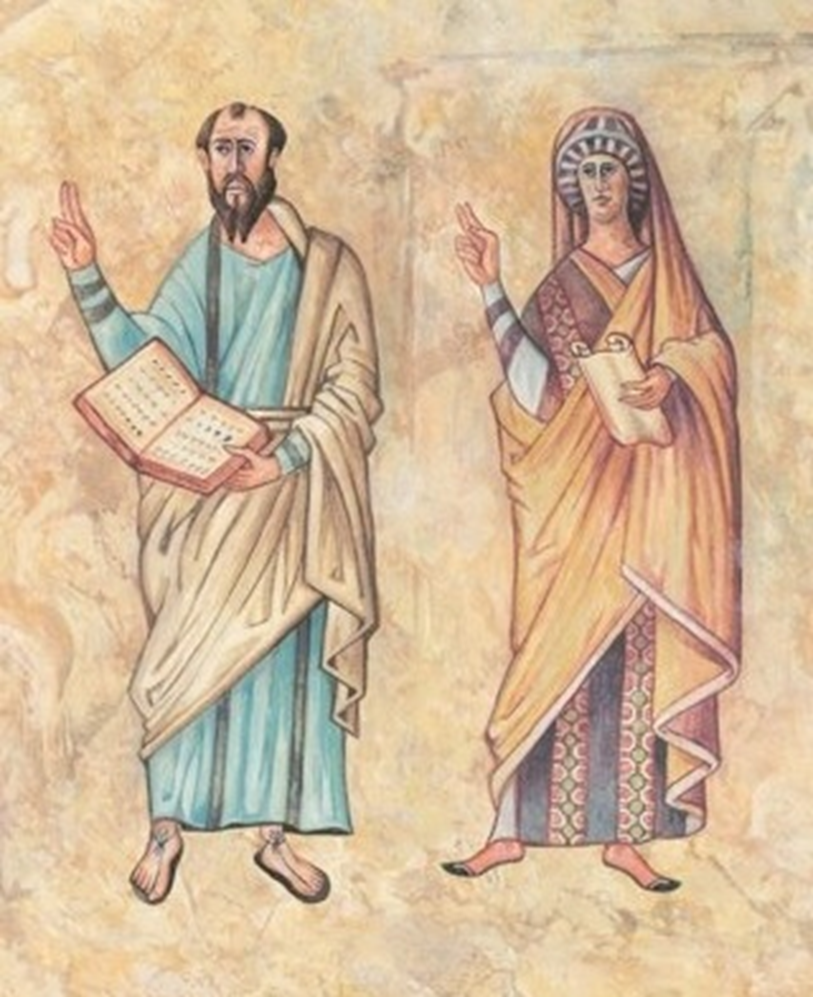
An artist’s creative restoration of that frescoed point-counterpoint from the Cave or Grotto of St. Paul at Ephesus.
Paul is just as the church’s post-Pauline tradition has always placed him. Theoclia is of equal height, but now with open eyes intact and upraised hand untouched as she was depicted in the sixth century.
Silence
Posted by Dallas Wolf in Ekklesia and church, Hesychasm - Jesus Prayer, Theology on March 24, 2025

“No wonder that silence is probably the foundational spiritual discipline in all the world’s religions at the more mature levels. At the less mature levels, religion is mostly noise, entertainment, and words. Catholics and Orthodox Christians prefer theatre and wordy symbols; Protestants prefer music and endless sermons.”
 First Thoughts