Archive for category First Thoughts
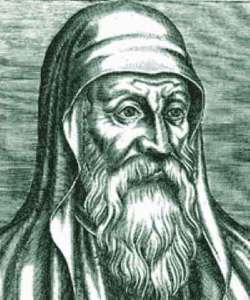
David Bentley Hart: “Saint Origen”
Posted by Dallas Wolf in First Thoughts, New Nuggets, Universal Restoration (Apokatastasis) on February 28, 2018
David Bentley Hart (born 1965) is an American Orthodox Christian philosophical theologian, cultural commentator and polemicist. Here, in one short essay published in First Things in 2015, Prof. Hart addresses three topics that institutional Orthodoxy would prefer to avoid: apokatastasis, Saint Origen, and the church’s chronic propensity to sleep with worldly empire (e.g., Byzantium and Russia)

Rohr: “Every time Paul uses the word flesh, just replace it with the word ego…”
Posted by Dallas Wolf in First Thoughts, New Nuggets on November 17, 2017
Fr. Richard Rohr – is a Franciscan priest, Christian mystic, and teacher of Ancient Christian Contemplative Prayer. He is the founding Director of the Center for Action and Contemplation in Albuquerque, NM.
 “The dialectic that we probably struggle with the most is the one Paul creates between flesh and spirit. I don’t think Paul ever intended for people to feel that their bodies are bad; he was not a Platonist. After all, God took on a human body in Jesus! Paul does not use the word “soma”, which literally means “body.” I think what Paul means by “sarx” is the trapped self, the small self, the partial self, or what Thomas Merton called the false self. Basically, spirit is the whole self, the Christ self that we were born into and yet must re-discover. The problem is not between body and spirit; it’s between part and whole. Every time Paul uses the word “flesh” [sarx], just replace it with the word “ego’, and you will be much closer to his point. Your spiritual self is your whole and True Self, which includes your body; it is not your self apart from your body. We are not angels, we are embodied human beings.” ~ From a meditation: “Paul as a Nondual Teacher“, Wednesday, May 17, 2017.
Met. Hierotheos: “Degrees of Spiritual Perfection”
Posted by Dallas Wolf in First Thoughts on November 11, 2017
Metropolitan Hierotheos (Vlachos) – (1945- ) is the Greek Orthodox Metropolitan of Nafpaktos, an author, and a theologian. He graduated from the Theological School of the University of Thessaloniki and is one of the finest Patristic scholars living. His books include: “Orthodox Psychotherapy: (the Science of the Fathers)“, “The Illness and Cure of the Soul in the Orthodox Tradition“, “The Person in the Orthodox Tradition“, and “A Night in the Desert of the Holy Mountain“.
Below is an excerpt on the Degrees of Spiritual Perfection from Chapter 4 of “Orthodox Spirituality, a brief introduction”, by Met. of Nafpaktos Hierotheos, pp. 40-49. This covers a number of topics central to Orthodox theology including the Fall, “Original” sin, the Church as hospital, the darkening of the nous, the cure of the nous through purification (Katharsis), illumination (Theoria), and union (Theosis), and the Essence and Energies of the Trinitarian Godhead.

Met. Hierotheos (Vlachos)
“The most important work of the Church is to cure man. Therefore the Orthodox Church is a Hospital, an infirmary of the soul. This does not mean that the Church disregards other domains of pastoral activity, since she aims at the whole of man, consisting of both body and soul. She cares indeed for the physical, economic and social problems as well; yet the main weight of her pastoral service is put on the soul’s therapy, for when man’s soul is cured then many other intractable problems are solved.
Some people accuse the Orthodox Church of not being very much involved in social problems. However, the Church does care about all matters which concern man. This is evident in the content of her prayers during worship services as well as in the work and teaching of the Holy Fathers. But just as a medical Hospital is primarily interested in the treatment of the body – and through this therapy it gets involved with the rest of a person’s problems – so it is in the Orthodox Church. She cures the core of human personality and through this, she heals the whole person. That is why even during times of social upheavals, when all governmental mechanisms are virtually brought to a halt – even peoples’ external freedoms are disrupted – the Church maintains its work: to treat and cure the person.
Healing of man’s personality is in fact his progress toward perfection which is actually identified as “theosis”, for in patristic theology theosis and perfection are synonymous terms. And this therapy is absolutely necessary, because man’s fall, effected in the person of Adam, constitutes the sickness of man’s nature.
In Paradise, before the Fall, Adam was in a state of “theoria” (vision) of God. The study of the book of Genesis reveals that Adam was in communion with God; however it was necessary for him to remain in that state, by virtue of his voluntary struggle, in order for him to become more stabilized and reach perfect communion and union with Him. St. John of Damascus describes this state of primordial “justice” characteristically. Adam was purified and nourished at the same time by the vision of God. His nous* was illumined, and this signifies above all that he was a temple of the Holy Spirit, and was experiencing unceasing remembrance of God.
“Original” sin consists of the darkening of the nous and the loss of communion with God. This, of course, had other repercussions, as well: man was clothed in the fleshly garments of decay and mortality The nous experienced a deep darkness. In other words, man lost the illumination of his nous; it became impure, impassioned and his body bore corruption and mortality. Thus, from the day of our birth, we bear within us corruption and death: a human life is brought into the world bound for death. Hence, because of the fall we experience universal malady. Both soul and body are sick and naturally, since man is the summation of all creation, – the microcosmos within the megacosmos – corruption also befell all of creation.
“My mind is wounded, my body has grown feeble, my spirit is sick, my speech has lost its power, my life is dead; then end is at the door. What shalt thou do, then, miserable soul, when the Judge comes to examine thy deeds?” (Great Canon).
In fact, when we speak of original sin and its consequences, we mean three things: first, the malfunction of the nous, since the nous ceased to work properly; secondly, the identification of the nous with reason (and to a certain extent, deification of reason) and thirdly the nous’ enslavement to the passions, anxiety and the conditions of the environment. And this constitutes man’s real death.
He experiences total disorganization; his inner self is deadened – his nous is overcome by darkness. And just as when the eye of the body is hurt,the whole body is obscure, so also when the eye of the soul – the nous – suffers blindness, the spiritual self as a whole becomes sick. It falls into the deepest darkness. This is what the Lord is referring, when He says: “If therefore the light that is in thee be darkness, how great is that darkness!” (Matt. 6, 23).
In addition to the disruption of the soul’s entire inner workings, original sin resulted also in the disorganization of man outwardly. He now confronts his fellow-men, God, the world and all of creation in a different way. The nous is unable to encounter God; so reason undertakes the effort. Thus idols of God are created leading to pagan religions and even heretical deviations.
Incapable of seeing man as an image of God, the nous encounters him under the influence of the passions. He ambitiously exploits his fellow-man, through his love of pleasure and material gain. He regards him as a vessel or instrument of pleasure; at the same time he idolizes all creation, which is what the Apostle Paul describes in his Epistle to the Romans: “Professing themselves to be wise, they became fools, And changed the glory of the uncorruptible God into an image made like to corruptible man, and to birds, and four-footed beasts, and creeping things” (Rom. 1, 22-23).
Therefore man needs to be cured, that is to be purified, to reach the illumination of the nous – Adam’s state before the Fall – and then attain theosis. This is achieved precisely through Christ’s incarnation and the entire work of the Divine Economy and of the Church. It is within this frame of reference we must see many liturgical texts according to which Christ is characterised a physician and healer of souls and bodies. Moreover, in the same framework various patristics texts should be studied, where it is apparent that the work of Christ is first and foremost a therapeutic one.
After the Fall man needed a cure. This was effected by the Incarnation of Christ and ever since then it has been the work of the Church. She cures and is curing man; she primarily cures his ailing personality – his nous and heart. All the Fathers of the Church exhort men to seek to be cured. Man is cured by the energy of God whose source is uncreated and revealed “in the person of Jesus Christ”. Christ’s energy, from which comes man’s cure, is granted freely, and for this reason is called divine grace. Therefore, whether we say uncreated energy or divine grace makes no difference; we mean the same thing. The Apostle Paul writes: “For by grace are ye saved through faith; and that not of yourselves: it is a gift of God” (Eph. 2, 8).
Living within the Church by grace, man must first cleanse his heart of the passions; attain the illumination of the nous – Adam’s state before the Fall – and then ascend to theosis, which constitutes man’s communion and union with God and is identified with salvation. These are the steps of spiritual perfection – the foundations of Orthodox spirituality.
Yet a few things about the divine grace need to be said before we see the stages of spiritual perfection – the method and way of man’s therapy – for it is closely connected with purification, illumination, and theosis.
In Orthodox spirituality purification, illumination and theosis are not stages of anthropocentric activity, but rather are results of the uncreated energy of God. When the divine grace (energy of God) purifies man from passions, it is call purifying; when it illumines his nous it is called illuminating; and when it deifies man it is called deifying. The same grace and energy of God is given various names according to its effects.
Throughout all patristic tradition the Fathers allude to the three stages of spiritual perfection as the three degrees of one’s cure. St. Dionysios the Areopagite makes mention of purification, illumination and perfection. St. Gregory of Nyssa also makes use of the same distinction. St. Maximos the Confessor refers, as well, to practical philosophy (purification), natural theoria (illumination) and mystical theology (theosis). St. Symeon the New Theologian, in his writings divides certain chapters into practical, gnostic, and theological. In all of Orthodox Tradition these three stages of perfection are frequently mentioned. In this way man is cured and experiences Holy Tradition; he becomes “Tradition” and creates “Tradition”. He is a bearer of Tradition. Distinctive is the subtitle of Philokalia which is the work of St. Nicodemos, of the Holy Mountain and of St. Makarios, Bishop of Corinth. In this work which is a compilation of the writings of the Holy Fathers [from the 4th to the 15th centuries], how man cures his nous by going through the three stages of spiritual life is discussed. And it is known that the Philokalia, which contains the complete method of cure for humans is a fundamental manual of the spiritual life.”
*Nous: The word has various uses in Patristic teaching, It indicates either the soul or the heart or even an energy of the soul. Yet, the nous is mainly the eye of the soul; the purest part of the soul; the highest attention. It is also called noetic energy and it is not identified with reason.
Met. Kallistos: “God in Trinity”
Posted by Dallas Wolf in First Thoughts, New Nuggets, The Holy Trinity, Theology on November 10, 2017
Metropolitan Kallistos (Ware) of Diokleia – (1934 = 2022) was a titular metropolitan of the Orthodox Ecumenical Patriarchate in Great Britain. From 1966-2001, he was Spalding Lecturer of Eastern Orthodox Studies at Oxford University, and has authored numerous books and articles pertaining to the Orthodox faith. The following excerpt is taken from Chapter 11 of Met. Kallistos’ book, The Orthodox Church: An Introduction to Eastern Christianity (1993)

“Our social programme, said the Russian thinker Fedorov, is the dogma of the Trinity. Orthodoxy believes most passionately that the doctrine of the Holy Trinity is not a piece of ‘high theology’ reserved for the professional scholar, but something that has a living, practical importance for every Christian. Man, so the Bible teaches, is made in the image of God, and to Christians God means the Trinity: thus it is only in the light of the dogma of the Trinity that man can understand who he is and what God intends him to be. Our private lives, our personal relations, and all our plans of forming a Christian society depend upon a right theology of the Trinity. ‘Between the Trinity and Hell there lies no other choice (V. Lossky, The Mystical Theology of the Eastern Church, p. 66). As an Anglican writer has put it: ‘In this doctrine is summed up the new way of thinking about God, in the power of which the fishermen. went out to convert the Greco-Roman world. It marks a saving revolution in human thought (D. J. Chitty, ‘The Doctrine of the Holy Trinity told to the Children,’ in Sobornost, series 4, no. 5, 1961, p. 241).
The basic elements in the Orthodox doctrine of God have already been mentioned in the first part of this book, so that here they will only be summarized briefly:
1. God is absolutely transcendent.
‘No single thing of all that is created has or ever will have even the slightest communion with the supreme nature or nearness to it (Gregory Palamas, P.G. 150, 1176c (quoted on p. 77)). This absolute transcendence Orthodoxy safeguards by its emphatic use of the ‘way of negation,’ of ‘apophatic’ theology. Positive or ‘cataphatic’ theology — the ‘way of affirmation’ — must always be balanced and corrected by the employment of negative language. Our positive statements about God — that He is good, wise, just and so on — are true as far as they go, yet they cannot adequately describe the inner nature of the deity. These positive statements, said John of Damascus, reveal ‘not the nature, but the things around the nature.’ ‘That there is a God is clear; but what He is by essence and nature, this is altogether beyond our comprehension and knowledge (On the Orthodox Faith, 1, 4 (P.G. 94, 800B, 797B)).
2. God, although absolutely transcendent, is not cut of from the world which He has made.
God is above and outside His creation, yet He also exists within it. As a much used Orthodox prayer puts it: ‘Thou art everywhere and finest all things.’ Orthodoxy therefore distinguishes between God’s essence and His energies, thus safeguarding both divine transcendence and divine immanence: God’s essence remains unapproachable, but His energies come down to us. God’s energies, which are God Himself, permeate all His creation, and we experience them in the form of deifying grace and divine light. Truly our God is a God who hides Himself, yet He is also a God who acts — the God of history, intervening directly in concrete situations.
3. God is personal, that a to say, Trinitarian.
This God who acts is not only a God of energies, but a personal God. When man participates in the divine energies, he is not overwhelmed by some vague and nameless power, but he is brought face to face with a person. Nor is this all: God is not simply a single person confined within his own being, but a Trinity of three persons, Father, Son, and Holy Spirit, each of whom ‘dwells’ in the other two, by virtue of a perpetual movement of love. God is not only a unity but a union.
4. Our God is an Incarnate God.
God has come down to man, not only through His energies, but in His own person. The Second Person of the Trinity, ‘true God from true God,’ was made man: “The Word became flesh and dwelt among us” (John 1:14). A closer union than this between God and His creation there could not be. God Himself became one of His creatures (For the first and second of these four points, see pp. 72-9; for the third and fourth points, see pp. 28-37).
Those brought up in other traditions have sometimes found it difficult to accept the Orthodox emphasis on apophatic theology and the distinction between essence and energies; but apart from these two matters, Orthodox agree in their doctrine of God with the overwhelming majority of all who call themselves Christians. Monophysites and Lutherans, Nestorians and Roman Catholics, Calvinists, Anglicans, and Orthodox: all alike worship One God in Three Persons and confess Christ as Incarnate Son of God (In the past hundred years, under the influence of ‘Modernism,’ many Protestants have virtually abandoned the doctrines of the Trinity and the Incarnation. Thus when I speak here of Calvinists, Lutherans, and Anglicans, I have in mind those who still respect the classical Protestant formularies of the sixteenth century).
Yet there is one point in the doctrine of God the Trinity over which east and west part company — the filioque. We have already seen how decisive a part this one word played in the unhappy fragmentation of Christendom. But granted that the filioque is important historically, does it really matter from a theological point of view? Many people today — not excluding many Orthodox — find the whole dispute so technical and obscure that they are tempted to dismiss it as utterly trivial. From the viewpoint of traditional Orthodox theology there can be but one rejoinder to this: technical and obscure it undoubtedly is, like most questions of Trinitarian theology; but it is not trivial. Since belief in the Trinity lies at the very heart of the Christian faith, a tiny difference in Trinitarian theology is bound to have repercussions upon every aspect of Christian life and thought. Let us try therefore to understand some of the issues involved in the filioque dispute.
One essence in three persons. God is one and God is three: the Holy Trinity is a mystery of unity in diversity, and of diversity in unity. Father, Son, and Spirit are ‘one in essence’ (homoousios), yet each is distinguished from the other two by personal characteristics. ‘The divine is indivisible in its divisions (Gregory of Nazianzus, Orations, 31, 14). for the persons are ‘united yet not confused, distinct yet not divided’ (John of Damascus, On the Orthodox Faith, 1, 8 (P.G. 94, 809A)); ‘both the distinction and the union alike are paradoxical’ (Gregory of Nazianzus, Orations, 25, 17).
But if each of the persons is distinct, what holds the Holy Trinity together? Here the Orthodox Church, following the Cappadocian Fathers, answers that there is one God because there is one Father. In the language of theology, the Father is the ‘cause’ or ‘source’ of Godhead, He is the principle (arche) of unity among the three; and it is in this sense that Orthodoxy talks of the ‘monarchy’ of the Father. The other two persons trace their origin to the Father and are defined in terms of their relation to Him. The Father is the source of Godhead, born of none and proceeding from none; the Son is born of the Father from all eternity (‘before all ages,’ as the Creed says); the Spirit proceeds from the Father from all eternity.
It is at this point that Roman Catholic theology begins to disagree. According to Roman theology, the Spirit proceeds eternally from the Father and the Son; and this means that the Father ceases to be the unique source of Godhead, since the Son also is a source. Since the principle of unity in the Godhead can no longer be the person of the Father, Rome finds its principle of unity in the substance or essence which all three persons share. In Orthodoxy the principle of God’s unity is personal, in Roman Catholicism it is not.
But what is meant by the term ‘proceed?’ Unless this is properly understood, nothing is understood. The Church believes that Christ underwent two births, the one eternal, the other at a particular point in time: he was born of the Father ‘before all ages,’ and born of the Virgin Mary in the days of Herod, King of Judaea, and of Augustus, Emperor of Rome. In the same way a firm distinction must be drawn between the eternal procession of the Holy Spirit, and the temporal mission, the sending of the Spirit to the world: the one concerns the relations existing from all eternity within the Godhead, the other concerns the relation of God to creation. Thus when the west says that the Spirit proceeds from the Father and the Son, and when Orthodoxy says that He proceeds from the Father alone, both sides are referring not to the outward action of the Trinity towards creation, but to certain eternal relations within the Godhead — relations which existed before ever the world was. But Orthodoxy, while disagreeing with the west over the eternal procession of the Spirit, agrees with the west in saying that, so far as the mission of the Spirit to the world is concerned, He is sent by the Son, and is indeed the ‘Spirit of the Son.’
The Orthodox position is based on John 15:26, where Christ says: ‘When the Comforter has come, whom I will send to you from the Father — the Spirit of truth, who proceeds from the Father — he will bear witness to me.’ Christ sends the Spirit, but the Spirit proceeds from the Father: so the Bible teaches, and so Orthodoxy believes. What Orthodoxy does not teach, and what the Bible never says, is that the Spirit proceeds from the Son.
An eternal procession from Father and Son: such is the western position. An eternal procession of the Spirit from the Father alone, a temporal mission from the Son: such was the position upheld by Saint Photius against the west. But Byzantine writers of the thirteenth and fourteenth centuries — most notably Gregory of Cyprus, Patriarch of Constantinople from 1283 to 1289, and Gregory Palamas — went somewhat further than Photius, in an attempt to bridge the gulf between east and west. They were willing to allow not only a temporal mission, but an eternal manifestation of the Holy Spirit by the Son. While Photius had spoken only of a temporal relation between Son and Spirit, they admitted an eternal relation. Yet on the essential point the two Gregories agreed with Photius: the Spirit is manifested by the Son, but does not proceed from the Son. The Father is the unique origin, source, and cause of Godhead.
Such in outline are the positions taken up by either side; let us now consider the Orthodox objections to the western position. The filioque leads either to ditheism or to semi-Sabellianism (Sabellius, a heretic of the second century, regarded Father, Son, and Spirit not as three distinct persons, but simply as varying ‘modes’ or ‘aspects’ of the deity). If the Son as well as the Father is an arche, a principle or source of Godhead, are there then (the Orthodox asked) two independent sources, two separate principles in the Trinity? Obviously not, since this would be tantamount to belief in two Gods; and so the Reunion Councils of Lyons (1274) and Florence (1438-1439) were most careful to state that the Spirit proceeds from Father and Son ‘as from one principle,’ tanquam ex (or ab) uno principio. From the Orthodox point of view, however, this is equally objectionable: ditheism is avoided, but the persons of Father and Son are merged and confused. The Cappadocians regarded the ‘monarchy’ as the distinctive characteristic of the Father: He alone is a principle or arche within the Trinity. But western theology ascribes the distinctive characteristic of the Father to the Son as well, thus fusing the two persons into one; and what else is this but ‘Sabellius reborn, or rather some semi-Sabellian monster,’ as Saint Photius put it? (P.G. 102, 289B).
Let us look more carefully at this charge of semi-Sabellianism. Orthodox Trinitarian theology has a personal principle of unity, but the west finds its unitary principle in the essence of God. In Latin Scholastic theology, so it seems to Orthodox, the persons are overshadowed by the common nature, and God is thought of not so much in concrete and personal terms, but as an essence in which various relations are distinguished. This way of thinking about God comes to full development in Thomas Aquinas, who went so far as to identify the persons with the relations: personae sunt ipsae relationes (Summa Theologica, 1, question 40, article 2). Orthodox thinkers find this a very meagre idea of personality. The relations, they would say, are not the persons — they are the personal characteristics of Father, Son, and Holy Spirit; and (as Gregory Palamas put it) ‘personal characteristics do not constitute the person, but they characterize the person’ (Quoted in J. Meyendorff, Introduction à 1’étude de Grégoire Palamas, Paris, 1959, p. 294). The relations, while designating the persons, in no way exhaust the mystery of each.
Latin Scholastic theology, emphasizing as it does the essence at the expense of the persons, comes near to turning God into an abstract idea. He becomes a remote and impersonal being, whose existence has to be proved by metaphysical arguments — a God of the philosophers, not the God of Abraham, Isaac, and Jacob. Orthodoxy, on the other hand, has been far less concerned than the Latin west to find philosophical proofs of God’s existence: what is important is not that a man should argue about the deity, but that he should have a direct and living encounter with a concrete and personal God.
Such are some of the reasons why Orthodox regard the filioque as dangerous and heretical. Filioquism confuses the persons, and destroys the proper balance between unity and diversity in the Godhead. The oneness of the deity is emphasized at the expense of His threeness; God is regarded too much in terms of abstract essence and too little in terms of concrete personality.
But this is not all. Many Orthodox feel that, as a result of the filioque, the Holy Spirit in western thought has become subordinated to the Son — if not in theory, then at any rate in practice. The west pays insufficient attention to the work of the Spirit in the world, in the Church, in the daily life of each man.
Orthodox writers also argue that these two consequences of the filioque — subordination of the Holy Spirit, over-emphasis on the unity of God — have helped to bring about a distortion in the Roman Catholic doctrine of the Church. Because the role of the Spirit has been neglected in the west, the Church has come to be regarded too much as an institution of this world, governed in terms of earthly power and jurisdiction. And just as in the western doctrine of God unity was stressed at the expense of diversity, so in the western conception of the Church unity has triumphed over diversity, and the result has been too great a centralization and too great an emphasis on Papal authority.
Such in outline is the Orthodox attitude to the filioque, although not all would state the case in such an uncompromising form. In particular, many of the criticisms given above apply only to a decadent form of Scholasticism, not to Latin theology as a whole.”
Markides: “Eastern Orthodox Mysticism and Transpersonal Theory”
Posted by Dallas Wolf in First Thoughts, Hesychasm - Jesus Prayer, New Nuggets on November 5, 2017

Dr. Kyriakos Markides
Kyriacos C. Markides (b. 1942) – Dr. Markides is a professor of sociology at the University of Maine. He has written several books on Christian mysticism including Mountain of Silence (2001), Gifts of the Desert (2005), and Inner River (2012). Dr. Markides is a contributor to Transpersonal Psychology, a sub-field or “school” of psychology that integrates the spiritual and transcendent aspects of the human experience with the framework of modern psychology. Based on the early works of Carl Jung, William James, and Abraham Maslow, it is also possible to define Transpersonal Psychology as a “spiritual psychology”. Dr. Markides is trying to introduce Eastern Orthodox Mysticism into Western secular Psychology, something that is long overdue and desperately needed.
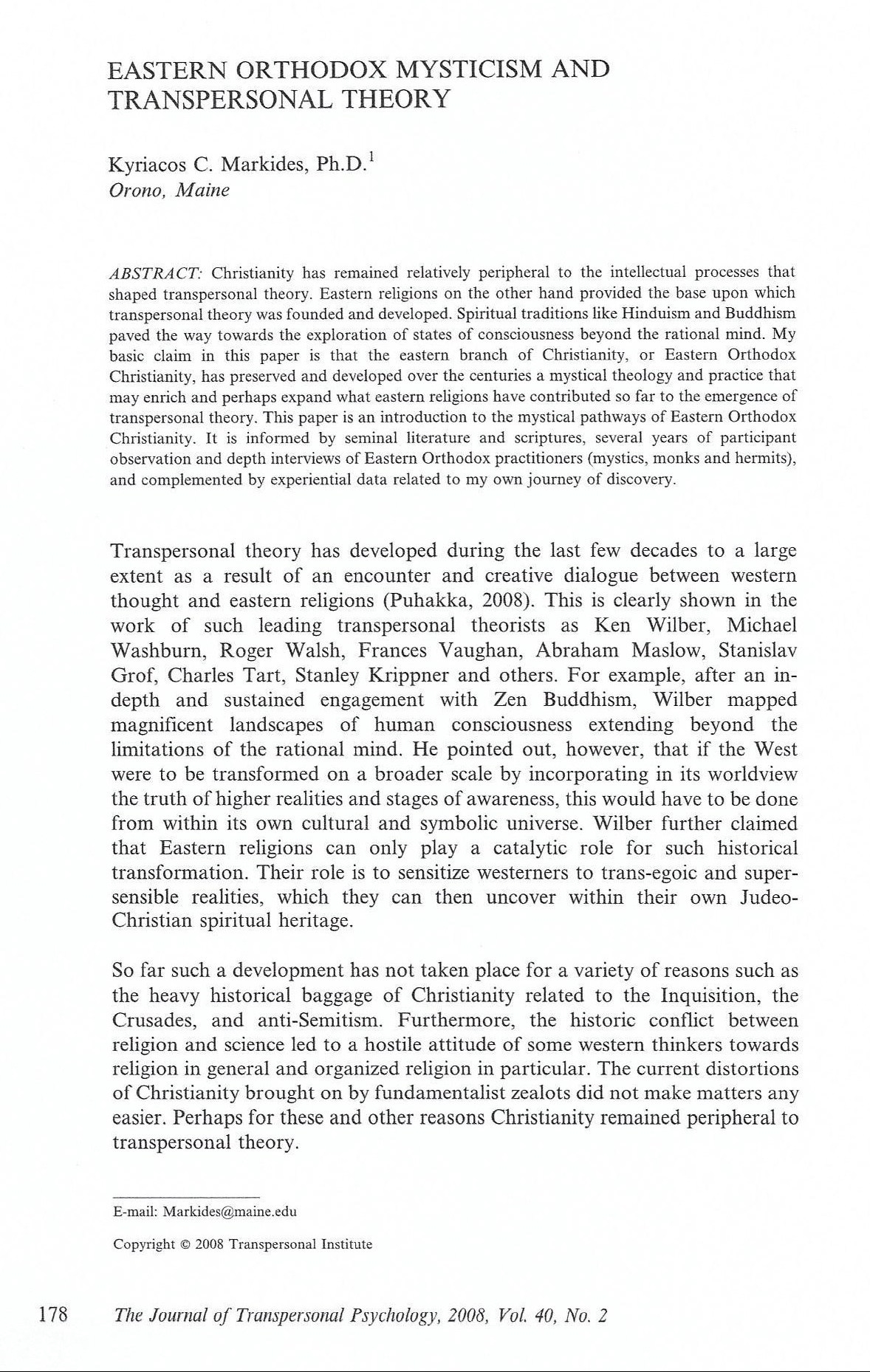
I attach a paper written by Dr. Markides and published in The Journal of Transpersonal Psychology, in 2008 (Vol. 40, No. 2). It is entitled, “Eastern Orthodox Mysticism and Transpersonal Theory”. As a “teaser” to the paper, I include Dr. Markides’ abstract:
ABSTRACT: Christianity has remained relatively peripheral to the intellectual processes that shaped transpersonal theory. Eastern religions on the other hand provided the base upon which transpersonal theory was founded and developed. Spiritual traditions like Hinduism and Buddhism paved the way towards the exploration of states of consciousness beyond the rational mind. My basic claim in this paper is that the eastern branch of Christianity, or Eastern Orthodox Christianity, has preserved and developed over the centuries a mystical theology and practice that may enrich and perhaps expand what eastern religions have contributed so far to the emergence of transpersonal theory. This paper is an introduction to the mystical pathways of Eastern Orthodox Christianity. It is informed by seminal literature and scriptures, several years of participant observation and depth interviews of Eastern Orthodox practitioners (mystics, monks and hermits), and complemented by experiential data related to my own journey of discovery.
Click on the blue hyperlink or the graphic, below, to open Dr. Markides paper:
Rohr: “Faith and Science; Open to Change”
Posted by Dallas Wolf in First Thoughts on October 23, 2017
Fr. Richard Rohr – is a Franciscan priest, Christian mystic, and teacher of Ancient Christian Contemplative Prayer. He is the founding Director of the Center for Action and Contemplation in Albuquerque, NM.
“God comes into the world in always-surprising ways so that the sincere seeker will always find. Is sincere seeking perhaps the real meaning of walking in darkness and faith? It seems to me that many scientists today are very sincere seekers. In fact, today’s scientists often seem to have more in common with the mystics than do many religious folks who do not seek truth but only assert their dogmas and pre-emptively deny the very possibility of other people’s God-experience.
The common scientific method relies on hypothesis, experiment, trial, and error. We might even call this “practice,” just like many of us have prayer practices. Yes, much of science is limited to the material, but at least the method is more open-ended and sincere than the many religious people who do no living experiments with faith, hope, and love, but just hang on to quotes and doctrines. They lack the personal practices whereby they can test the faithfulness of divine presence and the power of divine love.
Most scientists are willing to move forward with some degree of not-knowing; in fact, this is what calls them forward and motivates them. As new discoveries are affirmed, they remain open to new evidence that would tweak or even change the previous “belief.” Many religious folks insist upon complete “knowing” at the very beginning and then being certain every step of the way, which actually keeps them more “rational” and controlling than most scientists. This is the dead end of most fundamentalist religion, and why it cannot deal with thorny issues in any creative or compassionate way. Now I know why Paul dared to speak of “the curse of the law” (Galatians 3:13). Law reigns and discernment is unnecessary, which means there is little growth or change in such people. When you do not grow, you remain an infant.
The scientific mind today often has more openness to mystery than religion does! For example, it is willing to speak of dark matter, dark holes, chaos theory, fractals (the part replicates the whole), string theory, dark energy, and the atomic structure of all material things, which seems totally counter intuitive. Scientists “believe” in many things like electromagnetism, radioactivity, field theory, and various organisms such as viruses and bacteria before they can actually “prove” they exist. They know them first by their effects, or the evidence, and then argue backward to their existence. Isn’t this how good theologians have often tried to “prove” the existence of God?
Even though the entire world was captivated by the logical cause-and-effect worldview of Newtonian physics for several centuries, such immediately verifiable physics has now yielded to quantum physics, which is not directly visible to the ordinary observer at all—yet ends up explaining much more—without needing to throw out the simple logic of Newtonian physics in the everyday world. True transcendence always includes the previous stages, yet somehow also reshapes and expands them—just like mysticism does with our old doctrines and dogmas.
It feels as if the scientists of each age are often brilliant, seemingly “right,” but precisely because they are also tentative and searching—which creates a practical humility that we often do not see in clergy and “true believers.” A great scientist will move forward with a perpetual “beginner’s mind.”
Thus many scientists end up trusting in the reality of things that are still “invisible” and secret. It keeps them on the search. This feels like faith to me, whereas what many church people want is perfect certitude and clarity before every step forward. This does not create great or strong people. ~ Daily Meditation, Faith and Science, Open to Change, Monday, October 23, 2017
Good Science and Good Religion cannot be in Conflict.
Posted by Dallas Wolf in First Thoughts, New Nuggets on October 22, 2017
I do not believe that there is any real conflict between good science and good religion. There can’t be. If both science and religion genuinely seek truth and God is truth, they both seek the same thing. They are two sides of the same coin. The problem arises when either science or religion becomes entrenched and dogmatic in a theory or idea. This is where the conflict arises: Bad science and/or bad religion. The classic case is the Roman Catholic Church against Copernicus and Galileo and the heliocentric solar system. “You say the sun doesn’t revolve around the earth? Heresy, I say!”, said Pope. That was pretty stupid. But, to be fair, both sides have been guilty of arbitrarily turning speculation and theory into hard fact without total understanding or certainty.
In our contemporary world, it seems to me that science is often times doing better theology than the theologians. This is especially true in the field of Physics, including astro-physics, radio astronomy, and small particle physics. Let’s look at three examples:
Example 1: The Big Bang and the Voice of God
The Big Bang model is the prevailing cosmological theory of the origin of the universe. It postulates that the universe began as a very small, very dense, and extremely hot “ball” anywhere from the size of an atom to that of an orange. When this dense extremely hot “ball of fire” exploded it produced a “Big Bang” expanding outward in all directions, expanding into what our universe is today.
But, from where did this Big Bang come from? Theology had already provided an answer. In the beginning when God created all things he simply spoke—and it came forth from the word of his mouth! “And GOD SAID, Let there be light: and there was light” (Gen 1:3). The writer of Hebrews informs us that “The worlds were framed by the word of God, so that things which are seen were not made of things which do appear” (Heb. 11:3). In other words . . . God SPOKE, and BANG, it was!
But, back to science. Bell Labs built a giant antenna in Holmdel, New Jersey, in 1960. It was part of a very early satellite transmission system. Two employees of Bell Labs had their eye on the antenna. Arno Penzias, a German-born radio astronomer, joined Bell Labs in 1958. He knew the Holmdel antenna would also make a great radio telescope and was dying to use it to observe the universe. Another radio astronomer, Robert Wilson, came to Bell Labs in 1962 with the same idea.
When they began to use the Holmdel antenna as a telescope they found there was a background “noise” (like static in a radio). This annoyance was a uniform signal in the microwave range, seeming to come from all directions. Everyone assumed it came from the telescope itself, which was not unusual. Penzias and Wilson had to get rid of it to make the observations they planned. They checked everything to rule out the source of the excess radiation. It wasn’t urban interference. It wasn’t radiation from our galaxy or extraterrestrial radio sources. It wasn’t even the pigeons living in the big, horn-shaped antenna. Penzias and Wilson had to conclude it was not the antenna and it was not random noise causing the radiation.
Penzias and Wilson began looking for theoretical explanations. Around the same time, Robert Dicke at nearby Princeton University had been pursuing theories about the Big Bang. He had elaborated on existing theory to suggest that if there had been a Big Bang, the residue of the explosion should by now take the form of a low-level background radiation throughout the universe. Dicke was looking for evidence of this theory when Penzias and Wilson got in touch with his lab.
They didn’t realize it, but with their discovery of background cosmic microwave radiation in 1965. . . Penzias and Wilson were perhaps listening to the echoes of the creational voice of God! They won the Nobel Prize in Physics in 1978 for their discovery.
Example 2. Empty Space or a Relational Universe.
The second example also comes from Physics. Science believes that only about 5% of the universe is made up of “normal” matter. But, the remaining 95% of the universe is not empty. Scientists speculate that the balance of the universe is made up of what they describe as “dark energy” (~68%) and “dark matter” (~27%). They aren’t sure exactly what either of these are, but they know they exist because of the measurable effects of the relationships between them and “normal” matter.
Scientists are finding that the energy is in the space between the particles of the atom and between the planets and the stars. They are discovering that reality is absolutely relational at all levels.
This is exactly what Christian mystics have been telling religion and the rest of the world for two thousand years. “God is love, and he who abides in love abides in God, and God in him.” (1 John 4:16)
Example 3. More “Dimensions” Than We Thought
The last example comes to us from small particle physics. The “M theory” of small particle physics indicates (mathematically) that in addition to our classic four dimensions of spacetime (three dimensions in space: up/down, left/right, and forward/backward, and one dimension of time: later/earlier) there may be as many as seven additional dimensions we virtually know nothing about; for a total of 11 dimensions in theoretical spacetime.
Perhaps one or more of those seven additional dimensions of spacetime might be “spiritual” dimensions. Or perhaps all eleven dimensions may be evidence of the Divine Triune perichoresis, or circle-dance, which manifests in our spacetime yet also transcends it into the other dimensions that we just don’t have the “eyes” to see.
Regardless of the propensity of both science and religion to claim false certainties, I firmly believe that scientists and theologians alike are climbing different sides of the same mountain.
Evagrius Ponticus: “The Eight Evil Thoughts (Logísmoi)”
Posted by Dallas Wolf in First Thoughts, Hesychasm - Jesus Prayer, Monasticism on October 20, 2017
Evagrius Ponticus (c.346-399) – was originally from Pontus, on the southern coast of the Black Sea in what is modern-day Turkey. He served as a Lector under St. Basil the Great and was made Deacon and Archdeacon under St. Gregory of Nazianzus. In order to deal with his personal sin, Evagrius retreated to the Egyptian desert and joined a cenobitic community of Desert Fathers. As a classically trained scholar, Evagrius recorded the sayings of the desert monks and developed his own theological writings.

In AD 375, Evagrius developed a comprehensive list of eight evil “thoughts” (λογισμοι; logísmoi), or eight terrible temptations, from which all sinful behavior springs. This list was intended to serve a diagnostic purpose: to help his readers (fellow desert monks) identify the process of temptation, their own strengths and weaknesses, and the remedies available for overcoming temptation.
The “thoughts” (logísmoi) that concern Evagrius (cf., Skemmata 40–62) are the so-called “eight evil thoughts”. The basic list appears again and again in his writings:
1. Gluttony – (γαστριμαργία; gastrimargía);
2. Lust or Fornication – (πορνεία; porneía);
3. Avarice or Love of money – (φιλαργυρία; philarguría);
4. Dejection or Sadness – (λύπη; lúpe);
5. Anger – (ὀργή; orgé);
6. Despondency or Listlessness – (ἀκηδία; akedía);
7. Vainglory – (κενοδοξία; kenodoxía);
8. Pride – (ὑπερηφανία; huperephanía).
The order in which Evagrius lists the “thoughts” is deliberate. Firstly, it reflects the general development of spiritual life: beginners contend against the grosser and more materialistic thoughts (gluttony, lust, avarice); those in the middle of the journey are confronted by the more inward temptations (dejection, anger, despondency); the more advanced, already initiated into contemplation, still need to guard themselves against the most subtle and “spiritual” of the thoughts (vainglory and pride). Secondly, the list of eight thoughts reflects the threefold division of the human person into the appetitive (επιθυμητικόν; epithymitikón), the incensive (θυμικόν; thymikón), and the intelligent (λογιστικόν; logistikón) aspects. The first part of the soul is the epithymikón, the “appetitive” aspect of the soul. This is the part of the soul that desires things, such as food, water, shelter, sexual relations, relationships with people, and so on. The second part of the soul is the thymikón, which is usually translated the “incensive” aspect. This translation is a bit misleading. The thymikón is indeed the part of the soul that gets angry, but it also has to do with strong feelings of any kind. The third part of the soul, the logistikón, is the “intelligent” or “rational” aspect of the soul. The part of the logistikón that thinks and reasons is called the diánoia (διάνοια), but it is not as important to Evagrius and the other Greek Fathers as the nous (νου̃ς), the “mind”, or to be very precise, the part of the mind that knows when something is true just upon perceiving it.
Gluttony, lust, and avarice are more especially linked with the appetitive aspect; dejection, anger, and despondency, with the incensive power; vainglory and pride, with the intelligent aspect.
Evagrius’ disciple, St. John Cassian, transmitted this list of the eight “thoughts” to the West with some modification. Further changes were made by St. Gregory the Great, Pope of Rome (AD 590 – 604) and these came down to the West through the Middle Ages as the “Seven Deadly Sins” of vainglory, envy, anger, dejection, avarice, gluttony, and lust.
The “Ekklesía” of Jesus and Paul is not the “Church” of men.
Posted by Dallas Wolf in Ekklesia and church, First Thoughts, New Nuggets on October 19, 2017
Most English bible translators have interpreted the Greek word “ekklesía” as “church”, but “ekklesía” has nothing to do with the word “church”! Every word study and reference available agree that the word “church” does not come from the original Koine Greek word “ekklesía”, but comes from a different, late Greek word, which has a totally different meaning!
“Ekklesía” means an assembly of the “called out”, or “gathered apart”. In Scripture, it refers to a “convocation, assembly, or congregation”. “Ekklesía” clearly refers to people.
However, the word “church”, as you will learn, is defined as a place (physical building and its associated institutional infrastructure), and not as a people. That is the difference. Now, a group of believers, the Ekklesía, may go to a “church” building to worship God, but the “church” building and its supporting infrastructue is not the Ekklesía.
The English word “church” is derived from the Greek word kyrios, meaning ruler or lord. Specifically, it comes into English in the context of, “kyriake oikia”, “Lord’s house”, which by the 4th century was shortened to the adjective “kyriakon”, “of the Lord”, and was used to denote houses of Christian worship. Neither “kyriake oikia” nor “kyriakon” ever appear in the Greek New Testament referring to a congregation of worshippers or as a place of worship. This association did not occur until about AD 300, 270 years after Jesus’ Crucifixion. Regardless, this is the late Greek word that was first translated into Old English as “cirice”. It was then translated into Middle English as “chirche“, from which we get the modern English word “church”.
The Wycliffe Bible (1385), the first Bible printed in vernacular English, was a translation of the Latin Vulgate Bible (Jerome used “Ecclesiam”), and Wycliffe used the Middle English words “chirche”, “chirches”, and “chirchis” some 111 times in the New Testament.
On the other hand, if you look at William Tyndale’s Bible (1526), which was the first English Bible translated directly from Hebrew and Greek texts, he correctly translated “ekklesía” as “congregation”.
The first recorded use of the Modern English word “church” in a Bible was in 1556 by a Presbyterian follower of John Calvin, Theodore Beza. The following year the New Testament of the Geneva Bible (the Bible of the America’s Pilgrims) was published by Beza’s friend, William Wittingham, and he also used the word “church”. And of course, the later King James Bible of 1611 also uses the term “church”.
The word “ekklesía” is used 115 times in the Greek New Testament, and in most English bibles, it is always incorrectly translated as “church” with the exception of three instances (Acts 19:32,39,41) where it is properly translated as “assembly”.
By the Protestant Reformation, after some 1,200 years of institutional cathedrals, clergy, liturgy, ritual, doctrine and dogma, Jesus’s New Testament concept of “ekklesía” had become so obscured that Protestants, long preceded by Roman Catholic and Orthodox churchmen, considered the Greek word “ekklesía” virtually synonymous with “church”! We continue that convenient institutional rationalization and error today.
“Church” is not found in the original Greek New Testament in either word or concept. It is an afterthought and convenient rationalization of post-apostolic institutional men.
hilastérion (ἱλαστήριον): Propitiation or Expiation?
Posted by Dallas Wolf in First Thoughts, Theology on August 5, 2016
The Greek word ἱλαστήριον, transliterated as hilastérion (hil-as-tay’-ree-on) is translated into English as both “propitiation” and “expiation”. Hilastérion and it variants are found in the New Testament rarely, but there are three citings that are particularly important to the topic of atonement: Rom 3:25; 1 Jn 2:2; 4:10:
(1) Rom 3:25: “…whom God displayed publicly as a/an _____________ in His blood through faith. This was to demonstrate His righteousness, because in the forbearance of God He passed over the sins previously committed”
(2) 1 John 2:2: “…and He Himself is the ______________ for our sins; and not for ours only, but also for those of the whole world.
(3) 1 Jn 4:10: “This is love: not that we loved God, but that he loved us and sent his Son as an ______________ for our sins.
So what’s the difference between “propitiation” or “expiation”, the English translations of the Greek word hilastérion? A short passage from “Reconciliation,” in Colin Brown, ed., New International Dictionary of New Testament Theology, Vol. III, p. 151 (hereafter referred to as DNTT) summarizes:
“In discussing reconciliation and atonement it has become customary to draw a distinction between propitiation and expiation. In propitiation the action is directed towards God, or some other offended person. The underlying purpose is to change God’s attitude from one of wrath to one of good will and favor. In the case of expiation, on the other hand, the action is directed towards that which has caused the breakdown in the relationship… In short, propitiation is directed towards the offended person, whereas expiation is concerned with nullifying the offensive act” (DNTT, Vol. III, p. 151).
Given the above, “propitiate,” would indicate that God is changed; whereas “expiate” would indicate that the repentant sinner is changed. But, this raises another serious theological question: Does God change? On this question, we will take the traditional classical Christian position that “God does not change”.
Having introduced the question of change, we can now return to the original question at hand: In the New Testament, is the meaning of hilastérion more closely approximated by “propitiation” or “expiation”?
Summarizing the first 1,000 years of Christian patristic theology, Orthodox theologian and Bishop Kallistos Ware insists that Christ did not become incarnate to heal God the Father: He became incarnate to heal us. According to the Orthodox, the cross, resurrection, and ascension of Christ represent the “mercy seat” (Gk. hilastérion/ Heb. kippur) upon which our sins are “wiped away”/”expiated” by God, restoring us to His covenant love. This “expiation”, or removal of sin as an obstacle between man and God, transforms repentant sinners into His divine likeness and nature (2 Cor 3:18; 2 Pet 1:4 etc.). So, it is we who change rather than God. Orthodoxy emphatically supports the divine attribute of constancy of God (Mal 3:6; Jas 1:17).
If we concede the classical Christian position that God never changes and remains ever constant, then we must conclude that divine “propitiation” – a change in attitude from one of wrath to one of good will and favor- cannot be attributed to God; for He is, by definition, changeless. God cannot have been “propitiated” ontologically by having “a change of attitude” unless God Himself changed ontologically.
There is one final point to be made from the perspective of New Testament exegesis. In the case of “expiation”, “the action is directed towards that which has caused the breakdown in the relationship… In short, “propitiation” is directed towards the offended person, whereas “expiation” is concerned with nullifying the offensive act” (DNTT III, 173).
So, to what do the three New Testament passages using hilastérion and variants, cited above, refer to? Do they refer to God (as in God’s wrath being “propitiated”) or to the sins of man being wiped away and removed as an obstacle to union with God (“expiation”)? Clearly, in all three of the passages in question, hilastérion is used directly in reference to humankind’s sins as an obstacle to our union with God. They do not refer to God as an object of “propitiation”. This is not a “propitiation” for the Father,” but rather “expiation” “for our sins.”
In referring to the patristic theology of the first Christian millennium we should emphasize this is not an exclusively patristic or Orthodox view. Some leading academic scholars and some major Protestant scholars have held hilastérion is best understood as “expiation” – a change in man, wiping away his sin; rather than “propitiation” – a change of God, changing His disposition from anger to affection. God is constant and changeless. God is the same yesterday, today, and forever. It is humankind who must be transfigured by the changeless grace and mercy of God.
The Latin Western tradition, by contrast, has insisted since the Middle Ages on defining hilastérion in the sense of “propitiation”, including the traditional Calvinist interpretation. Historically the emphasis upon a change in God’s attitude rather than man’s condition arose from St. Augustine in the 5th century, but reached its zenith in the 11th century with Anselm of Canterbury. According to Anselm, man had broken honor with his liege Lord (God). And because his honor was slighted, “satisfaction” had to be made; in this case, by the death of his own son, (Jesus Christ).
The Eastern Orthodox Christian tradition bypassed this particular Western interpretation entirely. They never adopted a soteriology of merit/satisfaction (ala Anselm). To the Orthodox, the atonement is purely grace/gifting from God rather than a merit/earning system imposed on humankind.
 First Thoughts