Archive for category Monasticism
St. Symeon the New Theologian: “Whenever someone sees Him revealed, he sees light.”
Posted by Dallas Wolf in Hesychasm - Jesus Prayer, Monasticism, Patristic Pearls, Theology on October 20, 2017
St. Symeon the New Theologian (949-1022) – One of the great Orthodox mystics and hesychasts explains his experience and encounter of God as light.
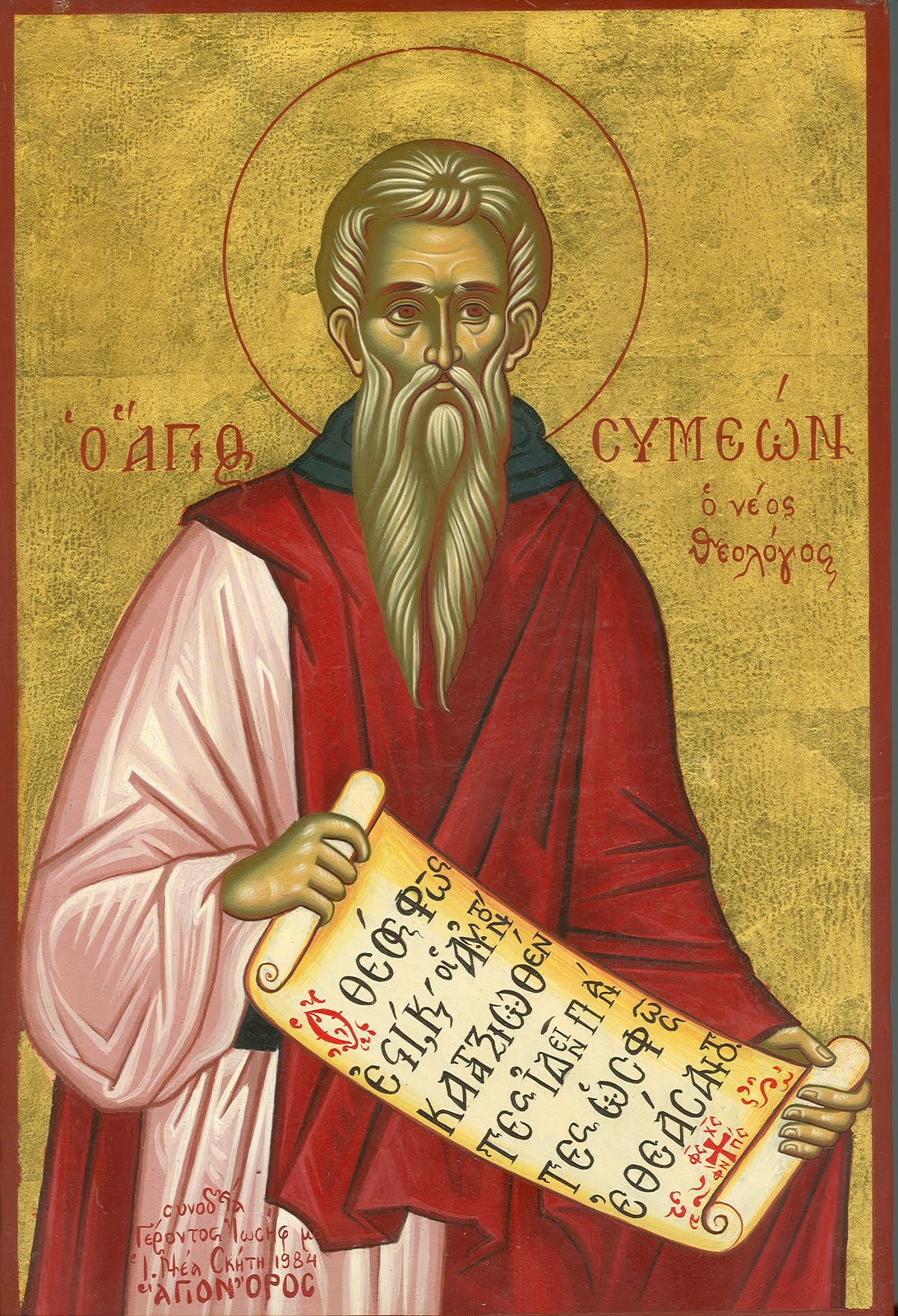
“This, invariably, is just what occurs concerning the invisible God. Whenever someone sees Him revealed, he sees light. While on the one hand he is amazed at what he has seen, on the other he does not know immediately who it is who has appeared, yet he dares not ask Him. And how could he? He is unable even to lift up his eyes and look on that grandeur. With fear and trembling he looks instead, as it were, at his own feet, knowing fully only that it is Someone Who has appeared before his face.
And if there happens to be some other man who has told him beforehand about such things, as having known God from before, he goes to this man [St Symeon’s elder] and says: “I have seen.” And the other says: “What did you see, child?” “Light, O my father, so sweet, sweet! So much so, father, that my reason has not the strength to tell you.”
And, while he is saying this, his heart leaps and pounds, and catches on fire with longing for what he has seen. Then, with many warm tears, he begins to say again: “That light, father, appeared to me. The walls of my cell immediately vanished and the world disappeared, fleeing I think from before His face, and I remained alone in the presence alone of the light. And I do not know, father, if this my body was there, too. I do not know if I was outside of it. For a while I did not know that I carry and am clothed with a body. And such great joy was in me and is with me now, great love and longing both, that I was moved to streams of tears like rivers, just like now as you see.”
The other then answers and says: “It is He, child.” And, at this word, he sees Him again and, little by little, comes to be completely purified and, purified, grows bold and asks that One Himself, and says: “My God, is it You?”
And He answers and says: ‘Yes, I am He, God, Who for your sake became man; and behold, I have made you, as you see, and shall make you, god’.”
~from On the Mystical Life (Vol. 2), pp. 53-54
Evagrius Ponticus: “The Eight Evil Thoughts (Logísmoi)”
Posted by Dallas Wolf in First Thoughts, Hesychasm - Jesus Prayer, Monasticism on October 20, 2017
Evagrius Ponticus (c.346-399) – was originally from Pontus, on the southern coast of the Black Sea in what is modern-day Turkey. He served as a Lector under St. Basil the Great and was made Deacon and Archdeacon under St. Gregory of Nazianzus. In order to deal with his personal sin, Evagrius retreated to the Egyptian desert and joined a cenobitic community of Desert Fathers. As a classically trained scholar, Evagrius recorded the sayings of the desert monks and developed his own theological writings.

In AD 375, Evagrius developed a comprehensive list of eight evil “thoughts” (λογισμοι; logísmoi), or eight terrible temptations, from which all sinful behavior springs. This list was intended to serve a diagnostic purpose: to help his readers (fellow desert monks) identify the process of temptation, their own strengths and weaknesses, and the remedies available for overcoming temptation.
The “thoughts” (logísmoi) that concern Evagrius (cf., Skemmata 40–62) are the so-called “eight evil thoughts”. The basic list appears again and again in his writings:
1. Gluttony – (γαστριμαργία; gastrimargía);
2. Lust or Fornication – (πορνεία; porneía);
3. Avarice or Love of money – (φιλαργυρία; philarguría);
4. Dejection or Sadness – (λύπη; lúpe);
5. Anger – (ὀργή; orgé);
6. Despondency or Listlessness – (ἀκηδία; akedía);
7. Vainglory – (κενοδοξία; kenodoxía);
8. Pride – (ὑπερηφανία; huperephanía).
The order in which Evagrius lists the “thoughts” is deliberate. Firstly, it reflects the general development of spiritual life: beginners contend against the grosser and more materialistic thoughts (gluttony, lust, avarice); those in the middle of the journey are confronted by the more inward temptations (dejection, anger, despondency); the more advanced, already initiated into contemplation, still need to guard themselves against the most subtle and “spiritual” of the thoughts (vainglory and pride). Secondly, the list of eight thoughts reflects the threefold division of the human person into the appetitive (επιθυμητικόν; epithymitikón), the incensive (θυμικόν; thymikón), and the intelligent (λογιστικόν; logistikón) aspects. The first part of the soul is the epithymikón, the “appetitive” aspect of the soul. This is the part of the soul that desires things, such as food, water, shelter, sexual relations, relationships with people, and so on. The second part of the soul is the thymikón, which is usually translated the “incensive” aspect. This translation is a bit misleading. The thymikón is indeed the part of the soul that gets angry, but it also has to do with strong feelings of any kind. The third part of the soul, the logistikón, is the “intelligent” or “rational” aspect of the soul. The part of the logistikón that thinks and reasons is called the diánoia (διάνοια), but it is not as important to Evagrius and the other Greek Fathers as the nous (νου̃ς), the “mind”, or to be very precise, the part of the mind that knows when something is true just upon perceiving it.
Gluttony, lust, and avarice are more especially linked with the appetitive aspect; dejection, anger, and despondency, with the incensive power; vainglory and pride, with the intelligent aspect.
Evagrius’ disciple, St. John Cassian, transmitted this list of the eight “thoughts” to the West with some modification. Further changes were made by St. Gregory the Great, Pope of Rome (AD 590 – 604) and these came down to the West through the Middle Ages as the “Seven Deadly Sins” of vainglory, envy, anger, dejection, avarice, gluttony, and lust.
St. Macarius the Great: “On the Heart”
Posted by Dallas Wolf in Hesychasm - Jesus Prayer, Monasticism, Patristic Pearls on December 27, 2015
St. Macarius the Great (the Egyptian) (c. AD 300 -390) was one of the most famous of the Desert Fathers, and one of the pioneers of Scetis.
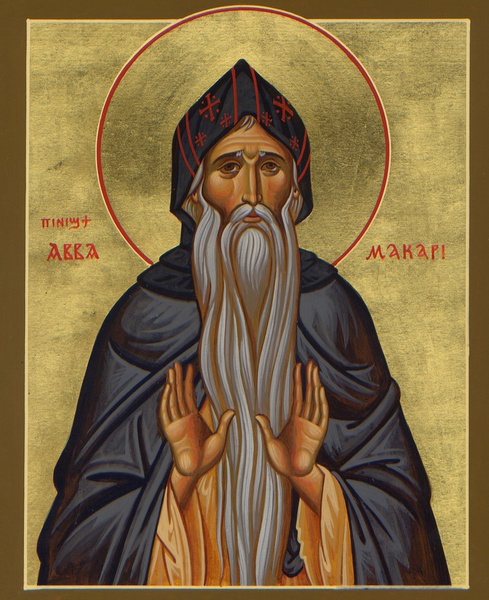
“The heart is but a small vessel; and yet dragons and lions are there, and there likewise are poisonous creatures and all the treasures of wickedness; rough, uneven paths are there, and gaping chasms. There also is God, there are the angels, there life and the Kingdom, there light and the apostles, the heavenly cities and the treasures of grace: all things are there.”
~ from: Homilies 43:7
St. Gregory Palamas: “Deification is an enhypostatic and direct illumination…”
Posted by Dallas Wolf in Hesychasm - Jesus Prayer, Monasticism, Patristic Pearls on May 11, 2015
St. Gregory Palamas (Greek: Γρηγόριος Παλαμάς; 1296–1359) – was a monk of Mount Athos in Greece and later the archbishop of Thessaloniki, known as a preeminent theologian of Hesychasm. The teachings embodied in his writings defending Hesychasm against the attack of Barlaam are sometimes referred to as Palamism, and his followers as Palamites.
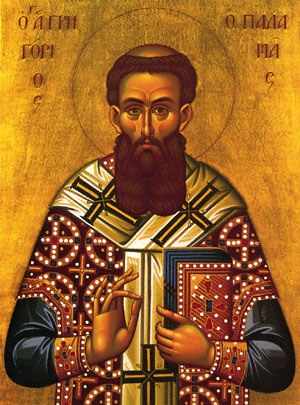
“But when you hear of the vision of God face-to-face, recall the testimony of Maximus: ‘Deification is an enhypostatic and direct illumination which has no beginning, but appears in those worthy as something exceeding their comprehension. It is indeed a mystical union with God, beyond intellect and reason, in the age when creatures will no longer know corruption. Thanks to this union, the saints, observing the light of the hidden and more-than-ineffable glory, become themselves able to receive the blessed purity, in company with the celestial powers”
~ St. Gregory Palamas, The Triads, III.i.28
St. Gregory of Nyssa: Moses and “Luminous Darkness”… “seeing that consists in not seeing”.
Posted by Dallas Wolf in Hesychasm - Jesus Prayer, Monasticism, Patristic Pearls, Theology on March 15, 2015
St. Gregory of Nyssa (c. 335 – c. 395), is one of the three Great Cappadocian Fathers along with his older brother, St. Basil the Great, and friend, St. Gregory of Nazianzus. I especially love Gregory Nyssen for his deep spirituality and mysticism. He was a highly original and sophisticated thinker who remains controversial among both liberal and conservative theologians to this day. In his treatise The Life of Moses, St. Gregory tells us that a person’s encounter of the mystery of God corresponds to the three theophanies of Moses, involving successive entry into light, cloud, and darkness.
According to St. Gregory Nyssen, the first stage in our quest to encounter God is Moses’ vision of God as the light of the burning bush; illuminating the darkness of our sin and ignorance. The second stage involves a journey from light into partial darkness where Moses encounters God as the ‘cloud’; the intermingling of light and darkness, revealing the distance between the Creator and the created realm. The third and final stage entails Moses entering the darkness of Sinai where God is; and our realization upon encountering and even being united with God that He is utterly incomprehensible in his essence.
In this treatment, I think, St. Gregory of Nyssa clearly identifies both cataphatic and apophatic theology, bridges the two and holds the tension between them, drawing the best from both.

“What does it mean that Moses entered the darkness and then saw God in it? What is now recounted seems somehow to be contradictory to the first theophany, for then the divine was beheld in light but now He is seen in darkness. Let us not think that this is at variance with the sequence of things we have contemplated spiritually. Scripture teaches by this that religious knowledge comes at first to those who receive it as light. Therefore what is perceived to be contrary to religion is darkness; an escape from darkness comes about when one participates in the light. But as the mind progresses and, through an ever greater and more perfect diligence, comes to apprehend reality, as it approaches more nearly to contemplation, it sees more clearly that God cannot be contemplated. For leaving behind everything that is observed, not only what sense comprehends but also what the intelligence thinks it sees, it keeps on penetrating deeper until by the intelligence’s yearning for understanding it gains access to the invisible and the incomprehensible and there it sees God. This is the true knowledge of what is sought; this is the seeing that consists in not seeing, because that which is sought transcends all knowledge, being separated on all sides by incomprehensibility as by a kind of darkness. Therefore, John the sublime who penetrated into the luminous darkness [λαµπρός γνόφος – lamprós gnóphos], says “no one has ever seen God,” thus asserting that knowledge of the divine essence is unattainable not only by humans but also by every intelligent creature. When, therefore, Moses grew in knowledge, he declared that he had seen God in the darkness, that is, that he had then come to know that what is divine is beyond all knowledge and comprehension, for the text says,’Moses approached the dark cloud where God was‘.”
~ from: The Life of Moses
St. Gregory of Nyssa – “… only wonder grasps anything”
Posted by Dallas Wolf in Hesychasm - Jesus Prayer, Monasticism, Patristic Pearls on August 5, 2014
St. Gregory of Nyssa (c. AD 335 – 395) – Along with his older brother, Basil of Caesarea, and their friend, Gregory of Nazianzus, Nyssen was one the three great Cappadocian Fathers of the 4th century. He was also younger brother of St. Macrina the Younger; virgin, mystic, monasatic, wonder worker, and philosopher of God.
“Concepts create idols; only wonder grasps anything; People kill one another over idols. Wonder makes us fall to our knees.”
~ from: The Life of Moses
Isaac of Nineveh: God’s Justice is not Rome’s Imperial ‘Iustitia’
Posted by Dallas Wolf in Monasticism, Patristic Pearls, Theology on July 4, 2014
Isaac of Nineveh – 7th century ascetic and mystic, born in modern-day Qatar, was made Bishop of Nineveh between 660-680. Here Isaac easily debunks the Western Latin notion that God’s righteousness, or “dikaiosyne theou“, is the same as secular Imperial Roman Justice, or “Iustitia“.

“How can you call God just when you read the parable of the laborers in the vineyard and their wages? ‘Friend, I am doing you no wrong… I choose to give to this last as I give to you… do you begrudge my generosity?’ Likewise how can you call God just when you read the parable of the prodigal son who squanders his father’s wealth in riotous living, and the moment he displays some nostalgia his father runs to him, throws his arms around his neck and gives him complete power over all his riches? It is not someone else who has told us this about God, so that we might have doubts. It is his own Son himself. He bore this witness to God. Where is God’s justice? Here, in the fact that we were sinners and Christ died for us…” ~ Ascetic Treatises, 60
St. Symeon the New Theologian: “…by what other means can he ever obtain salvation? By no means!”
Posted by Dallas Wolf in Hesychasm - Jesus Prayer, Monasticism, Patristic Pearls on June 22, 2014
St. Symeon the New Theologian (949-1022) was absolutely insistent that every believer must receive a second baptism, the Baptism of the Holy Spirit. It is not to be confused with ritual Orthodox Chrismation.
“… ‘John Baptized with water, but you shall be baptized with the Holy Spirit’. If one is ignorant of the Baptism wherewith he was baptized as a child and does not even realize that he was baptized, but only accepts it by faith and then wipes it away with thousands upon thousands of sins, and if he denies the second Baptism – I mean, that which is through the Spirit, given from above by the loving-kindness of God to those who seek it by penitence – by what other means can he ever obtain salvation? By no means!”
~ from: The Discourses. XXXII
St. Symeon the New Theologian: “… first seek to learn and experience these things in fact…”
Posted by Dallas Wolf in Hesychasm - Jesus Prayer, Monasticism, Patristic Pearls on June 21, 2014
St. Symeon the New Theologian (949-1022) excoriates the church clergy for not personally being contemplatives and experiencing the presence of God (theoria) themselves before trying to lead and teach the laity. This criticism is just as valid for the institutional church today as it was for the Byzantine church in AD 1000. Few, if any, of the contemporary institutional clergy practice contemplative Christian prayer.
“You priests and monks teach others with vain words and think that you are rulers – but falsely! Ask your elders and high priests, gather yourselves together in the love of God, and first seek to learn and experience these things in fact, and then have the will to see this and by experience become like God. Be anxious not merely to act a play and wear the garment thereof and so to approach apostolic dignities. Otherwise, as you in your imperfection rush to rule over others, before acquiring the knowledge of the mysteries of God, you will hear these words, ‘Woe to those who are wise in their own eyes and shrewd in their own sight! Woe to those who put darkness for light and light for darkness!'”
~ from: Discourses, XXXIII
St. Symeon the New Theologian: “…it is entirely possible when one desires it.”
Posted by Dallas Wolf in Monasticism, Patristic Pearls on June 18, 2014
St. Symeon the New Theologian (949-1022)
“Do not say that it is impossible to receive the Spirit of God.
Do not say that it is possible to be made whole without Him.
Do not say that one can possess Him without knowing it.
Do not say that God does not manifest Himself to man.
Do not say that men cannot perceive the divine light, or that it is impossible in this age!
Never is it found to be impossible, my friends.
On the contrary, it is entirely possible when one desires it.”
~ Hymns of Divine Love, 27
 First Thoughts