Archive for category Patristic Pearls
Clement of Alexandria on the Logos
Posted by Dallas Wolf in First Thoughts, Patristic Pearls, The Logos Doctrine (series), Theology on April 15, 2025
Clement of Alexandria (c. 150 – c. 215 AD), was a Christian theologian and philosopher who founded the Catechetical School of Alexandria. Among his pupils were Origen of Alexandria and Alexander of Jerusalem.
Excerpted from: Exhortation to the Heathen, By Clement of Alexandria.

You have, then, God’s promise; you have His love: become partaker of His grace. And do not suppose the song of salvation to be new, as a vessel or a house is new. For “before the morning star it was;” and “in the beginning was the Word, and the Word was with God, and the Word was God.” Error seems old, but truth seems a new thing. (Chap. I)
But before the foundation of the world were we, who, because destined to be in Him, pre-existed in the eye of God before,–we the rational creatures of the Word of God, on whose account we date from the beginning; for “in the beginning was the Word.” Well, inasmuch as the Word was from the first, He was and is the divine source of all things; but inasmuch as He has now assumed the name Christ, consecrated of old, and worthy of power, he has been called by me the New Song. This Word, then, the Christ, the cause of both our being at first (for He was in God) and of our well-being, this very Word has now appeared as man, He alone being both, both God and man–the Author of all blessings to us; by whom we, being taught to live well, are sent on our way to life eternal. For, according to that inspired apostle of the Lord, “the grace of God which bringeth salvation hath appeared to all men, teaching us, that, denying ungodliness and worldly lusts, we should live soberly, righteously, and godly, in this present world; looking for the blessed hope, and appearing of the glory of the great God and our Saviour Jesus Christ.” This is the New Song, the manifestation of the Word that was in the beginning, and before the beginning. The Saviour, who existed before, has in recent days appeared. He, who is in Him that truly is, has appeared; for the Word, who “was with God,” and by whom all things were created, has appeared as our Teacher. The Word, who in the beginning bestowed on us life as Creator when He formed us, taught us to live well when He appeared as our Teacher; that as God He might afterwards conduct us to the life which never ends. He did not now for the first time pity us for our error; but He pitied us from the first, from the beginning. But now, at His appearance, lost as we already were, He accomplished our salvation. (Chap. I)
For into all men whatever, especially those who are occupied with intellectual pursuits, a certain divine effluence has been instilled; wherefore, though reluctantly, they confess that God is one, indestructible, unbegotten, and that somewhere above in the tracts of heaven, in His own peculiar appropriate eminence, whence He surveys all things, He has an existence true and eternal. (Chap. VI)
For if, at the most, the Greeks, having received certain scintillations of the divine word, have given forth some utterances of truth, they bear indeed witness that the force of truth is not hidden, and at the same time expose their own weakness in not having arrived at the end. (Chap. VII)
Note: In the above text, when you see “Word”, substitute the Greek word “Logos”. There is no English word that spans the same conceptual range.
Clement of Alexandria. The Works of Clement of Alexandria: The Stromata, On the Salvation of the Rich Man, Fragments, Pædagogus, and Exhortation to the Heathen. Kindle Edition.
Christian Theology: Greek East and Latin West Contrasted *
Posted by Dallas Wolf in First Thoughts, Patristic Pearls, Theology on April 8, 2025
Theology is at its best and purest stage when it is intuitive [noetic]; it is based on our spiritual instincts [nous]; its only logic is that best of all logic, when there is one single step, as it has been well said, from the premise to the conclusion.
Eastern Greek theology set out with the doctrine of God in His relation to man. Conversely, Western Latin theology adopted the opposite doctrine of man in his relation to God.
The difference is more than verbal, whether we make man or God the starting-point of our inquiries on this subject. Setting out with man [the Latin model], we have to take him as we find him, blind and insensible to spiritual things. We have to find an explanation for this strange fact – we have to begin with a theory of original sin, a tradition of the fall, and the problem of evil in general. We get out of our depth all at once in a kind of theodicee [theodicy], which lands us at last in a dilemma which no thinker has yet to overcome, and which J.S. Mill admitted to be logically insoluable. Either God is all-goodness, but not all-mighty, or He is all-mighty, but not all-goodness. Pelagians and Augustinians, Arminians and Calvinists, have beaten their wings against the bars of this cage ever since Latin theology replaced Greek [in the Latin West], as it did soon after Augustine’s day, and we are no nearer a solution than ever.
On the other hand, setting out, as the Greeks did, at the other end of the problem, all unfolds itself in a simple and natural order, and there is no room for these gloomy afterthoughts which have made earth a prison-house, and evil a kind of Manichaean partner with good in the government of the universe. Let us notice the order in which the early Fathers of the Alexandrian school [Greek] approached the problem. Their point of departure was the general Fatherhood of God, – of a God, let us add, who was not so much transcendent as immanent in the world [e.g., the Incarnation and His energaeia]. The opening verses of the Gospel of St. John is the key to all that is distinctively Hellenistic in contrast with the Latin or magisterial conception of God. The Logos is σπερματικόσ, or germ-like, in the world: that Logos in man becomes reason or thought in its two-fold manifestation of speech and action. At a loss for a Latin equivalent for the Greek Logos, the Latin mind lost hold of the primitive and deep significance of the thought that there was a Wisdom which was one with God, and yet had its habitation with the children of men.
The Latins, lacking the Logos doctrine, never could see the true grounds of the incarnation which were laid deep in the original and unchangeable relations of God to men… In this point of view Latin theology never has been “rational” in the sense that the early and best type of Greek theology harmonized reason and revelation. To the Hellenistic mind there was no strained reconciliation between reason and faith… The contrast between the two theologies, for which we have to thank Aquinas, the one known as natural and the other as revealed, never so much as occurred to Greek thought when at its best and earliest stage.
History may be said to contain two chapters, and only two – one in which man seeks after God and loses himself in the search; and a second, in which God seeks after man, and seeks, as the shepherd after the lost sheep, until He finds it.
* Excerpted from Alexandrian and Carthaginian Theology Contrasted, John B. Heard. T&T Clark, Edinburgh 1893. Brackets [ ] mine.
Early References to Apophatic Darkness in Christian Mysticism
Posted by Dallas Wolf in First Thoughts, Patristic Pearls, Theology on April 3, 2025
Gregory of Nyssa – from The life of Moses (ca. AD 380)
“luminous darkness” (or dazzling darkness)
(λαµπρός γνόφος)
Pseudo-Dionysius the Areopagite – from The Mystical Theology (ca. AD 500)
“in the brilliant darkness of a hidden silence”
(τὸν ὑπέρφωτον τῆς σιγῆς γνόφον)
“the ray of divine darkness, which is above everything that is”
(τὸν ὑπερούσιον τοῦ θείου σκότους ἀκτῖνα)
Maximus the Confessor – from Two Hundred Chapters on Theology (ca. AD 633), 1.84, 1.85
“The great Moses, having pitched his tent outside the camp, that is, having established his will and intellect outside visible realities, begins to worship God; and having entered the dark cloud, the formless and immaterial place of knowledge, he remains there, performing the holiest rites.”
(Μωϋσῆς ὁ μέγας ἔξω τῆς παρεμβολῆς πηξάμενος ἑαυτοῦ τὴν σκηνήν, τουτέστι, τὴν γνώμην καὶ τὴν διάνοιαν ἱδρυσάμενος ἔξω τῶν ὁρωμένων, προσκυνεῖν τὸν Θεὸν ἄρχεται· καὶ εἰς τὸν γνόφον εἰσελθών, τὸν ἀειδῆ καὶ ἄϋλον τῆς γνώσεως τόπον, ἐκεῖ μένει τὰς ἱερωτάτας τελούμενος τελετάς.)
“The dark cloud is the formless, immaterial, and incorporeal condition containing the paradigmatic knowledge of beings; he who has come to be inside it, just like another Moses, understands invisible realities in a mortal nature; having depicted the beauty of the divine virtues in himself through this state, like a painting accurately rendering the representation of the archetypal beauty, he descends, offering himself to those willing to imitate virtue, and in this shows both love of humanity and freedom from envy of the grace of which he had partaken.”
(Ὁ γνόφος ἐστὶν ἡ ἀειδὴς καὶ ἄϋλος καὶ ἀσώματος κατάστασις, ἡ τὴν παραδειγματικὴν τῶν ὄντων ἔχουσα γνῶσιν· ἐν ᾗ ὁ γενόμενος ἐντός, καθάπερ τις ἄλλος Μωϋσῆς, φύσει θνητῇ κατανοεῖ τὰ ἀθέατα, δι᾿ ἧς τῶν θείων ἀρετῶν ἐν ἑαυτῷ ζωγραφήσας τὸ κάλλος, ὥσπερ γραφὴν εὐμιμήτως ἔχουσαν τοῦ ἀρχετύπου κάλλους τὸ ἀπεικόνισμα, κάτεισιν, ἑαυτὸν προβαλλόμενος τοῖς βουλομένοις μιμεῖσθαι τὴν ἀρετήν, καὶ ἐν τούτῳ δεικνύς, ἧς μετειλήφει χάριτος, τὸ φιλάνθρωπόν τε καὶ ἄφθονον.)
Kenosis: “… but emptied himself [ἐκένωσεν (ekénōsen)], taking the form of a slave,…”
Posted by Dallas Wolf in First Thoughts, Patristic Pearls, The Holy Trinity, Theology on March 31, 2025
Philippians 2:6-11 is probably one of the earliest Christian hymns ever recorded. Within the hymn are the words, “who, though he was in the form of God, did not regard equality with God as something to be exploited, but emptied himself, taking the form of a slave, being born in human likeness.” (Phil 2:6,7). This part of the hymn describes how Christ humbled himself in his divinity in obedience to the will and desire of God in an act of selfless sacrifice, even to death on a Cross, for the salvation and redemption of mankind. It is a powerful image.
The term kenosis comes from the Greek κενόω (kenóō), meaning “to empty out”. When talking about how Christ “emptied himself” in Philippians 2:7, the Greek word used is ἐκένωσεν (ekénōsen). It is the only time the word appears in the New Testament.
The fact that Christ was willing and able to “empty himself” in order to do the will of God the Father is key to His success as both savior and redeemer. Without this “kenosis”, He could not have done, or been either.
St. Justin Martyr: Synthesizing Philosophy and Faith; the ‘Spermatikos Logos’
Posted by Dallas Wolf in Ekklesia and church, First Thoughts, Patristic Pearls, The Logos Doctrine (series), Theology on March 17, 2025
St. Justin Martyr (100 -166 A.D.), also known as Justin the Philosopher, was an early Christian philosopher and apologist (Defender of the Faith). He was a Samaritan, born in Flavia Neapolis, Palestine, located near Jacob’s well (cf., John 4). From an early age, he studied Stoic and Platonic philosophers. At the age of 32, he converted to Christianity in Asia Minor (modern-day Turkey), possibly in Ephesus. Around the age of 35, he became an iterant preacher, moving from city to city in the Roman Empire, in an effort to convert educated pagans to the faith. Eventually, he ended up in Rome and spent a considerable amount of time there, debating and defending the faith. Of all his writings, only three survive: First Apology, Second Apology, and Dialogue with Trypho. St. Justin Martyr was scourged and beheaded in Rome in AD 166, under the reign of Marcus Aurelius, along with six of his followers.

Unlike Tertullian (a 2nd century Roman Carthaginian Christian author), who was opposed to Greek philosophy and viewed it as a dangerous pagan influence on Christianity, Justin Martyr viewed Greek philosophy in a more positive and optimistic light. He believed that Christianity both corrected and perfected philosophy.
While Tertullian refused to build a bridge between faith and philosophy, Justin Martyr was, on the other hand, eager to build a bridge between the two – and the name of that bridge was Logos*.
Logos, a central concept in ancient Greek philosophy, represents the divine reason or rational principle that governs the universe. The concept of Logos predates philosophical Stoicism. However, the Stoics, beginning with Zeno of Citium in the 3rd century BC, developed it into a cornerstone of their philosophical system. This Greek term, often translated as “word,” “reason,” or “plan,” is fundamental to understanding Stoic philosophical cosmology and ethics. In Stoic thought, Logos is not just an abstract principle but an active, generative force that permeates all of reality. To the Stoics, Logos represented:
• Universal Reason: Logos as the rational structure of the cosmos
• Divine Providence: The idea that the universe is governed by a benevolent plan
• Natural Law: Logos as the source of moral and physical laws
• Human Rationality: The belief that human reason is a fragment of the universal Logos
After John the Gospel Writer declared Christ to be the Logos in the prologue to his Gospel (cf., John 1, “In the beginning was the Logos…”) in about AD 90, the idea of Christ as Logos reached full bloom in the second century A.D., thanks to Justin Martyr and other early like-minded Christian philosophers.
Justin embraced the term “Logos” because it was familiar to Christians and non-Christians alike. Justin, in discussing the Logos, uses the expression, ζωτικόν πνεύμα (zotikon pneuma), vital spirit, which imparted reason as well as life to the soul. Justin understood this ζωτικόν πνεύμα as the divine principle in man. For Justin, it is a participation in the very life of the Logos. Therefore, he calls it the σπερματικόσ λόγοσ (spermatikos logos), the ‘seed of the word’, or reason in man.
This was a powerful tool in the hands of apologists like Justin. For by “Christianizing” Greek philosophy and literature, and deeming it a forerunner to Christ, the Christian apologists could easily counter the claims of the pagans who maintained that the Greeks beat the Christians to the punch. After all, the pagans said, the truths that the Christians were proclaiming as new were being taught by Greek philosophers years (read: centuries) before.
Justin maintained that the whole of Logos resided in Christ, but that all people, regardless of time or religion, contained these “seeds” of logos. Justin states,
“We have been taught that Christ is the first-born of God, and we have declared above that He is the Word [Logos] of whom every race of men were partakers; and those who lived reasonably are Christians, even though they have been thought atheists; as, among the Greeks, Socrates and Heraclitus, and men like them;” (First Apology, Chapt. 46)
Justin declared that even the pre-Christian philosophers who thought, spoke, and acted rightly did so because of the presence of the spermatikos logos in their hearts. To Justin, there is only one Logos that sows the seeds of spiritual and moral illumination in the hearts of human beings. Justin applied the spermatikos logos to explain that Christ, as the Logos, was in the world before his Incarnation, from the beginning of time, sowing the seeds of the logos in the hearts of all people. In this way, Christ united faith and philosophy. To Justin, Christ is the ultimate source of all wisdom and knowledge, even among pagans. Justin writes:
“For each man spoke well in proportion to the share he had of the spermatic word [spermatikos logos], seeing what was related to it… Whatever things were rightly said among all men, are the property of us Christians… For all the writers were able to see realities darkly through the sowing of the implanted word that was in them.” (Second Apology, Chap. 13)
According to Justin, some virtuous pagans recognized the spermatikos logos within themselves and cultivated it to a large extent. These became the great thinkers such as Socrates, Plato, and Aristotle. Some, in the manner of Christ, like Socrates and Heraclitus, were even hated and persecuted for their beliefs and actions. Justin tells us the following:
“And those of the Stoic school — since, so far as their moral teaching went, they were admirable, as were also the poets in some particulars, on account of the seed of reason [the Logos] implanted in every race of men — were, we know, hated, and put to death — Heraclitus for instance, and, among those of our own time…others.” (Second Apology, Chap. 8)
People who came before the Incarnation of Jesus Christ all had the spermaticos logos, the “seed” of the Logos, implanted in them. Those Christians who came after the incarnation and resurrection of Jesus Christ had full access to all of Christ, the complete Logos. Those who came before saw through a glass darkly, but those who embrace Jesus Christ in the Christian era experience the fullness of revelation—faith and philosophy synthesized via Christ as Logos.
The Logos reveals all of God because He is God and we Christians had all the fullness of Logos because we had the revelation of Jesus Christ. The pagans did not have that. They had the spermatikos logos, but not the resurrected Christ.
Justin’s Logos was Jesus Christ himself portrayed against the backdrop of the Old Testament “Word of God” and Greek philosophy.
Contemporary Christians can easily agree with Justin Martyr that all people have within them the seeds of the Logos, the spermatikos logos. It is another way of saying that we all are created in the image of God and have an inherent knowledge of him and desire for Him.
Justin Martyr clearly represents an early, inclusive, universal Christianity encompassing all persons and religions; a time before the Church developed into an exclusive, parochial, competitive, religious institution.
Regardless of Tertullian’s fear that synthesizing faith with philosophy would “Hellenize” Christianity, Justin’s efforts ended up doing the precise opposite; faith ended up “Christianizing” Hellenism.
* “In Latin, such is the poverty of the language, there is no term at all equivalent to the Logos.” – John B. Heard. The same is true of English.
Isaac of Nineveh: On Universal Restoration
Posted by Dallas Wolf in Heaven and Hell, Patristic Pearls, Universal Restoration (Apokatastasis) on March 9, 2025
St. Isaac of Nineveh – 7th century ascetic and mystic, born in modern-day Qatar, was made Bishop of Nineveh between 660-680. Especially influential in the Syriac tradition, Isaac has had a great influence in Russian culture, impacting the works of writers like Dostoyevsky.
Isaac composed dozens of homilies that he collected into seven volumes on topics of spiritual life, divine mysteries, judgements, providence, and more. Today, these seven volumes have survived in five Parts, titled from the First Part to the Fifth Part. Only the First Part was widely known outside of Aramaic speaking communities until 1983.
Some scholars argue that Isaac’s views from the Second Part appear to confirm earlier claims that Isaac advocated for universal reconciliation, or apokatastasis.
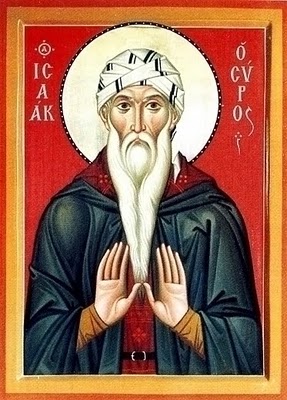
“God will not abandon anyone.” [First Part, Chap. 5]
“There was a time when sin did not exist, and there will be a time when it will not exist.” [First Part, Chap. 26]
“As a handful of sand thrown into the ocean, so are the sins of all flesh as compared with the mind of God; as a fountain that flows abundantly is not dammed by a handful of earth, so the compassion of the Creator is not overcome by the wickedness of the creatures… If He is compassionate here, we believe that there will be no change in Him; far be it from us that we should wickedly think that God could not possibly be compassionate; God’s properties are not liable to variations as those of mortals… What is hell as compared with the grace of resurrection? Come and let us wonder at the grace of our Creator.” [First Part, Chap. 50]
“It is not the way of the compassionate Maker to create rational beings in order to deliver them over mercilessly to unending affliction in punishment for things of which He knew even before they were fashioned, aware how they would turn out when He created them, and whom nonetheless He created.” [Second Part, Chap. 39]
“This is the mystery: that all creation by means of One, has been brought near to God in a mystery; then it is transmitted to all; thus all is united to Him…This action was performed for all of creation; there will, indeed, be a time when no part will fall short of the whole.” [Third Part, Chap. 5]
Gregory of Nyssa: Our Sister Macrina
Posted by Dallas Wolf in Monasticism, Patristic Pearls, The Cappadocians, Women in Early Christianity on March 7, 2025
Excerpt from Gregory of Nyssa: The Letters, by Ann M. Silvas, Brill, 2007
Gregory of Nyssa – Letter 19 To a certain John
The letter was written from Sebasteia in the first half of AD 380. The brief but intense cameo of Gregory’s sister, 19.6–10, is a foreshadowing and a promise of the Life of Macrina. It is the earliest documentation we have of Macrina’s existence, her way of life and her funeral led by Gregory, written less than a year after her death. The witness of her lifestyle, her conversations with him which were so formative and strengthening of his religious spirit, and above all his providential participation in her dying hours had a profound affect on him. It only needed time to absorb and reflect on these events. Then, when the occasion offered, he set out to make his remarkable sister better known to the world.
Our Sister Macrina

We had a sister who was for us a teacher of how to live, a mother in place of our mother. Such was her freedom towards God that she was for us a strong tower (Ps 60.4) and a shield of favour (Ps 5.13) as the Scripture says, and a fortified city (Ps 30.22, 59.11) and a name of utter assurance, through her freedom towards God that came of her way of life.
She dwelt in a remote part of Pontus, having exiled herself from the life of human beings. Gathered around her was a great choir of virgins whom she had brought forth by her spiritual labour pains (cf. 1 Cor 4.15, Gal 4.19) and guided towards perfection through her consummate care, while she herself imitated the life of angels in a human body.
With her there was no distinction between night and day. Rather, the night showed itself active with the deeds of light (cf. Rom 12.12–13, Eph 5.8) and day imitated the tranquility of night through serenity of life. The psalmodies resounded in her house at all times night and day.
You would have seen a reality incredible even to the eyes: the flesh not seeking its own, the stomach, just as we expect in the Resurrection, having finished with its own impulses, streams of tears poured out (cf. Jer. 9.1, Ps 79.6) to the measure of a cup, the mouth meditating the law at all times (Ps 1.2, 118.70), the ear attentive to divine things, the hand ever active with the commandments (cf. Ps 118.48). How indeed could one bring before the eyes a reality that transcends description in words?
Well then, after I left your region, I had halted among the Cappadocians, when unexpectedly I received some disturbing news of her. There was a ten days’ journey between us, so I covered the whole distance as quickly as possible and at last reached Pontus where I saw her and she saw me.
But it was the same as a traveler at noon whose body is exhausted from the sun. He runs up to a spring, but alas, before he has touched the water, before he has cooled his tongue, all at once the stream dries up before his eyes and he finds the water turned to dust.
So it was with me. At the tenth year I saw her whom I so longed to see, who was for me in place of a mother and a teacher and every good, but before I could satisfy my longing, on the third day I buried her and returned on my way.
“Daily” Bread in the Lord’s Prayer? A Word Study
Posted by Dallas Wolf in First Thoughts, Patristic Pearls, Theology on January 9, 2025
Sources:
1. http://aramaicnt.org/articles/the-lords-prayer-in-galilean-aramaic/
2. Origen of Alexandria (c. 185 – c. 254): On Prayer (Περί Ευχής), Chapter XVII
The Lord’s Prayer is with little debate the most significant prayer in Christianity. Although many theological and ideological differences may divide Christians across the world, it is a prayer that unites the faith as a whole.
Within the New Testament tradition, the Prayer appears in two places. The first and more elaborate version is found in Matthew 6:9-13 where a simpler form is found in Luke 11:2-4, and the two of them share a significant amount of overlap.
The prayer’s absence from the Gospel of Mark, taken together with its presence in both Luke and Matthew, has brought some modern scholars to conclude that it is a tradition from the hypothetical “Q” source (from German: Quelle, meaning “source”) which both Luke and Matthew relied upon in many places throughout their individual writings. Given the similarities and unique character of the Matthaean and Lukan versions of the Lord’s Prayer may be evidence that what we attribute to the Greek of “Q” may ultimately trace back to an Aramaic source.
One of the trickiest problems of translating the Lord’s Prayer into Aramaic is finding out what επιούσιος (epiousios), usually translated as “daily”, originally intended. It is a unique word in Greek, only appearing twice in the all of Greek literature: Once in the Lord’s Prayer in Matthew, and the other time in the Lord’s Prayer in Luke.
This raises some curious questions that have baffled scholars. Why would Jesus have used a singular, entirely unique word? In more recent times, the bafflement has turned to a different possible solution. Jesus, someone known to have spoken Aramaic in a prayer that was originally recited in Aramaic, would not have used the Greek επιούσιος, at all. So, the question has evolved to “What Aramaic word was επιούσιος supposed to represent?” It would have to be something unique or difficult enough that whoever translated it into Greek needed to coin a word to express or preserve some meaning that they thought was important, or something that they couldn’t quite wrap the Greek language around.
The first question to answer is the meaning of the unique koine Greek word ἐπιούσιον (epiousion). To do this, we consult the writings of Origen of Alexandria. Origen was a third century native koine Greek speaker, head of the famed Catechetical School of Alexandria, the greatest theologian of the early church, and first to perform an exegesis of the Lord’s Prayer (ca. AD 240).
Origen begins: ”Let us now consider what the word epiousion, needful, means. First of all it should be known that the word epiousion is not found in any Greek writer whether in philosophy or in common usage, but seems to have been formed by the evangelists. At least Matthew and Luke, in having given it to the world, concur in using it in identical form.”
Origen concludes his in-depth discussion of epiousion, needful, by stating, “Needful, therefore, is the bread which corresponds most closely to our rational nature and is akin to our very essence, which invests the soul at once with well being and with strength, and, since the Word of God is immortal, imparts to its eater its own immortality.”
In Aramaic, the best fit for επιούσιος is probably the word çorak. It comes from the root çrk, which means to be poor, to need, or to be necessary. It is a very common word in Galilean Aramaic that is used in a number of senses to express both need and thresholds of necessity, such as “as much as is required” (without further prepositions) or with pronominal suffixes “all that [pron.] needs” (çorki = “All that I need”; çorkak = “All that you need”; etc.). Given this multi-faceted nature of the word, it’s hard to find a one-to-one Greek word that would do the job, and επιούσιος is a very snug fit in the context of the Prayer’s petition. This might even give us a hint that the Greek translator literally read into it a bit.
The Aramaic word yelip is another possible solution. It is interesting to note that it comes from the root yalap or “to learn.” Etymologically speaking, learning is a matter of repetition and routine, and this connection may play off the idea of regular physical bread, but actually mean “daily learning from God” (i.e. that which is necessary for living, as one cannot live off of bread alone).
Bottom line:
Origen’s understanding of epiousion in his context of needful certainly has no connection or relationship to a simplistic English translation of epiousion as “daily’. Nor is the translation of epiousion as “daily” supported by either hypothetical original Aramaic word çorkak or yelip.
In fact, a translation of epiousion as “daily” makes this petition in the Lord’s Prayer (Matt. 6:11) directly contradict Jesus’ lengthy admonition 14 verses later, starting at Matt 6:25:
25 “Therefore I say to you, do not worry about your life, what you will eat or what you will drink; nor about your body, what you will put on. Is not life more than food and the body more than clothing?
26 “Look at the birds of the air, for they neither sow nor reap nor gather into barns; yet your heavenly Father feeds them. Are you not of more value than they?
31 “Therefore do not worry, saying, ‘What shall we eat?’ or ‘What shall we drink?’ or ‘What shall we wear?’
32 “For after all these things the Gentiles seek. For your heavenly Father knows that you need all these things.
33 “But seek first the kingdom of God and His righteousness, and all these things shall be added to you.
The Gospel writers of Matthew and Luke both used the same totally unique Greek word solely in the context of the Lord’s Prayer. There were other frequently used koine Greek words available to express the simple idea of “daily”. Perhaps the unique use of epiousion was not accidental or coincidental, but needed to express the intent of the original Aramaic prayer. Origen may provide the best insight into the intended meaning of ἐπιούσιον as needful of the supra-essential Word of God.
von Balthasar on Gregory of Nyssa
Posted by Dallas Wolf in Concept of "Person" (series), Ekklesia and church, Essence and Energies (series), Patristic Pearls, The "Nous" (series), The Cappadocians, The Holy Trinity on December 26, 2024
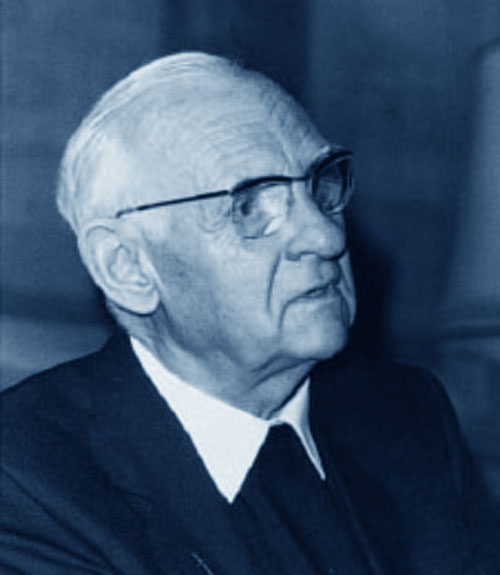
Hans Urs von Balthasar (1905–1988) – Hans Urs von Balthasar was a Swiss theologian and Catholic priest who is considered one of the most important Catholic theologians of the 20th century. Over the course of his life, he authored 85 books, over 500 articles and essays, and almost 100 translations.
Excerpt from Hans Urs von Balthasar: Presence and Thought: Essay on the Religious Philosophy of Gregory of Nyssa (1988)

“Less brilliant and prolific than his great master Origen, less cultivated than his friend Gregory Nazianzen, less practical than his brother Basil, he [Gregory of Nyssa] nonetheless outstrips them all in the profundity of his thought, for he knew better than anyone how to transpose ideas inwardly from the spiritual heritage of ancient Greece into a Christian mode.”
Prayer Ropes and Rosaries
Posted by Dallas Wolf in Ekklesia and church, Hesychasm - Jesus Prayer, Monasticism, New Nuggets, Patristic Pearls on December 21, 2024
Both the prayer rope and the rosary are revered traditional aids to Christian prayer, yet each has its own unique origin, symbolism, and devotional use.

The Prayer Rope, now largely associated with the Eastern Orthodox Church, is a loop of knots (each knot containing seven crosses), usually made of wool, that is used to focus and intensify prayer, particularly the Jesus Prayer. It acts as a physical guide for a repeated, meditative style of prayer, allowing practitioners to keep count while reflecting and meditating. The prayer rope has its beginnings in early fourth century Christian monasticism in the Egyptian Desert, where it was devised as a tool to aid in the ascetic practice of continuous prayer (1 Thes. 5:17).
Origins: The prayer rope is known as a ‘komboskini’ in Greek and ‘chotki’ in Russian. The prayer rope owes its origins to St. Pachomius the Great, a fourth century “Desert Father” in upper Egypt and founder of cenobitic monasticism (a monastic tradition that stresses community life, over the older, eremitic, or solitary tradition). St. Pachomius established the prayer rope as a practical solution for the monks under his supervision to count prayers and prostrations consistently. The prayer rope evolved as a useful instrument for monks to keep track of their prayers, particularly the Jesus Prayer, without distraction. It gradually took on a deeper spiritual value, with each knot symbolizing a request for mercy and humility.
Symbolic Significance: Wool knots, each knot containing seven crosses, are commonly used on traditional prayer ropes to represent Christ’s flock and the shepherd’s care. The number of knots in a prayer rope varies; typically 33 (Christ’s age at crucifixion), 50, or 100.
Traditional Use: In Orthodox Christian practice, the prayer rope is typically used for private prayer in reciting the Jesus Prayer, acting as a physical and spiritual guide to help the mind (nous) and heart concentrate on prayer.

The Rosary, strongly associated with the Roman Catholic Church, is a string of beads that ends with a crucifix and is used to guide Catholics through a sequence of prayers that reflect on the lives of Christ and the Virgin Mary. Each bead signifies a specific prayer, such as the Hail Mary, and each set of beads makes a ‘decade’ that corresponds to a mystery in Christ’s life. The rosary has a long history, dating back to the Middle Ages when it first arose as a popular form of laity devotion, eventually becoming a prominent practice in Catholic piety.
Origins: The rosary is typically identified with Saint Dominic in the early 13th century. The rosary began as a simple way for lay people to join in the monastic practice of reciting the Psalms, but has since evolved into a systematic form of prayer. The rosary prayers are split into decades, each with ten Hail Marys, an Our Father, and a Glory Be, and are frequently accompanied by meditations on the Mysteries of the Rosary.
Symbolic Significance: Each rosary bead represents a prayer as well as a step in the meditation journey through Jesus Christ’s and the Virgin Mary’s lives. The rosary culminates with a crucifix, which represents Christ’s sacrifice.
Traditional Use: Roman Catholics utilize the rosary for both personal meditation and social worship. It is frequently prayed privately for personal spiritual development or in groups for social objectives and celebrations.
 First Thoughts