Archive for category Theology
Recovering from the Council of Chalcedon, AD 451
Posted by Dallas Wolf in Council of Chalcedon, Ekklesia and church, Theology on February 5, 2019
Two Families of Orthodox
The following is excerpted from the website of the Coptic Orthodox Church of Alexandria, Diocese of Los Angeles, Southern California and Hawaii (http://lacopts.org/orthodoxy/orthodox-life/two-families-of-orthodox/)
For over fifteen hundred years [since the Council of Chalcedon in AD 451] the Eastern (Byzantine) Orthodox churches and the Oriental Orthodox churches have remained separated. Only thirty years ago they came together for the first of four unofficial theological consultations : Aarhus (1964), Bristol (1967), Geneva (1970) and Addis Ababa (1971).
These were followed by the establishment of a Joint Commission of the Theological Dialogue between the Orthodox Church and the Oriental Orthodox Churches, which has held four meetings : Chambesy, Geneva (December 1985), Anba Bishoy monastery, Egypt (June 1989), Chambesy II (September 1990) and Chambesy III (November 1993). Ignorance of the remarkable advance towards the eventual reunion of the “two families” is still widespread and it is a sad reflection on the lack of understanding of what has been agreed already that some journals, commenting on the recent reception of the British Orthodox Church by the Coptic Orthodox Patriarchate, are still impugning the Orthodoxy of the Oriental Orthodox churches with accusations of the Monophysite heresy.
There is, of course, always the zealot fringe, which has rather foolishly and improbably attempted to stigmatise the deep and careful deliberations of the Joint Commission as just another step in the liberal, ecumenist sell-out, preferring – for its own reasons – to re-open old wounds rather than pour out the healing balm of charity and truth. In accordance with the Bulletin’s declared policy of explaining our common understanding of the Orthodox faith, we published in this issue the key texts issued by the Joint Commission.
Members of the Joint Commission included official representatives of the Coptic Orthodox Church, the Syrian Orthodox Patriarchate of Antioch and All the East, the Supreme Catholicosate of All Armenians at Etchmiadzin, the Armenian Catholicosate of Cilicia, the Malankara Orthodox Syrian Church of the East and the Ethiopian Orthodox Church from the Oriental Orthodox family; the Ecumenical Patriarchate, the Greek Orthodox Patriarchate of Alexandria, the Greek Orthodox Patriarchate of Antioch, the Russian Patriarchate, the Romanian Patriarchate, the Serbian Patriarchate, the Bulgarian Patriarchate, the Georgian Patriarchate, the Church of Cyprus, the Church of Greece, the Church of Albania, the Czechoslovakian Orthodox Church, the Polish Orthodox Church and the Finnish Orthodox Church from the Byzantine Orthodox family.
First Agreed Statement (1989)
We have inherited from our fathers in Christ the one apostolic faith and tradition, though as Churches we have been separated from each other for centuries. As two families of Orthodox Churches long out of communion with each other we now pray and trust in God to restore that communion on the basis of the common apostolic faith of the undivided church of the first centuries which we confess in our common creed. What follows is a simple reverent statement of what we do believe on our way to restore communion between our two families of Orthodox Churches.
Throughout our discussions we have found our common ground in the formula of our common father, St. Cyril of Alexandria : mia physis hypostasis (he mia hypostasis)[1] tou Theou Logou sesarkomene, and in the dictum that “it is sufficient for the confession of our true and irreproachable faith to say and to confess that the Holy Virgin is Theotokos” (Hom : 15, cf. Ep. 39).
Great indeed is the wonderful mystery of the Father, Son and Holy Spirit, one True God, one ousia in three hypostases or three prosopa. Blessed be the Name of the Lord our God, for ever and ever.
Great indeed is also the ineffable mystery of the Incarnation of our Lord Jesus Christ, for us and for our salvation.
The Logos, eternally consubstantial with the Father and the Holy Spirit in His Divinity, has in these last days, become incarnate of the Holy Spirit and Blessed Virgin Mary Theotokos, and thus became man, consubstantial with us in His humanity but without sin. He is true God and true Man at the same time, perfect in His Divinity, perfect in His humanity. Because the one she bore in her womb was at the same time fully God as well as fully human we call the Blessed Virgin Theotokos.
When we speak of the one composite (synthetos) hypostasis of our Lord Jesus Christ, we do not say that in Him a divine hypostasis and a human hypostasis came together. It is that the one eternal hypostasis of the Second Person of the Trinity has assumed our created human nature in that act uniting it with His own uncreated divine nature, to form an inseparably and unconfusedly united real divine-human being, the natures being distinguished from each other in contemplation (theoria) only.
The hypostasis of the Logos before the incarnation, even with His divine nature, is of course not composite. The same hypostasis, as distinct from nature, of the Incarnate Logos, is not composite either. The unique theandric person (prosopon) of Jesus Christ is one eternal hypostasis Who has assumed human nature by the Incarnation. So we call that hypostasis composite, on account of the natures which are united to form one composite unity. It is not the case that our Fathers used physis and hypostasis always interchangeably and confused the one with the other. The term hypostasis can be used to denote both the person as distinct from nature, and also the person with the nature, for a hypostasis never in fact exists without a nature.
It is the same hypostasis of the Second Person of the Trinity, eternally begotten from the Father Who in these last days became a human being and was born of the Blessed Virgin. This is the mystery of the hypostatic union we confess in humble adoration – the real union of the divine with the human, with all the properties and functions of the uncreated divine nature, including natural will and natural energy, inseparably and unconfusedly united with the created human nature with all its properties and functions, including natural will and natural energy. It is the Logos Incarnate Who is the subject of all the willing and acting of Jesus Christ.
We agree in condemning the Nestorian and the Eutychian heresies. We neither separate nor divide the human nature in Christ from His divine nature, nor do we think that the former was absorbed in the latter and thus ceased to exist.
The four adverbs used to qualify the mystery of the hypostatic union belong to our common tradition – without commingling (or confusion) (asyngchytos), without change (atreptos), without separation (achoristos) and without division (adiairetos). Those among us who speak of two natures in Christ, do not thereby deny their inseparable, indivisible union; those among us who speak of one united divine-human nature in Christ do not thereby deny the continuing dynamic presence in Christ of the divine and the human, without change, without confusion.
Our mutual agreement is not limited to Christology, but encompasses the whole faith of the one undivided church of the early centuries. We are agreed also in our understanding of the Person and Work of God the Holy Spirit, Who proceeds from the Father alone, and is always adored with the Father and the Son. [2]
Second Agreed Statement (1990)
The first Agreed Statement on Christology adopted by the Joint Commission of the Theological Dialogue between the Orthodox and Oriental Orthodox Churches, at our historic meeting at the Anba Bishoy Monastery, Egypt, from 20th to 24th June 1989 forms the basis of this Second Agreed Statement on the following affirmations of our common faith and understanding, and recommendations on steps to be taken for the communion of our two families of Churches in Jesus Christ our Lord, Who prayed “that they all may be one”.
1. Both families agree in condemning the Eutychian heresy. Both families confess that the Logos, the Second Person of the Holy Trinity, only begotten of the Father before the ages and consubstantial with Him, was incarnate and was born from the Virgin Mary Theotokos; fully consubstantial with us, perfect man with soul, body and mind (nous); He was crucified, died, was buried, and rose from the dead on the third day, ascended to the Heavenly Father, where He sits on the right hand of the Father as Lord of all Creation. At Pentecost, by the coming of the Holy Spirit He manifested the Church as His Body. We look forward to His coming again in the fullness of His glory, according to the Scriptures.
2. Both families condemn the Nestorian heresy and the crypto-Nestorianism of Theodoret of Cyrus. They agree that it is not sufficient merely to say that Christ is consubstantial both with His Father and with us, by nature God and by nature man; it is necessary to affirm also that the Logos, Who is by nature God, became by nature Man, by His Incarnation in the fullness of time.
3. Both families agree that the Hypostasis of the Logos became composite (sunqetoj) by uniting to His divine uncreated nature with its natural will and energy, which He has in common with the Father and the Holy Spirit, created human nature, which He assumed at the Incarnation and made His own, with its natural will and energy.
4. Both families agree that the natures with their proper energies and wills are united hypostatically and naturally without confusion, without change, without division and without separation, and that they are distinguished in thought alone (th qewria monh). 20
5. Both families agree that He Who wills and acts is always the one Hypostasis of the Logos incarnate.
6. Both families agree in rejecting interpretations of Councils which do not fully agree with the Horos of the Third Ecumenical Council and the letter (433) of Cyril of Alexandria to John of Antioch.
7. The Orthodox agree that the Oriental Orthodox will continue to maintain their traditional Cyrillian terminology of “one nature of the incarnate Logos” (“mia fusij tou qeou Logou sesarkwmenh”), since they acknowledge the double consubstantiality of the Logos which Eutyches denied. The Orthodox also use this terminology. The Oriental Orthodox agree that the Orthodox are justified in their use of the two-natures formula, since they acknowledge that the distinction is “in thought alone” (th qewria monh). Cyril interpreted correctly this use in his letter to John of Antioch and his letters to Acacius of Melitene (PG 77, 184-201), to Eulogius (PG 77, 224-228) and to Succensus (PG 77, 228-245).
8. Both families accept the first three Ecumenical Councils, which form our common heritage. In relation to the four later Councils of the Orthodox Church, the Orthodox state that for them the above points 1-7 are the teachings also of the four later Councils of the Orthodox Church, while the Oriental Orthodox consider this statement of the Orthodox as their interpretation. With this understanding, the Oriental Orthodox respond to it positively.
In relation to the teaching of the Seventh Ecumenical Council of the Orthodox Church, the Oriental Orthodox agree that the theology and practice of the veneration of icons taught by that Council are in basic agreement with the teaching and practice of the Oriental Orthodox from ancient times, long before the convening of the Council, and that we have no disagreement in this regard.
9. In the light of our Agreed Statement on Christology as well as of the above common affirmations, we have now clearly understood that both families have always loyally maintained the same authentic Orthodox Christological faith, and the unbroken continuity of the apostolic tradition, though they have used Christological terms in different ways. It is this common faith and continuous loyalty to the Apostolic Tradition that should be the basis for our unity and communion.
10. Both families agree that all the anathemas and condemnations of the past which now divide us should be lifted by the Churches in order that the last obstacle to the full unity and communion of our two families can be removed by the grace and power of God. Both families agree that the lifting of anathemas and condemnations will be consummated on the basis that the Councils and Fathers previously anathematized or condemned are not heretical.”
St. Isaac of Nineveh: On Silence
Posted by Dallas Wolf in Hesychasm - Jesus Prayer, Monasticism, Patristic Pearls, Theology on February 19, 2018
St. Isaac of Nineveh – 7th century ascetic and mystic, born in modern-day Qatar, was made Bishop of Nineveh between 660-680. Here he speaks of the importance of silence in monastic life.
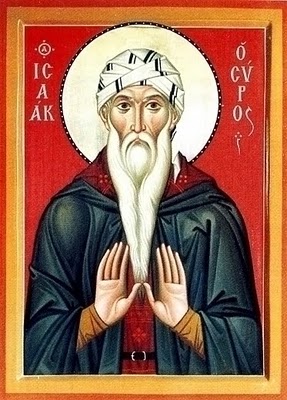
“Love silence above all things. It brings thee near the fruit which the tongue is too weak to interpret. At first we compel ourselves to be silent. Then from our silence something is born which draws us toward silence. May God grant thee to perceive that which is born of silence. If thou beginnest with this discipline, I do not know how much light will dawn in thee through it. Concerning what is said about the admirable Arsenius: that Fathers and brethren came to see him, but that he sat with them in silence and dismissed them in silence – do not think, my brother, that this happened by the action of his will alone, though in the beginning he had to compel himself. After some time some delight is born in the heart from the exercise of this service and by force it draws the body towards remaining in silence.”
“If thou placest all labors of this discipline [solitary life] on one side and silence on the other, silence will outweigh them.”
~St. Isaac of Nineveh, from Ascetical Treatises 65
Met. Kallistos: “God in Trinity”
Posted by Dallas Wolf in First Thoughts, New Nuggets, The Holy Trinity, Theology on November 10, 2017
Metropolitan Kallistos (Ware) of Diokleia – (1934 – 2022) was a titular metropolitan of the Orthodox Ecumenical Patriarchate in Great Britain. From 1966-2001, he was Spalding Lecturer of Eastern Orthodox Studies at Oxford University, and has authored numerous books and articles pertaining to the Orthodox faith. The following excerpt is taken from Chapter 11 of Met. Kallistos’ book, The Orthodox Church: An Introduction to Eastern Christianity (1993)

“Our social programme, said the Russian thinker Fedorov, is the dogma of the Trinity. Orthodoxy believes most passionately that the doctrine of the Holy Trinity is not a piece of ‘high theology’ reserved for the professional scholar, but something that has a living, practical importance for every Christian. Man, so the Bible teaches, is made in the image of God, and to Christians God means the Trinity: thus it is only in the light of the dogma of the Trinity that man can understand who he is and what God intends him to be. Our private lives, our personal relations, and all our plans of forming a Christian society depend upon a right theology of the Trinity. ‘Between the Trinity and Hell there lies no other choice (V. Lossky, The Mystical Theology of the Eastern Church, p. 66). As an Anglican writer has put it: ‘In this doctrine is summed up the new way of thinking about God, in the power of which the fishermen. went out to convert the Greco-Roman world. It marks a saving revolution in human thought (D. J. Chitty, ‘The Doctrine of the Holy Trinity told to the Children,’ in Sobornost, series 4, no. 5, 1961, p. 241).
The basic elements in the Orthodox doctrine of God have already been mentioned in the first part of this book, so that here they will only be summarized briefly:
1. God is absolutely transcendent.
‘No single thing of all that is created has or ever will have even the slightest communion with the supreme nature or nearness to it (Gregory Palamas, P.G. 150, 1176c (quoted on p. 77)). This absolute transcendence Orthodoxy safeguards by its emphatic use of the ‘way of negation,’ of ‘apophatic’ theology. Positive or ‘cataphatic’ theology — the ‘way of affirmation’ — must always be balanced and corrected by the employment of negative language. Our positive statements about God — that He is good, wise, just and so on — are true as far as they go, yet they cannot adequately describe the inner nature of the deity. These positive statements, said John of Damascus, reveal ‘not the nature, but the things around the nature.’ ‘That there is a God is clear; but what He is by essence and nature, this is altogether beyond our comprehension and knowledge (On the Orthodox Faith, 1, 4 (P.G. 94, 800B, 797B)).
2. God, although absolutely transcendent, is not cut of from the world which He has made.
God is above and outside His creation, yet He also exists within it. As a much used Orthodox prayer puts it: ‘Thou art everywhere and finest all things.’ Orthodoxy therefore distinguishes between God’s essence and His energies, thus safeguarding both divine transcendence and divine immanence: God’s essence remains unapproachable, but His energies come down to us. God’s energies, which are God Himself, permeate all His creation, and we experience them in the form of deifying grace and divine light. Truly our God is a God who hides Himself, yet He is also a God who acts — the God of history, intervening directly in concrete situations.
3. God is personal, that a to say, Trinitarian.
This God who acts is not only a God of energies, but a personal God. When man participates in the divine energies, he is not overwhelmed by some vague and nameless power, but he is brought face to face with a person. Nor is this all: God is not simply a single person confined within his own being, but a Trinity of three persons, Father, Son, and Holy Spirit, each of whom ‘dwells’ in the other two, by virtue of a perpetual movement of love. God is not only a unity but a union.
4. Our God is an Incarnate God.
God has come down to man, not only through His energies, but in His own person. The Second Person of the Trinity, ‘true God from true God,’ was made man: “The Word became flesh and dwelt among us” (John 1:14). A closer union than this between God and His creation there could not be. God Himself became one of His creatures (For the first and second of these four points, see pp. 72-9; for the third and fourth points, see pp. 28-37).
Those brought up in other traditions have sometimes found it difficult to accept the Orthodox emphasis on apophatic theology and the distinction between essence and energies; but apart from these two matters, Orthodox agree in their doctrine of God with the overwhelming majority of all who call themselves Christians. Monophysites and Lutherans, Nestorians and Roman Catholics, Calvinists, Anglicans, and Orthodox: all alike worship One God in Three Persons and confess Christ as Incarnate Son of God (In the past hundred years, under the influence of ‘Modernism,’ many Protestants have virtually abandoned the doctrines of the Trinity and the Incarnation. Thus when I speak here of Calvinists, Lutherans, and Anglicans, I have in mind those who still respect the classical Protestant formularies of the sixteenth century).
Yet there is one point in the doctrine of God the Trinity over which east and west part company — the filioque. We have already seen how decisive a part this one word played in the unhappy fragmentation of Christendom. But granted that the filioque is important historically, does it really matter from a theological point of view? Many people today — not excluding many Orthodox — find the whole dispute so technical and obscure that they are tempted to dismiss it as utterly trivial. From the viewpoint of traditional Orthodox theology there can be but one rejoinder to this: technical and obscure it undoubtedly is, like most questions of Trinitarian theology; but it is not trivial. Since belief in the Trinity lies at the very heart of the Christian faith, a tiny difference in Trinitarian theology is bound to have repercussions upon every aspect of Christian life and thought. Let us try therefore to understand some of the issues involved in the filioque dispute.
One essence in three persons. God is one and God is three: the Holy Trinity is a mystery of unity in diversity, and of diversity in unity. Father, Son, and Spirit are ‘one in essence’ (homoousios), yet each is distinguished from the other two by personal characteristics. ‘The divine is indivisible in its divisions (Gregory of Nazianzus, Orations, 31, 14). for the persons are ‘united yet not confused, distinct yet not divided’ (John of Damascus, On the Orthodox Faith, 1, 8 (P.G. 94, 809A)); ‘both the distinction and the union alike are paradoxical’ (Gregory of Nazianzus, Orations, 25, 17).
But if each of the persons is distinct, what holds the Holy Trinity together? Here the Orthodox Church, following the Cappadocian Fathers, answers that there is one God because there is one Father. In the language of theology, the Father is the ‘cause’ or ‘source’ of Godhead, He is the principle (arche) of unity among the three; and it is in this sense that Orthodoxy talks of the ‘monarchy’ of the Father. The other two persons trace their origin to the Father and are defined in terms of their relation to Him. The Father is the source of Godhead, born of none and proceeding from none; the Son is born of the Father from all eternity (‘before all ages,’ as the Creed says); the Spirit proceeds from the Father from all eternity.
It is at this point that Roman Catholic theology begins to disagree. According to Roman theology, the Spirit proceeds eternally from the Father and the Son; and this means that the Father ceases to be the unique source of Godhead, since the Son also is a source. Since the principle of unity in the Godhead can no longer be the person of the Father, Rome finds its principle of unity in the substance or essence which all three persons share. In Orthodoxy the principle of God’s unity is personal, in Roman Catholicism it is not.
But what is meant by the term ‘proceed?’ Unless this is properly understood, nothing is understood. The Church believes that Christ underwent two births, the one eternal, the other at a particular point in time: he was born of the Father ‘before all ages,’ and born of the Virgin Mary in the days of Herod, King of Judaea, and of Augustus, Emperor of Rome. In the same way a firm distinction must be drawn between the eternal procession of the Holy Spirit, and the temporal mission, the sending of the Spirit to the world: the one concerns the relations existing from all eternity within the Godhead, the other concerns the relation of God to creation. Thus when the west says that the Spirit proceeds from the Father and the Son, and when Orthodoxy says that He proceeds from the Father alone, both sides are referring not to the outward action of the Trinity towards creation, but to certain eternal relations within the Godhead — relations which existed before ever the world was. But Orthodoxy, while disagreeing with the west over the eternal procession of the Spirit, agrees with the west in saying that, so far as the mission of the Spirit to the world is concerned, He is sent by the Son, and is indeed the ‘Spirit of the Son.’
The Orthodox position is based on John 15:26, where Christ says: ‘When the Comforter has come, whom I will send to you from the Father — the Spirit of truth, who proceeds from the Father — he will bear witness to me.’ Christ sends the Spirit, but the Spirit proceeds from the Father: so the Bible teaches, and so Orthodoxy believes. What Orthodoxy does not teach, and what the Bible never says, is that the Spirit proceeds from the Son.
An eternal procession from Father and Son: such is the western position. An eternal procession of the Spirit from the Father alone, a temporal mission from the Son: such was the position upheld by Saint Photius against the west. But Byzantine writers of the thirteenth and fourteenth centuries — most notably Gregory of Cyprus, Patriarch of Constantinople from 1283 to 1289, and Gregory Palamas — went somewhat further than Photius, in an attempt to bridge the gulf between east and west. They were willing to allow not only a temporal mission, but an eternal manifestation of the Holy Spirit by the Son. While Photius had spoken only of a temporal relation between Son and Spirit, they admitted an eternal relation. Yet on the essential point the two Gregories agreed with Photius: the Spirit is manifested by the Son, but does not proceed from the Son. The Father is the unique origin, source, and cause of Godhead.
Such in outline are the positions taken up by either side; let us now consider the Orthodox objections to the western position. The filioque leads either to ditheism or to semi-Sabellianism (Sabellius, a heretic of the second century, regarded Father, Son, and Spirit not as three distinct persons, but simply as varying ‘modes’ or ‘aspects’ of the deity). If the Son as well as the Father is an arche, a principle or source of Godhead, are there then (the Orthodox asked) two independent sources, two separate principles in the Trinity? Obviously not, since this would be tantamount to belief in two Gods; and so the Reunion Councils of Lyons (1274) and Florence (1438-1439) were most careful to state that the Spirit proceeds from Father and Son ‘as from one principle,’ tanquam ex (or ab) uno principio. From the Orthodox point of view, however, this is equally objectionable: ditheism is avoided, but the persons of Father and Son are merged and confused. The Cappadocians regarded the ‘monarchy’ as the distinctive characteristic of the Father: He alone is a principle or arche within the Trinity. But western theology ascribes the distinctive characteristic of the Father to the Son as well, thus fusing the two persons into one; and what else is this but ‘Sabellius reborn, or rather some semi-Sabellian monster,’ as Saint Photius put it? (P.G. 102, 289B).
Let us look more carefully at this charge of semi-Sabellianism. Orthodox Trinitarian theology has a personal principle of unity, but the west finds its unitary principle in the essence of God. In Latin Scholastic theology, so it seems to Orthodox, the persons are overshadowed by the common nature, and God is thought of not so much in concrete and personal terms, but as an essence in which various relations are distinguished. This way of thinking about God comes to full development in Thomas Aquinas, who went so far as to identify the persons with the relations: personae sunt ipsae relationes (Summa Theologica, 1, question 40, article 2). Orthodox thinkers find this a very meagre idea of personality. The relations, they would say, are not the persons — they are the personal characteristics of Father, Son, and Holy Spirit; and (as Gregory Palamas put it) ‘personal characteristics do not constitute the person, but they characterize the person’ (Quoted in J. Meyendorff, Introduction à 1’étude de Grégoire Palamas, Paris, 1959, p. 294). The relations, while designating the persons, in no way exhaust the mystery of each.
Latin Scholastic theology, emphasizing as it does the essence at the expense of the persons, comes near to turning God into an abstract idea. He becomes a remote and impersonal being, whose existence has to be proved by metaphysical arguments — a God of the philosophers, not the God of Abraham, Isaac, and Jacob. Orthodoxy, on the other hand, has been far less concerned than the Latin west to find philosophical proofs of God’s existence: what is important is not that a man should argue about the deity, but that he should have a direct and living encounter with a concrete and personal God.
Such are some of the reasons why Orthodox regard the filioque as dangerous and heretical. Filioquism confuses the persons, and destroys the proper balance between unity and diversity in the Godhead. The oneness of the deity is emphasized at the expense of His threeness; God is regarded too much in terms of abstract essence and too little in terms of concrete personality.
But this is not all. Many Orthodox feel that, as a result of the filioque, the Holy Spirit in western thought has become subordinated to the Son — if not in theory, then at any rate in practice. The west pays insufficient attention to the work of the Spirit in the world, in the Church, in the daily life of each man.
Orthodox writers also argue that these two consequences of the filioque — subordination of the Holy Spirit, over-emphasis on the unity of God — have helped to bring about a distortion in the Roman Catholic doctrine of the Church. Because the role of the Spirit has been neglected in the west, the Church has come to be regarded too much as an institution of this world, governed in terms of earthly power and jurisdiction. And just as in the western doctrine of God unity was stressed at the expense of diversity, so in the western conception of the Church unity has triumphed over diversity, and the result has been too great a centralization and too great an emphasis on Papal authority.
Such in outline is the Orthodox attitude to the filioque, although not all would state the case in such an uncompromising form. In particular, many of the criticisms given above apply only to a decadent form of Scholasticism, not to Latin theology as a whole.”
St. Gregory Palamas: “Theosis, the Uncreated Thaboric Light”
Posted by Dallas Wolf in Hesychasm - Jesus Prayer, Monasticism, Patristic Pearls, Theology on October 21, 2017
St. Gregory Palamas (Greek: Γρηγόριος Παλαμάς; 1296–1359) – was a monk of Mount Athos in Greece and later the archbishop of Thessaloniki, known as a preeminent theologian of Hesychasm. The teachings embodied in his writings defending Hesychasm against the attack of Barlaam are sometimes referred to as Palamism, and his followers as Palamites.
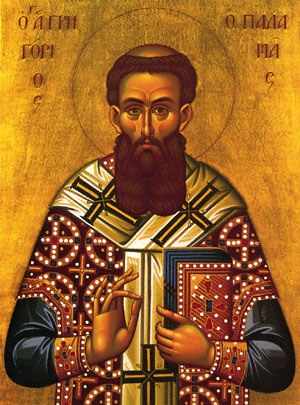
“Since the Son of God, in his incomparable love for man, did not only unite His divine Hypostasis with our nature, by clothing Himself in a living body and a soul gifted with intelligence… but also united himself… with the human hypostases themselves, in mingling himself with each of the faithful by communion with his Holy Body, and since he becomes one single body with us (cf. Eph. 3:6), and makes us a temple of the undivided Divinity, for in the very body of Christ dwelleth the fullness of the Godhead bodily (Col. 2:9), how should he not illuminate those who commune worthily with the divine ray of His Body which is within us, lightening their souls, as He illumined the very bodies of the disciples on Mount Thabor? For, on the day of the Transfiguration, that Body, source of the light of grace, was not yet united with our bodies, it illuminated from outside those who worthily approached it, and sent the illumination into the soul by an intermediary of the physical eyes; but now, since it mingled with us and exists in us, it illuminates the soul from within.”
~ from: Triads I.iii.38.
St. Gregory Palamas: “In Mystical Contemplation Man Sees God’s Light with the Spirit”
Posted by Dallas Wolf in Hesychasm - Jesus Prayer, Monasticism, Patristic Pearls, Theology on October 21, 2017
St. Gregory Palamas – Greek: Γρηγόριος Παλαμάς; (1296–1359) – was a monk of Mount Athos in Greece and later the archbishop of Thessaloniki, known as a preeminent theologian of Hesychasm. The teachings embodied in his writings defending Hesychasm against the attack of Barlaam are sometimes referred to as Palamism, and his followers as Palamites.
“In mystical contemplation a man sees neither with the intellect nor with the body, but with the Spirit; and with full certainty he knows that he beholds supernaturally a light which surpasses all other light. But he does not know through what organ he beholds this light, nor can he analyze the nature of the organ; for the ways of the Spirit, through which he sees, are unsearchable. And this is what St Paul affirmed, when he heard things which it is not lawful for man to utter and saw things which none can behold: ‘ … whether in the body or whether out of the body, I cannot tell’ (2 Cor. l2:3) – that is, he did not know whether it was his intellect or his body which saw them. For he did not perceive these things by sensation, yet his vision was as clear as that whereby we see the objects of sense perception, and even clearer still. He saw himself carried out of himself through the mysterious sweetness of his vision; he was transported not only outside every object and thought but even outside himself.
This happy and joyful experience which seized upon Paul and caused his intellect to pass beyond all things in ecstasy, which made him turn entirely in upon himself, this experience took the form of light – a light of revelation, but such as did not reveal to him the objects of sense perception. It was a light without bounds or termination below or above or to the sides; he saw no limit whatever to the light which appeared to him and shone around him, but it was like a sun infinitely brighter and larger than the universe: and in the midst of this light he himself stood, having become nothing but eye. Such, more or less, was his vision.”
~ from: Triads, I.iii. 21
St. Symeon the New Theologian: “Whenever someone sees Him revealed, he sees light.”
Posted by Dallas Wolf in Hesychasm - Jesus Prayer, Monasticism, Patristic Pearls, Theology on October 20, 2017
St. Symeon the New Theologian (949-1022) – One of the great Orthodox mystics and hesychasts explains his experience and encounter of God as light.
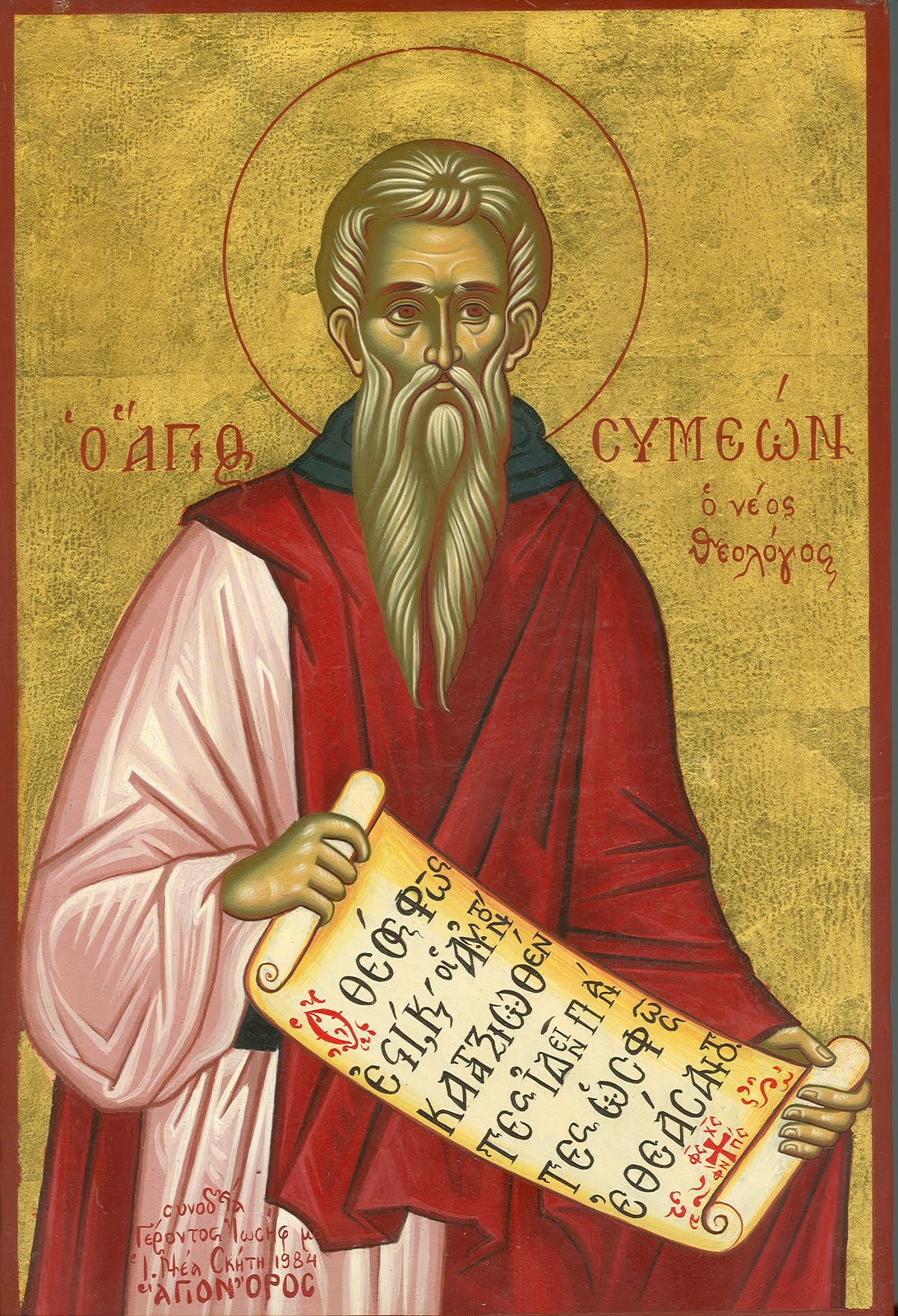
“This, invariably, is just what occurs concerning the invisible God. Whenever someone sees Him revealed, he sees light. While on the one hand he is amazed at what he has seen, on the other he does not know immediately who it is who has appeared, yet he dares not ask Him. And how could he? He is unable even to lift up his eyes and look on that grandeur. With fear and trembling he looks instead, as it were, at his own feet, knowing fully only that it is Someone Who has appeared before his face.
And if there happens to be some other man who has told him beforehand about such things, as having known God from before, he goes to this man [St Symeon’s elder] and says: “I have seen.” And the other says: “What did you see, child?” “Light, O my father, so sweet, sweet! So much so, father, that my reason has not the strength to tell you.”
And, while he is saying this, his heart leaps and pounds, and catches on fire with longing for what he has seen. Then, with many warm tears, he begins to say again: “That light, father, appeared to me. The walls of my cell immediately vanished and the world disappeared, fleeing I think from before His face, and I remained alone in the presence alone of the light. And I do not know, father, if this my body was there, too. I do not know if I was outside of it. For a while I did not know that I carry and am clothed with a body. And such great joy was in me and is with me now, great love and longing both, that I was moved to streams of tears like rivers, just like now as you see.”
The other then answers and says: “It is He, child.” And, at this word, he sees Him again and, little by little, comes to be completely purified and, purified, grows bold and asks that One Himself, and says: “My God, is it You?”
And He answers and says: ‘Yes, I am He, God, Who for your sake became man; and behold, I have made you, as you see, and shall make you, god’.”
~from On the Mystical Life (Vol. 2), pp. 53-54
Fr. Richard Rohr: “The Jesus Hermeneutic”
Posted by Dallas Wolf in Hermeneutics, New Nuggets, Theology on October 18, 2017
Fr. Richard Rohr, OFM, is a Franciscan Priest and contemporary Christian mystic. He is a noted teacher, author, and lecturer and founding Director of the Center for Action and Contemplation in Albuquerque, NM.
 “You deserve to know my science for interpreting sacred texts. It is called a “hermeneutic.” Without an honest and declared hermeneutic, we have no consistency or authority in our interpretation of the Bible. My methodology is very simple; I will try to interpret Scripture the way that Jesus did.
Even more than telling us exactly what to see in the Scriptures, Jesus taught us how to see, what to emphasize, and also what could be de-emphasized, or even ignored. Jesus is himself our hermeneutic, and he was in no way a fundamentalist or literalist. He was a man of the Spirit. Just watch him and watch how he does it (which means you must have some knowledge of his Scriptures!).
Jesus consistently ignored or even denied exclusionary, punitive, and triumphalistic texts in his own Jewish Bible in favor of texts that emphasized inclusion, mercy, and justice for the oppressed. He had a deeper and wider eye that knew what passages were creating a highway for God and which passages were merely cultural, self-serving, and legalistic additions. When Christians state that every line in the Bible is of equal importance and inspiration, they are being very unlike Jesus . . . .
Jesus read the inspired text in an inspired way, which is precisely why he was accused of “teaching with authority and not like our scribes” (Matthew 7:29).”
~ From “Yes, And…: Daily Meditations“
Fortuin: “The Christ Hermeneutic”
Posted by Dallas Wolf in Hermeneutics, New Nuggets, Theology on October 18, 2017
Robert F. Fortuin is Adjunct Professor of Orthodox Theology at St Katherine College in San Diego, California.
 “It is my contention that Soli Traditio is as misleading as Sola Scriptura for its failure to acknowledge Christ alone as hermeneutic principle; it is in Christ in whom the authority and meaning—of tradition and scripture—is properly situated.
Christ the Interpreter is the principle of tradition as the context of scripture. The practice of tradition by the Eastern Orthodox constitutes a radical shift of perspective—neither placing authority in text nor in tradition. The authoritative hermeneutic is provided by, and is, the enfleshed Son of God, the crucified and risen Christ. The apostolic Christ provides inspiration, meaning, and illumination; only in Christ resides the authority to bring an end to the false dichotomies of ‘scripture vs tradition’, ‘faith vs works’, ‘clergy vs laity’. These dichotomies are theological and spiritual dead-ends, needless disputes which have embroiled the western Christian churches for far too long. The Orthodox do not dismiss the Protestant Reformers’ concerns—Christians from the orient direct our gaze to the risen Christ of ‘the faith that was passed down to the saints once and for all’ (Jude 1:3) and in whom alone resides all meaning and authority.” ~ Excerpts from “Sola Scriptura, Holy Tradition, and the Hermeneutics of Christ“, 2017
Clément: “The Trinity as Taught by the Church Fathers”
Posted by Dallas Wolf in Hesychasm - Jesus Prayer, New Nuggets, The Holy Trinity, Theology on October 1, 2016
Olivier-Maurice Clément (1921 – 2009) – was an Orthodox Christian theologian, who taught at St. Sergius Orthodox Theological Institute in Paris, France. There he became one of the most highly regarded witnesses to early Christianity, as well as one of the most prolific.
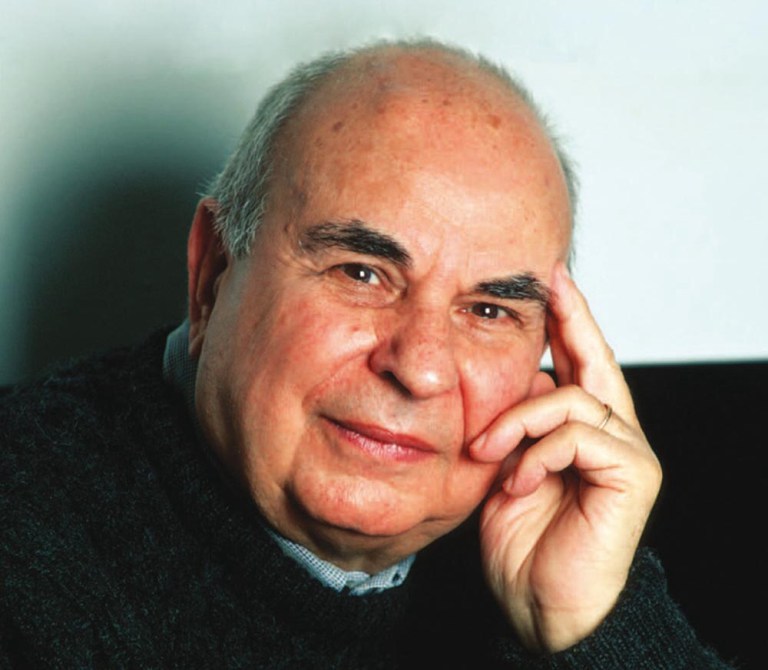
“We are made in the image of God. From all eternity there is present in God a unique mode of existence, which is at the same time Unity and the Person in communion; and we are all called to realize this unity in Christ, when we meet him, under the divided flames of the Spirit. Therefore we express the metaphysics of the person in the language of Trinitarian theology. What could be called the ‘Trinitarian person’ is not the isolated individual of Western society (whose implicit philosophy regards human beings as ‘similar’ but not ‘consubstantial’). Nor is it the absorbed and amalgamated human being of totalitarian society, or the systematized oriental mysticism, or of the sects. It is, and must be, a person in a relationship, in communion. The transition from divine communion to human communion is accomplished in Christ who is consubstantial with the Father and the Spirit in his divinity and consubstantial with us in his humanity. […]
In their expositions of the Trinity, St. Basil and St. Maximus the Confessor emphasize that the Three is not a number (St. Basil spoke in this respect of ‘meta-mathematics’). The divine Persons are not added to one another, they exist in one another: the Father is in the Son and the Son is in the Father, the Spirit is united to the Father together with the Son and ‘completes the blessed Trinity’ as if he were ensuring the circulation of love within it. This circulation of love was called by the Fathers perichoresis, another key word of their spirituality, along with the word we have already met, kenosis. Perichoresis, the exchange of being by which each Person exists only in virtue of his relationship with the others, might be defined as a ‘joyful kenosis’. The kenosis of the Son in history is the extension of the kenosis of the Trinity and allows us to share in it.”
From: The Roots of Christian Mysticism, Texts from the Patristic Era with Commentary, pp. 65-67.
Louth: “The Relationship Between Mystical and Dogmatic Theology”
Posted by Dallas Wolf in Hesychasm - Jesus Prayer, New Nuggets, Theology on October 1, 2016
Andrew Louth (1944 – ) – is a Christian theologian, Eastern Orthodox priest, and Professor of Patristic and Byzantine Studies at the University of Durham, England. He has taught at Durham since 1996, and previously taught at Oxford and the University of London. Louth is an expert in the history and theology of Eastern Christianity.
 “This formative period [1st through 5th centuries] for mystical theology was, of course, the formative period for dogmatic theology, and that the same period was determinative for both mystical and dogmatic theology is no accident since these two aspects of theology are fundamentally bound up with one another. The basic doctrines of the Trinity and Incarnation, worked out in these centuries, are mystical doctrines formulated dogmatically. That is to say, mystical theology provides the context for direct apprehensions of the God who has revealed himself in Christ and dwells within us through the Holy Spirit; while dogmatic theology attempts to incarnate those apprehensions in objectively precise terms which then, in their turn, inspire a mystical understanding of the God who has thus revealed himself which is specifically Christian.
Put like that it is difficult to see how dogmatic and mystical theology could ever have become separated; and yet there is little doubt that, in the West at least, they have so become and that ‘dogmatic and mystical theology, or theology and ‘‘spirituality’’ [have] been set apart in mutually exclusive categories, as if mysticism were for saintly women and theological study were for practical but, alas, unsaintly men’.” From: The Origins of the Christian Mystical Tradition, p. x

