Posts Tagged eastern orthodox tradition
Nous (νοῦς) – “…the highest faculty in man” 3
Posted by Dallas Wolf in The "Nous" (series) on June 18, 2014
“… the noetic energy that functions in the heart of a person that is spiritually healthy.”
Originally, “nous” was understood by ancient (pre-Christian) Greek philosophers, most notably Plato and Aristotle, as man’s highest intellectual faculty. By intellectual faculty, the ancient Greeks did not mean the ability to reason things out to a logical conclusion, but rather the intuitive and immediate grasp of the reality of things. To them, “nous” was more of a direct contact between mind and truth.
The Church Fathers borrowed the term “nous” from Greek philosophy and gave it a distinctive Christian meaning. They used it to refer to the noetic energy that functions in the heart of a person that is spiritually healthy. The “nous” can be used to explain another borrowed concept from philosophy, the Logos Doctrine of the church. Second century Christian apologist Justin Martyr used the spermatikos logos (“seed” of the Word) to explain the universal indwelling presence of the Logos, the Word, or Son of God the Father within every human being (cf. the prologue to the Gospel of John, vv. 1:1-18). The idea of the “nous” also evolved over time among the Fathers. Early use of the term can be ambiguous as some early Fathers used the word “nous” when they were referring to the reasoning rational mind.
According to Orthodox theologian Fr. Michael Pomazansky (in his book, Orthodox Dogmatic Theology), it was the teaching of the overwhelming majority of the Church Fathers that the phrase ‘Image of God’ (cf. Genesis 1:26) refers to man’s soul, more precisely to the highest faculty of the soul, the “nous”. So, man is the “Image” by virtue of the spiritual nature of his “nous”. One common comparison made among patristic writers illustrates the relationship between body and the healthy “nous”. The analogy is that of the body being similar to a horse and the “nous” to the rider guiding and controlling the animal to move in the direction he would have it go.
St. Clement of Alexandria: “Woman has the same spiritual dignity as man.” AD 198
Posted by Dallas Wolf in Patristic Pearls on June 17, 2014
St. Clement of Alexandria (150 CE — bet. 211 and 215) – Christian apologist and missionary theologian to the Hellenistic (Greek cultural) world, and second known leader and teacher of the catechetical School of Alexandria. The most important of his surviving works is a trilogy comprising the Protreptikos (“Exhortation”), the Paidagōgos (“Instructor”), and the Strōmateis (“Miscellanies”).

“Woman has the same spiritual dignity as man. Both of them have the same God, the same Teacher, the same Church. They breathe, see, hear, know, hope, and love in the same way. Beings who have the same life, grace and salvation are called … to the same manner of being.”
~ from: Paedagogus, 1,4
Nous (νοῦς) – “…the highest faculty in man” 4
Posted by Dallas Wolf in The "Nous" (series) on June 17, 2014
” As a consequence of the “Fall”, the “nous” became dissipated and diseased…”
The “nous” in all of humankind was severely injured, diseased, and damaged in the “Adamic Fall” (The “Fall” in the Garden of Eden). The “Fall” is seen as the misuse of free will; of focusing on oneself rather than on God for guidance, wisdom and worship. Free will gave man the right to choose. And choose he did. In the “Fall”, humans shifted their focus from God to themselves (and any number of other idols). As a consequence of the “Fall”, the “nous” became dissipated and diseased, overwhelmed with increasing concerns for individual survival and the needs and desires of the body in the physical, material world. The “nous” became estranged from God’s grace and humankind’s whole nature became sick. This sickness was handed on to later descendants as the inheritance of ancestral sin.
The Orthodox do not understand the “Fall” in legal terms, as Western Christianity does, but rather in medical terms. When Paul says in Romans 5:19, “as by one man’s disobedience many were made sinners,” it is understood in a medical sense, not a legal one. In other words, as a result of one man’s sin, human nature became sick.
The Incarnation and ministry of Jesus Christ is seen as a therapeutic (Greek therapeuo) mission of love from God to humankind in order to heal and restore our fallen sick souls. The key to this is the healing and restoration of the “nous”, the “eye of the heart”. Jesus possessed a complete human nature, not only on the lower side (body) but also on the higher spiritual side, the “nous”. His perfect human nature broke the grip of sin on fallen human nature, opening the possibility of restoring the diseased “nous” of every human being to its spiritual pre-Fall state.
In his book, Orthodox Psychotherapy: the Science of the Fathers, Archimandrite Hierotheos Vlachos (now Metropolitan Hierotheos) quotes Saint Maximus the Confessor (7th century) as saying “The nous functions in accordance with nature when it keeps the passions under control, contemplates the inner essences of created beings, and abides with God.” The “nous” is changed by every conceptual image that it accepts. When the “nous” is in a fallen state, confusion is created in the whole of the spiritual organism of man. In this “fallen” state, the “nous” needs therapy/purification.
St. Symeon the New Theologian: “We bear witness that ‘God is light’…”
Posted by Dallas Wolf in Hesychasm - Jesus Prayer, Monasticism, Patristic Pearls, Theology on June 16, 2014
St. Symeon the New Theologian (949-1022) was a 10th century mystic monk. His many direct experiences of God (theoría) convinced him that all Christians must have an actual baptism of the Holy Spirit in addition to the ritualized water baptism and chrismation of the church. His mystical experiences also taught him that God is always received in the form of divine light. Symeon wrote about that light and its power to transform:
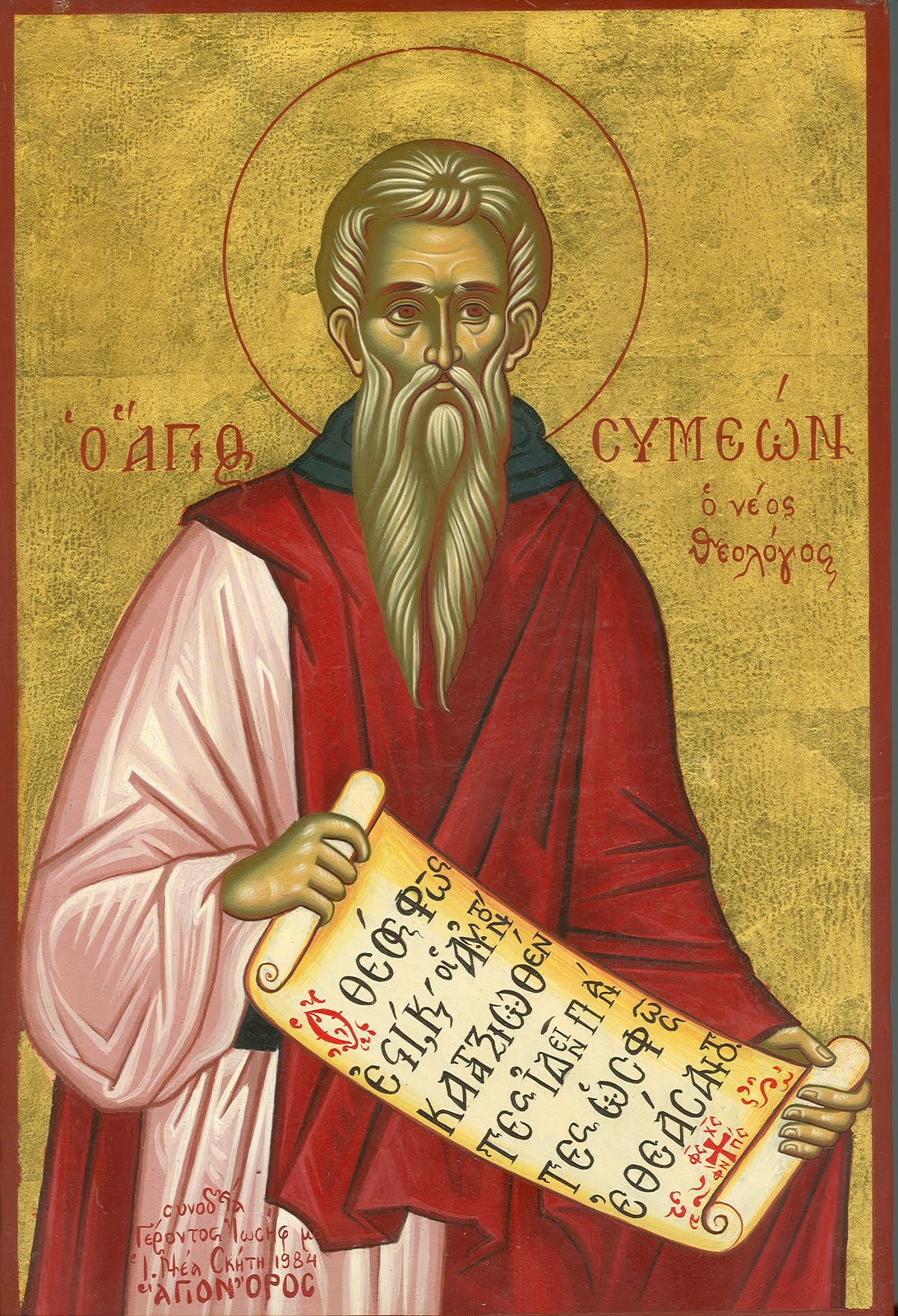
“It shines on us without evening, without change, without alteration, without form. It speaks, works, lives, gives life, and changes into light those whom it illuminates. We bear witness that “God is light,” and those to whom it has been granted to see Him have all beheld Him as light. Those who have seen Him have received Him as light, because the light of His glory goes before Him, and it is impossible for Him to appear without light. Those who have not seen His light have not seen Him, for He is the light, and those who have not received the light have not yet received grace. Those who have received grace have received the light of God and have received God, even as Christ Himself, who is the Light, has said, “I will live in them and move among them.” (2 Cor. 6:16)
~ from: Discourses, No. XXVIII
Nous (νοῦς) – “…the highest faculty in man” 5
Posted by Dallas Wolf in The "Nous" (series) on June 16, 2014
“The aim is to restore the pre-Fall health of the ‘nous’…”
St. John of Damascus (8th century) says that the “nous” is the eye of the soul. The essence of the soul is the heart (kardia). The “nous” is that part of the soul that sees things most clearly and so it is important that it be purified of any impediment. When the healthy “nous”, the purest noetic power of the soul, is returned to its rightful place in the heart, it is then again capable of experiencing God’s presence through grace. It is this unification or return of the “nous” to the heart that constitutes the cure of the “nous”.
In “Orthodox Psychotherapy“, Hierotheos (Vlachos) speaks of the Church as a hospital which exists to heal those who are sick with sin. That is, to restore to health the diseased and dissipated “nous”, made sick by the “Fall”. The first step is to guard and protect the “nous” so that it can realize its origin in the “Image of God”. Then it can begin to be purified and restored to its intended role of leading the entire human being in “attaining to the likeness of God (cf. Gen. 1:26), or “deification” (theosis). In order to restore the diseased “nous” to this healthy state, it must first pass through a stage of purification. The church’s therapeutic work takes place in this stage of purification.
The “nous” can only be purified with the help of the Holy Spirit. For this reason, it is imperative that every believer be baptized in the Holy Spirit (cf. St. Symeon the New Theologian) and experience His indwelling presence. Through a regimen of self-discipline called ascesis (borrowed from the Greek word askesis, meaning athletic exercise or training), the “nous” can be purified and eventually healed. This only happens as a result of our active cooperation (synergeía) in this work with the Holy Spirit. The first result of this healing of the “nous” is a state which is called dispassion (apatheia) or a release of the “nous” from the influence and distraction of human passions and emotion. Real theology (i.e., a mystical experience of God) is another result, as are an authentic self-knowledge and an accompanying sense of freedom and joy.
Nous (νοῦς) – “…the highest faculty in man” 6
Posted by Dallas Wolf in The "Nous" (series) on June 15, 2014
“In Illumination, a vision of God is granted to the now-healed “nous”.”
When the “nous” is healed and restored, it is no longer dissipated among all the various senses and distractions of this world but is able instead to retire within itself to attain to a vision of God (theoria). A purified “nous” can be illuminated by grace, seeing the glory of Christ reflected in itself and seeing spiritual things clearly. In Illumination, a vision of God is granted to the now-healed “nous”. This vision of God is of His manifested energy (energeía), not His essence (oúsia), which remains beyond human conception and unknowable.
This is the spiritual development process of the early church: purification (katharsis), followed by illumination (theoria), culminating in deification (theosis). These three stages are the purpose of the mystical life of the church.
The manner of healing the “nous” is outlined by Hierotheos (Vlachos) in “Orthodox Psychotherapy“: First, the guarding of the “nous”; second, the purifying of the “nous”; and third, the returning of the “nous” to the heart through the practice (ascesis) of repentance and noetic contemplative prayer so that the “nous” might finally be illuminated by the “divine light” of God’s grace.
This noetic contemplative prayer is the Primitive Christian Prayer tradition of Jesus, Paul and the early church. This, Hierotheos assures us, is the common experience and teaching of the Church Fathers. They may have sometimes differed from one another as they sought to describe this common experience, but the variations in how they expressed themselves should be seen as just that. The true problem may not even be in their expression but in our interpretation; fragmented, locked into a rational modern worldview, and lacking in spiritual understanding as we are in comparison with them.
In closing this discussion of the “nous”, I return us to the point I made at the beginning of this series. Modern Western culture has virtually deified the rational, reasoning mind and intellect over the past 500 years. So thorough is our fixation and obsession with the rational mind, that any other conception of mind or intellect, such as “nous”, is virtually unknown, even within the church.
It is no wonder that we operate at such a low level of spiritual consciousness. But, now you know about your “nous”, the ‘eye of your soul’. You also now know about the 2,000 year Christian tradition of the healing of the “nous” and “attaining to the likeness of God”. So, what will you do now that you’ve discovered your “nous”?
Contemplative Primitive Christian Prayer 1
Posted by Dallas Wolf in Contemplative Prayer (series) on June 13, 2014
“after the fire a still small voice”. ~ 1 Kings 19:12
1 Kings 19 talks about Elijah running from a very evil queen Jezebel. God wants to talk with Elijah and Elijah experiences a great wind, an earthquake, and a fire, yet he does not hear the voice of God. He hears it in a “still small voice” or as the Greek Septuagint has it, “φωνὴ αὔρας λεπτῆς”, “a sound minute and poor”.
We can only hear “a sound minute and poor” when we ourselves are quiet, still, and attentive. We need to be calm in spirit, ignoring the endless blather of our own mind, and open to the moment without expectation or judgment. That is contemplation. It is how Jesus spent most of his time “praying”. It is what the early church meant by prayer.
Western Latin Christianity (Roman Catholicism) completely lost their contemplative prayer tradition by the rational argumentation of the Reformation of the 16th century and the rational intellectual revolution of the Enlightenment of 17th century. Protestantism never had a contemplative prayer tradition.
The bad news is that we in the West have no idea how to pray as Jesus prayed. The good news is that the tradition of contemplative prayer is being re-discovered in the West and has always been available in the Eastern Orthodox tradition of “hesychasm” to anyone motivated to quiet themselves and seek it.
Contemplative Primitive Christian Prayer 3
Posted by Dallas Wolf in Contemplative Prayer (series) on June 11, 2014
“a higher state still” ~ John Cassian, ca. AD 400
In this discussion over the next few posts, I will quote recognized Church Fathers from the early centuries of the Church in order to introduce the Primitive Christian Prayer tradition to a mostly Protestant audience. The reason for this is simple: it’s a prayer tradition that we Protestants do not have and never had; it had virtually disappeared from the institutional Roman Catholic Church by the time of the Protestant Reformation.
To the modern Roman Catholic and Protestant believer, prayer is usually broken down into five basic types: Blessing and Adoration, Petition, Intercession, Thanksgiving, and Praise (cf. Catechism of the Roman Catholic Church).
John Cassian (c. 350 – c.435) was a Christian mystic who spent 15 years in the Egyptian Desert with the Desert Fathers and Mothers of the 4th century. Highly educated, he was equally comfortable writing in either Greek or Latin. He tells us that Primitive Christian Prayer went well past the types we recognize today:
“The various kinds of prayer [cf. 1 Tim. 2:1; petition, prayer (i.e., praise), intercessions, thanksgiving] are followed by a higher state still… it is the contemplation of God alone, an immeasurable fire of love. The soul settles in it and sinks into its depths” (Conferences, IX, 18).
Contemplative Primitive Christian Prayer 5
Posted by Dallas Wolf in Contemplative Prayer (series) on June 9, 2014
“then he will see the mind appear similar to sapphire or to the color of the sky.” Evagrius Ponticus, 4th century
This state of a quieted soul, what Evagrius calls a state of “dispassion” [apatheia] is very difficult to achieve. Dispassion was difficult enough in the isolation of the 4th century Egyptian desert (it took years of practice to achieve) and it is infinitely more difficult for us in the modern world. First of all, unlike the people of Evagrius’s time, we are culturally conditioned to respect and use only our rational intellect, which is not the part of us that ascends to the Lord in prayer (see the note on the “nous”, below). Second, we are also the most over stimulated people in history; if not with the endless chatter of our own self-centered desires and judgments, then certainly with the distractions of the modern world trying to capture our attention moment by moment with dazzling technology.
Again, in “On Prayer”, Evagrius tells us: “The state of prayer is one of dispassion [apatheia], which by virtue of the most intense love [agape] transports to the noetic realm the spirit [nous] that longs for wisdom. He who wishes to pray truly must not only control his incensive power [“thumos”- irascible faculty, anger] and his desire [epithumia], but must also free himself from every impassioned thought.” If we wish to reach that state beyond normal prayer, that “higher state” described by John Cassian, Evagrius advises us that, “If one wishes to see the state (katastasis) of the mind (nous) [referring to the state of contemplation, pure prayer, “gnosis”], let him deprive himself of all representations (noemata), and then he will see the mind appear similar to sapphire or to the color of the sky. But to do that without being passionless (apatheia) is impossible, for one must have the assistance of God who breathes into him the kindred light.”
This is ancient foundational Primitive Christian Prayer to which the early church aspired and practiced. This is praying like Jesus and Paul prayed.
*The nous is the “image of God” present in the consciousness of every human. It is the highest faculty of the human soul. The notion of man being created in the “image of God” is a constant throughout Christian theology and spirituality deriving from the creation story of Genesis 1. Note that the idea of “nous” has been totally lost to the Western world, where it has been completely subsumed by our obsession with the “rational intellect” since the Reformation and Enlightenment.
Contemplative Primitive Christian Prayer 7
Posted by Dallas Wolf in Contemplative Prayer (series) on June 7, 2014
“This disposition is accompanied by interior tears, then by a sort of fullness, eager for silence.” ~ Diadochus of Photike, 5th century
We now turn back to John Cassian (ca. AD 400), who tells us how to pray like the Desert Fathers and Mothers:
“We have to take particular care to follow the Gospel precept that bids us go into our inner room and shut the door to pray to our Father.
This is how to do it.
We are praying in our inner room when we withdraw our heart completely from the clamor of our thoughts and preoccupations, and in a kind of secret dialogue, as between intimate friends, we lay bare our desires before the Lord.
We are praying with our door shut when, without opening our mouth, we call on the One who takes no account of words but considers the heart.
We are praying in secret when we speak to God with the heart alone and with concentration of the soul, and make known our state of mind to him alone, in such a way that even the enemy powers themselves cannot guess their nature. Such is the reason for the deep silence that it behooves us to keep in prayer…” (Conferences, IX)
Diadochus of Photike from the 5th century (AD 400’s) is one of the principal spiritual authorities of the Orthodox East. He was one of the first to mention the use of the famous “Jesus Prayer”, which remains one of the primary mystic tools of the Orthodox contemplative tradition of hesychasm (silence, quietude) to this day. Diadochus describes the presence of the Holy Spirit in contemplative prayer and the need for silence:
“When the Holy Spirit acts in the soul he sings psalms and prays with complete relaxation and sweetness in the secret places of the heart. This disposition is accompanied by interior tears, then by a sort of fullness, eager for silence.” Gnostic Chapters, 73
The tricky thing about contemplative Primitive Christian Prayer is that if you think you’re doing it right, you clearly aren’t! By thinking you’re doing it right, by making that judgment, you have made prayer into a dualistic contest, a worthiness exercise. That makes you guilty of “philautia” (φιλαυτία), self-centeredness, the root of all of the deadly sins and the greatest hindrance to pure prayer, at least according to Evagrius Ponticus!
 First Thoughts