The Seven Sacraments, or Mysteries of the Christian Church
Posted by Dallas Wolf in Ekklesia and church, New Nuggets, Theology on April 2, 2025
The inward life of the Christian Church is mystical (or sacramental). The word “mysteries” (Greek mysteria) is the term used in the Orthodox East; “sacraments” (Latin sacramenta), the term used in the Latin West. So, how and when did Western Latin and Eastern Orthodox come to identify and accept the seven sacraments, or mysteries of the Christian Church?
One might reasonably assume that the seven Sacraments (Mysteries) were determined early in the period of the united Church (AD 33 – 1054). That assumption would be false.
One of the renowned teachers of the united Church, Pseudo-Dionysius the Areopagite (6th Century) listed six sacraments in his work The Ecclesiastical Hierarchy (ca. AD 500): baptism, Eucharist, confirmation, priesthood, the consecration of monks, and rites for the dead.
Two centuries later, another early teacher revered East and West, John of Damascus (675-749), mentions only two sacraments: Baptism together with the corresponding chrismation and the Eucharist (Communion), the only two mysteries identified in the New Testament and instituted by Jesus.
Clearly, there was no unanimity on the identity or number of sacraments/mysteries in the first 1,000 years of the unified Christian Church, nor at the time of the Great East-West Schism of 1054.
In the post-Schism Latin West, Peter Lombard (1100-1164), in his fourth Book of Sentences (d.ii, n.1), enumerated the seven sacraments. This list of sacraments was accepted by the Western Latin Roman Church at the Fourth Lateran Council in 1215.
49 years later, during the Second Ecumenical Council of Lyons in 1274, Eastern Greek theologians, under Byzantine Emperor Michael VIII Palaiologos (in his Profession of Faith), accepted the seven Latin Sacraments: Baptism, Confirmation (Chrismation), Eucharist, Penance, Priesthood, Marriage, and Anointing of the Sick.
So, clearly, neither the Seven Holy Sacraments of the Roman Catholic Church nor the Seven Holy Mysteries of the Eastern Orthodox Church are First Thoughts of God, but mostly, save two, distant Afterthoughts of Man, codified a thousand years after Jesus and the Apostolic age.
New Testament “Love”
Posted by Dallas Wolf in New Nuggets, Theology on March 31, 2025
Koine (common) Greek, the Greek of the New Testament, is often much more specific than English. This is important for those wanting to understand exactly what the New Testament means. An example of this specificity is the Koine Greek words used to describe the word “love.”
In English, the word “love” can be applied to a variety of types of love. “Love” can apply to feelings toward a spouse, parents, siblings, strangers, or even a cup of coffee. Koine Greek, however, uses a specific word for each type of love. Here are the Greek words that were used during Christ’s time to convey the different meanings of the word “Love”:
- Eros (ἔρως): Refers to romantic love felt towards one’s spouse or lover. This Greek term is where the word “erotic” is derived from. The word “Eros” is not actually used in either the Old or New Testaments.
- Phileo (φιλέω): Refers to feelings one has towards close friends; “brotherly love”. This word was used in the New Testament to describe Jesus’ love for his disciples (John 20:2) and for Lazarus (John 11:3).
- Agape (ἀγάπη): Sometimes called “God’s kind of love”. This is the kind of love that we should have for all men, and also for our enemies. It is a selfless kind of love that Christians must have in regard to acting in the best interest for all human beings. “But I say unto you, love your enemies, bless them that curse you, do good to them that hate you, and pray for them which despitefully use you, and persecute you;” (Matthew 5:44).
- Storge (στοργή): This Greek word refers to love we have for our parents, siblings, our children and other members of our family. Paul used this word in the negative in Romans 1:31 when he described the pagans that he was in contact with as being without “natural affection.”
Kenosis: “… but emptied himself [ἐκένωσεν (ekénōsen)], taking the form of a slave,…”
Posted by Dallas Wolf in First Thoughts, Patristic Pearls, The Holy Trinity, Theology on March 31, 2025
Philippians 2:6-11 is probably one of the earliest Christian hymns ever recorded. Within the hymn are the words, “who, though he was in the form of God, did not regard equality with God as something to be exploited, but emptied himself, taking the form of a slave, being born in human likeness.” (Phil 2:6,7). This part of the hymn describes how Christ humbled himself in his divinity in obedience to the will and desire of God in an act of selfless sacrifice, even to death on a Cross, for the salvation and redemption of mankind. It is a powerful image.
The term kenosis comes from the Greek κενόω (kenóō), meaning “to empty out”. When talking about how Christ “emptied himself” in Philippians 2:7, the Greek word used is ἐκένωσεν (ekénōsen). It is the only time the word appears in the New Testament.
The fact that Christ was willing and able to “empty himself” in order to do the will of God the Father is key to His success as both savior and redeemer. Without this “kenosis”, He could not have done, or been either.
Human Institutions
Posted by Dallas Wolf in Ekklesia and church, New Nuggets on March 31, 2025
Nothing on earth has a stronger amoral drive for survival than a human institution; secular or religious.
Woman Wisdom: Chokmah, Sophia, Wisdom in the Old Testament
Posted by Dallas Wolf in Ekklesia and church, First Thoughts, Theology, Women in Early Christianity on March 29, 2025
“Woman Wisdom” was well established in the Hebrew literature of the Old Testament long before the New Testament era. The patriarchal (some might say misogynistic) leaders of the post-Apostolic Christian Church, especially after the 2nd century, so completely suppressed this idea of the feminine personification of God, that they had to invent the cult of Mary in the 5th and 6th centuries to redress the obvious, embarrassing imbalance!
If you want to explore the beautiful ancient Hebrew tradition of the Feminine emanation of the Godhead (called Chokmah in Hebrew, Sophia in Greek, and Wisdom in English), try the following:
- Proverbs 1-9, (10th c. BC)
- Sirach (AKA Ecclestiasticus) 24, (200-175 BC)
- Wisdom of Solomon 7-9, (100 BC-100 AD)
In the interest of full disclosure, my male noetic intuition has always experienced both Wisdom (Chokmah) and the Holy Spirit (Ruach) as female. In case you think that’s in error or heretical, let me point out that in Hebrew both Chokmah and Ruach are feminine nouns.
Nous: Noesis and Dianoia
Posted by Dallas Wolf in First Thoughts, The "Nous" (series) on March 26, 2025
Noesis refers to immediate, intuitive understanding or insight, while dianoia involves discursive thinking, particularly in mathematical and technical contexts. Essentially, noesis is about direct apprehension, whereas dianoia is a more analytical and reasoned thought process.
In the Christian Latin West, the Enlightenment (17th – early 19th century) enthroned and focused almost entirely on the discursive, analytical, reasoning mind. So complete was that focus on the sensory, reasoning faculty (dianoia), that it literally came to define “mind” in the Western world. It still does.
The Greek East, although influenced heavily by the Enlightenment, did not lose their ancient distinction between noesis, direct apprehension, and dianoia, reasoned thought. To them, mind was “nous” (a term unknown in the West), and included both the noetic and the dianoetic faculties of the human mind.
In Eastern Christian culture, the noetic faculty is considered more mature than the dianoetic, because by noesis humans can instantly and intuitively apprehend God and truth of things spiritual whereas dianoia is focused on a dualistic understanding of the material, sensory world. It is no accident that noesis and dianoia both share the same Greek root; nous.
So, I guess one could say that both the Latin West and Greek East defined “mind” correctly; the West just lost the better half of theirs.
Thecla: A Visual Example of Early Christian Equality and Later Inequality of Women
Posted by Dallas Wolf in Ekklesia and church, Women in Early Christianity on March 24, 2025
Desecration

“In 1906 a small cave was discovered cut into the rock on the northern slope of Bülbül Dag, high above the ruins of ancient Ephesus, just off the mid-Aegean coast of Turkey. To the right of the entrance and beneath layers of plaster, Karl Herold of the Austrian Archaeological Institute uncovered two sixth-century images of Saint Theoklia [sic, Thecla] and Saint Paul. They both have the same height and are therefore iconographically of equal importance.
They both have their right hands raised in teaching gesture and are therefore iconographically of equal authority. But while the eyes and upraised hand of Paul are untouched, some later person scratched out the eyes and erased the upraised hand of Theoklia. If the eyes of both images had been disfigured, it would be simply another example of iconoclastic antagonism since that was believed to negate the spiritual power of an icon without having to destroy it completely. But here only Theoklia’s eyes and her authoritative hand are destroyed. Original imagery and defaced imagery represent a fundamental clash of theology. An earlier image in which Theoklia and Paul were equally authoritative apostolic figures has been replaced by one in which the male is apostolic and authoritative and the female is blinded and silenced. And even the cave-room’s present name, St. Paul’s Grotto, continues that elimination of female-male equality once depicted on its walls.
We take that original assertion of equality and later counter-assertion of inequality as encapsulating visually the central claim of this book in terms of Christianity itself. The authentic and historical Paul, author of the seven New Testament letters he actually wrote, held that within Christian communities, it made no difference whether one entered as a Christian Jew or a Christian pagan, as a Christian man or a Christian woman, as a Christian freeborn or a Christian slave. All were absolutely equal with each other. But in 1 Timothy, a letter attributed to Paul by later Christians but not actually written by him, women are told to be silent in church and pregnant at home (2:8-15). And a later follower of Paul inserted in 1 Corinthians that it is shameful for women to speak in church but correct to ask their husbands for explanations at home (14:33-36).
Those pseudo-Pauline, post-Pauline, and anti-Pauline obliterations of female authority are the verbal and canonical equivalent of that visual and iconographic obliteration of Theoklia’s eyes and hand in that hillside cave. But both defacements also bear witness to what was there before the attack.”
Quote excerpted from: In Search of Paul: How Jesus’s Apostle Opposed Rome’s Empire with God’s Kingdom by John Dominic Crossan and Johnathan L. Reed, 2004, HarperCollins, NY, NY. pp. xxii-xiii
____________________________________________________________________________________
Restoration
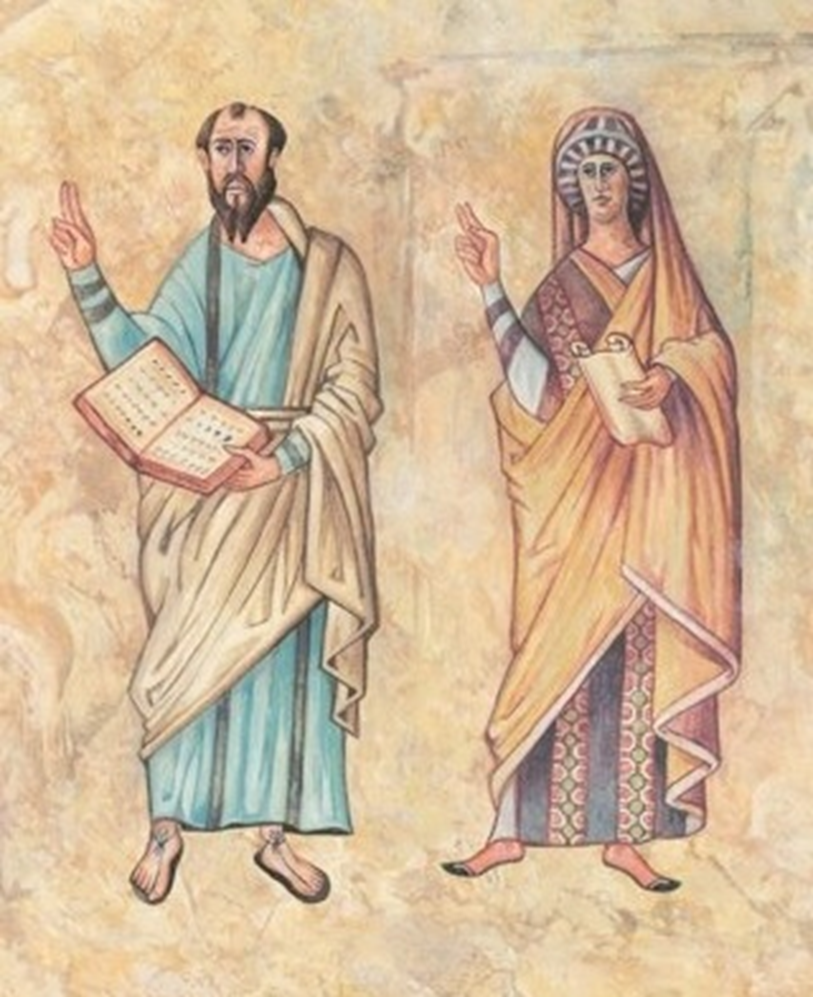
An artist’s creative restoration of that frescoed point-counterpoint from the Cave or Grotto of St. Paul at Ephesus.
Paul is just as the church’s post-Pauline tradition has always placed him. Theoclia is of equal height, but now with open eyes intact and upraised hand untouched as she was depicted in the sixth century.
Silence
Posted by Dallas Wolf in Ekklesia and church, Hesychasm - Jesus Prayer, Theology on March 24, 2025

“No wonder that silence is probably the foundational spiritual discipline in all the world’s religions at the more mature levels. At the less mature levels, religion is mostly noise, entertainment, and words. Catholics and Orthodox Christians prefer theatre and wordy symbols; Protestants prefer music and endless sermons.”
The Women Disciples of Jesus
Posted by Dallas Wolf in Ekklesia and church, Women in Early Christianity on March 22, 2025
Christianity most often focuses on the twelve male disciples as followers of Jesus. We most often overlook the women who followed Jesus. Luke tells us that there were a large group of women who were also followers of Jesus. In fact, Luke lists the women along with the disciples.
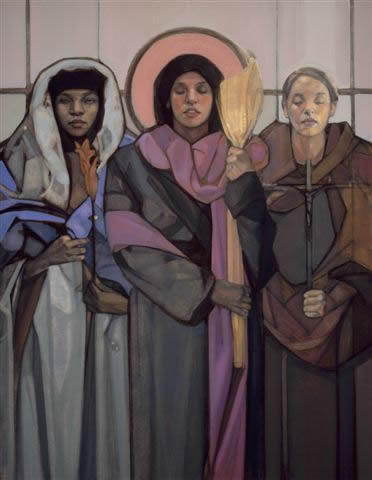
8:1 Soon afterwards he went on through cities and villages, proclaiming and bringing the good news of the kingdom of God. The twelve were with him, 8:2 as well as some women who had been cured of evil spirits and infirmities: Mary, called Magdalene, from whom seven demons had gone out, 8:3 and Joanna, the wife of Herod’s steward Chuza, and Susanna, and many others, who provided for them out of their resources.
Mark tells us that the women at the cross were among those who followed Jesus and provided for him.
15:40 There were also women looking on from a distance; among them were Mary Magdalene, and Mary the mother of James the younger and of Joses, and Salome. 15:41 These used to follow him and provided for him when he was in Galilee; and there were many other women who had come up with him to Jerusalem.
Matthew also tells us of women followers at the cross and later at the tomb (cf. John 19:25).
27:55 Many women were also there, looking on from a distance; they had followed Jesus from Galilee and had provided for him. 27:56 Among them were Mary Magdalene, and Mary the mother of James and Joseph, and the mother of the sons of Zebedee. . .
These women “provided for them out of their resources” (Luke 8:3). “Provided” [Gk: diakoneo] means “to serve, wait on, minister to as deacon,” and it was used in the early Christian community to describe “eucharistic table service and proclamation of the word” (Jane Schaberg, Women’s Bible Commentary, 376).
Mary Magdalene “was a prominent disciple of Jesus who followed him in Galilee and to Jerusalem. She is always listed first in groups of named female disciples” (The Dictionary of Jesus and the Gospels, 884). She is mentioned in all four Gospel accounts of Jesus’ crucifixion. Mary was one of the women Luke named in chapter 8, not only following Jesus, but serving him from her own means. She stood at the cross with the other woman and saw where Jesus was buried. She was the first to see the Risen Christ. She became known as the “apostle to the apostles”.
In all the Gospel accounts women are the first to the tomb Sunday morning, and they are the first to see the risen Christ and commanded to carry the good news to the disciples. In all four accounts different women are named, but one name is constant in all four gospels: Mary Magdalene. She was the first preacher of the good news of the resurrection to the male disciples.
The tradition that Christ appeared first to women was well established by the end of the second century when Celsus, a pagan critic, discounted the gospel and resurrection by saying that an account given by a hysterical woman could not be trusted (cf. Luke 24:11). Origen, an Early Church Father, responded by saying that there was more than one woman who witnessed the risen Christ, and that none of them were hysterical in the Gospels.
It is ironic, with the low status of women in the Greco-Roman world of that day, that Jesus chose to appear to Mary and the other women; and that “the first Christian preachers of the Resurrection were not men, but women!” (The Dictionary of Jesus and the Gospels, 883).
Jesus did not first appear to the “rock” of the church, Peter, or even to the beloved disciple, John. He appeared to Mary and the women who followed him and served him. Mary saw him first, and she received the central tenet of the Christian faith: “He is risen!” She was the first to proclaim the good news, or gospel, of the resurrection. That he appeared to Mary first can only mean that this was by divine appointment and was a deliberate act on His part.
________________________________________________________________________________
Shawna Renee Bound, “Women in the Gospels” in Your Daughters Shall Prophesy: A Biblical Theology of Single Women in Ministry, unpublished thesis, (Copyright © 2002 by Shawna Renee Bound).
Dictionary of Jesus and the Gospels (Downers Grove, IL: InterVarsity Press, 1992).
Gail R. O’Day, “John” in the Women’s Bible Commentary, exp. ed., eds. Carol A. Newsome and Sharon H. Ringe (Louisville: Westminster John Knox Press, 1998).
Jane Schaberg, “Luke” in the Women’s Bible Commentary, exp. ed., eds. Carol A. Newsome and Sharon H. Ringe (Louisville: Westminster John Knox Press, 1998).
Women Serving in the “5 Ministries” of the 1st Century Church
Posted by Dallas Wolf in Ekklesia and church, Women in Early Christianity on March 22, 2025
Ephesians 4:11-13 outlines the five ministries in the 1st Century Church:
“It was he [Christ] who gave some to be apostles, some to be prophets, some to be evangelists, and some to be shepherds (pastors) and teachers, to prepare God’s people for works of service, so that the body of Christ may be built up until we all reach unity in the faith and in the knowledge of the Son of God and become mature, attaining to the whole measure of the fullness of Christ.”
Apostle
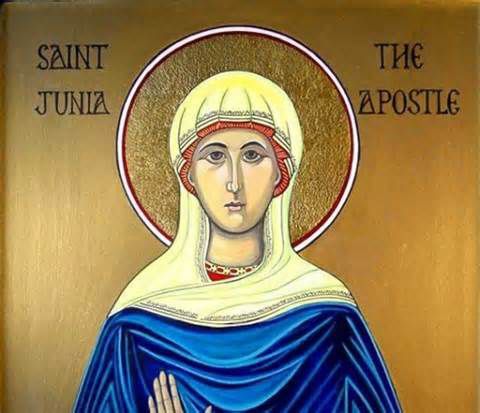
Junia was considered an Apostle by St. Paul, as was her husband Andronicus (cf. Romans 16:7). The King James Version sounds ambivalent in calling them “of note among the apostles”. The New Revised Standard Version (which I consider usually the most accurate of all translations) has: “They are prominent among the apostles.” The New Century Version probably translates it best: “They are very important apostles.” In the Middle Ages, some writers, because of male chauvinist prejudices, changed “Junia” to “Junias”, making her a man. But, “Junias” was never known as a man’s name in the Graeco-Roman world, while “Junia” was a common name for a woman!
Prophet
Philip’s four daughters were named as prophets (cf. Acts 21:9, also Acts 2:15-18).
Shepherd (Pastor is a later Latin word) and Teacher
Phoebe is recognized as diakonon (minister) of the church at Cenchrea (cf. Rom. 16:1-2). She is referred to as a deacon (Greek: diakonos), not a deaconess — but a deacon in the sense of a preacher, a minister; because Paul uses the same word to describe himself. He calls himself, in a number of instances, a deacon of the new covenant in 2 Corinthians.
Prisca/Priscilla was certainly both a shepherd (pastor) and a teacher in the church, with Aquila her partner, in their house (cf. Acts 18:26, Rom 16:3-5). The German scholar Adolph von Harnack proposed that she was the actual author of the Epistle to the Hebrews!
Evangelist
There is no woman named as an evangelist in the New Testament canon. Only one man is so named, Philip (Acts 21.9). But church history of the first century knows of women evangelists, the most prominent of whom was Thecla, from Iconium in what is now Turkey (St. Thecla’s tomb is at Silifke). She was a disciple of Paul. “The Acts of Paul and Thecla,” while not belonging in the canon of Scripture, is regarded as an accurate historical account of her ministry. The Greek Church gives her title of “Protomartyr among women and equal to the Apostles”.
So, the New Testament names women as occupying four of the five-fold ministries of Ephesians 4 and apostolic church history clearly documents a woman serving in the fifth ministry.

