Archive for category Ekklesia and church
Prayer Ropes and Rosaries
Posted by Dallas Wolf in Ekklesia and church, Hesychasm - Jesus Prayer, Monasticism, New Nuggets, Patristic Pearls on December 21, 2024
Both the prayer rope and the rosary are revered traditional aids to Christian prayer, yet each has its own unique origin, symbolism, and devotional use.

The Prayer Rope, now largely associated with the Eastern Orthodox Church, is a loop of knots (each knot containing seven crosses), usually made of wool, that is used to focus and intensify prayer, particularly the Jesus Prayer. It acts as a physical guide for a repeated, meditative style of prayer, allowing practitioners to keep count while reflecting and meditating. The prayer rope has its beginnings in early fourth century Christian monasticism in the Egyptian Desert, where it was devised as a tool to aid in the ascetic practice of continuous prayer (1 Thes. 5:17).
Origins: The prayer rope is known as a ‘komboskini’ in Greek and ‘chotki’ in Russian. The prayer rope owes its origins to St. Pachomius the Great, a fourth century “Desert Father” in upper Egypt and founder of cenobitic monasticism (a monastic tradition that stresses community life, over the older, eremitic, or solitary tradition). St. Pachomius established the prayer rope as a practical solution for the monks under his supervision to count prayers and prostrations consistently. The prayer rope evolved as a useful instrument for monks to keep track of their prayers, particularly the Jesus Prayer, without distraction. It gradually took on a deeper spiritual value, with each knot symbolizing a request for mercy and humility.
Symbolic Significance: Wool knots, each knot containing seven crosses, are commonly used on traditional prayer ropes to represent Christ’s flock and the shepherd’s care. The number of knots in a prayer rope varies; typically 33 (Christ’s age at crucifixion), 50, or 100.
Traditional Use: In Orthodox Christian practice, the prayer rope is typically used for private prayer in reciting the Jesus Prayer, acting as a physical and spiritual guide to help the mind (nous) and heart concentrate on prayer.

The Rosary, strongly associated with the Roman Catholic Church, is a string of beads that ends with a crucifix and is used to guide Catholics through a sequence of prayers that reflect on the lives of Christ and the Virgin Mary. Each bead signifies a specific prayer, such as the Hail Mary, and each set of beads makes a ‘decade’ that corresponds to a mystery in Christ’s life. The rosary has a long history, dating back to the Middle Ages when it first arose as a popular form of laity devotion, eventually becoming a prominent practice in Catholic piety.
Origins: The rosary is typically identified with Saint Dominic in the early 13th century. The rosary began as a simple way for lay people to join in the monastic practice of reciting the Psalms, but has since evolved into a systematic form of prayer. The rosary prayers are split into decades, each with ten Hail Marys, an Our Father, and a Glory Be, and are frequently accompanied by meditations on the Mysteries of the Rosary.
Symbolic Significance: Each rosary bead represents a prayer as well as a step in the meditation journey through Jesus Christ’s and the Virgin Mary’s lives. The rosary culminates with a crucifix, which represents Christ’s sacrifice.
Traditional Use: Roman Catholics utilize the rosary for both personal meditation and social worship. It is frequently prayed privately for personal spiritual development or in groups for social objectives and celebrations.
Rohr: Power, Prestige, and Possessions; Major Obstacles to the Reign of God
Posted by Dallas Wolf in Ekklesia and church, New Nuggets on November 28, 2024
Fr. Richard Rohr – is a Franciscan priest, Christian mystic, and teacher of Ancient Christian Contemplative Prayer. He is the founding Director of the Center for Action and Contemplation in Albuquerque, NM.

In Jesus’s consistent teaching and in Mary’s great Magnificat, both say that there are three major obstacles to the coming of the reign of God. I call them the three P’s: power, prestige and possessions. Mary refers to them as “the proud,” “the mighty on thrones” and “the rich.” These, she says, God is “routing,” “pulling down” and “sending away empty.” (This great prayer of Mary was considered so subversive by the Argentine government that they banned it from public recitation at protest marches!) We can easily take nine-tenths of Jesus’s teachings and very clearly align it under one of those three categories: Our attachments to power, prestige and possessions are obstacles to God’s coming. Why could we not see that?
—from the book Preparing for Christmas: Daily Meditations for Advent
by Richard Rohr
The “Icon Corner”
Posted by Dallas Wolf in Contemplative Prayer (series), Ekklesia and church, First Thoughts, Hesychasm - Jesus Prayer, Monasticism on November 21, 2024

The Book of Acts and the Epistles of the Apostle Paul record that in the early Church, Christians used to meet in the homes of the faithful. This tradition of the House church assembly continues to this day in Eastern Christianity. An Orthodox Christian is expected to pray constantly. Thus the house, just like the Temple (church building), is considered to be a consecrated place. The center of worship in the house is the icon corner (Greek: εικονοστάσι, iconostási).
An icon corner is normally oriented to face east. It is often located in a corner to eliminate worldly distractions and allow prayer to be more concentrated. Here is where the family’s icons were located and displayed. From the earliest days, Light has been an important part of Christian worship. It not only provides a beautiful and calming ambience; it takes on a theological significance with Christ as the Light of the World. Thus, oil lamps and candles frequently illuminate the icons in the icon corner.
In the theology of Orthodox iconography, the prayers and veneration directed to the icons are passed on to the prototype—the person depicted in the image. For, as St. John of Damascus wrote, “we do not worship paint or wood, we do not worship matter; we worship the God who created matter, who became matter (flesh) for our sake“.
The icons in the icon corner also remind us of the declaration in Hebrews 12:1, that “we are surrounded by so great a cloud of witnesses“; so we need never pray alone. We venerate these witnesses through their icons, petition them and join them in prayer and worship of our Triune God.
St. Gregory of Nyssa: “Epektasis (ἐπέκτασις)- The soul’s eternal ‘straining toward’ God”.
Posted by Dallas Wolf in Ekklesia and church, First Thoughts, Monasticism, Patristic Pearls, The Cappadocians, Theology on April 20, 2023
“Brothers, I do not yet reckon myself to have seized hold, save of one thing: Both forgetting the things lying behind and also stretching out [ἐπεκτεινόμενος] to the things lying ahead,”
Philippians 3:13 from The New Testament- a translation by David Bentley Hart
_________________________________________________________________________
Background – A Brief Summary of Gregory of Nyssa’s Theology
In Gregory’s account of creation, the nature-energies distinction, developed to counter Eunomius, a defender of the 4th century Arian heresy, becomes extended into a general cosmological principle.
To Gregory, the essence of God is incomprehensible, transcendent, and cannot be defined by any set of human concepts. When speaking of God’s essence, or ousia, all that can be said is what that essence is not (Against Eunomius II, IV). In saying this, Gregory anticipates the via negativa (apophatic) theology of Pseudo-Dionysius (5th century) and much of subsequent Orthodox theological thought.

If God is simply some transcendent, unknowable entity, what possible relation to the world could God ever have? Gregory answers these questions by distinguishing between God’s “nature” (phusis) and God’s “energies” (energeiai). God’s energies are the projection of the divine nature into the world; initially creating it and ultimately guiding it to its appointed destination (Beatitudes VI). The idea of God’s energies in Gregory’s theology emphasizes God’s actual presence in those parts of creation which are perfected just because of that presence. Whereas God’s nature is totally transcendent and unknowable, God’s energies are immanent and knowable to mankind. With this revelation, Gregory anticipates the more famous substance-energies distinction of the 14th century Byzantine theologian Gregory Palamas.
Gregory’s view of human nature is dominated by his belief that humans were created in the image of God. This means that because God’s transcendent nature projects energies out into the world, we would expect the same structural relationship to exist in human beings between their minds and their bodies. In fact, that is precisely what Gregory argues concerning the human nous (a word that was traditionally translated as “mind”, but by the 4th century included the Christian idea of its nature also extending beyond and separate from the physical world).
The most important characteristic of the nature of the nous is that it provides for a unity of consciousness; where the myriad perceptions from various sense organs are all coordinated with each other. Using the metaphor of a city in which family members come in by various gates but all meet somewhere inside, Gregory’s assertion is that this can occur only if we presuppose a transcendent self to which all of one’s experiences are referred (Making of Man 10). But Gregory maintains that this unity of consciousness is entirely mysterious, much like the mysterious nature of the Godhead (Making of Man 11).
Yet the nous is also extended by its energies throughout the body, which includes our ordinary sensory and psychological experiences as well as our discursive, rational mind (dianoia) (Making of Man 15; Soul and Resurrection).
There are two further important characteristics of the human nous according to Gregory. First, because the human nous is created in the image of God, it possesses a certain “dignity of royalty” (to tes basileias axioma) that is lacking in the rest of creation. Second, the nous is free. Gregory derives the freedom of the nous from the freedom of God. For God, being dependent on nothing, governs the universe through the free exercise of will; and the nous is created in God’s image (Making of Man 4).
Epektasis – the eternal ‘stretching and straining’ of the soul toward God
This concept of epektasis features heavily throughout the writings of Gregory of Nyssa (most especially in his Life of Moses and Homilies on the Song of Songs). His work leans toward an ascetic, mystical approach to the faith. Gregory believed that man’s ultimate purpose was to grow in participation in the divine. Since God is transcendent and infinite and man is created and finite, he reasoned that man could never reach a point where he fully participated in God; hence the need for the concept of epektasis. Gregory rejected the more typical view that happiness and perfection are found in attaining a concrete spiritual goal. Rather, he suggested, since humanity is incapable of reaching the actual transcendent perfection of God, purpose and meaning are found in progress toward that relationship standard. Gregory’s views on spiritualty had an early and lasting impact on the Eastern Orthodox interpretation of theosis.
Epektasis is derived from a Greek word found in verses such as Philippians 3:13, where it is translated as “stretching out.” Epectasis, like askesis, is a term from athletics. It implies something that is becoming, developing, being strived for. It has alternately been understood as “evolving” or “growing.” As it pertains to Christian theology, epektasis implies that true joy in Christian living is found in the process of spiritual growth and development. That is, it is the internal change we experience that produces a sense of happiness, not the achievement of any particular goal. Specifically, epektasis emphasizes the need for continual “spiritual transformation” and suggests this process will continue forever in eternity. For Gregory, it is the journey that is important.
As Gregory puts it, “Deity is in everything, penetrating it, embracing it, and seated in it” (Great Catechism 25). So, we directly experience the divine energies in the only thing in the universe that we can view from within – ourselves. God’s energies are always a force for good. Thus, we encounter them in the experience of virtues such as purity, passionlessness (apatheia), sanctity, and simplicity in our own moral character. “if . . . these things be in you,” Gregory concludes, “God is indeed in you” (Beatitudes VI).
Gregory tells us epektasis also imposes certain obligations on us in relation to both others and ourselves. To others we owe mercy (Beatitudes V) and the Christian virtue of agape (Beatitudes VII). To ourselves we owe the effort to overcome (through askesis; athletic training) the deficiencies and shortcomings in our likeness to God; for we are unable to contemplate God directly, and morally our free will has been compromised by the passions (pathe). Thus, with respect to ourselves we must continuously stretch out our souls (epektasis; like a straining athlete), toward intellectual and moral perfection (Beatitudes III).
_________________________________________________________________________________
“Whereby he has given us his precious and majestic promises, so that through these you may become communicants in the divine nature, having escaped from the decay that is in the cosmos on account of desire.”
2 Peter 1:4 from The New Testament- a translation by David Bentley Hart
___________________________________________
Text references (by Gregory of Nyssa):
Against Eunomius
Homilies on the Beatitudes
On the Making of Man
On the Soul and the Resurrection
The Life of Moses
Homilies on the Song of Songs
The Great Catechism
Icons: “… we are surrounded by so great a cloud of witnesses,”
Posted by Dallas Wolf in Ekklesia and church on April 12, 2023

“Therefore, since we are surrounded by so great a cloud of witnesses1, let us also lay aside every weight and the sin that clings so closely, and let us run with perseverance the race that is set before us,” ~ Hebrews 12:1
________________________________________________________________________________
One of the most striking visuals in an Orthodox church is the great number and variety of highly stylized icons covering walls, ceilings, and seemingly any other available floor or shelf space.
Strictly speaking, an icon (εικών, eikon – image, picture) is a portable sacred image, painted on a piece of wood according to the style and techniques of Byzantine art. But in its broader sense, an icon is any sacred image painted, or otherwise reproduced, for the purpose of veneration2.
The Patristic Fathers taught that an “icon makes present that which it represents.” Veneration happens when we stop seeing an icon as an object of art or decoration and nothing more, and begin seeing it as a close, face-to-face encounter with the person represented. Veneration is far more than the acts of bowing, kissing, crossing oneself, offering incense or lighting candles. In fact, those things only become veneration when they are offered towards the person who is made present in an icon.
Many icons depict persons recognized as holy Saints by the church. Of these, some of them are martyrs, having died for their Christian witness; some are confessors, having maintained their witness under especially difficult and or dangerous conditions, but not lost their lives; but the majority of Saints are neither; just people in all ages recognized as extraordinarily holy. Saints are not an anachronist relic of the distant past. They have been recognized since the birth of the church and new Saints continue to be identified and recognized to this day.
For most of church history, the majority of Christians could not read or write. In the Greco-Roman world of the Apostles, it is estimated that less than 15% of the population was literate. Hearing the Scripture read during church services and understanding the stories and people depicted in the icons adorning the church building served as important tools for the transmission of Christian tradition and faith. It follows then that icons continue to serve as educational and worshiping aids. The Holy Spirit speaks to us through icons, as images that complement the written words of Scripture. Icons also serve to transport us into the realm of spiritual experience, to go beyond our material world, to show us the greatness and perfection of the divine reality that is invisible to us.
During an Orthodox church service, it feels like the entire congregation is worshiping along with all of the Saints depicted in the icons adorning the church. And even when praying alone in an empty Orthodox church, you cannot feel alone; but rather accompanied, comforted, and supported by all of the Saints present through the icons.
_____________________________________________________________________________
1 Witness (Gr. μάρτυς, mártys) in its original meaning, the Greek word martyr, was used in the secular sphere as well as in the New Testament. The process of bearing witness was not intended to lead to the death of the witness, although it is known from ancient writers (e.g., Josephus) and from the New Testament that witnesses often died for their testimonies. During the early Christian centuries, the term martyr came to mean one who gives his or her life for the faith. A confessor (ομολογητής) came to mean a person who does not actually die for the faith but witnesses to it under difficult and often dangerous conditions.
2 Veneration (Gr. σεβασμός) is a reverence, love, and recognition paid to all those persons portrayed in an icon. Many people in the West often misinterpret veneration as worship; however, worship (προσκύνησης, total devotion of the self) in the Eastern Orthodox Church is reserved for God alone.
St. Athanasius on St. Antony the Great: “… learn what the life of monks ought to be;”
Posted by Dallas Wolf in Ekklesia and church, Monasticism, Patristic Pearls on April 8, 2023
St. Antony the Great (Greek: Ἀντώνιος) (251 – 356)- was a Christian ascetic monk from Egypt. Antony was among the first anchorites known to go into the Egyptian desert wilderness in about AD 270. Because of his importance among the Desert Fathers and to all later Christian monastics, he is also known as the Father of All Monks. Most of what is known about Antony comes from the Life of Antony, written around 360 by St. Athanasius of Alexandria. It depicts Anthony as an illiterate holy man who, through his stark solitary ascetic life in the desert, forges an absolute connection to the divine Truth. This biography of Antony’s life helped to spread the concept of Christian monasticism into both the Greek and Latin worlds. The excerpt below is from St. Athanasius’ Life of Antony:
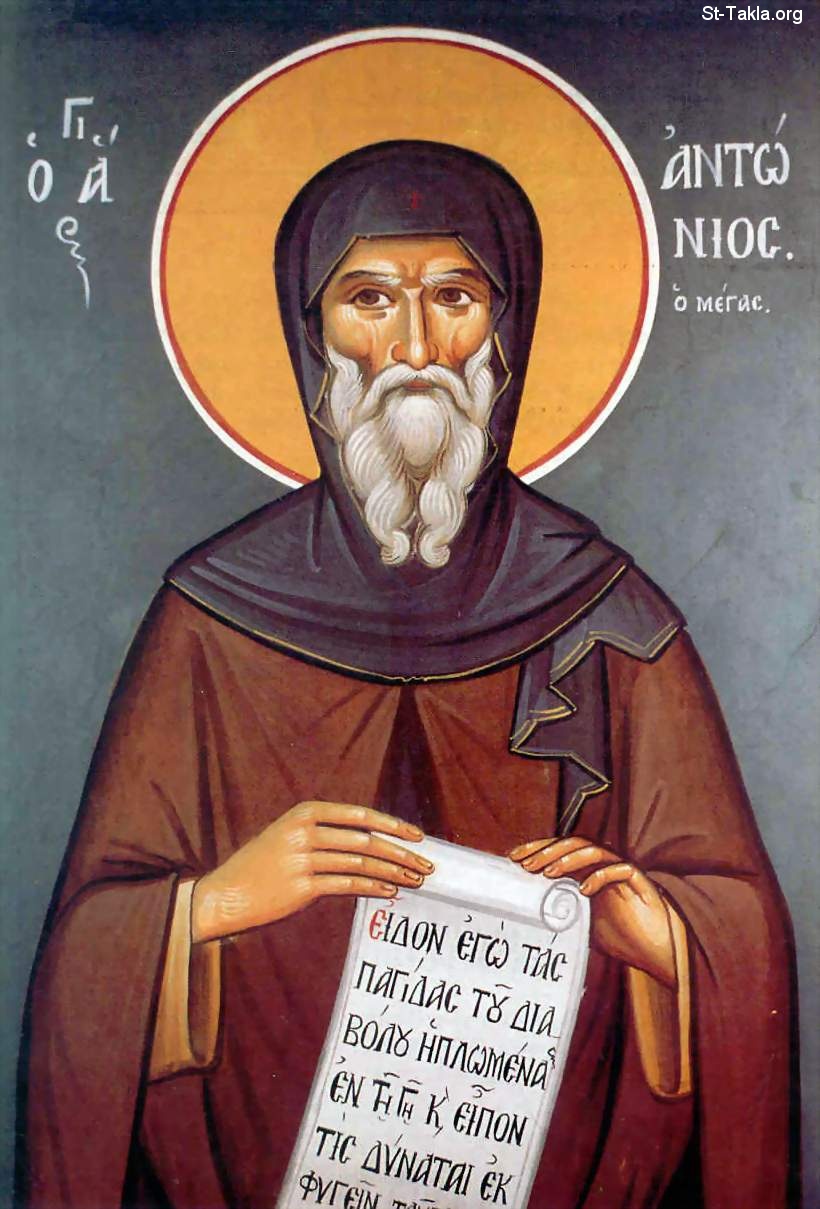
“Further, he was able to be of such use to all, that many soldiers and men who had great possessions laid aside the burdens of life, and became monks for the rest of their days. And it was as if a physician had been given by God to Egypt. For who in grief met Antony and did not return rejoicing? Who came mourning for his dead and did not forthwith put off his sorrow? Who came in anger and was not converted to friendship? What poor and low-spirited man met him who, hearing him and looking upon him, did not despise wealth and console himself in his poverty? What monk, having being neglectful, came to him and became not all the stronger? What young man having come to the mountain and seen Antony, did not forthwith deny himself pleasure and love temperance? Who when tempted by a demon, came to him and did not find rest? And who came troubled with doubts and did not get quietness of mind?” (87).
“Read these words, therefore, to the rest of the brethren that they may learn what the life of monks ought to be; and may believe that our Lord and Saviour Jesus Christ glorifies those who glorify Him: and leads those who serve Him unto the end, not only to the kingdom of heaven, but here also— even though they hide themselves and are desirous of withdrawing from the world— makes them illustrious and well known everywhere on account of their virtue and the help they render others. And if need be, read this among the heathen, that even in this way they may learn that our Lord Jesus Christ is not only God and the Son of God, but also that the Christians who truly serve Him and religiously believe in Him, prove, not only that the demons, whom the Greeks themselves think to be gods, are no gods, but also tread them under foot and put them to flight, as deceivers and corrupters of mankind, through Jesus Christ our Lord, to whom be glory for ever and ever. Amen.” (94)
~ from: St Athanasius, Life of Antony, 87, 94
St. Gregory of Nazianzus: “The Holy Ghost, which proceeds from the Father;”
Posted by Dallas Wolf in Ekklesia and church, First Thoughts, Monasticism, Patristic Pearls, The Cappadocians, The Holy Trinity on April 8, 2023
St. Gregory of Nazianzus (c. 329 – 25 January 390), also known as Gregory the Theologian or Gregory Nazianzen, was a 4th-century Archbishop of Constantinople, theologian, and one of the Cappadocian Fathers (along with Basil the Great and Gregory of Nyssa). He is widely considered the most accomplished rhetorical stylist of the patristic age. Gregory made a significant impact on the shape of Trinitarian theology among both Greek and Latin-speaking theologians, and he is remembered as the “Trinitarian Theologian”.

“The Holy Ghost, which proceeds from the Father; Who, inasmuch as He proceeds from That Source, is no Creature; and inasmuch as He is not Begotten is no Son; and inasmuch as He is between the Unbegotten and the Begotten is God. And thus escaping the toils of your syllogisms, He has manifested himself as God, stronger than your divisions. What then is Procession? Do you tell me what is the Unbegottenness of the Father, and I will explain to you the physiology of the Generation of the Son and the Procession of the Spirit, and we shall both of us be frenzy-stricken for prying into the mystery of God. And who are we to do these things, we who cannot even see what lies at our feet, or number the sand of the sea, or the drops of rain, or the days of Eternity, much less enter into the Depths of God, and supply an account of that Nature which is so unspeakable and transcending all words?”
~ from: The Orations and Letters of Saint Gregory Nazianzus, Oration 31 (5th Theological Oration), VIII.
St. Basil the Great: “Homily About Ascesis – How a Monk Should be Adorned”
Posted by Dallas Wolf in Ekklesia and church, Monasticism, Patristic Pearls, The Cappadocians on April 8, 2023
St. Basil of Caesarea, also called Saint Basil the Great (330 – January 379), was a bishop of Caesarea Mazaca in Cappadocia (modern-day Turkey). He was an influential theologian who supported the Nicene Creed and opposed the heresies of the early Christian church. Together with Pachomius, he is remembered as a father of communal (coenobitic) monasticism in Eastern Christianity. Basil, together with his brother Gregory of Nyssa and his friend Gregory of Nazianzus, are collectively referred to as the Cappadocian Fathers.

“The monk, above all, must not possess anything in his life. He must have bodily isolation, proper clothing, a moderate tone of voice, and discipline speech; he must not cause a ruckus about the food and drink and he must eat in silence; he must be silent before his elders and be attentive to wiser men; he must love his peers and advise those junior in a loving way; he must move away from the immoral and the carnal and the sophisticated; he must think much and say less; he must not become impudent in his words, nor gossip and not be amenable to laughter; he must be adorned with shame, directing his gaze to the ground and his soul upward; he must not object with words of contention but rather be compliant; he must work with his hands and always keep in remembrance the end of this age; he must rejoice with hope, endure sadness, pray unceasingly and thank God for everything; he must be humble towards all and hate pride; he must be vigilant in keeping his heart pure of any evil thought; he must gather treasures in Heaven by keeping the commandments, examine himself for his thoughts and actions each day and not be involved in vain things of life and in idle talk; he must not examine inquisitively the life of idle people, but imitate the lives of the Holy Fathers; he must be happy with those who achieve virtue and not be envious; he must suffer with those suffering and weep with them and be sorry for them, but not criticise them; he must not reproach one who returns from his sin and never justify himself. Above all else he must confess before God and the men that he is a sinner and admonish the unruly, strengthen the faint-hearted, minister unto the sick and washed the feet of the saints; he must attend to hospitality and brotherly love, to be at peace with those who have the same faith and abhor the heretics; he must read the canonical books and not open even a single one of the occult; he must not talk about the Father and the Son and the Holy Spirit, but think and confess the uncreated and consubstantial Trinity with courage, and tell those who ask that there is the need of to be baptised, as we have received it from the tradition, to believe, as we have confessed it according to our baptism, and to glorify God, as we have believed.”
~ from: The Monastic Rule of St. Basil the Great
St. Basil the Great: “On the Holy Spirit”
Posted by Dallas Wolf in Ekklesia and church, First Thoughts, Monasticism, Patristic Pearls, The Cappadocians, The Holy Trinity, Theology on April 6, 2023
St. Basil of Caesarea, also called Saint Basil the Great (330 – January 379), was a bishop of Caesarea Mazaca in Cappadocia (modern-day Turkey). He was an influential theologian who supported the Nicene Creed and opposed the heresies of the early Christian church. Together with Pachomius, he is remembered as a father of communal (coenobitic) monasticism in Eastern Christianity. Basil, together with his brother Gregory of Nyssa and his friend Gregory of Nazianzus, are collectively referred to as the Cappadocian Fathers.
“Just as when a sunbeam falls on bright and transparent bodies, they themselves become brilliant too, and shed forth a fresh brightness from themselves, so souls wherein the Spirit dwells, illuminated by the Spirit, themselves become spiritual, and send forth their grace to others. Hence comes foreknowledge of the future, understanding of mysteries, apprehension of what is hidden, distribution of good gifts, the heavenly citizenship, a place in the chorus of angels, joy without end, abiding in God, the being made like to God, and, highest of all, the being made God. Such, then, to instance a few out of many, are the conceptions concerning the Holy Spirit, which we have been taught to hold concerning His greatness, His dignity, and His operations, by the oracles of the Spirit themselves.”
~ from: On the Holy Spirit (De Spiritu Sancto), Chap. 9
St. Gregory of Nazianzus: “… the confession of the Father and the Son and the Holy Ghost.”
Posted by Dallas Wolf in Ekklesia and church, First Thoughts, Patristic Pearls, The Cappadocians, The Holy Trinity, Theology on April 6, 2023
St. Gregory of Nazianzus (c. 329 – 25 January 390), also known as Gregory the Theologian or Gregory Nazianzen, was a 4th-century Archbishop of Constantinople, theologian, and one of the Cappadocian Fathers (along with Basil the Great and Gregory of Nyssa). He is widely considered the most accomplished rhetorical stylist of the patristic age. Gregory made a significant impact on the shape of Trinitarian theology among both Greek and Latin-speaking theologians, and he is remembered as the “Trinitarian Theologian”.
“Besides all this and before all, keep I pray you the good deposit, by which I live and work, and which I desire to have as the companion of my departure; with which I endure all that is so distressful, and despise all delights; the confession of the Father and the Son and the Holy Ghost. This I commit unto you today; with this I will baptize you and make you grow. This I give you to share, and to defend all your life, the One Godhead and Power, found in the Three in Unity, and comprising the Three separately, not unequal, in substances or natures, neither increased nor diminished by superiorities or inferiorities; in every respect equal, in every respect the same; just as the beauty and the greatness of the heavens is one; the infinite conjunction of Three Infinite Ones, Each God when considered in Himself; as the Father so the Son, as the Son so the Holy Ghost; the Three One God when contemplated together; Each God because Consubstantial; One God because of the Monarchia. No sooner do I conceive of the One than I am illumined by the Splendour of the Three; no sooner do I distinguish Them than I am carried back to the One. When I think of any One of the Three I think of Him as the Whole, and my eyes are filled, and the greater part of what I am thinking of escapes me. I cannot grasp the greatness of That One so as to attribute a greater greatness to the Rest. When I contemplate the Three together, I see but one torch, and cannot divide or measure out the Undivided Light.”
~ from The Orations and Letters of Saint Gregory Nazianzus . Oration 40, XLI.

