Posts Tagged Roman Catholic Theology
Never Fully Trust a Translation
Posted by Dallas Wolf in Ancient Christian Manuscripts, Ekklesia and church, Theology on March 28, 2026
Never fully trust a translation of Scripture, regardless of the skill and/or good intention of the translator. “… ἐφ᾽ ᾧ…”.
Understanding Scripture
Posted by Dallas Wolf in Ekklesia and church, Hermeneutics, New Nuggets, Theology on March 28, 2026
For their lack of understanding of Greek, the Romans never fully understood the New Testament; for their lack of understanding of Hebrew, the Greeks never fully understood the Old Testament; for our lack of understanding of both, we fully understand neither.
The Frankish Papacy
Posted by Dallas Wolf in Ekklesia and church, The Holy Trinity, Theology on March 28, 2026
The Frankish Papacy, which lasted from 756 to 857, was a period marked by the dominance of the kings of the Franks over the Roman Papacy. Pepin the Short, Charlemagne, and Louis the Pious played significant roles in the selection and administration of popes, leading to the establishment of the Papal States. This period was crucial in the transformation of Rome’s authority and the establishment of the Papacy as a central institution in medieval Western Christendom.
J.B. Heard: The Afterthoughts of St. Augustine
Posted by Dallas Wolf in Ekklesia and church, First Thoughts, Heaven and Hell, Theology on March 19, 2026
Rev. John Bickford Heard (28 Oct 1828 – 29 Feb 1908) was born in Dublin, Ireland. He was a British clergyman and graduate/lecturer at Cambridge University (M.A. 1864). His series of lectures at the Cambridge Hulsean Lectures of 1892-93 served as the basis of his book, Alexandrian and Carthaginian Theology Contrasted, published by T&T Clark, Edinburgh, in 1893. Excerpt below is from this work:
“To discuss all these afterthoughts of theology, sin and salvation, heaven, hell, and purgatory, grace and its two channels, faith and the sacraments, would be to write the history of Augustinianism in its many phases.”
David Bentley Hart: Romans 5:12 “… one of the most consequential mistranslations in Christian history.”
Posted by Dallas Wolf in Ancient Christian Manuscripts, Christian Anthropology -East & West (Series), Ekklesia and church, First Thoughts, New Nuggets on March 18, 2026

David Bentley Hart (born 1965) is an American Orthodox Christian philosophical theologian, cultural commentator and polemicist. An acknowledged expert in koine Greek and New Testament exegesis, Hart published his own translation of the New Testament from Greek. Hart’s Greek basis for translation is grounded in “the so-called Critical Text, which is based on earlier and different manuscript sources (such as those of the Alexandrian Text-type)… but also included a great many verses and phrases found only in the Majority Text [Byzantine Text-type] (placing them in brackets to set them off from the Critical Text).”
See The New Testament – A Translation, by David Bentley Hart, Second Edition, Yale University Press, (C) 2017, 2023.
Romans 5:12
English: “Therefore, just as sin entered into the cosmos through one man, and death through sin, so also death pervaded all humanity, whereupon all sinned;”[1]
Greek: Διὰ τοῦτο ὥσπερ δι᾽ ἑνος ἀνθρώπου ἡ ἁμαρτὶα εἰς τὸν κόσμον εἰσῆλθεν καὶ διὰ τῆς ἁμαρτίας ὁ θὰνατος, καὶ οὕτως εἰς πάντας ἀνθρώπους ὁ θὰνατος διῆλθεν, ἐφ᾽ ᾧ πὰντες ἥμαρτον.
Transcription: Dia touto hōsper di’ henos anthrōpou hē hamartias eis to kosmon eisēlthen kai dia tēs hamartias ho thanatos, kai houtōs eis pantas anthrōpous ho thanatos diēlthen, eph’ hōi pantes hēmarton.
A fairly easy verse to follow until one reaches the final four words, whose precise meaning is already obscure, and whose notoriously defective rendering in the Latin Vulgate (in quo omnes peccaverunt) constitutes one of the most consequential mistranslations in Christian history. The phrase ἐφ᾽ ᾧ (eph’ hōi) is not some kind of simple adverbial formula like the διὰ τοῦτο (dia touto) (“therefore”) with which the verse begins; literally, ἐφ᾽ ᾧ means “upon which,” “whereupon,” but how to understand this is a matter of some debate. Typically, as the pronoun ᾧ is dative masculine, it would be referred back to the most immediate prior masculine noun, which in this case is θάνατος (thanatos), “death,” and would be taken to mean (correctly, I believe) that the consequence of death spreading to all human beings is that all became sinners. The standard Latin version of the verse makes this reading impossible, for two reasons: first, it retains the masculine gender of the pronoun (quo) but renders θάνατος by the feminine noun mors, thus severing any connection that Paul might have intended between them; second, it uses the preposition in, which when paired with the ablative means “within.” Hence what became the standard reading of the verse in much of Western theology after the late fourth century: “in whom [i.e., Adam] all sinned.” This is the locus classicus of the Western Christian notion of original guilt—the idea that in some sense all human beings had sinned in Adam, and that therefore everyone is born already damnably guilty in the eyes of God—a logical and moral paradox that Eastern tradition was spared by its knowledge of Greek. Paul speaks of death and sin as a kind of contagion here, a disease with which all are born; and elsewhere he describes it as a condition like civil enslavement to an unjust master, from which we must be “redeemed” with a manumission fee; but never as an inherited condition of criminal culpability. It has become more or less standard to render ἐφ᾽ ᾧ as “inasmuch as” or “since,” thus suggesting that death spread to all because all sinned. But this reading seems to make little sense: not only does it evacuate the rest of the verse of its meaning, but it is contradicted just below by v. 14, where Paul makes it clear that the universal reign of death takes in both those who have sinned and those who have not. Other interpretations take the ἐφ᾽ ᾧ as referring back to Adam, not as in the Latin mistranslation but in the sense that all have sinned “because of” the first man; this, though, fails to honor the point Paul seems obviously to be making about the intimate connection between the disease of death and the contagion of sin (and vice versa). The most obvious and, I think, likely reading is that, in this verse, a parallelism (something for which Paul has such a marked predilection) is given in a chiastic form: just as sin entered into the cosmos and introduced death into all its members, so the contagion of death spread into the whole of humanity and introduced sin into all its members. This, as we see in Romans and elsewhere, is for Paul the very dynamism of death and sin that is reversed in Christ: by his triumphant righteousness he introduced eternal life into the cosmos, and so as that life spreads into the whole of humanity it makes all righteous (as in vv. 15–19 below, or as in 1 Corinthians 15:20–28).[2]
[1] Hart, David Bentley. The New Testament: A Translation (p.296). Yale University Press. 2017
[2] ibid., p.319
David Bentley Hart: “Traditio Deformis – The long history of defective Christian scriptural exegesis occasioned by problematic translations”
Posted by Dallas Wolf in Ancient Christian Manuscripts, New Nuggets, Theology on March 8, 2026
David Bentley Hart (born 1965) is an American Orthodox Christian philosophical theologian, cultural commentator and polemicist. Here, in one short essay published in “First Things” in May 2015, Prof. Hart addresses, “The long history of defective Christian scriptural exegesis occasioned by problematic translations”.
The long history of defective Christian scriptural exegesis occasioned by problematic translations is a luxuriant one, and its riches are too numerous and exquisitely various adequately to classify. But I think one can arrange most of them along a single continuum in four broad divisions: some misreadings are caused by a translator’s error, others by merely questionable renderings of certain words, others by the unfamiliarity of the original author’s (historically specific) idiom, and still others by the “untranslatable” remoteness of the author’s own (culturally specific) theological concerns. And each kind comes with its own special perils and consequences.
But let me illustrate. Take, for example, Augustine’s magisterial reading of the Letter to the Romans, as unfolded in reams of his writings, and ever thereafter by his theological heirs: perhaps the most sublime “strong misreading” in the history of Christian thought, and one that comprises specimens of all four classes of misprision. Of the first, for instance: the notoriously misleading Latin rendering of Romans 5:12 that deceived Augustine into imagining Paul believed all human beings to have, in some mysterious manner, sinned “in” Adam, which obliged Augustine to think of original sin—bondage to death, mental and moral debility, estrangement from God—ever more insistently in terms of an inherited guilt (a concept as logically coherent as that of a square circle), and which prompted him to assert with such sinewy vigor the justly eternal torment of babes who died unbaptized. And of the second: the way, for instance, Augustine’s misunderstanding of Paul’s theology of election was abetted by the simple contingency of a verb as weak as the Greek proorizein (“sketching out beforehand,” “planning,” etc.) being rendered as praedestinare—etymologically defensible, but connotatively impossible. And of the third: Augustine’s frequent failure to appreciate the degree to which, for Paul, the “works” (erga, opera) he contradistinguishes from faith are works of the Mosaic law, “observances” (circumcision, kosher regulations, and so on). And of the fourth—well, the evidences abound: Augustine’s attempt to reverse the first two terms in the order of election laid out in Romans 8:29–30 (“Whom he foreknew he also marked out beforehand”); or his eagerness, when citing Romans 5:18, to quote the protasis (“Just as one man’s offence led to condemnation for all men”), but his reluctance to quote the (strictly isomorphic) apodosis (“so also one man’s righteousness led to justification unto life for all men”); or, of course, his entire reading of Romans 9–11 . . .
Ah—thereby hangs a tale.
Not that Paul’s argument there is difficult to follow. What preoccupies him is the agonizing mystery that the Messiah has come, yet so few of the house of Israel have accepted him, while so many Gentiles—outside the covenant—have. What then of God’s faithfulness to his promises? It is not an abstract question regarding who is “saved” and who “damned”: By the end of chapter 11, the former category proves to be vastly larger than that of the “elect,” or the “called,” while the latter category makes no appearance at all. It is a concrete question concerning Israel and the Church. And ultimately Paul arrives at an answer drawn, ingeniously, from the logic of election in Hebrew Scripture.
Before reaching that point, however, in a completely and explicitly conditional voice, he limns the problem in the starkest chiaroscuro. We know, he says, that divine election is God’s work alone, not earned but given; it is not by their merit that Gentile believers have been chosen. “Jacob have I loved, but Esau have I hated” (9:13)—here quoting Malachi, for whom Jacob is the type of Israel and Esau the type of Edom. For his own ends, God hardened Pharaoh’s heart. He has mercy on whom he will, hardens whom he will (9:15–18). If you think this unjust, who are you, O man, to reproach God who made you? May not the potter cast his clay for purposes both high and low, as he chooses (9:19–21)? And, so, what if (ei de, quod si) God should show his power by preparing vessels of wrath, solely for destruction, to provide an instructive counterpoint to the riches of the glory he lavishes on vessels prepared for mercy, whom he has called from among the Jews and the Gentiles alike (9:22–24)? Perhaps that is simply how it is: The elect alone are to be saved, and the rest left reprobate, as a display of divine might; God’s faithfulness is his own affair.
Well, so far, so Augustinian. But so also, again, purely conditional: “What if . . . ?” Rather than offering a solution to the quandary that torments him, Paul is simply restating it in its bleakest possible form, at the very brink of despair. But then, instead of stopping here, he continues to question God’s justice after all, and spends the next two chapters unambiguously rejecting this provisional answer altogether, in order to reach a completely different—and far more glorious—conclusion.
Throughout the book of Genesis, the pattern of God’s election is persistently, even perversely antinomian: Ever and again the elder to whom the birthright properly belongs is supplanted by the younger, whom God has chosen in defiance of all natural “justice.” This is practically the running motif uniting the whole text, from Cain and Abel to Manasseh and Ephraim. But—this is crucial—it is a pattern not of exclusion and inclusion, but of a delay and divagation that immensely widens the scope of election, taking in the brother “justly” left out in such a way as to redound to the good of the brother “unjustly” pretermitted. This is clearest in the stories of Jacob and of Joseph, and it is why Esau and Jacob provide so apt a typology for Paul’s argument. For Esau is not finally rejected; the brothers are reconciled, to the increase of both precisely because of their temporary estrangement. And Jacob says to Esau (not the reverse), “Seeing your face is like seeing God’s.”
And so Paul proceeds. In the case of Israel and the Church, election has become even more literally “antinomian”: Christ is the end of the law so that all may attain righteousness, leaving no difference between Jew and Gentile; thus God blesses everyone (10:11–12). As for the believing “remnant” of Israel (11:5), they are elected not as the number of the “saved,” but as the earnest through which all of Israel will be saved (11:26), the part that makes the totality holy (11:16). And, again, the providential ellipticality of election’s course vastly widens its embrace: For now, part of Israel is hardened, but only until the “full entirety” (pleroma) of the Gentiles enter in; they have not been allowed to stumble only to fall, however, and if their failure now enriches the world, how much more so will their own “full entirety” (pleroma); temporarily rejected for “the world’s reconciliation,” they will undergo a restoration that will be a “resurrection from the dead” (11:11–12, 15).
This, then, is the radiant answer dispelling the shadows of Paul’s grim “what if,” the clarion negative: There is no final “illustrative” division between vessels of wrath and of mercy; God has bound everyone in disobedience so as to show mercy to everyone (11:32); all are vessels of wrath so that all may be made vessels of mercy.
Not that one can ever, apparently, be explicit enough. One classic Augustinian construal of Romans 11, particularly in the Reformed tradition, is to claim that Paul’s seemingly extravagant language—“all,” “full entirety,” “the world,” and so on—really still means just that all peoples are saved only in the “exemplary” or “representative” form of the elect. This is, of course, absurd. Paul is clear that it is those not called forth, those allowed to stumble, who will still never be allowed to fall. Such a reading would simply leave Paul in the darkness where he began, reduce his glorious discovery to a dreary tautology, convert his magnificent vision of the vast reach of divine love into a ludicrous cartoon of its squalid narrowness. Yet, on the whole, the Augustinian tradition on these texts has been so broad and mighty that it has, for millions of Christians, effectively evacuated Paul’s argument of all its real content. It ultimately made possible those spasms of theological and moral nihilism that prompted John Calvin to claim (in book 3 of The Institutes) that God predestined even the Fall, and (in his commentary on 1 John) that love belongs not to God’s essence, but only to how the elect experience him. Sic transit gloria Evangelii. I have to say that, as an Orthodox scholar, I have made many efforts over the years to defend Augustine against what I take to be defective and purely polemical Eastern interpretations of his thought, in the realms of metaphysics, Trinitarian theology, and the soul’s knowledge of God (often to the annoyance of some of my fellow Orthodox). But regarding that part of his intellectual patrimony that has had the widest effect—his understanding of sin, grace, and election—not only do I share the Eastern distaste for (or, frankly, horror at) his conclusions; I am even something of an extremist in that respect. In the whole long, rich history of Christian misreadings of Scripture, none I think has ever been more consequential, more invincibly perennial, or more disastrous.
J.B. Heard: Theology Proper
Posted by Dallas Wolf in Ekklesia and church, First Thoughts, The Logos Doctrine (series), Theology on April 27, 2025
Rev. John Bickford Heard (28 Oct 1828 – 29 Feb 1908) was born in Dublin, Ireland. He was a British clergyman and graduate/lecturer at Cambridge University (M.A. 1864). His series of lectures at the Cambridge Hulsean Lectures of 1892-93 served as the basis of his book, Alexandrian and Carthaginian Theology Contrasted, published by T&T Clark, Edinburgh, in 1893. Excerpts below are from this work:
“Nor need we be at a loss for a definition of theology, since the Master has himself deigned to define it. At the crowning stage of His ministry, in summing up all He had been given to teach, He sums it up: “And this is life eternal: that they might know Thee the only true God, and Jesus Christ whom Thou hast sent.” [John 17:3]
Theology, rightly considered, is the knowledge of God in His relation to us, the cardinal point of which lies in the truth which the old Greek poet [Acts 17:28] had glanced at. “For we are also His offspring” – this is the true keynote; and theology, setting out from this kinship between us and God, we at once soar, as on wings of a spiritual intuition, across the abyss between creature and Creator.”
Op. cit. pp. 31, 32. Brackets [ ] mine.
Christian Theology: Greek East and Latin West Contrasted *
Posted by Dallas Wolf in First Thoughts, Patristic Pearls, Theology on April 8, 2025
Theology is at its best and purest stage when it is intuitive [noetic]; it is based on our spiritual instincts [nous]; its only logic is that best of all logic, when there is one single step, as it has been well said, from the premise to the conclusion.
Eastern Greek theology set out with the doctrine of God in His relation to man. Conversely, Western Latin theology adopted the opposite doctrine of man in his relation to God.
The difference is more than verbal, whether we make man or God the starting-point of our inquiries on this subject. Setting out with man [the Latin model], we have to take him as we find him, blind and insensible to spiritual things. We have to find an explanation for this strange fact – we have to begin with a theory of original sin, a tradition of the fall, and the problem of evil in general. We get out of our depth all at once in a kind of theodicee [theodicy], which lands us at last in a dilemma which no thinker has yet to overcome, and which J.S. Mill admitted to be logically insoluable. Either God is all-goodness, but not all-mighty, or He is all-mighty, but not all-goodness. Pelagians and Augustinians, Arminians and Calvinists, have beaten their wings against the bars of this cage ever since Latin theology replaced Greek [in the Latin West], as it did soon after Augustine’s day, and we are no nearer a solution than ever.
On the other hand, setting out, as the Greeks did, at the other end of the problem, all unfolds itself in a simple and natural order, and there is no room for these gloomy afterthoughts which have made earth a prison-house, and evil a kind of Manichaean partner with good in the government of the universe. Let us notice the order in which the early Fathers of the Alexandrian school [Greek] approached the problem. Their point of departure was the general Fatherhood of God, – of a God, let us add, who was not so much transcendent as immanent in the world [e.g., the Incarnation and His energaeia]. The opening verses of the Gospel of St. John is the key to all that is distinctively Hellenistic in contrast with the Latin or magisterial conception of God. The Logos is σπερματικόσ, or germ-like, in the world: that Logos in man becomes reason or thought in its two-fold manifestation of speech and action. At a loss for a Latin equivalent for the Greek Logos, the Latin mind lost hold of the primitive and deep significance of the thought that there was a Wisdom which was one with God, and yet had its habitation with the children of men.
The Latins, lacking the Logos doctrine, never could see the true grounds of the incarnation which were laid deep in the original and unchangeable relations of God to men… In this point of view Latin theology never has been “rational” in the sense that the early and best type of Greek theology harmonized reason and revelation. To the Hellenistic mind there was no strained reconciliation between reason and faith… The contrast between the two theologies, for which we have to thank Aquinas, the one known as natural and the other as revealed, never so much as occurred to Greek thought when at its best and earliest stage.
History may be said to contain two chapters, and only two – one in which man seeks after God and loses himself in the search; and a second, in which God seeks after man, and seeks, as the shepherd after the lost sheep, until He finds it.
* Excerpted from Alexandrian and Carthaginian Theology Contrasted, John B. Heard. T&T Clark, Edinburgh 1893. Brackets [ ] mine.
Apophatic and Cataphatic Theology: An Issue of Emphasis and Balance
Posted by Dallas Wolf in Contemplative Prayer (series), Ekklesia and church, Essence and Energies (series), First Thoughts, Hesychasm - Jesus Prayer, The Cappadocians, Theology on April 6, 2025
Overview
Apophatic and Cataphatic are two terms used in theology to describe different approaches to understanding God. The Eastern Orthodox and Latin West each use both types. The issue comes down to one of emphasis and balance: The Orthodox East is overwhelmingly Apophatic in approach, while the Latin West is predominantly Cataphatic.
Definitions
Apophatic theology (from Greek: ἀπόφημι apophēmi, meaning “to deny”) uses “negative” terminology to indicate what it is believed the divine is not. It means emptying the mind of words and ideas and simply resting in the presence of God. Apophatic prayer is prayer that occurs without words, images, or concepts. This approach to prayer regards silence, stillness, unknowing and even darkness as doorways, rather than obstacles, to communication with God. Apophatic theology relies primarily on experience and revelation.
Cataphatic theology (from the Greek word κατάφασις kataphasis meaning “affirmation”) uses “positive” terminology to describe or refer to the divine, i.e. terminology that describes or refers to what the divine is believed to be. Cataphatic prayer is prayer that speaks thoroughly, intensively, or positively of God: prayer that uses words, images, ideas, concepts, and the imagination to relate to God. Cataphatic theology relies heavily on logic and reason.
Background
Apophatic theology—also known as negative theology or via negativa—is a theology that attempts to describe God by negation. In Orthodox Christianity, Apophatic theology is based on the assumption that God’s essence is unknowable or ineffable and on the recognition of the inadequacy of human language to describe God. The Apophatic tradition in Orthodoxy is balanced with Cataphatic theology (positive theology) via belief in the Incarnation and the self-revealed energies of God, through which God has revealed himself in the person of Jesus Christ. However, Apophatic theology is the dominant traditional Eastern paradigm of an experiential, revealed theology, intimately linking doctrine with contemplation through purgation (catharsis), illumination (theoria), and union (theosis).
Clement of Alexandria (c. 150 – 215) was an early proponent of Apophatic theology with elements of Cataphatic. Clement holds that God is unknowable, although God’s unknowability, concerns only his essence, not his energies, or powers. According to Clement’s writings, the term theoria develops further from a mere intellectual “seeing” toward a spiritual form of contemplation. Clement’s Apophatic theology or philosophy is closely related to this kind of theoria and the “mystic vision of the soul.” For Clement, God is both transcendent in essence and immanent in self-revelation.
The Cappadocian Fathers (Basil the Great, Gregory of Nyssa, and Gregory of Nazianzus (4th century)) were early exemplars of this Apophatic theology. They stated that mankind can acquire an incomplete knowledge of God in his attributes, positive and negative, by reflecting upon and participating in his self-revelatory operations (energeia). But, the essence of God is completely unknowable.
A century later Pseudo-Dionysius the Areopagite (late 5th century) in his short work Mystical Theology, first introduced and explained what came to be known as Apophatic or negative theology.
Maximus the Confessor (7th century) maintained that the combination of Apophatic theology and hesychasm—the practice of silence and stillness—made theosis or union with God possible.
John of Damascus (8th century) employed Apophatic theology when he wrote that positive (cataphatic) statements about God reveal “not the nature, but the things around the nature.”
All in all, Apophatic theology remains crucial to much of the theology in Eastern Orthodox Christianity. The opposite tends to be true in Western Latin Christianity, with a few notable exceptions to this rule.
Cataphatic theology
In the Latin West a heavily Cataphatic theology, or via positiva, developed, which remains today in most forms of Western Christianity. This type of Cataphatic theology is based on using human reason to make positive statements about the nature of God. It slowly developed from the 5th to the 11th century, emerging as Scholasticism in the Medieval Period (11th-17th centuries). (see entries for Anselm and Thomas Aquinas, below)
Augustine of Hippo (354–430) significantly influenced scholasticism, emphasizing the integration of faith and reason. His ideas laid the groundwork for later Scholastic thinkers who sought to reconcile Christian theology with classical philosophy, particularly through dialectic reasoning. Augustine’s doctrines of the filioque, original sin, the doctrine of grace, and predestination found little support outside of the Western Roman Church. Within the Western Latin church, ‘Augustinianism’ dominated early theology.
Anselm of Canterbury (c. 1033 – 1109) is widely considered the father of Scholasticism, endeavoring to render Christian tenets of faith, traditionally taken as a revealed truth, as a rational system. Scholasticism prescribed that Aristotelian dialectic reason be used in the elucidation of spiritual truth and in defense of the dogmas of Faith.
Thomas Aquinas (c. 1225 – 7 March 1274) reflects the mature emergence of this new medieval Scholastic paradigm, which promoted the use of formal intellectual reason, putting it at odds with the predominantly Eastern revealed tradition of hesychastic contemplation. Aquinas’ Summa Theologica (1265–1274), is considered to be the pinnacle of Medieval Scholastic Christian philosophy and theology. The resulting ‘Thomism’ remains the foundation of contemporary Western Latin theology.
The Apostle Paul: Radical, Conservative, or Reactionary?
Posted by Dallas Wolf in Ancient Christian Manuscripts, Ekklesia and church, First Thoughts, Theology, Women in Early Christianity on March 21, 2025
The Apostle Paul is a controversial figure. More than half of the New Testament is written by him, about him, or in his name. There is a general consensus among contemporary scholars that the Apostle Paul did not write all 13 New Testament letters attributed to him.
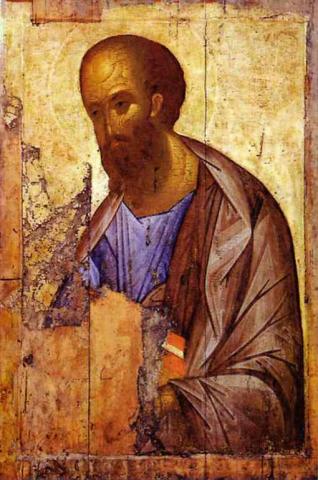
Modern scholarship attributes seven of Paul’s 13 canonical letters as unquestionably authentic:
- Romans,
- Galatians,
- I Corinthians,
- II Corinthians,
- I Thessalonians,
- Philippians, and
- Philemon
Three others are generally considered deutero or (pseudo) – Pauline and are Pauline in theology, with a couple of notable exceptions, but are different in style and much more mainline and conservative in tone than the undisputed letters. They were probably written in the generation after Paul’s death by people very familiar with his teaching. The deutero (or pseudo)-Pauline letters are:
- Colossians,
- Ephesians, and
- II Thessalonians
The last three, the “Pastoral Letters”, are largely considered pseudepigrapha (a bible scholar’s politically-correct term for “forgery”) and were probably written around the beginning of the 2nd century and exhibit patriarchal, sexist, and reactionary social attitudes one would expect of an entrenched Greco-Roman cultural institution (exactly what the early Church was becoming by that time).1,2 The pseudepigraphical letters are:
- I Timothy,
- II Timothy, and
- Titus
What follows are estimates of the percentages of biblical scholars who reject Paul’s authorship of the six books in question:
- 2 Thessalonians = 50 percent;
- Colossians = 60 percent;
- Ephesians = 70 percent;
- 2 Timothy = 80 percent;
- 1 Timothy and Titus = 90 percent.2
In addition to judgments about entire letters, scholars also question the authorship of certain passages in the undisputed letters. Post-Pauline texts are those alleged to have been inserted into a letter after its composition and are generally called scribal “interpolations”.
Among the passages that some scholars label as interpolations are:
- Romans 5:5-7, 13:1-7, 16:17-20, 16:25-27;
- 1 Corinthians 4:6b, 11:2-16, 14:33b-35 or 36;
- 2 Corinthians 6:14-7:1; and
- 1 Thessalonians 2:14-16.2,3
Given the above, one could argue that there are really three “Pauls” in the New Testament:
- The Radical Paul of the seven undisputed authentic letters
- The Conservative Paul of the three deutero-Pauline letters
- The Reactionary Paul of the three pseudepigraphical Pastoral Letters
___________________________________________________________
- The First Paul, Reclaiming the Radical Visionary Behind the Church’s Conservative Icon, By Marcus J. Borg and John Dominic Crossan , 2009 HarperCollins, NY, NY
- Apostle of the Crucified Lord, A Theological Introduction to Paul & His Letters, by Michael J. Gorman, 2004 Wm. B. Eerdmans, Grand Rapids, MI / Cambridge, UK
- The Authentic Letters of Paul, A New Reading of Paul’s Rhetoric and Meaning, by Arthur J. Dewey, Roy W. Hoover, Lane C. Mc Gaughy, and Daryl D. Schmidt, 2010 Polebridge Press, Salem, OR
 First Thoughts