Posts Tagged Roman Catholic Theology
Apophatic and Cataphatic Theology: An Issue of Emphasis and Balance
Posted by Dallas Wolf in Contemplative Prayer (series), Ekklesia and church, Essence and Energies (series), First Thoughts, Hesychasm - Jesus Prayer, The Cappadocians, Theology on April 6, 2025
Overview
Apophatic and Cataphatic are two terms used in theology to describe different approaches to understanding God. The Eastern Orthodox and Latin West each use both types. The issue comes down to one of emphasis and balance: The Orthodox East is overwhelmingly Apophatic in approach, while the Latin West is predominantly Cataphatic.
Definitions
Apophatic theology (from Greek: ἀπόφημι apophēmi, meaning “to deny”) uses “negative” terminology to indicate what it is believed the divine is not. It means emptying the mind of words and ideas and simply resting in the presence of God. Apophatic prayer is prayer that occurs without words, images, or concepts. This approach to prayer regards silence, stillness, unknowing and even darkness as doorways, rather than obstacles, to communication with God. Apophatic theology relies primarily on experience and revelation.
Cataphatic theology (from the Greek word κατάφασις kataphasis meaning “affirmation”) uses “positive” terminology to describe or refer to the divine, i.e. terminology that describes or refers to what the divine is believed to be. Cataphatic prayer is prayer that speaks thoroughly, intensively, or positively of God: prayer that uses words, images, ideas, concepts, and the imagination to relate to God. Cataphatic theology relies heavily on logic and reason.
Background
Apophatic theology—also known as negative theology or via negativa—is a theology that attempts to describe God by negation. In Orthodox Christianity, Apophatic theology is based on the assumption that God’s essence is unknowable or ineffable and on the recognition of the inadequacy of human language to describe God. The Apophatic tradition in Orthodoxy is balanced with Cataphatic theology (positive theology) via belief in the Incarnation and the self-revealed energies of God, through which God has revealed himself in the person of Jesus Christ. However, Apophatic theology is the dominant traditional Eastern paradigm of an experiential, revealed theology, intimately linking doctrine with contemplation through purgation (catharsis), illumination (theoria), and union (theosis).
Clement of Alexandria (c. 150 – 215) was an early proponent of Apophatic theology with elements of Cataphatic. Clement holds that God is unknowable, although God’s unknowability, concerns only his essence, not his energies, or powers. According to Clement’s writings, the term theoria develops further from a mere intellectual “seeing” toward a spiritual form of contemplation. Clement’s Apophatic theology or philosophy is closely related to this kind of theoria and the “mystic vision of the soul.” For Clement, God is both transcendent in essence and immanent in self-revelation.
The Cappadocian Fathers (Basil the Great, Gregory of Nyssa, and Gregory of Nazianzus (4th century)) were early exemplars of this Apophatic theology. They stated that mankind can acquire an incomplete knowledge of God in his attributes, positive and negative, by reflecting upon and participating in his self-revelatory operations (energeia). But, the essence of God is completely unknowable.
A century later Pseudo-Dionysius the Areopagite (late 5th century) in his short work Mystical Theology, first introduced and explained what came to be known as Apophatic or negative theology.
Maximus the Confessor (7th century) maintained that the combination of Apophatic theology and hesychasm—the practice of silence and stillness—made theosis or union with God possible.
John of Damascus (8th century) employed Apophatic theology when he wrote that positive (cataphatic) statements about God reveal “not the nature, but the things around the nature.”
All in all, Apophatic theology remains crucial to much of the theology in Eastern Orthodox Christianity. The opposite tends to be true in Western Latin Christianity, with a few notable exceptions to this rule.
Cataphatic theology
In the Latin West a heavily Cataphatic theology, or via positiva, developed, which remains today in most forms of Western Christianity. This type of Cataphatic theology is based on using human reason to make positive statements about the nature of God. It slowly developed from the 5th to the 11th century, emerging as Scholasticism in the Medieval Period (11th-17th centuries). (see entries for Anselm and Thomas Aquinas, below)
Augustine of Hippo (354–430) significantly influenced scholasticism, emphasizing the integration of faith and reason. His ideas laid the groundwork for later Scholastic thinkers who sought to reconcile Christian theology with classical philosophy, particularly through dialectic reasoning. Augustine’s doctrines of the filioque, original sin, the doctrine of grace, and predestination found little support outside of the Western Roman Church. Within the Western Latin church, ‘Augustinianism’ dominated early theology.
Anselm of Canterbury (c. 1033 – 1109) is widely considered the father of Scholasticism, endeavoring to render Christian tenets of faith, traditionally taken as a revealed truth, as a rational system. Scholasticism prescribed that Aristotelian dialectic reason be used in the elucidation of spiritual truth and in defense of the dogmas of Faith.
Thomas Aquinas (c. 1225 – 7 March 1274) reflects the mature emergence of this new medieval Scholastic paradigm, which promoted the use of formal intellectual reason, putting it at odds with the predominantly Eastern revealed tradition of hesychastic contemplation. Aquinas’ Summa Theologica (1265–1274), is considered to be the pinnacle of Medieval Scholastic Christian philosophy and theology. The resulting ‘Thomism’ remains the foundation of contemporary Western Latin theology.
The Apostle Paul: Radical, Conservative, or Reactionary?
Posted by Dallas Wolf in Ancient Christian Manuscripts, Ekklesia and church, First Thoughts, Theology, Women in Early Christianity on March 21, 2025
The Apostle Paul is a controversial figure. More than half of the New Testament is written by him, about him, or in his name. There is a general consensus among contemporary scholars that the Apostle Paul did not write all 13 New Testament letters attributed to him.
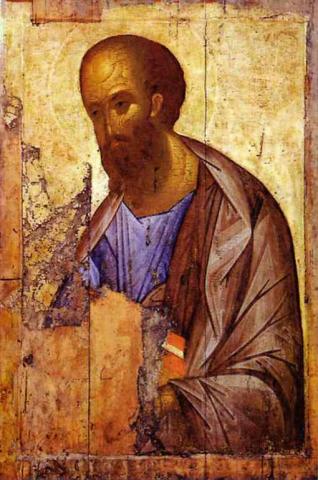
Modern scholarship attributes seven of Paul’s 13 canonical letters as unquestionably authentic:
- Romans,
- Galatians,
- I Corinthians,
- II Corinthians,
- I Thessalonians,
- Philippians, and
- Philemon
Three others are generally considered deutero or (pseudo) – Pauline and are Pauline in theology, with a couple of notable exceptions, but are different in style and much more mainline and conservative in tone than the undisputed letters. They were probably written in the generation after Paul’s death by people very familiar with his teaching. The deutero (or pseudo)-Pauline letters are:
- Colossians,
- Ephesians, and
- II Thessalonians
The last three, the “Pastoral Letters”, are largely considered pseudepigrapha (a bible scholar’s politically-correct term for “forgery”) and were probably written around the beginning of the 2nd century and exhibit patriarchal, sexist, and reactionary social attitudes one would expect of an entrenched Greco-Roman cultural institution (exactly what the early Church was becoming by that time).1,2 The pseudepigraphical letters are:
- I Timothy,
- II Timothy, and
- Titus
What follows are estimates of the percentages of biblical scholars who reject Paul’s authorship of the six books in question:
- 2 Thessalonians = 50 percent;
- Colossians = 60 percent;
- Ephesians = 70 percent;
- 2 Timothy = 80 percent;
- 1 Timothy and Titus = 90 percent.2
In addition to judgments about entire letters, scholars also question the authorship of certain passages in the undisputed letters. Post-Pauline texts are those alleged to have been inserted into a letter after its composition and are generally called scribal “interpolations”.
Among the passages that some scholars label as interpolations are:
- Romans 5:5-7, 13:1-7, 16:17-20, 16:25-27;
- 1 Corinthians 4:6b, 11:2-16, 14:33b-35 or 36;
- 2 Corinthians 6:14-7:1; and
- 1 Thessalonians 2:14-16.2,3
Given the above, one could argue that there are really three “Pauls” in the New Testament:
- The Radical Paul of the seven undisputed authentic letters
- The Conservative Paul of the three deutero-Pauline letters
- The Reactionary Paul of the three pseudepigraphical Pastoral Letters
___________________________________________________________
- The First Paul, Reclaiming the Radical Visionary Behind the Church’s Conservative Icon, By Marcus J. Borg and John Dominic Crossan , 2009 HarperCollins, NY, NY
- Apostle of the Crucified Lord, A Theological Introduction to Paul & His Letters, by Michael J. Gorman, 2004 Wm. B. Eerdmans, Grand Rapids, MI / Cambridge, UK
- The Authentic Letters of Paul, A New Reading of Paul’s Rhetoric and Meaning, by Arthur J. Dewey, Roy W. Hoover, Lane C. Mc Gaughy, and Daryl D. Schmidt, 2010 Polebridge Press, Salem, OR
“And we believe in one, holy, catholic, and apostolic Church.”
Posted by Dallas Wolf in Ekklesia and church, First Thoughts, Hesychasm - Jesus Prayer, Monasticism on December 28, 2024
In the original koine Greek of the Nicene-Constantinopolitan Creed of AD 381, the subject line reads: Εἰς μίαν, Ἁγίαν, Καθολικὴν καὶ Ἀποστολικὴν Ἐκκλησίαν.
I find it sadly ironic that The Nicene-Constantinopolitan Creed, as it is recited in most worship services today, uses the first person singular (“I believe…”/”Πιστεύω”) rather than the first person plural (“We believe…”/”Πιστεύομεν”) as it was enacted at the first and second ecumenical councils (Nicaea AD 325 and Constantinople AD 381) of the undivided Church. In this self-centered, affluent, secularized, and fragmented Western world, I guess the shift from a collective “we” to an individual “I” should come as no surprise.
Christianity became the State Religion of the Roman Empire in AD 380. Since becoming that key religious institution in the social and political infrastructure of worldly power, very little has changed to this day, regardless of the form or character of the Church’s earthbound imperial partners. Fr. Richard Rohr, OFM, calls it the Church’s 1,700 year addiction to Power, Prestige, and Possessions.
Let’s analyze our subject line from the Creed: “And we believe in one, holy, catholic, and apostolic Church.”
The institutional Christian Church was no longer “One” after 451 AD; increasingly less “Holy” after 313 AD; no longer “Catholic” after 1054 (worse after 1517); and “Apostolic” only in origin (and Rome’s claim to Peter and Constantinople’s claim to Andrew are tenuous, at best.). So, nothing in this line from the Creed has been objectively true in more than 1,000 years. Reciting this line from the Nicene-Constantinopolitan Creed now is not so much a proclamation of faith, as a largely an unsupportable exercise in wishful thinking. Don’t believe it? “Google” the dated Church events and read for yourself.
Until the issues raised in the preceding paragraphs are meaningfully addressed (read: confession and repentance) by the legacy institutional Church, I think it will continue to shrink in numbers, authority, influence, and credibility. I believe the Ecclesia (Ἐκκλησία) of scripture will endure and eventually prevail; the institutional imperial Church, not so much. And Ecclesia and Church are not the same thing, in spite of institutional protests to the contrary.
In the meantime, solitary Christian hermits patiently remain in silent prayer within their virtual deserts.
Prayer Ropes and Rosaries
Posted by Dallas Wolf in Ekklesia and church, Hesychasm - Jesus Prayer, Monasticism, New Nuggets, Patristic Pearls on December 21, 2024
Both the prayer rope and the rosary are revered traditional aids to Christian prayer, yet each has its own unique origin, symbolism, and devotional use.

The Prayer Rope, now largely associated with the Eastern Orthodox Church, is a loop of knots (each knot containing seven crosses), usually made of wool, that is used to focus and intensify prayer, particularly the Jesus Prayer. It acts as a physical guide for a repeated, meditative style of prayer, allowing practitioners to keep count while reflecting and meditating. The prayer rope has its beginnings in early fourth century Christian monasticism in the Egyptian Desert, where it was devised as a tool to aid in the ascetic practice of continuous prayer (1 Thes. 5:17).
Origins: The prayer rope is known as a ‘komboskini’ in Greek and ‘chotki’ in Russian. The prayer rope owes its origins to St. Pachomius the Great, a fourth century “Desert Father” in upper Egypt and founder of cenobitic monasticism (a monastic tradition that stresses community life, over the older, eremitic, or solitary tradition). St. Pachomius established the prayer rope as a practical solution for the monks under his supervision to count prayers and prostrations consistently. The prayer rope evolved as a useful instrument for monks to keep track of their prayers, particularly the Jesus Prayer, without distraction. It gradually took on a deeper spiritual value, with each knot symbolizing a request for mercy and humility.
Symbolic Significance: Wool knots, each knot containing seven crosses, are commonly used on traditional prayer ropes to represent Christ’s flock and the shepherd’s care. The number of knots in a prayer rope varies; typically 33 (Christ’s age at crucifixion), 50, or 100.
Traditional Use: In Orthodox Christian practice, the prayer rope is typically used for private prayer in reciting the Jesus Prayer, acting as a physical and spiritual guide to help the mind (nous) and heart concentrate on prayer.

The Rosary, strongly associated with the Roman Catholic Church, is a string of beads that ends with a crucifix and is used to guide Catholics through a sequence of prayers that reflect on the lives of Christ and the Virgin Mary. Each bead signifies a specific prayer, such as the Hail Mary, and each set of beads makes a ‘decade’ that corresponds to a mystery in Christ’s life. The rosary has a long history, dating back to the Middle Ages when it first arose as a popular form of laity devotion, eventually becoming a prominent practice in Catholic piety.
Origins: The rosary is typically identified with Saint Dominic in the early 13th century. The rosary began as a simple way for lay people to join in the monastic practice of reciting the Psalms, but has since evolved into a systematic form of prayer. The rosary prayers are split into decades, each with ten Hail Marys, an Our Father, and a Glory Be, and are frequently accompanied by meditations on the Mysteries of the Rosary.
Symbolic Significance: Each rosary bead represents a prayer as well as a step in the meditation journey through Jesus Christ’s and the Virgin Mary’s lives. The rosary culminates with a crucifix, which represents Christ’s sacrifice.
Traditional Use: Roman Catholics utilize the rosary for both personal meditation and social worship. It is frequently prayed privately for personal spiritual development or in groups for social objectives and celebrations.
Thomas Aquinas: “… all that I have written seems to me as so much straw”
Posted by Dallas Wolf in First Thoughts, Theology on December 10, 2024
Thomas Aquinas OP (c. 1225 – 7 March 1274) was an Italian Dominican friar and priest, the foremost Scholastic thinker, as well one of the most influential philosophers and theologians in the Western tradition. Thomas’s best-known work is the unfinished Summa Theologica, or Summa Theologiae (1265–1274). As a Doctor of the Church, Thomas Aquinas is considered one of the Roman Catholic Church’s greatest theologians and philosophers.
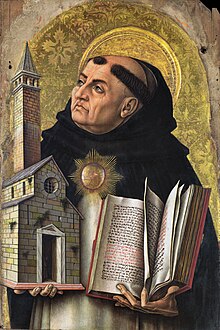
On December 6th, 1273, while Thomas Aquinas was celebrating Holy Communion during the Feast of Saint Nicholas, he received a revelation that so affected him he called his principal work, the Summa Theologica, nothing more than “straw” and left it unfinished.
Aquinas described his Divine Experience: “The most perfect union with God is the most perfect human happiness and the goal of the whole of the human life, a gift that must be given to us by God.”
When his friend and secretary tried to encourage Aquinas to write more, he replied:
“I can do no more. The end of my labors has come. Such things have been revealed to me that all that I have written seems to me as so much straw. Now I await the end of my life after that of my works.”
Aquinas would die just three short months later. The Great Doctor finally got it right, I think. Experience (theoria) trumps reason.
Rohr: Power, Prestige, and Possessions; Major Obstacles to the Reign of God
Posted by Dallas Wolf in Ekklesia and church, New Nuggets on November 28, 2024
Fr. Richard Rohr – is a Franciscan priest, Christian mystic, and teacher of Ancient Christian Contemplative Prayer. He is the founding Director of the Center for Action and Contemplation in Albuquerque, NM.

In Jesus’s consistent teaching and in Mary’s great Magnificat, both say that there are three major obstacles to the coming of the reign of God. I call them the three P’s: power, prestige and possessions. Mary refers to them as “the proud,” “the mighty on thrones” and “the rich.” These, she says, God is “routing,” “pulling down” and “sending away empty.” (This great prayer of Mary was considered so subversive by the Argentine government that they banned it from public recitation at protest marches!) We can easily take nine-tenths of Jesus’s teachings and very clearly align it under one of those three categories: Our attachments to power, prestige and possessions are obstacles to God’s coming. Why could we not see that?
—from the book Preparing for Christmas: Daily Meditations for Advent
by Richard Rohr
The Seven Ecumenical Councils
Posted by Dallas Wolf in Council of Chalcedon, Ekklesia and church on February 3, 2023
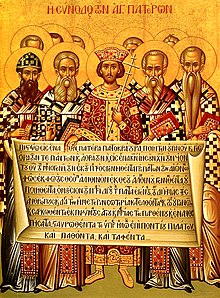
A Church Council is an official ad hoc gathering of representatives to settle Church business. Such Councils are called rarely and are not the same as the regular gatherings of church leaders (synods, etc.). An ecumenical council is one at which the whole Church is represented. The three major contemporary branches of the Church (Orthodox, Roman Catholic, Protestant) recognize seven ecumenical councils: Nicea (325), Constantinople (381), Ephesus (431), Chalcedon (451), Constantinople II (553), Constantinople III (680), Nicaea II (787). Further ecumenical councils were rendered impossible by the widening split between Eastern Orthodox (Greek speaking) and Roman Catholic (Latin speaking) Churches, a split that was rendered official in AD 1054 and has not yet been healed.
Note: In addition to these universally-acknowledged councils, the Roman Catholic Church recognizes a further fourteen ecumenical councils: Constantinople IV (869-70), Lateran I (1123), Lateran II (1139), Lateran III (1179), Lateran IV (1215), Lyons I (1245), Lyons II (1274), Vienne (1311-12), Constance (1414-18), Florence (1438-45), Lateran V (1512-17), Trent (1545-63), Vatican I (1869-70), Vatican II (1965). But these were councils of only the Catholic Church, and are not recognized by the Orthodox or Protestant Churches.
The Council of Nicaea, 325
In 324 Constantine became sole ruler of the Roman Empire, reuniting an empire that had been split among rival rulers since the retirement of Domitian in 305. Constantine, the first Christian emperor, reunified the empire but found the Church bitterly divided over the nature of Jesus Christ. He wanted to reunify the Church as he had reunified the Empire. The major dispute was over the teaching of Arius, but there were other doctrinal issues also.
- Arianism: teaching of Arius of Alexandria (d. 335), who believed that Jesus Christ was created ex nihilo (out of nothing) by the Father to be the means of creation and redemption. Jesus was fully human, but not fully divine. He was elevated as a reward for his successful accomplishment of his mission. The Arian rallying cry was “There was a time when the Son was not.”
- Monarchianism: defended the unity (mono arche, “one source”) of God by denying that the Son and the Spirit were separate persons.
- Sabellianism: a form of monarchianism taught by Sabellias, that God revealed himself in three successive modes, as Father (creator), as Son (redeemer), as Spirit (sustainer). Hence there is only one person in the Godhead.
Constantine summoned the bishops at imperial expense to Nicea, 30 miles from his imperial capital in Nicomedia. Here they were to settle their differences in a council over which he presided. The council rejected Arianism. The Council issued a creed based upon an existing baptismal creed from Syria and Palestine. This creed became known as the Nicene Creed, or Confession of the Faith.
The Council also issued a set of canons, primarily dealing with church order.
The Council of Constantinople, 381
The second council met in Constantinople, the new imperial capital. The council issued a new creed, clarifying the understanding of the Holy Spirit as a co-equal Person of the Trinitarian Godhead as expressed in the Nicene Creed adopted in 325. This creed became known as the Niceno-Constantinopolitan Creed and remains the Confession of the Faith today in the Eastern Church.
Later, the Roman Church, under the influence of the Franks in the 8th century, unilaterally added a single word to the Creed, inserting Filioque “and the Son” to the statement about the Spirit, so as to read “the Spirit…proceeds from the Father and the Son.” In 867 the Patriarch of Constantinople declared Rome heretical for unilaterally inserting this clause into the Niceno-Constantinopolitan Creed. To this day the Western Church (Roman Catholic and Protestant) accepts the filioque clause, while the Eastern Church (Orthodox) does not.
The Council of Ephesus, 431
Condemned Nestorius and his teaching (Nestorianism) that Christ had two separable natures, human and divine. Declared Mary to be theotokos (lit. God-bearer, i.e., Mother of God) in order to strengthen the claim that Christ was fully divine.
The Council of Chalcedon, 451
Issued the Chalcedonian Formula, affirming that Christ is two natures in one person.
The Council of Constantinople II, 553
Condemned the Three Chapters, which emphasized Christ’s humanity at the expense of his deity. Their opponents held Alexandrian theology emphasizing Christ’s deity.
The Council of Constantinople III, 680
Condemned monothelitism (Christ has a single will), affirming that Christ had a human will and a divine will that functioned in perfect harmony.
The Council of Nicea II, 787
Declared that icons are acceptable aids to worship, rejecting the iconoclasts (icon-smashers)
Rohr: “Where the material and spirit coincide, there is the Christ”
Posted by Dallas Wolf in New Nuggets, Theology on October 30, 2022
Fr. Richard Rohr – is a Franciscan priest, Christian mystic, and teacher of Ancient Christian Contemplative Prayer. He is the founding Director of the Center for Action and Contemplation in Albuquerque, NM.
“If you had been present at the moment of the Resurrection, what would you have seen? If there had been a video camera outside the tomb, what would it have recorded? Perhaps there would have been a huge flash of light or a subtle glimmer of a dimension beyond our usual perception. At the Resurrection, we believe the historical body of Jesus moved beyond any confinement of space and time. The presence which was captured in finite form was revealed to be an infinite omnipresence. He moved from Jesus to Christ, which now includes in its sweep all of creation and even you and me. The texts all agree that this movement had a physical dimension to it, but it is a new kind of embodiment that is both of this world and yet not limited by it. Thanks to Einstein, we now know that matter and energy are convertible forces.
Whenever the material and the spiritual coincide, there is the Christ. Jesus accepted that full identity and walked it into history. He was fully human and fully divine at the same time. So now we can begin to imagine how they could coexist. The material and the spiritual are one, the human and the divine are forever, the physical plumbed to its depth finds transcendence! The hiding place of God is also the place of revelation—here and now and everywhere. This is an utterly new notion of religiosity, so much so that most of Christian history (Orthodox, Catholic, Protestant, or Pentecostal) missed this major point and lived in a split universe.
The mystery of Christ is revealed, and the Christ “comes again,” whenever you are able to see the spiritual and the material coexisting, in any moment, in any event, and in any person. God’s hope for history seems to be that humanity will one day be able to recognize its dignity as the divine dwelling place, which it shares with the rest of creation. I don’t know when it will happen or what it will look like to reach the tipping point, for the Christ Mystery to come to fullness. All I know is that this meaning, planted in the middle of things, was meant to give humanity both direction and immense confidence. I suspect “the Second Coming of Christ” happens whenever and wherever we allow this to be utterly true for us. We’re still living in the in-between right now, slowly edging forward, with much resistance. As it says in Romans 8:22-23, creation is “groaning in anticipation,” or as one translation states, “We are standing on tiptoe waiting for the revelation of the sons and daughters of God.” I hope such implanted hope gets your whole life up on its toes!”
Meditation – Monday, March 23, 2015
What it Means to be Human – East and West – 2
Posted by Dallas Wolf in Christian Anthropology -East & West (Series) on February 13, 2022
Eastern Greek Anthropology
Human beings are dignified creatures created by God. This very positive view of humanity was the position of all early Christian authorities and remained the conviction of the unified Church for nearly five centuries. The doctrine included the following points from Genesis 1:26:
- God created humankind intentionally. Humans are not an accident of evolution.
- God created humans in his image and likeness.
This means that humanity is theomorphic, having the form, image, or likeness of God. This is a very optimistic and positive view of anthropology.
Some of the Greek Fathers made a distinction between image (Heb. צֶ֫לֶם – tselem; Grk. εικονα –eikona) and likeness (Heb. דְּמוּת – demuth; Grk. ομοιωσιν – homoiosin) in Gen 1:26. They argued that image and likeness were not synonymous or rhetorical equivalents. They pointed out that in Hebrew, image (tselem) always indicates a “physical” or structural image of some kind. This distinguishes it from likeness (demuth), which usually refers to some kind of “functional” image, to be like, or resemble. I bring this up to point out that later Western Latin theologians would attempt to refute the distinction between image and likeness, calling it a simple example of rhetorical Hebrew parallelism or hendiadys.
To illustrate the Eastern Greek understanding, I quote St. Basil the Great (c. 330-c. 379), who said this about God’s image and likeness:
“Let us make the human being [he quotes God] according to our image and according to our likeness”. [Then he continues] By our creation, we have the first, and by our free choice we build the second. In our initial structure co-originates and exists our coming into being according to the image of God. By free choice, we are conformed to that which is according to the likeness of God.
Note also in this quote, Basil also alludes to two other very important early doctrines; “free choice” (free will) and “conformed… to the likeness” (synergy). We will encounter both of these doctrines further on.
This made human beings inherently valuable and dignified. This was the theological position of the early Church Fathers such as Sts. Basil and Ephraim in the East and St. Ambrose in the West.
For many Fathers, the metaphor of the Tree of Life served as a symbol and expression of humankind’s communion with God, participating in the very life of God in paradise.
But humankind was expelled from paradise when it freely chose to live without God, when it chose death over life in God. This is the “Fall”, the primordial sin.
So, expelled from paradise and stripped of his dignity, humankind suffered what St. Athanasius (c. 298— 373) described as an anthropological catastrophe. It disrupted and disfigured the intention of God for the human race. Athanasius wrote, “Because death and corruption were gaining ever firmer hold on them, the human race was in the process of destruction.” He termed this the “De-humanization of man”. Humanity suffered and waited for God to act.
God did respond and he responded positively through the Incarnation of his Son, the Logos, the Christ, to defeat sin and clearly teach humanity the path of salvation, to a restoration of a life in God. John the theologian describes it in John 1:14, “the Logos became flesh and tabernacles among us”. Through Christ man is re-created. In a famous passage from his book, “On the Incarnation”, Athanasius echoes the words of St. Irenaeus and other Fathers before (and after) him:
“God became man that man might become god.”
In other words, the early church Fathers declared that the deification of humanity was possible. This is a very, very positive affirmation of the dignity, value, and potential of every human being.
The Fathers of the Eastern Greek Church described salvation in many different ways. There was more than just one image of salvation, but one of the most common, compelling, and powerful was that of the forementioned deification (Grk, theosis), or union with God.
The role of baptism was vitally important to the early church in the process of salvation of man through deification. It was not just for the forgiveness of sins that baptism imparted, but also for the impartation of deification and the experience of paradise, bringing a person into the light of God himself. St. Cyril of Jerusalem (c. 313-386) explains:
Great indeed is the baptism which is offered you. It is a ransom to captives, the remission of offenses, the death of sin, the regeneration of the soul, the garment of light, the holy seal indissoluable, the chariot to heaven, the luxury of paradise, a procuring of the kingdom, and the gift of adoption.
St, Cyril also talks about the rite of chrismation, the impartation of the gift of the Holy Spirit. That distinct rite always followed baptism immediately. Effectively there was no separation of the two rites in terms of time. This is a further indication that baptism is not just for the remission of sins but also a gift of life in the kingdom of heaven; the opportunity for deification.
Again, we are presented with a very positive view of the human person.
There is another doctrine critical to an understanding of salvation as the deification of humanity: the understanding of the essence and energies of God. Appropriated from Aristotelian metaphysics by the early Greek Fathers, this doctrine states that God in his essence is simply unknowable to humanity, so great and so far beyond human comprehension that he will never be knowable. However, God, through his actions and activity in creation, shares his energies with human beings made in his image and likeness to know him and participate in his life.
Basil tells us:
While we affirm that we know our God in his energies, we scarcely promise that he may be approached in his very essence. For although his energies descend to us, his essence remains inaccessible.
As a result of this doctrine of divine essence and energies the Greek Fathers described how humans could experience the immanent presence and life of an otherwise transcendent and unknowable God: deification.
Yet again, a very positive, optimistic view of humanity.
There are two more doctrines which complete the Eastern Greek understanding of anthropology; Free will and Synergy. Humans possess free will (not to be confused with autonomy) and can exercise it in a way as synergy, or cooperation, with the energies God. So, human beings are assigned a great dignity as they participate with God in their own salvation, even if in an asymmetrical way (God initiates everything!). Part of this synergy requires a deep desire on the part of the believer for a purification (katharsis) that leads to an experience of God (theoria), and ultimately union with God (theosis).
St. Gregory of Nyssa (c. 335-c.395), brother of St. Basil, sums it up beautifully:
The Lord does not say that it is blessed to know something theoretically about God, but to possess God in oneself.
This demonstrates that the Greek East maintained a very positive view of the inherent dignity and value of humanity, a very optimistic anthropology.
Again, I must emphasize that this positive, optimistic anthropology was the prevailing position of the united universal Christian Church for the first 400 years of its existence. In fact, it remains the doctrine of the Eastern Orthodox Church to this day, including all five of the original Patriarchates of the united Church, with the notable exception of Rome.
We will deal with the anthropology of the Latin West, next.
What it Means to be Human – East and West – 3
Posted by Dallas Wolf in Christian Anthropology -East & West (Series) on February 13, 2022
Western Latin Anthropology
We now examine the Latin West and the foundation of an alternative anthropology, which became increasingly pessimistic about the human condition. This pessimism would grow to have a profound impact upon the Middle Ages and lead to the large-scale abandonment of traditional Christianity during the Renaissance.
The foundation of this pessimistic anthropology is based on the early 5th century thought of St. Augustine (354-430), Bishop of Hippo Regius, in the Roman Province of Numidia on the North African coast (modern north-east Algeria).
Augustine outweighs, by far, the collective influence of all the other Latin Fathers (e.g., St. Jerome, St. Ambrose, Gregory the Great) and dominates the theological thinking and tradition of Western Latin Christianity from the 5th century all the way up to the present. By Western Latin Christianity I include the Roman Catholic Church and the vast majority of the 35,000+ denominations contained within Protestantism. As we shall see, the Protestant Reformer John Calvin will make much use of Augustine’s thought.
Augustine’s own life experiences, detailed in his book Confessions, and his disputes with British-born heretic Pelagius (c. 354- c.418) and his disciples did much to influence his thinking on the human will and grace.
Pelagius believed that humans are self-willed and autonomous in relationship to God. He even had a slogan for this belief: A deo emancipatus homo est. Man is emancipated from God.
How different this is from the Greek patristic understanding of human free will in synergy with God and totally dependent on God, finding fulfillment only in divine life.
But Augustine engaged Pelagius very differently. He took the opposite view of the human will from Pelagius, developing a doctrine of heteronomy; being ruled by another than oneself. Augustine believed that humans possess a free will, but that it has been vitiated, that is weakened and undermined and functionally powerless. Based on that conclusion, Augustine came up with his own slogan: non posse non peccare. [Man is] not able not to sin.
Not a very optimistic or positive view of humanity.
Therefore, to Augustine, salvation comes to depend on divine intervention in the form of a grace from God that precedes any action from a human being toward good; it came to be known as prevenient grace. It is prevenient grace that causes the human will to do good. Augustine saw this grace as created, and not God himself. How different this is from the Greek patristic doctrine of grace as the uncreated energies that really are God and penetrate and deify the believer and bring them ever more fully within the life of God himself.
To Augustine, if the human will is good, then it is through God and his prevenient grace activating the will. Of course, according to Augustine’s doctrine of heteronomy, there is the other (hetero) that could activate the human will as well. That would be the will of the devil. But in either case, it’s not the human will, but the will of another that leads the human in the direction he takes in life.
As a corollary, Augustine also developed the doctrine of “predestination”, which declares that, given that the human will as vitiated and powerless, God predestines those whom he has chosen as elect to save.
Again, not a very optimistic or positive assessment of the human will.
Augustine’s doctrine of predestination goes further than anything discussed to this point in undermining a belief that humans possess a free will and that they can work out their salvation in cooperation, or synergy, with God.
More than 1,100 years later, Protestant Reformer John Calvin would double-down and fully develop Augustine’s doctrine of predestination. If you believe that Augustine’s influence was limited to the Roman Catholic church and did not effect Protestant theology, I invite you to consider Calvin’s T.U.L.I.P., a summary of his principle doctrines; Total depravity, Unconditional election, Limited atonement, Irresistible grace, and Perseverance of the saints. Calvin drew directly from Augustine and is perhaps the most consistent theologian under his influence during the 16th century Protestant Reformation in the West. The Protestant Reformation bought Augustinian theology, pretty much in whole or at least in part.
Augustine, while rightly defending Orthodoxy against the anthropological heresy of Pelagius, had unfortunately taken positions that put him at odds with the consensus of the early unified church, East and West, concerning the condition of humanity, its inherent value and dignity, its place in this age, and the possibility of experiencing the divine, paradise itself, even in this world.
The last of Augustine’s unique doctrines we will discuss is arguably his most controversial; original sin. This doctrine goes well beyond the conception of the Fall and primordial sin of Adam and Eve that had been developed by Eastern Greek Fathers and even by Western Latin Fathers before the 5th century. For Augustine, the Fall resulted in humankind’s actual participation in the guilt of Adam’s original sin. This is a fundamental difference between the Eastern Greek patristic understanding of the Fall and the subsequent Western Latin Augustinian understanding.
This gets a little tedious but stay with me.
Augustine was led to this interpretation of the Fall by the translation of the Bible that was now being used in the West in his time. In the fourth century, St. Jerome translated the Bible into Latin (the Latin Vulgate bible), and in a very important passage from the epistle of Paul to the Romans 5:12, the original Greek was mistranslated by Jerome. Scholar David Bentley Hart, author of the recent The New Testament, a Translation, remarks that this “notoriously defective rendering in the Latin Vulgate (in quo omnes peccaverunt) constitutes one of the most consequential mistranslations in Christian history.” Below is the original Greek of Romans 5:12 (underline mine):
Διὰ τοῦτο ὥσπερ δι’ ἑνὸς ἀνθρώπου ἡ ἁμαρτία εἰς τὸν κόσμον εἰσῆλθεν καὶ διὰ τῆς ἁμαρτίας ὁ θάνατος, καὶ οὕτως εἰς πάντας ἀνθρώπους ὁ θάνατος διῆλθεν ἐφ’ ᾧ πάντες ἥμαρτον
The key here is that in the original Greek, above, the word “ἐφ’ ᾧ” (transliterated as “ef ho”), underlined near the end of the passage, is usually translated as “because” in English, as you can clearly see, underlined in the New King James Version (NKJ) translation, below:
Therefore, just as through one man [Adam] sin entered the world and death through sin, and thus death spread to all men because all sinned…
So, “Death and sin entered the world and spread to all human beings because all sinned.”
But in the Latin Vulgate, Jerome mistranslated “ef ho” and entirely changed the meaning of Romans 5:12. Jerome’s Latin translation of “ef ho” was “in quo”, which means “in whom”, and relates, in this passage, to Adam himself. This would mean that entire human race itself participated in Adam’s sin, in a willful act of transgression.
Augustine’s poor skills in Greek would not allow him to read the original Greek New Testament, so he was forced to rely solely on Jerome’s Latin Vulgate.
So, with this flawed translation of Romans 5:12 in hand, Augustine was able to assert that in Adam, in the person of Adam and in his very act of willful rebellion against God in the Fall, in the original sin, all human beings have sinned; all human beings have willfully participated, as descendants of Adam, in Adam’s personal sin.
Adam’s sin, for Augustine, was grounded in his concept of concupiscence, or evil desire. As a result, all of Adam’s descendants (all of humanity) participated in that act of will and are personally guilty for the transgression. His inclination toward this interpretation of the Fall came from his doctrine of grace and free will, that he had worked out early in his life in response to his personal experiences with lustful desires (cf. Confessions) and from his response to the earlier Pelagian controversy (both earlier in this summary).
It goes without saying that this reflects a negative, pessimistic view of humanity.
Augustine’s doctrine of original sin had important corollaries that were worked out in the Western Latin church over time. Some of these corollaries were worked out by Augustine himself. For example:
1. One corollary states that: if all human beings have sinned in Adam through original sin and been conceived in sin and have therefore come into the world personally guilty of original sin, then all human beings are deserving of punishment by God. The human condition is understood as one deserving of punishment, universal punishment.
2. Another corollary that grew out of Augustine’s doctrine of original sin was that unbaptized infants who died before they could be baptized were destined for hell because they were born with the guilt of Adam and, not having that guilt washed away by baptism, were destined to be punished in hell for it.
3. Yet another corollary to the doctrine of original sin is that baptism increasingly becomes understood as a sacrament exclusively of washing away, of remission of sins. Baptism lost its earlier traditional aspect of also imparting deification, the gift of the Holy Spirit deifying the believer.
4. Finally, a corollary to Augustine’s doctrine of original sin is that humanity became characterized by the condition of depravity: a moral bankruptcy. Augustine used the term massa damnata, a damned mass, for the entire human race awaiting punishment were it not for the life-creating sacraments of the Church.
Augustine’s anthropological pessimism saw the human condition in the world as one of misery, almost unmitigated misery. Salvation was seen as a release from punishment in the afterlife.
As Augustine reflected on these miseries, which result from the reality of original sin, he also discussed the role of punishment and the value of punishment, arguing that punishment can, and often does, play a valuable role in bringing the saints who have been predestined for paradise to that experience which awaits them after their death.
So, paradise, from which humanity was expelled, has no place in this world. It is something predestined saints will experience after death in this world. This life is penal, a place of punishment. But that punishment is good, purificatory, for the numbered elect saints being prepared for paradise.
For everybody else, it’s just punishment.
A very negative and pessimistic anthropology, indeed.

